How to Turn One Signature Talk into Keynotes, Workshops, Podcasts, and Content
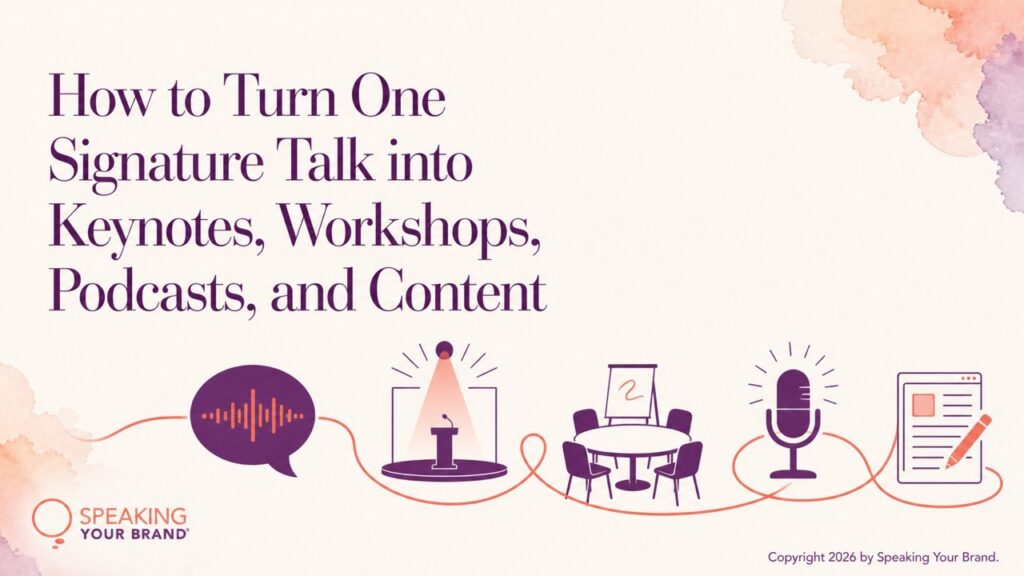
You do not need to create a brand-new presentation every time you speak. You need one strong signature talk with a core message, framework, and stories you can adapt to the audience, the format, and the time available.
That doesn’t mean giving the same canned talk everywhere. Audience relevance matters. Your healthcare audience may need different examples than an HR audience. A group of college students may respond to a different activity than women who have been in their industry for 30 years. A six-minute talk cannot carry the same number of stories and teaching points as a 60-minute keynote.
But the center should still be yours.
In episode 486 of the Speaking Your Brand podcast, I’m joined by our coaches Diane Diaz and Erin Mark. We talk about how we adapt our own presentations, what we encourage our clients to keep, and what can change without diluting the thought leadership message they want to be known for.
One of the best examples came from Erin. A few days before a conference, she realized the topic attached to her session was universal design. It’s an important field, but it isn’t her area of professional expertise.
She could have searched Google, asked ChatGPT for an outline, filled a slide deck with information, and tried to teach the room about universal design. Instead, she asked a better question: How can I serve this audience from the expertise and lived experience I actually have?
That question changed the talk and the audience’s response to it.
Why Shouldn’t You Create Every Presentation from Scratch?
Creating a new talk for every engagement can feel audience-centered. The organizer gives you a topic, so you build exactly what she requested. The audience is different, so you start with a blank slide deck and try to make everything specific to them.
The problem is that constant reinvention has costs you may not see right away.
You spend your time rebuilding instead of refining
Every new presentation requires decisions about the topic, structure, stories, examples, slides, and takeaways. By the time you finish building it, you may have very little time left to rehearse or improve the audience experience.
When you return to the same foundational talk, you get the benefit of repetition. You become more comfortable with the material. You notice where the audience laughs, leans in, or looks confused. You sharpen the stories and transitions. The talk gets better because you’ve had the chance to learn from giving it.
New material can make your delivery feel clunky
Even experienced speakers need reps with new content. If the structure, story, and teaching points change every time, you’re repeatedly delivering material that hasn’t had time to settle into your voice.
The audience can feel that. You may be giving them useful information, but you aren’t as present because part of your attention is still on remembering what comes next.
Too many topics dilute your positioning
Before a consultation call, I often look at the woman’s LinkedIn profile, website, and speaker page. Sometimes I’ll see 10, 15, or even 20 topics listed.
I understand the instinct. You want to give an event organizer plenty of options so she can find something that fits.
But a long list can have the opposite effect. It makes it harder to understand what you really help an audience with. It also makes it harder for someone to remember, refer, and book you.
If you are continually creating presentations on disconnected topics, people may remember that you were a good speaker. They may not know what to call you for next.
What Is a Foundational Signature Talk?
A foundational signature talk is the presentation that carries the central message, framework, stories, and audience transformation you want to be known for. It can usually stand on its own as a 35- to 45-minute talk, then expand, contract, or shift based on the opportunity.
At Speaking Your Brand, we use our Brand Voice Canvas as one guide for that foundation. It has four parts:
- your mission
- your expertise
- your methodology
- your experiences
Together, those elements help you stay connected to your central message, even when an organizer gives you a different title or asks you to approach the topic from a particular angle.
That throughline is also your differentiator. It gives people something specific to associate with you.
What Should Stay the Same When You Adapt a Signature Talk?
The exact balance will vary, but these are the elements you generally want to protect:
Your core message and point of view
What do you want the audience to understand differently because they heard you speak? That belief should remain recognizable from one engagement to the next.
Diane speaks frequently about personal branding. The stories and activities may change, but she continues to connect personal branding to storytelling and thought leadership. That connection makes her presentation different from every other personal-branding talk the audience could hear.
Your framework or methodology
A named framework gives your talk structure and gives the audience language they can remember.
Erin’s CALM framework helps audiences navigate uncertainty and change without burning out:
- C: Control what you can
- A: Adapt
- L: Lean on others
- M: Move forward
She can emphasize the framework differently in a healthcare keynote, an HR conference, or a shorter talk. But CALM keeps the message organized around the work she is known for.
Your essential stories
Diane’s strongest advice in this conversation was simple: Never, never, never take out your stories.
When speakers have to shorten a talk, stories are often the first thing they cut. We think the audience needs all three teaching points, so we remove the story to make room for more information.
That choice usually works against us. People may not remember each point on a slide, but they will remember the story that helped the lesson make sense.
Diane once gave a 15-minute keynote built around one story threaded through all of her main points. She didn’t need a collection of stories. She needed the right one.
The audience transformation
Your audience should still be moving toward the same central result, even if the immediate application changes.
The question is not simply, “What should I talk about to this audience?” It is, “How does my message best serve this audience?”
That keeps you from becoming an on-demand content generator while still making the presentation relevant to the people in the room.
What Can Change for a Different Audience?
You can customize quite a lot without losing your message.
Stories and examples
For an audience of experienced professional women, Diane may draw from her 30 years of professional experience. For emerging professionals or college women, she chooses stories they can see themselves in now.
Erin makes similar choices by industry. In healthcare, she may talk about navigating unexpected change during a shift and staying present for patients and colleagues. At an HR conference, she may focus on organizational change, pressure, burnout, engagement, and connection.
The message remains consistent. The doorway into it changes.
Audience engagement
An activity that works for seasoned professionals may not work for college students. One group may benefit from discussion. Another may need a worksheet, a reflective prompt, or a quick show of hands.
Audience engagement should meet people where they are. It should also have a job. Do not add an activity simply because you have more time.
Research, context, and terminology
You can bring in research, language, or industry context that helps the audience connect your message to the pressures they’re experiencing.
This is why Erin asks event organizers, “What pressures is your industry dealing with right now?” Their answer helps her select the right examples and show the audience that she understands the room.
Depth and number of teaching points
A short talk may focus on one part of your framework. A keynote may include three key points. A workshop may give participants time to apply the framework and receive feedback.
More time does not mean including everything you know. It means creating more room for the audience to understand and use what matters most.
The call to action
The close should fit the event. One audience may need a reflection question. Another may need a specific action to take at work. A business audience may be ready to learn about a workshop or program.
The core message can stay stable while the next step changes.
How Do You Adapt a 35-Minute Talk to 15 Minutes?
Start by protecting the opening, one strong story, and the single most useful part of your framework.
Diane cautions speakers not to skip Act 1 (see our Signature Talk Canvas framework). You still need to set the stage, establish credibility, and show the audience that you understand where they are. But you may need to reduce the amount of audience discussion or move quickly through challenges you would normally ask them to name.
For example, instead of asking several people to share the barriers they face, you might say, “Here are the three challenges I often hear. Does this resonate?” Then move into the story and the one action you want them to take.
If your full framework has three parts, you can show the whole framework and say, “Today, because of our time, we’re going to focus on the one part that will be most useful to you right now.”
That gives the audience a meaningful experience without pretending you can cover a 45-minute talk in 15 minutes.
How Do You Expand a Signature Talk into a Workshop?
Do not add more slides simply because the agenda is longer.
Expand the experience by giving participants time to reflect, discuss, practice, and apply your framework to their own situation. You can add a worksheet, paired conversation, small-group exercise, or feedback.
The keynote helps people see something differently. The workshop gives them room to do something with that shift.
This is also an opportunity to go deeper into parts of your methodology you only introduced in the talk. But keep making choices. A longer session can become a content dump just as easily as a short one.
What If an Organizer Gives You a Topic Outside Your Expertise?
Erin’s universal-design session is a useful example because she did not pretend to have expertise she didn’t have.
Universal design is the practice of creating products, buildings, and digital spaces so they are accessible and usable by more people. Erin lives with a chronic invisible illness, which may have been why the conference connected her to the topic. But by the time she realized what the session title was, she had only a few days to prepare.
Her professional message is about navigating uncertainty and change without burning out. So she asked how that message could honestly connect to the assigned topic.
She talked about the uncertainty she experiences when entering a workplace, event, or conference. Will there be breaks? Will she need to walk a long distance with low lung function? What barriers will she encounter that other people cannot see?
Then she widened the lens. People carry many invisible challenges: chronic illness, grief, anxiety, caregiving responsibilities, and other pressures we may know nothing about.
Her throughline became this: If we cannot navigate the invisible pressures in our own lives, how can we better recognize and support the people around us who are carrying theirs?
After the session, an audience member told Erin she had attended mainly because she needed the session credit. She hadn’t known what to expect. But Erin’s story made her think differently about the invisible challenges other people may be carrying. The woman then shared that she was going through invisible challenges of her own and thanked Erin for seeing her.
That response came from Erin’s story and actual area of insight, not from pretending to be a universal-design expert.
The lesson is not to ignore the organizer’s needs. It is to find the honest intersection between what the audience came for and what you are genuinely equipped to offer.
How Can a Signature Talk Become Content Beyond the Stage?
Your signature talk is not only a presentation. It can become the organizing center for your website, podcast interviews, speaker proposals, and social content.
Use your framework in podcast interviews
When I’m a podcast guest, I try to mention one of our frameworks, such as the I.D.E.A. Framework, the IDEAL Story Method, or our V.O.I.C.E. thought leadership model.
The framework gives the host an easy follow-up question and keeps the conversation moving along a clear pathway. It also makes the interview easier for listeners to follow and remember.
Use your talk to clarify your website and speaker page
Your core message helps a visitor quickly understand what you believe, what problem you help audiences solve, and how your approach is different.
Instead of displaying a long menu of loosely related topics, your speaker page can show a clear body of work with a few relevant applications.
Turn stories, questions, and research into social posts
Erin uses pieces of her talk in her LinkedIn content. A post may connect to adaptability, uncertainty, outside pressure, or the small changes that create a ripple effect. It doesn’t have to repeat the keynote or sound like a business lesson attached to every personal moment.
She also keeps the posts short. One point can become Tuesday’s post. Another can become Thursday’s. That makes it easier to create consistently without squeezing three different ideas into one piece of content.
During our conversation, I looked at the board I had mapped for my own upcoming keynote. I could immediately see months of content: the opening story, an audience activity, a question, a key point, or a piece of supporting research.
You may already have more content than you think. It’s sitting inside the talk.
A Practical Signature Talk Adaptation Checklist
Before your next speaking engagement, ask:
- What is the core message I want to be known for?
- Which framework or methodology should remain visible?
- What does this audience care about most right now?
- Which story or example will help them recognize themselves?
- What can I reduce without removing the emotional center of the talk?
- Which one to three teaching points matter most for the time available?
- What type of engagement fits this audience and format?
- What is the most realistic next step for them?
- Am I customizing the talk, or am I accidentally reinventing my message?
Frequently Asked Questions
Should I give the exact same signature talk to every audience?
No. Keep the central message, framework, essential stories, and audience transformation recognizable, then adapt the examples, research, terminology, participation, depth, pacing, and call to action.
How many signature talks should a speaker have?
Many speakers benefit from one foundational signature talk that can be adapted into several formats and audience-specific versions. You may eventually develop additional talks, but a long list of disconnected topics can make your positioning harder to understand.
What should I cut first when shortening a presentation?
Reduce extra teaching points, extended explanations, and time-consuming audience interaction before cutting every story. One strong story can carry several lessons and make a short talk more memorable.
How do I customize a keynote for a specific industry?
Ask what pressures the industry and audience are facing. Then choose relevant stories, examples, terminology, or research while keeping your core message and framework intact.
Can I use my signature talk for content marketing?
Yes. Stories, audience questions, framework components, examples, activities, and research from the talk can become website copy, podcast talking points, speaker proposals, emails, and social posts.
What if an event organizer assigns me a topic outside my expertise?
Clarify what the organizer and audience need, then look for an honest connection to your actual expertise or lived experience. Do not pretend to be an expert in a field you do not know. If there is no responsible connection, the assignment may not be the right fit.
Build a Talk You Can Strengthen, Not Continually Replace
Creating a new presentation every time is a disservice to you and to the audience.
You spend more time building and less time refining. Your delivery can feel less natural because the material is always new. And your message becomes harder for people to remember, refer, and book.
A foundational signature talk gives you something to return to. You can change the stories, examples, industry context, audience activities, timing, and close. You can expand it into a workshop, contract it into a short talk, use the framework in a podcast interview, and turn the board into months of content.
But you are not starting over. You are strengthening the body of work you want to be known for.
If you’d like our help finding that central message and mapping your signature talk, learn more about our Thought Leader Academy. We work with you one-on-one during a VIP Day and in a small cohort of smart, talented women.
You can also schedule a consultation call so we can learn about your goals, answer your questions, and see whether the program is a good fit.