Making the Invisible Visible: Live Signature Talks from Our Thought Leader Academy Grads with Diane Diaz: Podcast Ep. 490
Subscribe to the podcast!


How do you turn an overlooked pattern or experience into a thought leadership message that changes how your audience sees themselves and the world around them?
One of the most powerful things a speaker can do is make the invisible visible.
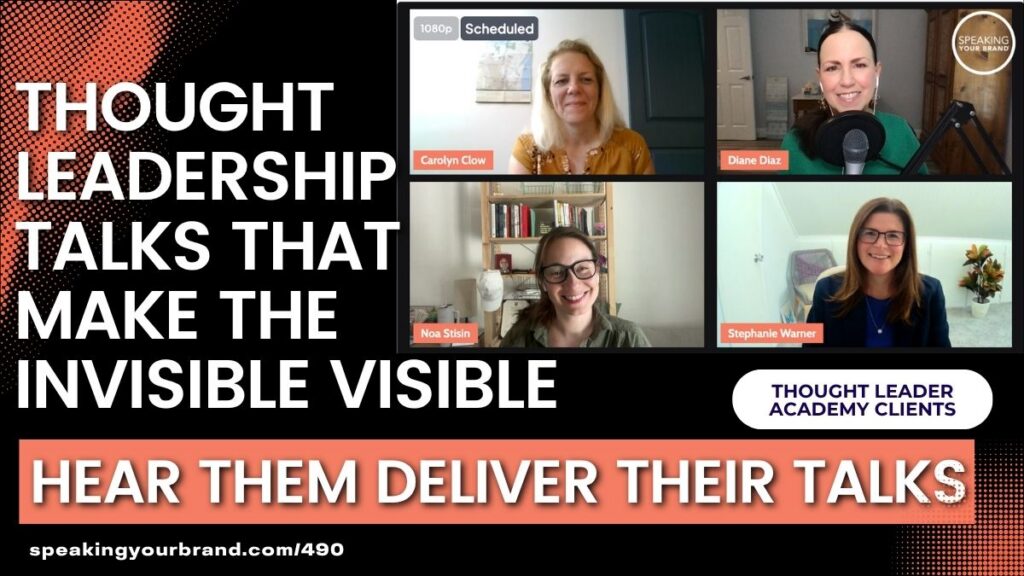
In this Back Stage with Speaking Your Brand live show, our lead speaking coach Diane Diaz hosts three of our recent Thought Leader Academy grads, Stephanie Warner, Noa Stisin, and Carolyn Clow, as they each deliver a 10-minute version of the signature talk they developed in the program.
Each speaker makes an invisible influence visible:
- Stephanie reveals how our sensory environments quietly shape our energy, capacity, and leadership.
- Noa explores how a parent’s internal state and inherited patterns shape what happens in difficult moments with a child.
- Carolyn shows how the often-overlooked practice of self-leadership affects our ability to lead others.
You’ll hear how they:
- Bring an overlooked problem or pattern into view
- Use stories to make an unseen experience recognizable
- Give audiences language for something they may have felt but couldn’t name
- Turn an abstract insight into a memorable framework
- Offer a practical next step audiences can use in their own lives
We also have a roundtable conversation about what Stephanie, Noa, and Carolyn have learned while developing their talks and what’s next for them as speakers and thought leaders.
About Us: The Speaking Your Brand podcast is hosted by Carol Cox. At Speaking Your Brand, we help women entrepreneurs and professionals clarify their brand message and story, create their signature talks, and develop their thought leadership platforms. Our mission is to get more women in positions of influence and power because it’s through women’s stories, voices, and visibility that we challenge the status quo and change existing systems. Check out our coaching programs at https://www.speakingyourbrand.com.
Links:
Show notes at https://www.speakingyourbrand.com/490/
Watch the video at https://www.youtube.com/live/ZWHCwywBH1Q?si=U6QsPCGhG4EqTEc-
Discover your Speaker Archetype by taking our free quiz at https://www.speakingyourbrand.com/quiz/
Apply for our Thought Leader Academy: https://www.speakingyourbrand.com/academy/
Connect on LinkedIn:
- Carol Cox = https://www.linkedin.com/in/carolcox
- Diane Diaz = https://www.linkedin.com/in/dianediaz
- Stephanie Warner = https://www.linkedin.com/in/stephanie-warner-tcp/
- Noa Stisin = https://www.linkedin.com/in/noastisin/
- Carolyn Clow = https://www.linkedin.com/in/carolynaclow/
Related Podcast Episodes:
490-SYB-LI-Live-TLA-Clients-Diane.mp3: Audio automatically transcribed by Sonix
490-SYB-LI-Live-TLA-Clients-Diane.mp3: this mp3 audio file was automatically transcribed by Sonix with the best speech-to-text algorithms. This transcript may contain errors.
Diane Diaz:
Hi everyone and welcome to backstage at Speaking Your Brand. Have you ever been thinking through an idea? You’re kicking it around and you’re thinking to yourself, hmm, what if more people knew about this? That would make a big change for them in some way. Well, taking that invisible pattern or your experience and sharing it with an audience to make the visible for them can really make a huge difference, not only in how they see that issue, but also in how they see themselves and the world around them. Well, you are in for a treat today because you’re going to hear from three of our thought Leader Academy grads as they share ten minute versions of the talks that they worked on in the Thought Leader Academy. And they through their talks, they are helping to make the invisible visible for their audiences. So today we have Stephanie Warner, who is a sensory performance consultant and founder of the Capacity Standard. We also have Noa Stisin, who is a coach and educator for parents and founder of Rewriting Childhood. And we have Carolyn Clow, who is a Self-leadership guide, and they have amazing stories, all three of them. So we’re going to jump right in and get started. And first I’m going to turn the stage over to Stephanie. So Stephanie, take it away.
Stephanie Warner:
I was muted, I have to be honest with you. Every time I get home at the end of a long day, I just want to take off all my clothes. The bra, the shoes, the pants. I call this the shed. And I know that each one of you has your own version of this. Because every time I’ve ever said this in a room full of women. I get nods of recognition. And I want to ask you something. Scan your body. What makes you want to shed? Is there something that feels uncomfortable? Maybe your hair is tickling your face, or your bra is feeling tight on your ribs, or that button in your pants is pushing right into your stomach. Whatever it is, I want you to notice it. And I’m sure that you found something in about two seconds flat, which tells me that your body and your nervous system has been monitoring it long before I asked you to go and look for it. Now, I want you to find something that feels comfortable on your body. Maybe it’s the smell of nice lotion on your hands, or soft fabric of a shirt or a sweater on your skin. Or maybe it’s the compression of a cami that helps you feel secure. Whatever it is, I want you to notice it. I want you to remember it. And we’re going to come back to it at the end.
Stephanie Warner:
I used to think of the shed as the exhale at the end of a long day. By Friday, I’d even have this pile of clothes building up at the front door. And yet, it had never occurred to me that a pile, that big of relief was costing me something. And it took a lesson from my daughter for me to start to recognize what the shed actually meant. One Christmas, my daughter, who was three at the time, refused to wear matching Christmas sweaters with me. And this was on brand for her because she’s very opinionated about what she wears. And she’s always been and everything is itchy kind of kid. And in her defense, it was a scratchy sweater, but I was so mad that she would not give me that picture perfect moment. And it sounds ridiculous now, but I treated her refusal like a compliance problem. And it took a whole nother year. And for her language to start to develop, for us to be in this battle once again. And she looked up at me and said, in the most self-assured and genuine way, Mama, why would I wear something uncomfortable? Q mom, guilt. Because of course, I didn’t want her to be uncomfortable. I just needed her to get dressed so we could get out the door. And so I quickly realized that I had a problem to solve.
Stephanie Warner:
So I did what any millennial mom does and I turned to Instagram for answers. And while that was actually pretty helpful, I also started developing checklists of her non-negotiables. And I even went so far as learning to sew and sewing her all of her clothes. But where I actually found the answers I needed were buried in the occupational therapy research. And what I learned is that our environment interacts with our senses, and all of that information comes into our bodies, to our brain, where our brain has to decide how we’re going to respond, behave, what our energy levels are going to be like. And I was reminded of those five senses we learned about in elementary school. Sight. Sound. Smell. Touch, taste. Yeah. Apparently those are still relevant because even as adults, we still have sensory systems. Now, a lot of the occupational therapy research has been applied to pediatric settings and to the neurodivergent community. But I’m going to tell you that every single one of us has a stable sensory system. And we still get overstimulated. We experience the bright lights, the itchy clothes, the stacked meetings, and we just keep pushing through. And we don’t call it sensory overstimulation. We call it exhaustion. Irritability, brain fog, a short fuse, and sometimes we even tell ourselves that we are the problem. And so when I started looking back at that Christmas with my daughter, I realized that I just wasn’t forcing her into a scratchy sweater.
Stephanie Warner:
I was standing there wearing one myself. I had started. I had been ignoring what my own sensory environment was telling me. And so it took me. I started this journey out as a mom trying to find answers for her daughter. But what I found was that sensory processing, neuroscience, organizational psychology, and gendered social conditioning all overlap to contribute to burnout and professional performance for women. All of these fields were sitting in. All of this information was sitting in different fields of study, but they were all saying the same thing. So prior or after the sweater incident, I decided to become a sensory intelligence practitioner so that I could learn more about this. And I am now the founder of the Capacity Standard, a consultancy that redesigns environments for women so that they can have a more stable mood, energy and attention. And through this work, I have found that our sensory processing system affects far more than just our wardrobe. It affects all of our work. I have a master’s, I have a master’s in social work, and I used to work in a large hospital. Early on in my career, I worked inpatient in an intensive care unit and I had a private office. The work was challenging and intense at times, but the units were mostly quiet and I loved the work that I did.
Stephanie Warner:
A couple years later, I moved to an outpatient cancer center. It was a very, very different vibe. I was sat among appointment schedulers who were on the phone all day. My caseload brought me to clinics all over the buildings, and I was wrung out by the end of the day. My coworkers told me that I needed better boundaries, that I needed to care less. So when I did eventually burn out and I burned out hard. I blamed myself, and I had a lot of shame that I was not able to persevere. And what I know now, what I didn’t know then was that the cancer center was not giving me harder work. It was the same job I did in the intensive care unit. The difference was the sensory environment was giving me too much input. And what I want to show you is that we all have an optimal level that we operate at and how we manage our sensory environment. And when we get too much, we become overstimulated and we have energy crashes and anxiety. But if we don’t get enough stimulation, we can also be understimulated and bored and have apathy and make unnecessary changes in our environment. And I like to use a cut metaphor to help make this a really tangible example. And so we all have different size cups and we all have a regulation line.
Stephanie Warner:
And throughout the day, different sensory input gets poured into our cup, like the computer monitor light, back to back meetings, painful heels, restrictive clothing, the tapping of a keyboard. And we all have the we’ve all worked with the guy who paces behind you in the office, taking his work calls, and all of that pours into our cup. But the opposite is also true. Well, I’ll say it when you’re overflowing, we experience irritability or distracted, exhausted, overstimulated. I think we can all recognize a time in our life when this has happened. But the opposite is also true. If we are not getting enough sensory input into our cups, we don’t ever make it to our optimal line of regulation. And we are missing out on focus on engagement. We are not using our full cognitive capacity that we have, and so we are under-stimulated and we get antsy and we can make bad decisions. So I’m not telling you to prevent sensory stimulation. I’m not trying to convince you to go live in a bubble either. What’s important to understand is that we all have different sensory wirings. We all have different cup sizes, and what works for you doesn’t necessarily work for another person, But oftentimes when we look at others around us and we see that other people maybe are doing better or appear to be doing better than we are, we blame ourselves.
Stephanie Warner:
We think that we are not doing enough, and we tend to treat our environment as fixed, and that we are the variable that we need to change. And women are particularly well suited to believe this. Growing up, we are told to wear the thing to push through. Don’t make waves. Be a good girl. But the reality is that sensory overstimulation and discomfort in our environment actually decreases our performance, our concentration, our productivity. In studies, when women were put in uncomfortable clothing, they had an increase in self monitoring. They had a decrease in good decision making and they offered fewer ideas. So I want to encourage you to see your environment as something that you can change. You have more control than you have been taught to believe. And then. And what you’re using now. So here are some tips that you can take away with you. Take sensory breaks. Drink hot teas or cold drinks to wake up your senses. We’re earbuds to block out extra noise in the office. At the grocery store. When you first walk in the door at the end of a long day. Go out in nature and go for walks and move your body. Lay down and feel the hard ground put all over your body, sending grounding signals to your whole sensory system. And when you do take breaks, look beyond your computer monitor.
Stephanie Warner:
Look out windows, look beyond the skyline. All of those things are going to help. Dump your sensory cup so that you can get closer to where you are optimally regulated. Because one small change can have a ripple effect across your day, across your career. And my hope is that it’ll have a ripple effect to our younger generations. So they never learn that they have to wear the scratchy sweater. And I want to go back to the question that I asked you at the beginning. I want you to remember what felt uncomfortable and what did feel comfortable. And I want you to do a one day experiment. I want you to not put on something that causes you discomfort. I want you to edit your outfit until you feel like you are not going to have to shed it at the end of the day. And I want you to monitor how your energy and your mood feels that day. And I want you to clock it and then decide if you’re going to do the same thing again tomorrow. Because comfort is not the reward you get for surviving the day. It determines how the day goes in the first place. And let’s face it, until the shed becomes a viable workplace accommodation, we all are going to have to learn to get more comfortable wearing our clothes. Thank you.
Diane Diaz:
Oh my goodness. Well done Stephanie. Great job. How did how did that feel?
Stephanie Warner:
It felt good. It was a good um, I was encouraged to go without my script and I did. I just had pictures of my slides because there were a lot of them. Yeah. That’s good. Um, yeah, I feel very proud of myself.
Diane Diaz:
You should. Great job. Excellent. And I just love the messaging of getting outside and sort of getting in touch with your environment because, I mean, that’s just does wonders for mental health in general. So well done.
Stephanie Warner:
Thank you.
Diane Diaz:
All right. Well next up we have Noa Stisin. Noah. What? Take it away.
Noa Stisin:
Thank you. Good morning. Afternoon. Uh, before we begin, I have a very important question. And this is a big one. Has anyone here ever been a child before? Yeah. Great. Fantastic. Looks like everybody has. Yes, we were all children once. And then, poof! Suddenly we’re adults with jobs, responsibilities and bills to pay. And yet, regardless of your background, some of you ended up becoming a parent. And your parenting is hard. And because of that, I’m sure many of us want the same thing to feel proud of the parent we are to have better and more lasting relationships with their children than many of us had with our own parents and children who grow up with kinder inner voices than the ones many of us grew up with. And underneath all that, which is beautiful, how about some peace in your parenting? Anyone here want to feel more peace in their parenting experience? Yes. So why is it so hard for us to find that peace so often in parenting? Well, many of us went from running our own lives, our own schedule. Our own needs for years without having to think much about anyone else. Right. And now there’s this whole other human that depends 100% on us with their own schedule, their own needs, and who doesn’t always comply. And suddenly this little child who we love so much starts to feel like they’re in the way of the life we used to have. We lose control over our schedule.
Noa Stisin:
We lose our patience. We feel more stressed. And it makes sense, right? To blame the child. It’s the only physical factor that has really changed in our life. But let me put this out there. What if the child was never the obstacle to your peace? And to show you what I mean. I have to go back a long way back. I want you for a moment to imagine a little girl, say, 3 or 4 years old. And these are some of the things she’s hearing growing up. You’re a bad girl. What is wrong with you? Stop crying or I’ll give you something to cry about. And now imagine the faces of the adults saying these words. The disgust, the coldness. The way they looked at her like she was this massive burden. Imagine how that lands in the body of a little girl who can’t understand any of it yet, except that something about her is wrong. That was me. And when I grew up, I promised myself if I ever became a mother, my children would never hear me say any of those things to them. And then I became a mother. Back then, I hadn’t started any of this work yet, and I had no idea what I was doing. And there’s a moment from that time that will haunt me forever. I remember like it was yesterday. My daughter was four months old and I hadn’t slept in what felt like forever.
Noa Stisin:
And one day I put her to sleep in the crib next to my bed, and I was desperate to fall asleep myself. And she just could not fall asleep. She cried and cried. And out of nowhere, I snapped. I yelled at her, go to sleep now. I had a baby out. A four month old baby. And so there it was. Without any warning, I heard my mother come out of my mouth. The exact thing I had promised I would never become. It happened. And since that day, I was on a mission to make sure I didn’t let that moment become my whole parenting. So I went back to school. I learned about child development. I became a certified parent coach. But what I learned the most was about myself. And that journey is what took me here today. My name is Noah Stinson, and I’m the founder of Rewriting Childhood. And I work with parents on weekly, one on one coaching sessions, helping them rewrite the stories they were handed about childhood so they can become the parents they want to be. And one of the things that has surprised me the most about this work is that parents come to me for their children and yet and yet end up finding themselves. Because this is the thing Many of us want to parent differently to how we were parented. But how are we supposed to do that when we never saw what different looked like? It wasn’t modeled for us.
Noa Stisin:
And so here’s what happens. Most of the time in our parenting, we’re not showing up as ourselves. We’re showing up from patterns we never chose. So we spend most of our energy trying to change the child because that’s what we were taught to do. They tried to change us all the time. And when nothing changes, we start to wonder if there’s something wrong with the child. But almost no one is ever looking in the mirror first. And so you may be wondering, so, Noah, what do I do? I know I want to show up differently, but then in the moments of trigger, I do it anyway. I snap. I yell. Right. Maybe you’ve read the books. You’ve listened to the podcasts. You have the script in your head of what you want to say next, and then it all goes out the window. It happens over and over again. But here’s the good news. Our history is not our destiny. We’re not doomed to repeat it. So today I’m going to share a framework that I created called the Three Rewrites. But to really understand it, let’s first look at what’s actually happening in the moments of trigger. Our body has a system that is constantly scanning one question am I safe or am I unsafe? It’s called the nervous system. And that’s the same system that guides our bodies to respond to our children one way or the other, depending on our capacity.
Noa Stisin:
And here’s the thing about the nervous system. It’s automatic. It acts before we can even think. So the majority of the time our reactions are not something that we get to choose. So what is actually setting those reactions off? Stories. The stories that were handed down to us and that we now tell ourselves about each moment, about ourselves, about our children, and without meaning to, we hand them on to our children. And so with the three rewrites framework, we go back to those stories and we rewrite them And we rewrite how we see ourselves, how we see our children. And as a result, how our children will see themselves. In the first rewrite, we turn the mirror on ourselves. We start paying attention to how we are actually showing up our face, our tone, what our body is doing well, our words are saying something else because our children are reacting to how our body shows up much more than our words. And the second rewrite, we look at our children and we stop seeing them as people who are doing things to us, and we start seeing them for their experience, their state. Because a child who’s acting out is not choosing that behavior. It’s a child having a hard time who can’t communicate it any other way. And in the third rewrite, we look at the story our children are building about who they are. And we do that by asking a harder question.
Noa Stisin:
Not what am I teaching them, but what are they learning about themselves that is becoming their inner voice? Because that inner voice is the one they will carry with them into adulthood. And here’s the thing. Information does not equal transformation. So just knowing this won’t change how we show up in the moment. And you may be asking, so what do we do then? I’m going to share a secret with you, but you can’t tell anyone. You can’t choose your first reaction, but you can always redo. Humans live and react in the present moment. We’re not actors who get to rehearse before we act, and yet not many of us were taught that we could try again. So here’s one thing I want you to take with you today. After you show up in a way you’re not proud of, or you say the thing you wish you hadn’t said to your to your children. Take a moment for yourself and reflect on what you would have loved to do instead. If you can think of anything and then go back to your child and say, can I try again? That’s the redo. And here’s something beautiful. When you start doing redos with your children, one day they turn to you and say, Mama, can I do a redo? Or like my daughter who also demands them from me now? So I want you to imagine for a moment, not feeling so guilty for the moments you didn’t show up the way you wished.
Noa Stisin:
Imagine feeling safer in your own body when conflict comes because so it will come. And imagine feeling confident in the relationship you’re building with your children. Because you know that a hard moment isn’t the end of it. What would that feel like for you, for your family? That little girl in the photo has done a lot of work. She sees her own parent coach, a somatic practitioner. It’s been years of it not to erase what happened to her, but to make sure I don’t pass the same voices to my children. Because our children do not deserve to carry what was handed down to us. And I want to be clear about something. I’m not a coach because I got it. I’m a coach because I get it. Because I still cry on my kitchen floor. Because I still yell. Because I still feel the pull to shame my children for what they did. Because that’s what was done to me. And it’s still the first thing my body reaches for. The difference is my children are learning something. I never learned that they’re not bad people choosing bad behaviors, that they’re humans who make mistakes they didn’t choose, and they can always go back and redo. We can all always redo. If any of this resonated and you’d like to go deeper, you can find me at rewriting childhood.com. I offer complimentary calls and I would love to hear your story. Thank you.
Diane Diaz:
A wonderful job well done. Applause all around. Noa, how did that feel for you?
Noa Stisin:
To be honest? Beautiful. Much more than what I expected. Yay!
Diane Diaz:
Well, that’s a win. That’s fantastic. You did a great job. Great job. All right. And last but certainly not least, we have Carolyn Clow. So Carolyn, let me add your slides and you can go ahead and get started.
Carolyn Clow:
Thank you so much, Diane. So I’d like to start off by asking how many people here feel stuck in any situations at their work. Few of you.
Diane Diaz:
Carolyn. You’re muted. There you go.
Carolyn Clow:
And how many of you have spent time outside for at least 30 minutes in the past two weeks? Mhm. A couple fewer hands. Of spending time outside as a way that you could get unstuck from some of the things that you are stuck at, at work. So many times, um, we have leaders ourselves as leaders and others around us. We find, um, have their personal habits and their own self leadership getting in the way of the things that they’re trying to do and the ways that they are trying to lead. I’m coming to you today as a local government leader with 25 years of experience. I lead a business office, um, in county government. I’ve been a local elected official, and I’m an entrepreneur working to build my business with making leadership opportunities in the outdoors. And still, I’ve recently had some experiences where I’ve come to the limits of my own leadership, fostered mainly by the limits of my own ability to lead myself. So I’ll ask you if you can think of a leader whose lack of self leadership has affected your life. Now my slide has the flames, which might lead you to think of a leader whose self leadership might have affected your life in a negative way. Perhaps someone who has difficulty maintaining their anger, someone who has a lot going on at home and carries that into work and puts the burden onto other staff members.
Carolyn Clow:
But this can also work in positive ways. How about the leader who’s incredibly gifted and including other people, and is able to bring you into an organization at a difficult time, or a leader who’s able to provide incredible mentorship because of their skills, connecting you with your higher abilities and connecting you with other things that you do. All of those types of self-leadership show up every day in our workplaces and in our country. And as we go out and we participate in our world, in our families, in our communities, and in our workplaces, our self-leadership impacts us every day. So I have a story that I’ll share with you about going outside. This is my sister, Christy, about going outside and finding myself and finding some changes to my own leadership. In December of 2025, I had the great opportunity of traveling to Patagonia with my sister to fill a life, fulfill a 30 year dream of getting back to Torres del Paine National Park, and doing an 82 mile backpacking and hiking trip. And on this trip, I went into it from a really challenging place. My workplace had had a lot of leadership changes in the previous years. I had lost an election that was important to me. My choices, um, were my personal choices were having a negative impact on some of the people around me.
Carolyn Clow:
I had a frozen shoulder that I had just been working through. My health was in a state of disarray. I had stopped being able to lead myself well. So when we were in, when we were in Patagonia, we embarked on our journey. And I didn’t realize that I was going to find so much of myself outdoors there. I didn’t realize fully the impact that my choices were having on me. But between my time outside and my time looking inside, I was able to find out some things about myself. So I’ll tell you a little bit more about that trip later in my talk. But right now, I’ll tell you a little bit more about what Self-leadership is. Self-leadership is an idea that came from the work of Charles C Manns in the early 80s. It’s the practice of setting the course of your own life and finding the motivation to succeed internally. So many times we think of leadership as something that we need to go to a classroom course for. We need to listen to another podcast or read another book or learn another thing. We need to network more. We need to spend a bunch of money. We need to find the time to do all of this. And we look outside and outside and outside for the solutions to improving our leadership.
Carolyn Clow:
And in the meantime, we neglect ourselves. We neglect our our health, we neglect our bodies. We neglect our relationships, the values that are most important to us. And we get further and further away from our ability to positively impact the people around us. But interestingly, the Niagara Institute, which is a leading institute on leadership and organizational development, says 27.4% of US leaders report that we lead by example as their top leadership quality. So we’re leading by example, but we’re not leading ourselves. That can lead to a lot of problems. So many times we don’t believe that the choices that we make are impacting the people around us, and that they impact our leadership to us, that we don’t have self leadership as an area on, for example, our performance reporting at work, we’re not rewarded financially specifically for self leadership. It’s not a box to check off, but it is an extremely important element in our leadership and our ability to make an impact on the world. So as we were hiking and I was working through my own leadership issues, we we had a great opportunity the very last night of our trip. We were in a park called Torres del Paine the Towers, and we woke up at 1:00 in the morning. We were getting ready to hike in the dark with their headlamps five miles up a trail to see the summit and be able to see the sunrise at Bass Taurus.
Carolyn Clow:
So we got up, we buckled up, we locked in, put our headlamps on, try not to trip over a rock, or get blown off the edge of the of the wall. And we were hiking hour after hour, hiking along with people, many people passing us. We were some of the older and maybe slower members of the group. As we continued up, we got close to the top. We saw the one kilometer sign. Hooray! We’d been going, uh, about 75, 76 miles at this point through the park. So we thought, no problem, one kilometer, we can make it. We can do absolutely anything for one kilometer. And that KM got very long and very hard. I think this one KM sign that they had was a little bit misplaced. Possibly. We really wanted to make it up to the summit. It was important to us. We thought the most important thing on the trip was what we what we had thought we were going there for. And it got harder. I just stop and fill my water bottle in a stream because I was out of water. We had more people passing us. They were encouraging us. I sat down, I wasn’t sure about getting up again. It got rockier. I had to scramble hands and feet and.
Carolyn Clow:
And finally I sat down. My knee was hurting, I was tired. We still had to get back down. We’d been going just shy of five hours at this point, and we knew we had to get five hours back or, um, I don’t know if they could have gotten a helicopter or burro or anybody up there to help us, but we had a ways to go. And I looked at my sister and I said, I think I’m done. I think this path, this journey led us here, but not any further. And I really didn’t want to say that to her. We’d gone all this way ourselves. We’d been summiting. I knew it was important for her. I didn’t I didn’t want to be the one who couldn’t do it. But I really knew that it wasn’t particularly safe, and certainly wasn’t particularly fun or comfortable for me to go any further. And she looked back at me and she said, okay, we’ll take a rest, and then we’ll turn around and we’ll go back down. And in that moment, we learned more about ourselves and more about our ability to journey than than we ever thought we would. We had dug deep to find our summit and to build our leadership outdoors. We didn’t even know that was what we were going to do, but that was what we did.
Carolyn Clow:
And so as you work through time, may not have the opportunity to go to Torres del Paine National Park in southern Chile. I live in Wisconsin, just outside of Madison. The map behind me is the Ice Age Trail, which is a National Scenic Trail right here, just miles from my house. But I would encourage you to look where you can, dig deep to find your outdoor experience and your summit to build your leadership. At the end of the day, we did make it back down. Those five hours hiking down, there was a small coffee shop in a in a little lodge on the way, and that coffee was much appreciated. But when we got back to town, we treated ourselves to a nice charcuterie platter, um, and something cold to drink, which we had definitely earned by that point. And we learned that that too, was part of our leadership, that we both needed to climb to the summit, but we also needed to celebrate what we had done and celebrate what we had learned. So thank you so much for listening to my talk today. If you are interested in learning more and having help to design your own outdoor transformation, please feel free to reach out to me. My name is Carolyn Clough and my contact information is on the slide below. Thank you very much.
Diane Diaz:
Wonderful job. That makes me want to go do that. I love it.
Carolyn Clow:
Well, come on out, Diane.
Diane Diaz:
I’m right there. I’m. I’m. I got the information.
Carolyn Clow:
Aren’t that far apart.
Diane Diaz:
That’s right. Well, how did you feel delivering your talk?
Carolyn Clow:
Um, it’s been really challenging for me to get from my initial phase of working with Carol on my, um, the outline for my talk to getting here today. Uh, even yesterday I was super nervous and I almost sent you about four emails to back out, but I’m really glad that I gave my talk. And again, like Stephanie, you had encouraged me to do it without reading through my notes, just building out my slide deck and really following along with that. And I think that really helped me. So I appreciate the confidence, um, of the group and those of you that are here today and the whole course all the way through really changed my ability to be able to do this.
Diane Diaz:
Oh thank you. So that’s such, such a, such good feedback. And, you know, I know it’s a nice segue into our round table discussion. So first of all, well done everyone. But as we segue into our round table discussion, uh, Carolyn, that is an excellent point because I think a lot of our clients come to Thought Leader Academy and you all can chime in about this, but they come to the Thought Leader Academy. They have this idea for a talk, but then it is hard. Yeah. You put the talk together, maybe you have some slides and then it’s hard to sort of like rip that band aid off and get yourself like, I need to deliver this talk, but I got to get past that. It’s like that, that resistance, right? That we feel of whatever it is, it’s maybe it’s not good enough. I can’t let go of my notes or I don’t have the slides or whatever it is that’s making us feel stuck. And so you spoke to that very eloquently, Carolyn, but I, I’d love to hear from you. Stephanie, what was your experience with that sort of was there some kind of resistance that you might have felt, and how did that go and what helped you overcome it?
Stephanie Warner:
Oh, absolutely. I fall into the perfectionist trap, and I have this idea in my head of what I want to convey, and I feel it, and you get me on the spot and I can give you very eloquent, research backed, Personalized information. But when you’re making a speech, you have to build it and decide what you’re going to to put in it. And that perfectionism in me really, uh, was a struggle for me to keep persevering through because it takes a lot of rounds of, of getting it to feel like it feels like inside of you. Um, and I think that the forcing of the ten minutes and then the four just being part of this program and knowing like every single week, everyone else is moving forward. And, um, this was the commitment that I made. It helped me, it helped me. I didn’t have time to be a perfectionist. I had to keep moving forward. I had to give this today. Um, you’re never ready. But this was a great experience because I wouldn’t have been able to create this kind of like pressured and encouragement, like you need both. Um, for that change. And so, um, yeah, that’s, that was that experience for me. And I think that moving forward, when I make new speeches or I continue to work on this one, I will have already had that hard work of pushing through the perfectionism and doing it anyways, and trusting that it will come out the way that I want to. It just it’s not going to happen in a day.
Diane Diaz:
Yeah. Thank you for sharing that. I think that you make a good point about sort of having that deadline of the thing that you’ve got to deliver, right? Because what I’m, I’m a recovering perfectionist or recovering, I should say. Um, and I understand that wanting it, it could just be a little bit better, maybe a little bit better. And maybe the slides are better, maybe my notes are better, maybe Whatever. And then we we kind of don’t want to give it until it’s perfect, right? But when you have the deadline, you have to. And like you said, you need, you also need the support. And so Carol and I are sitting on this side of it, knowing from our experience with other clients that you can do it, but on your side, it feels like, but wait, it has to be this or it has to be that, right? But we know the delivering of it is where you, like you said, it starts to embody you and then it feels like it’s in you. And that’s what makes it better not to be perfect, but makes it better and makes it easier for you to give the talk, and I would suggest also helps you enjoy the talk more. So Noa, maybe you can speak to this idea of, you know, you have this message about parenting and, you know, certainly we could spend lots of time, you know, perfecting it or, you know, whatever in months and months. But what was it like for you to just sort of go with what you had now? What did that feel like? And especially on the practices that we did, and because we did for everyone listening, we did two practice sessions in the Thought Leader Academy. So maybe talk about what that was like and then getting to this point.
Noa Stisin:
Yeah. Uh, one of my biggest problems, which I’ve brought to the academy since day one, is that I have so many thoughts and so many ideas, and those get keeping built on one on top of the other. So it’s like never ending. And the hardest part has always been to pick and choose. And at the end of the day, kind of listen to your body. And what’s most important to put, because you only have a certain amount of time. And when we. So our main here, we’re building like a proper keynote. And then when we need to practice for like a ten minute one, it really forces you to pick and choose what’s the most important message you want to relay. And that was so hard. And yet it was such a great exercise. Um, like yesterday, for example, I was still working on a few things and I’m like, oh, but I’m on 12 minutes. I need to bring it down. And then I was able to bring it down to 11 minutes 30. And then I was like, I just can’t, I can’t remove one more thing because then it won’t make any sense. So I compromised to 11 minutes 30. Um, but that also made me realize what like my, I don’t know if it’s a ceiling because it’s more like the bottom of, of it all, like what’s my cap to what I can remove. Um, and I even practiced it with my husband and he said like, it felt like a Ted talk. And I was like, oh, yeah. Like I didn’t realize how summarizing and bringing act one with a little bit of act two, a little bit of act three, like could end up becoming that. So that was very exciting.
Diane Diaz:
Mhm. Yeah. It’s, it’s a really good point that the constraint of the ten minutes, it’s almost like it is an exercise in knowing what, what is the most important thing to focus on. It’s also an exercise in almost like a stress test, you know, like you got to get it down to the close to ten minutes, but then you also have to deliver it in imperfect as it may be. Because I think I think you all can say now that you’re on the other side of having delivered it, that you can kind of feel the talk more, you feel more comfortable. I mean, I can I because I’ve seen you go through the Thought Leader Academy, I saw both of your practices. Now the delivery of it here, I can see the evolution that you’ve gone through. And so and so maybe we can talk a little bit about when you’re in the Thought Leader Academy. Was there a piece of advice that each of you got that you felt like really changed the direction of your talk, or changed the way you saw yourself as a speaker? And maybe we can start with you, Carolyn.
Carolyn Clow:
Sure. There absolutely is. And it’s the idea that human that my humanness, your humanness, all of our humanness is the most important of who we are. And the reason that what I have to say is valuable is because of my place in the human world and how that fits into the bigger picture. And I think that overarching it’s and, and Diane and Carol gave us tons and tons of specific, like, you can tweak your slide this way and you can do your logo like this. And here’s ways to market yourself and all of those things. Those elements are all there. Um, in this program as well. But that overarching idea really has changed the way I look at myself, the way I look at this particular keynote and the way I will frame my contributions going forward. That because that crisis of confidence for me kept coming up, kept coming up, kept coming up. And so just knowing that by virtue of my humanness and the ideas that that I have here, that they’re worthy of sharing.
Diane Diaz:
Oh, that’s so beautifully put. And that’s and it’s so true. So true. Um, Stephanie, was there a piece of advice or some feedback that you got that really changed your sort of trajectory on your talk?
Stephanie Warner:
I think that, well, I know that, um, Carol helped me rev up my conviction. I had it, I had it in when I talk one on one, when I write, uh, when I talk to my clients. But I wasn’t. I was holding back for the talk because I wanted universality. Um, and I realized that anybody can give a bland talk and that I have a message to share. And it is okay if, uh, I, I can speak with conviction. It’s okay that I have an opinion. Um, and so I think that was very helpful to be encouraged, um, especially at the level that, like you and Carol speak at that was encouraging to hear back like, no, rev that engine, take it there. You can always, you can always water it down for, you know, the corporate audience, but it’s harder to rev it up.
Diane Diaz:
Yes. Oh, I’m so glad you said that because we speak a lot about that idea that, you know your message. It could be that there’s a little controversial element, or it may run counter to how your industry thinks, but when that is the case, or somehow infusing your story into it revs it up. That is the thing that’s going to bring the audience in. And it may not appeal to everyone, but it’s not meant to. Right. It’s meant to appeal to certain, to certain people, because part of marketing yourself as a speaker or marketing in general is you will attract some people and not attract other people. And that is okay. But the more dialed in that revving up is, the more powerful your talk is, and the more powerful you are as a speaker. So I’m glad that you kind of took that away. Noa, what what piece of advice did you take away from this that kind of changed how you look at yourself as a speaker.
Noa Stisin:
Yeah. Thank you. Well, first of all, I’m just so grateful that you and Carol exist.
Diane Diaz:
Oh, I think.
Noa Stisin:
I feel I feel not only exists as a brand exists as humans, and that you chose on top of your busy schedules, on top of the work you’re already giving, creating this for women to help them find their voice. Like it’s so important and I’m so grateful. And I do feel like I got what I came for because I had a talk that I’ve given, and yet there was a part of me that knew that it was missing essence. Like I had all the information I had all of the things that I wanted to say, but there was something that I knew that I needed help with. So first of all, the framework that was amazing to have something to actually guide you even more me with ADHD and I have all my thoughts all over the place, having that to keep you on track was amazing. And then like having you, having that person that I can email at 130 in the morning because I can’t stop thinking about this. And not that you reply at 130 in the morning, but.
Diane Diaz:
I was going to say that.
Noa Stisin:
But the fact that I. That I feel safe, that I can that you see me, that you know that you meet me and my nerves with so much grace and understanding that for me has been invaluable. And I think that that’s with coaching all over, like a personal trainer, right? Like you’re going to go and do the workout and want to do it much more when you have that person there. And I didn’t realize how much my, my talk and my brand was missing that support from a person that could come from the outside and help me. So it’s not one advice. It’s all of it that came with it.
Diane Diaz:
Oh yeah. Yeah, it’s a good point though, because I think when you’re working on your own content, you can’t see it from the outside, right? And you kind of need that sounding board to sort of reflect it back to you. And, and to give you, like you said, the structure, the framework to put it in that packages it up in a way that we know that the audience can then take it right. So I think that that packaging up is super helpful. So thank you for the kind words, I appreciate that. Yeah. All right, ladies, well, let’s just take a quick second and hear what is next for each of you. Stephanie, what is next for you as a speaker and this talk that you’ve now created?
Stephanie Warner:
Well, I actually ended up getting booked for a conference in January, so I’m very excited about that. Congratulations and thank you. And so I’m hoping to build out this keynote into a workshop as well, and start bringing it to businesses and move from one on one work to more group work.
Diane Diaz:
I love it. Wonderful. And Carolyn, how about you?
Carolyn Clow:
Um, I’m looking to lead some more trips with groups of women and then to be able to bring be marketing my talk, uh, in 2027, to be able to bring some to some different groups in the area.
Diane Diaz:
Fantastic. I can see that talk really making an impact on people. That’s awesome. So how about you? What’s next for you as a speaker?
Noa Stisin:
First of all, sleep. Because I haven’t slept for two weeks working on this.
Diane Diaz:
Real talk here.
Noa Stisin:
Stephanie, let’s try to see each other in Napa because I need some rest.
Diane Diaz:
Oh, Napa is on the horizon. That’s right.
Noa Stisin:
Uh, but as soon as I come back from that. I’m so excited. Like, I have so much more hope and excitement in my body of what is possible for me. Um, and I’m just going to start looking like I want to go to schools all over and reach out to businesses and show them how parenting can be such a burnout factor in their employees and how that can affect the, the employees, um, engagement and workflow. So that’s where I want to go with this next.
Diane Diaz:
That’s fantastic. Well wonderful job everyone. Thank you to Stephanie, Noa, and Carolyn for sharing their talks and their messages with all of us today. Um, for those of you who are listening, don’t forget to connect with all three of our speakers today on LinkedIn so that you can cheer them on in their speaking. Follow along with their speaking journey and just get to know them more. And if you want to explore any idea that you’ve been kicking around and turn it into a powerful, powerful talk with a memorable framework and an engaging story that’s really going to move your audience to action and leave them seeing themselves and the world in a different way. You can join us in the Thought Leader Academy. You can get all the details at speaking your brand.com/academy. Again, that’s speaking your brand.com/academy. We will see you there. And until next time, thanks for listening.
About this transcript
The transcript on this page was created automatically with Sonix, which combines automated English transcription with fast automatic mp3 conversion. Learn more about AI audio and video translation.
This transcript could just as easily be in another language: the automated translation feature and translating audio to Chinese (Mandarin) show how Sonix translates recordings while keeping the original timing.
Create a free Sonix account — 30 minutes of free transcription, no credit card required. Or review plans and pricing first.