496-SYB-Jennifer-Gardner.mp3: this mp3 audio file was automatically transcribed by Sonix with the best speech-to-text algorithms. This transcript may contain errors.
Carol Cox:
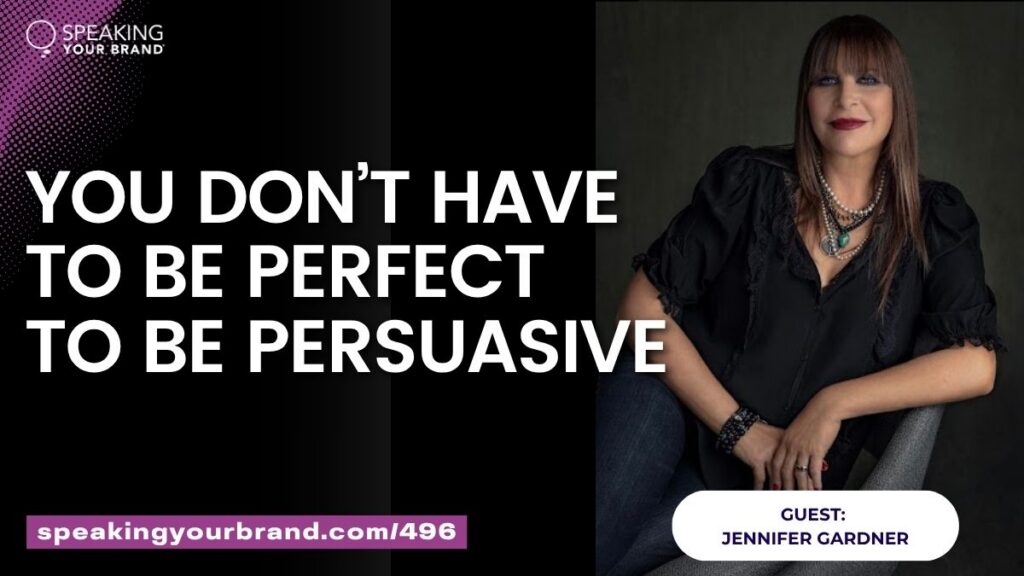
How do you persuade an audience without feeling like you’re putting on an act or trying to sell them something? We want people to connect with our ideas and take action. But when you’re up there speaking, it’s easy to get caught up in trying to sound too polished and too perfect so that you get everything just right. Hi everyone. I’m Carol Cox, host of the Speaking Your Brand podcast. My guest today is Jennifer Gardner, a trial lawyer who also teaches professionals how to communicate more persuasively. One thing I appreciated about our conversation is how candidate Jennifer is about still feeling nervous even after a decades of speaking in courtrooms. We talk about how she prepares the crucial role that emotion plays in communicating our ideas, and why letting people see that we’re human can help build trust in our conversation. I also share what happened after right here on the podcast. Years ago, I shared about a speaking engagement I completely bombed and why the response from listeners surprised me. Jennifer, welcome to the Speaking Your Brand podcast.
Jennifer Gardner:
Thank you Carol. I’m really happy to be here and to be having this conversation with you.
Carol Cox:
Now, can I just ask you a quick question? Do you get confused with the actress Jennifer Garner of Alias fame.
Jennifer Gardner:
Almost every day, especially here in LA, where they expect her to show up for the dinner reservation. And instead, it’s me.
Carol Cox:
All right, but let’s talk about your background as a trial lawyer. Now, I’m sure people think about movies or TV shows that they’ve watched with court cases and trial lawyers. Is that the kind of work that you did, or what exactly did you do as a trial lawyer?
Jennifer Gardner:
Well, first of all, I’m still very much doing it. I was trial lawyering late into the night last night, organizing evidence and getting a case ready that’s about to go to trial. So I’m still very actively Involved, I. I haven’t hung up my boxing gloves just yet, but I do more and more public speaking and I have been educating for at least four years now. While the time is really flying, like officially educating other lawyers and professionals on how to be a persuasive communicator. Yeah. Breakthrough in how I conceptualized the work that I do over ten years ago, when or maybe 20 years ago, because I’ve been doing this for a long time. When I realized that the essence of my work, whether I’m communicating with a client or a potential client or an opposing party or the court is communication. So every word that comes out of my mouth or off my keyboard is extremely, intentionally crafted to position a client, to position myself depending on the situation, to present an idea, to shift a perspective. It’s, it’s, it’s all about communication and it’s very intentional. It’s not something that I take for granted, and it’s not something that I easily outsource.
Carol Cox:
Was there a particular situation or experience you had about ten years ago that caused you to have this light bulb moment?
Jennifer Gardner:
More and more often, the record that I would create of the email chains in my communication with opposing counsel would be used by the court to to rule in my favor. So a lot of lawyers and a lot of people who are creating these emails, they’re just typing them, not giving much thought. But the fact is, is that every email I write I know is going to become part of a court record someday, potentially. And I started realizing that like, for example, there are emotions that sometimes I would not oppose, but because the moving party would attach my correspondence to their moving papers, I would win. And then I started to realize, wow, it’s super important. Even a written communication, even a cryptic email, as many as 3 or 4 sentences long.
Carol Cox:
Well, now I know we’re going to get more into the neuroscience of persuasion and what speakers can do when they’re on the stage. But I even think about when we work with our clients and our thought Leader Academy, we help them with their outreach emails and proposals, speaker proposals. And one of the things that we, we share with them is how important it is to be proactive in communication with the event organizer who has hired them, and to make sure that you are, number one, delivering everything that they need on a timely manner. But you’re almost doing a lot of thinking for them. Like, oh, I have, you know, here’s, here’s my draft of my slide deck. Let me go ahead and send it to you instead of constantly waiting to be on the receiving end. And that really goes a long way to establishing that trust and rapport.
Jennifer Gardner:
100%. It’s all about building trust. It’s all about creating rapport. 100%. Yes, I agree with that.
Carol Cox:
Jennifer, as a trial lawyer, I am sure that, again, a lot of listeners have in mind the I know the literally the scene that pops into my mind right now is from A Few Good Men, you know, Tom cruise, Jack Nicholson, right? When Jack Nicholson, you know, you can’t handle the truth. And because Tom cruise is, you know, they’re right trying to get the truth out of him. So that is probably what a lot of people have in mind. But how do you frame this idea of persuasion that we can use as non-attorneys, and especially because we’re not there to debate our audience or to extract some type of truth out of our audience that they’re not willing to share with us.
Jennifer Gardner:
Right. Okay. Well, the first rule is that it really starts with you. It really starts with you being grounded in yourself, having presence. And then I’m going to go a layer deeper. You know, we hear a lot about Authenticity and vulnerability being as real as you can and as grounded as you can in your purpose. And the core of your message is so important for building trust and credibility and becoming the magnetic speaker that you want to be. Now, I still feel like I’m a beginner, but when I say that to people, they’ll say, what, almost 40 years of speaking in courtrooms, that’s public speaking and you think you’re a beginner. And I’m like, yes, every time I get up to speak, I don’t care if it’s emotion or if it’s a podcast or if it’s a speaking event or if it’s a jury trial. I’m always nervous. I’m always afraid. And I always have that sense of myself that was wired into me at a very young age, that what I have to say isn’t valuable. Nobody cares what I have to say. Um, I’m an imposter. It’s not going to be good enough. All of these things. I want to just like share with your audience. They run through my mind and I’ve spent my life trying to rewire that so that I could help other people because I felt compelled to speak in a way that would enlighten and help other people. And I do that in the justice system, right? Getting justice for people.
Jennifer Gardner:
But I also do that when I speak today. I think in terms of like, what is that core truth? What is my purpose? And I’m not afraid to connect with my fear because the fear makes me more human and relatable. People can probably feel it. I’m not afraid. Well, in the past it wasn’t a question of being afraid. It was a matter of being able to, uh, manage the overwhelming feelings of fear that I had. But now it’s a question of, you know what? That’s a very effective, real way to be, because I’ve felt that the jury always has saved me as much as they’ve saved my client. When I can show up that way and it’s the only way I can show up, it’s just unfortunately, fortunately, it’s the way that I’m wired. So I try to, um, bring that to all my communications and teach that concept, even though most people are like, oh, no, no, I mean, there are moments when you don’t want to show fear and you definitely want to show competence and confidence and warmth, but in order to be perceived as a leader. But if you completely weed out what it is that makes you human, which are these very natural, psychological, uh, thoughts that run through everyone’s head when they’re about to be more visible and speak up, then I think you’re much more relatable and you’re much more credible and you’re much more believable and you’re much more persuasive.
Carol Cox:
Absolutely, Jennifer, and I appreciate you sharing that. You still get nervous. You still have, you know, a little bit of fear the butterflies before doing something I feel like most of us do, especially because we want to do a good job. We want to make sure that we’re providing value and that we’re clear about what we’re communicating. So now this idea of vulnerability, authentic vulnerability, not what I call contrived vulnerability, which we definitely see, especially on social media with, yes, you know, people who are trying to game the algorithm, but authentic vulnerability is that part of the neuroscience of persuasion.
Jennifer Gardner:
I believe that it is. I mean, I believe that, um, it’s really important to build rapport. And one excellent way to build rapport is to stumble and fumble, especially if you’re in a perceived position of authority or someone who has higher status. And this is something that women especially need to be aware of. There was a study done. I haven’t brushed up on it lately, but it’s the pratfall effect. And basically what the neuroscientists and the social psychologists have found, which was documented in this study, is that when you have a person who’s in a in a higher status position, the more that they stumble, fumble, make minor blunders, the more relatable they are, the more credible they are and the more likable they are. And unfortunately, it’s well documented that people have to like us if they’re going to decide for us, or like or agree with us, or be persuaded by us, or even trust us.
Carol Cox:
That is fascinating, Jennifer, because I think about so many women leaders, women who run for elected office, especially for higher positions and that and it’s almost this double bind where they have to come across as perfect in order to be seen as capable and competent to assume that role. Yet because they try to put on this facade of perfection, they end up being less relatable and less likable than they otherwise would have been if they had just shown not necessarily flaws, but that they too are not perfect or that you know they have feelings. Which sounds so weird for me to say that. But I feel like a lot of women do, especially in professional environments, do feel like they can’t show any weaknesses.
Jennifer Gardner:
I think that we need to show a certain amount of weakness, and then we also have to strike the balance between showing the weakness, the non-performative authenticity and vulnerability. You know, the realness. I really feel that it’s important on a on a neuroscientific level to really tap into our emotional truth around the topic that we’re speaking about and really be rooted in that when we’re delivering our message, whatever it is.
Carol Cox:
Let’s talk about a little bit about neuroscience and how audiences make decisions. So imagine we are presenting at a conference. We have our thought leadership message. We have our talk created, so we’re there to present some new information to the audience again, to get them to think or see something differently than they have before. The people are sitting in the audience. Some of them are naturally going to be more receptive, some of them a little bit more reticent based on personality or existing knowledge that they have. How can we maybe break through some of those barriers that people have, either consciously or subconsciously, that they have to, so that we are doing what we can on our end to make them more open minded to what it is that we’re sharing.
Jennifer Gardner:
Well. A lot of it has to do with what I’ve already shared, which is preparing ourself first and being really grounded in the purpose and the emotion that we’re bringing to the situation that we’re communicating about. Whenever I’m getting ready to give any kind of a statement in court. I always try to ground myself in that, in the righteousness of my client’s position, in the emotional piece of that. I think a lot of people, when they go to speak or present publicly, they, they, they don’t want to be in touch with their emotions. So the neuroscience shows that the more that we’re in touch with our emotions when we’re speaking, the more that other people will feel those emotions. And it’s through this phenomenon involving, um, mirror neurons, mirror neurons. So for example, when I give an opening statement, which is or a closing argument, um, I want to be grounded in the emotion because as I’m telling the story of the case, either the story of the case that the jury is going to see or the story of the case based on the evidence that we showed at the trial. Um, I’m telling a story beginning, middle and end. And you notice I’ve been telling stories while I’m talking to you. It’s like micro stories. Macro stories. Right? So the story of what happened. I always want to be cognizant of the emotions of my clients and the emotions even of my opponents. Because when I’m feeling that as I’m speaking, mirror neurons are firing in my brain in these neural networks, we used to think it was right brain and left brain, but now we know there are complex neural networks that go between all parts of our brain all, all like chambers or, or portions of our brain.
Jennifer Gardner:
And they’re firing. And the functional MRI and functional EEG has shown that when I’m feeling a certain story, excuse me, a certain emotion while I’m telling a story or I’m relating a set of facts, the listeners, the same parts of their brains are firing as they’re listening to me. And the, the research also shows that it’s emotions that are responsible for the decision making process, emotions, trump data and logic. Now you need data and logic in order to establish your credibility. But it’s the emotions on which people base their decisions, how you make them feel. So feelings are super, super important. I used to think that I was too sensitive to do this work, but now I realize that sensitivity is a superpower, and that’s what I teach my clients when I’m consulting with them about the importance of storytelling and persuasive communication. It’s so important to allow yourself to feel the emotions. So I would say to anybody out there who’s a highly sensitive person, which I am, or, you know, a introverted and shy person who doesn’t think that they’re a public speaker, that’s a myth. That’s a myth. You have to shift your belief and your perception of who you are and your identity, and understand what the ingredients are, persuasion. And once you understand what they are, these very basic things, anyone can do it.
Carol Cox:
It’s funny, Jennifer, because I, I’m very much an introvert and I would say over half of our clients are introverts, even though they enjoy public speaking. And I agree with you. I think it’s a myth that introverts either can’t be or don’t want to be public speakers. For me, being a speaker at an event was my life hack because it was a way for me to break the ice with the attendees there. I had a badge that said speaker. So then people would come up to me very much as the introvert and talk to me versus me having to go find people to talk to. And it gave me a role, a purpose for being at an event more than just an attendee. And that worked wonders from when I was young and very much shy and introverted. I mean, I’m less shy now, but I’m still an introvert. Is there anything that you do to help yourself prepare before either going into court or for a speaking engagement, whether you’re helping your mentally. So either mental talk or anything that you’re doing physically with your body.
Jennifer Gardner:
Um, yes, I put my feet on the floor. And I take deep breaths and I really get centered in myself. I really do that. I really do that. As corny as it sounds, the breathing really does help your nervous system regulate and slow down and get get centered. That’s how I center myself. And I also, like I’ve said now, I think 3 or 4 times, I’m sorry if I’m repeating myself, but tuning into myself and the purpose for what it is I’m there to accomplish, and then the emotional core tuning into that, relating it to something within myself. So this is something that actors do. In fact, the whole idea of presence is something that I learned from the acting world and from taking acting classes. And it’s, it’s, it’s like if you can’t tune into yourself and it’s so basic and we all can do it, we all have a self, right? If we’re alive. We’re above ground on the planet. We have a self. You got to tune into that in order to first be able to turn outward and speak effectively.
Carol Cox:
Yes. Jennifer. Well, that’s really helpful. And I think so. So many times we’re rushing from thing to thing, and we don’t give ourselves the space and the margin to just take that pause. Right. Settle into ourselves, take those deep breaths, really, you know, close our eyes, think about where we’re at and what our purpose is there, and then be present for that event or for that audience.
Jennifer Gardner:
Yes. And that doesn’t mean that it’s so easy, but it’s a really good habit to take those moments. I mean, I’ll be sitting in a courtroom waiting for them to call my case, and I’m doing that, and I’m intentionally tuning out everybody else who’s in there. It’s almost a meditative practice for me.
Carol Cox:
Well, it reminds me in this, and you said this earlier too, about how if we never show any, you know, anything that has ever gone wrong, if we just put on this perfect facade, and especially if we’re in a position of authority, then people, it’s harder for people to build that rapport with us. And as a speaker on a stage or in front of the room at a workshop, you are inherently in a position of authority relative to the audience. Even if you don’t see yourself as an authority figure, you are a leader to them. And I remember back on the podcast, it was in towards the second year of this podcast. I am now nine and a half years in to the podcast. So this was, yeah, it’s been, it’s been a while, but somewhere towards the end of the second year was episode 92. I remember it, I shared a speaking engagement, I totally bombed, and at the time I had started the business, I was about a year into this business and I put so much pressure on myself as the speaking coach to have the perfect talk. And it was a room full of about 50 women, most of whom I knew because it was a local event and my body just shut down physiologically.
Carol Cox:
And I told this whole story on the podcast. I’ll link to it in the show notes. And I was nervous to release that episode because I was thinking, well, people are going to listen to this and they’re going to think, well, why should I hire her when she bombed a speaking engagement? But the opposite happened. I got emails from listeners who said, thank you, Carol, for sharing that. Now, I know you’re not perfect, not that I ever claim to be, but you know, they just listen to the podcast. Now, I know you’re not perfect and I know now you can relate to me that I’m afraid of something going wrong in my speaking engagement. That I have nerves and doubts and fears too. And because you share that, I feel like I can talk to you in that way that I couldn’t before. And that unlocked so much of understanding about that power of vulnerability. It’s one thing to read about it and think, oh yeah, sure, I should be vulnerable. It’s another thing to do it and then receive that kind of feedback.
Jennifer Gardner:
Yes. Wow, what a story. How interesting. That just proves what we’re talking about here. 100%. 100%. So you went into freeze. I’ve done that.
Carol Cox:
Yes. Yes.
Jennifer Gardner:
It’s terrifying. And you know you’re in it and you can’t get out.
Carol Cox:
It’s awful. You can’t. Because even though my mind is telling my body, like, Carol, you’re fine. You’re safe. There’s nothing wrong. My body is like, I don’t care.
Jennifer Gardner:
Oh, yeah. I have been there in my early trials. It happened to me quite often. And, um, I remember one time looking at the clock and it was like three minutes to four when the, when the court was going to be over. And that second hand on the clock was ticking so slowly. And I was frozen. I really. The judge was trying to teach me an evidentiary lesson. So the other side was objecting and I kept giving my offer proof for why this was good evidence and should come into evidence. And the court kept sustaining the objection, and I was I was flummoxed and I froze, and the only thing I could do was to ask for a continuance. Now, I know you can’t do that in the middle of a speaking engagement, but I think it’s really important to own it, to own it. I said, you know, I don’t know, Your Honor. I need to consult with my partners. You know, I need to I need to call my office. I need a continuance. I don’t know the answer to your question. I’m sorry. You know, doesn’t work all the time and all the places, but, you know, it happens. It happens. But look, that was how many years ago I moved on. And I really think that this gets to another quality that’s so important and has to do with resilience and grit.
Carol Cox:
Mhm. Yes, Yes. So true. Like you. Just like I got back up. Like I got to do more speaking engagements and get back past this, this block that I had, and I did.
Jennifer Gardner:
Yes. Yes. Yes. I don’t, I don’t ever rule out entirely the possibility that that’s going to happen to me again. And, you know, it has happened since, but in smaller, less serious ways. And I always do what I talked about in the very beginning of the episode, which is I ground myself, okay, where am I? And you know what, in a in a courtroom. And I’m sure it’s true for an audience, people are like, they’re not going to think less of you. They’re going to root for you. They’re going to pull for you. They’re going to want to help you. I always pull the jury, pull the jury after they give us a verdict. And and I didn’t do this in this one case. I didn’t freeze it. All. I did, I did quote unquote well. And my client, I walked my client, it was a criminal case, a woman who was, oh my goodness, a terrible situation where she was looking at losing her child because she was being prosecuted for a felony child endangerment, which wasn’t true. She was she was violently ill on the bathroom floor, and her child actually wandered out the front door onto a busy street. And they had the nerve to prosecute this woman for felony child endangerment because she was a single parent and was sick. Right. So I walked her, but they went all the way to trial. And, um, at the, at the end of the case, I’m standing by the elevator speaking to the jurors. And I said, I want we, we both thanked them so much. And you know what they said, I’ll never forget these words. 2 or 3 of them said the same thing. Anything we can do to help. Wow. What does that tell you about the, the, the, the intrinsic nature of humans? They want to help. None of them wanted to be jurors, I can assure you of that. Right. Nobody wants to sit there. But. But they wanted to help. Oh, I never forgot that.
Carol Cox:
That is such a great point, Jennifer. Yes, your audience is on your side, whatever that audience happens to be, whatever, wherever it is that you are presenting to and communicating. I think that’s such a nice place for us to end. Well, Jennifer, it has been a pleasure to have you on the podcast. There are links in the show notes. Check out Jennifer’s website. There’s also a link to her LinkedIn profile. Make sure to connect with her there. Jennifer, thank you again so much for sharing your stories and your insights with us.
Jennifer Gardner:
Carole, thank you so much for having me on your show. And it was great having this conversation with you.
Carol Cox:
Until next time. Thanks for listening.
About this transcript
This transcript was generated by Sonix in just a few minutes using automated English transcription and mp3-to-text conversion. Want to see how it works? Start with converting audio to text.
Transcripts are step one — captions are step two. Learn about turning mp3 files into SRT subtitles, English subtitle creation, and SDH (deaf and hard-of-hearing) subtitles to make your videos accessible and searchable.
Create a free Sonix account to transcribe your own recordings in minutes — and check our pricing before you commit.