The 3 R’s for Becoming a Bookable Speaker
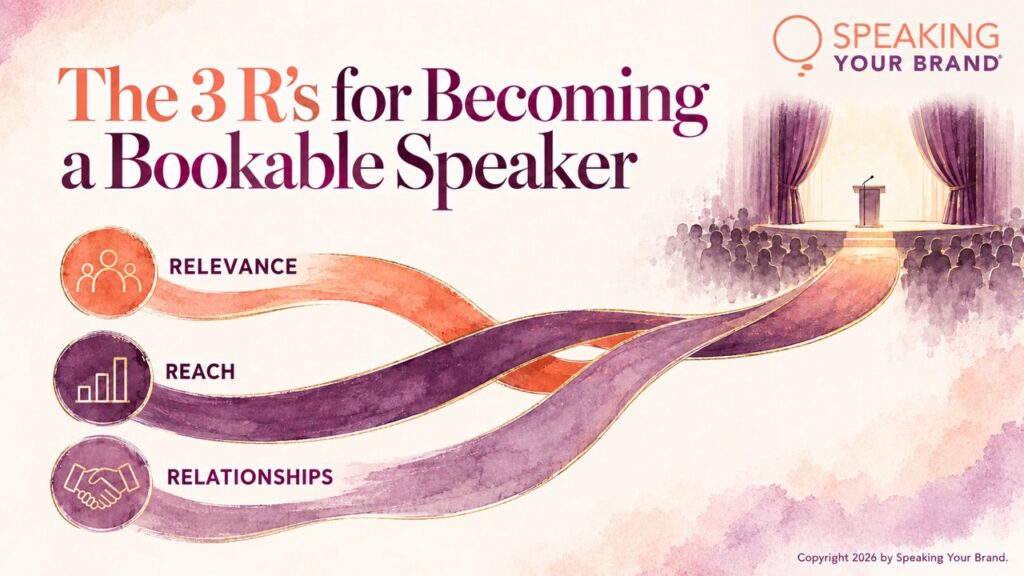
If you’ve been sending speaker proposals and hearing nothing back, I would look at three things: relevance, reach, and relationships. Does the organizer understand why your talk fits their audience? Can they see evidence of you speaking? And do people in your network know what you speak about well enough to recommend you?
Those are the three R’s we’re covering in the first episode of our Become Bookable series. I talked with Speaking Your Brand coaches Diane Diaz and Erin Mark about what each one looks like in practice. All three matter. And if I had to tell you where the best invitations in our own speaking careers have come from, all three of us would say relationships.
I was reminded of this recently when I gave a keynote at a leadership retreat for the Space Coast Chamber of Commerce here in Florida. A woman I’ve known for more than ten years reached out to me about the event. We hadn’t seen each other in person since around 2019, but we’d stayed in touch and supported each other’s work. That relationship opened the conversation. Then I had to show her how my work on story and voice would serve a room of community leaders, nonprofit directors, business leaders, elected officials, and people working at private space companies.
The invitation came through a relationship. The talk got shaped through relevance. And the next time an organizer considers me for a room like that, I’ll have another example of my work to show them. That’s how the three R’s work together.
1. Relevance: Can the Organizer See the Fit?
Speaker relevance means connecting your topic and expertise to the event organizer’s actual audience, challenge, and desired outcome. Your talk can have a consistent core while the title, examples, and language change for a particular room.
Erin speaks about resilience, burnout, and performance through change. When she talks with a health care organization, she may emphasize helping teams navigate pressure and burnout while continuing to care for patients. With HR or people leaders, she may emphasize resilient teams that adapt and stay engaged through change. She hasn’t created a different area of expertise for each buyer. She’s making it easier for each buyer to recognize the problem her talk addresses.
One way Erin describes her positioning is: I work with [who] to solve or improve [what] so they can [outcome]. It’s a useful starting point if your speaker bio currently tells people a lot about your credentials but very little about what their audience will get from you.
Ask What the Event Needs Before You Write the Proposal
For the Space Coast keynote, I didn’t walk in promising to teach public speaking or storytelling. The organizer told me the group was trying to break down silos in the community. That gave me a better question to build the keynote around: What bigger community question do we need to ask, and whose voices and stories are missing from the room?
It was still rooted in my work. I framed that work around the challenge this audience had come together to address. I also built activities into a two-hour keynote because I wasn’t going to talk at more than 100 people for two straight hours.
When you talk with an organizer, ask questions such as:
- What do you want people to take away from this talk?
- What would make this session successful for you?
- What challenge is this audience facing right now?
- What have you tried at past events? What worked, and what didn’t?
Then let the answers shape your proposal. If several speakers look qualified on paper, a proposal that reflects the organizer’s actual needs gives them something concrete to respond to.
Keep a Core Talk and Make Room for What Is Current
I often suggest thinking of a signature talk as roughly 80 percent timeless and 20 percent responsive to current concerns. That isn’t a strict formula. It keeps you from rebuilding the whole presentation every time a new trend appears while giving the audience a reason to care about the talk now.
Diane has spoken about personal branding for years. Today, she can connect that work to questions organizations are asking about trust, human connection in an AI-saturated world, and the difference between thought leadership and simply producing more content. At one conference, the AI angle may be the relevant entry point. At another, the organizer may be more interested in how a person’s voice comes through. Diane’s expertise is consistent; the framing meets the room.
Erin does something similar with titles. One version of a talk may emphasize navigating uncertainty without burnout. An organization that doesn’t want uncertainty in the title may respond better to The Resilience Response. She may customize part of the talk for the organization, while keeping its core. As we discussed in [Episode 486: Stop Creating Every Presentation from Scratch], you don’t need to invent three or four unrelated talks to speak to three or four audiences.
2. Reach: Can People Find You and See You Speak?
Reach is the visibility and proof that help people discover you, look you up, and picture you on their stage. That includes your speaker website, social media, YouTube, and the video clips you share. We’ll spend more time on social media and AI SEO in the next episodes of this series. For this checklist, start with video.
My thinking about speaker video has changed. When I started Speaking Your Brand more than ten years ago, I didn’t see a speaker reel as essential for most of our clients. Plenty of them got speaking opportunities without one. Capturing and editing good footage was harder and more expensive then, too.
Erin’s experience in the speaking market has made me rethink that advice. Organizers ask for clips because they want to see how a speaker communicates and engages a room. A polished description can tell them what your talk is about. Footage lets them get a feel for what happens when you’re actually delivering it.
How Can You Get Useful Speaking Video?
Start with the opportunities you already have. Erin often brings a phone and tripod to an engagement. She has also asked a few audience members, when the room feels right, to take a photo or a short clip from different angles and email it to her. She offers a small coffee gift card as thanks. That has given her shots she couldn’t have captured from one stationary camera.
If you’re considering hiring a videographer, ask about the room and stage before you spend the money. Will the setup give you the footage you need? Does the person understand speaking events and know to capture your full talk, different angles, audience reactions, and useful footage of the room? Tell them where a story lands or where the audience usually laughs so they can be ready for those moments.
Diane hired a professional videographer for her Orlando Women’s Conference keynote. It was a beautiful stage with a large audience, and she wanted footage that would show her delivering a keynote. The engagement itself was unpaid. She negotiated other promotional benefits and arranged to bring her own videographer. That footage later became part of her speaker reel.
I also put filming terms in my speaker contracts. I want the option to film my own talk, whether I’m using my phone or hiring someone. If the event has its own photographer or videographer, I ask to receive footage of my session. Diane cautions that the event crew may only capture brief moments while covering the whole conference. If you’re counting on video for your speaker materials, talk through what will be filmed, who will provide it, and when you’ll receive it.
You can start small, but do capture something. Photos and clips from actual speaking engagements help people recognize that you’re available to speak and give an organizer a way to assess your style.
3. Relationships: Who Knows You Speak?
Speaker relationships are the connections you build and maintain with organizers, past colleagues, associations, other speakers, and people who’ve seen you present. They make warm introductions and referrals possible. They take time, which is one reason it’s tempting to spend another hour polishing your website instead.
Erin gave us a perfect example. She submitted her information to a local TV show in the Saratoga Springs area and didn’t hear back. Later, her friend Melissa Snyder appeared on the show and asked why Erin hadn’t been on. Melissa introduced Erin directly to one of the hosts with a voice memo about her work. The host looked Erin up and invited her on. Another host had already saved a screenshot of Erin’s social media profile because she was interested in featuring her, but they hadn’t connected yet.
Erin’s online presence helped confirm who she was. Melissa’s introduction got the conversation moving.
Diane described how her speaking career grew through a women’s group in Orlando. She was doing some consulting when a woman in the group invited her to speak to a larger group about personal branding. Diane didn’t even have a finished talk yet. Someone heard her there and invited her to speak elsewhere. Those connections eventually led to a conference keynote. Years later, a woman who remembered her from that network invited her to speak to another group, and that talk led to three clients. Diane had stayed visible in the meantime by keeping in touch and supporting people’s work on LinkedIn.
My Space Coast invitation followed a similar long arc. The organizer and I had a real relationship before she had a stage to fill. We stayed in contact and supported each other over the years. When she thought about the leadership retreat, she thought of me.
Start With the Network You Already Have
If you feel as though you don’t know event organizers, start closer to home. Look at past employers, professional associations, local groups, alumni communities, and LinkedIn connections. You don’t need every person in your network to run an event. Someone may know the person who does.
Other speakers belong in that network, too. Erin pointed out that speakers can refer one another when an opportunity is a better fit for someone else’s topic. A trusted recommendation can also help the organizer who’s trying to find next year’s speaker.
And don’t dismiss a short or small talk. Erin has been hired by someone who heard her speak for five minutes. Diane’s early talks led to other talks. Speaking gives someone the chance to experience your work, remember you, and recommend you later. Then you can share a photo or clip that helps the next person see it, too.
Your Bookable Speaker Checklist
Before your next pitch, take a few minutes with these questions:
- Relevance: Can I name the audience, the challenge they’re facing, and the outcome the organizer wants? Does my title and proposal reflect that, while staying true to my core talk?
- Reach: If an organizer looks me up, can they quickly understand what I speak about and see or hear me speaking? Do I have a plan to capture photos and video at my next engagement?
- Relationships: Who already knows my work? Have I told them what I speak about, stayed in touch, and made it easy for them to introduce or refer me?
The checklist is a way to find your next useful action. Maybe that action is a better question for an organizer. Maybe it’s setting up your phone at your next talk. Maybe it’s writing to someone whose work you genuinely want to support and reconnect with.
Frequently Asked Questions
Do I need several keynote talks to appeal to different audiences?
You can begin with one strong core talk and adapt its title, examples, and framing for the buyer. Erin positions her work on resilience differently for health care organizations and HR leaders while keeping the same central expertise.
What should I ask an event organizer before proposing a talk?
Ask who will be in the room, what challenge they’re facing, what they want people to leave with, and what has or hasn’t worked at past events. Use those answers to show how your talk fits their specific event.
Do I need a professional speaker reel before I pitch?
You can start capturing footage with a phone and tripod. The important first step is to have video that lets a buyer see you speak. A professionally filmed keynote can be a valuable investment when the stage and room will give you useful footage.
Can I use video filmed by the event?
Ask in advance what the event crew will film and whether you can get a copy of your session. Put the terms in your speaker contract. If the footage matters to you, consider bringing your own videographer because the event crew may be covering the entire conference.
Where do speaking referrals come from?
They can come from people who have watched you speak, past colleagues, associations, friends, event organizers, and other speakers. You can start with a small local talk and maintain the relationships that grow from it.
Keep Building Your Bookable Speaker Ecosystem
The three R’s work together. Position your talk for the audience in front of you. Capture proof of what happens when you deliver it. Keep building the relationships that help people remember and recommend you.
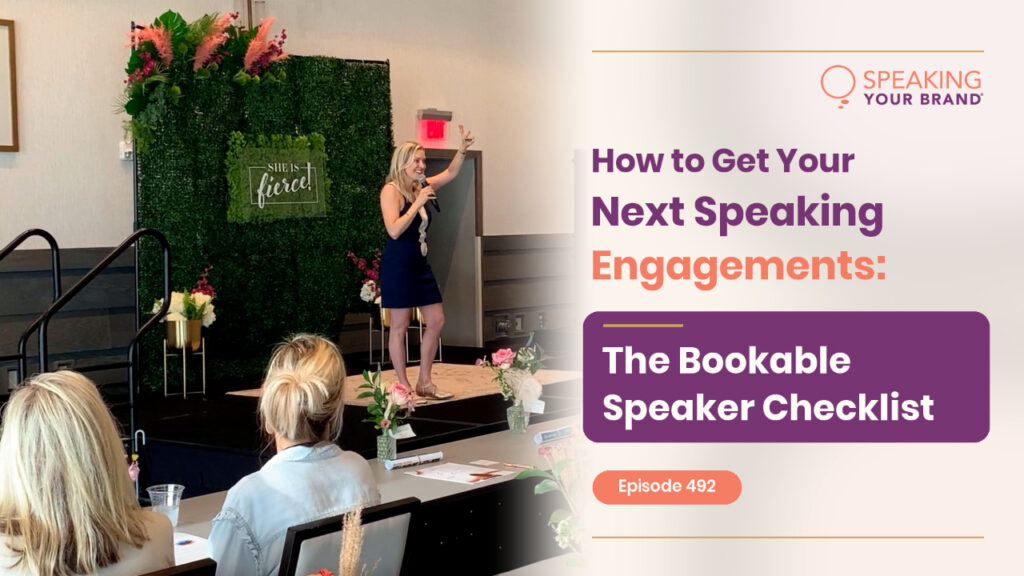
Download the Bookable Speaker Checklist for a recap and questions to ask organizers and videographers. You can also listen to Episode 492: How to Get Your Next Speaking Engagements: The Bookable Speaker Checklist and listen to Episode 486: Stop Creating Every Presentation from Scratch.
If you’d like help developing your signature talk and learning how to get booked and paid, explore Thought Leader Academy. If you’re ready to practice and film parts of your talk on a stage, learn about our Speaking Your Brand Live Retreat in Orlando.