What Makes Speaking Your Brand’s VIP Day Different From Other Speaking Coaching?
If you’ve ever finished a coaching call with good advice and a fresh list of things to do, you know what can happen next. You open a blank document and all your ideas are still in your head. Which story goes first? What can you leave out? How do you make a room full of people care about the same idea you care about?
At Speaking Your Brand, we’re different from other speaking coaches and programs. We create the talk with you.
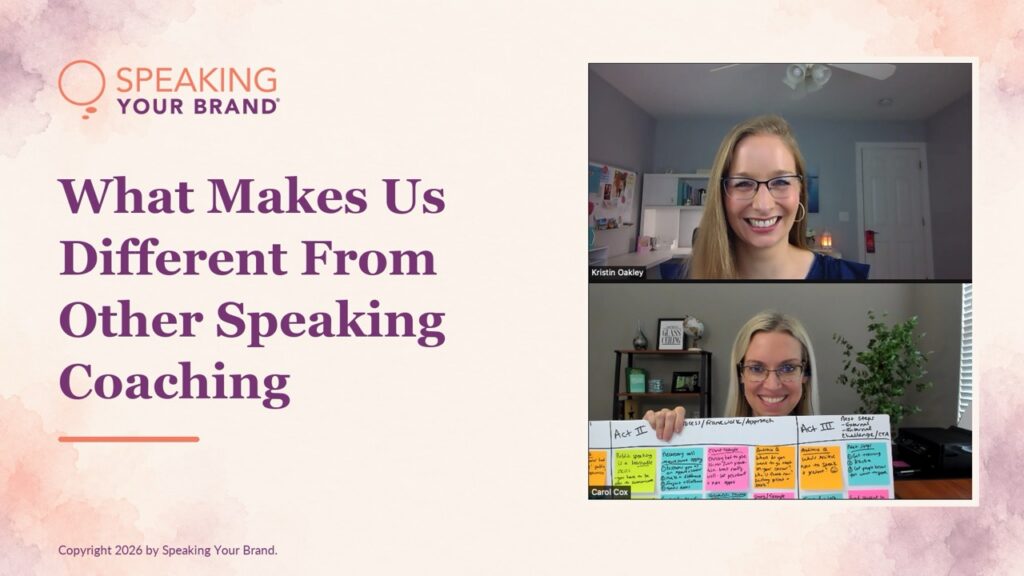
In a three-hour, one-on-one VIP Day on Zoom, either I (Carol Cox, founder) or our lead speaking coach Diane Diaz asks the questions, listens for the idea running through your work, and maps your signature talk from opening to closing using our unique and proven Signature Talk Canvas®.
You bring your experience, stories, and point of view. We do the heavy lifting of turning them into a talk an audience can follow and remember.
That difference sounds simple. When you’re the person staring at the blank document, it is enormous.
What actually happens in a VIP Day?
Before we meet, we send you a short set of questions so we can get oriented. You don’t need to arrive with a finished outline or a bunch of prep work. You have already done the important preparation by living your experience, building your expertise, and working in your business or career.
During the session, you do a lot of talking. We ask about your audience, the change you want them to make, the stories you keep returning to, and the ideas that feel important but haven’t quite found their place. On our end, we’re building your talk on the Signature Talk Canvas® poster board with Post-it notes. We make decisions together about the opening, the through line, the key points, the stories, audience interaction, and the closing.
Then we keep working with you. After the VIP Day, we have follow-up coaching calls and review of your practice and slides The three hours give us the map; the follow-up helps you make it speakable.
Here’s a short video with snippets from some of our clients’ VIP Days:
Why don’t we just hand you a template?
Templates can help you see a structure. They can’t decide which of your twenty possible stories belongs in this talk, or notice that the point you almost skipped is the one your audience most needs to hear.
As a coach, I think of myself as wearing three hats during a VIP Day. First, I’m in the audience: Why should I care? What do I need to understand before I’m ready for your next idea? Second, I’m the event organizer: Why this speaker for this audience? Third, I’m your thought partner. If two possible messages emerge, we’ll explore both. I’ll ask you to tell me more when I hear something specific and alive in your answer.
That is why the talk stays yours. We build from your words, expertise, examples, and sense of humor. You’re able to deliver it as yourself, rather than trying to memorize language someone else handed you.
I founded Speaking Your Brand to help amplify women’s voices and advance gender equality through public speaking. That mission shapes our Thought Leader Academy and in-person retreat for women, and it shapes how we coach: your experience deserves to be heard as a point of view, not buried under a pile of information you feel obliged to cover.
What makes the talk useful beyond one event?
A signature talk gives you a strong center. You can change a story, question, or example for a particular audience while keeping the core message intact. You can expand a section for a longer keynote or tighten it for a shorter presentation. You don’t have to start from scratch each time someone asks you to speak.
We also ask what you want speaking to do for you. You might want to bring the right clients into your business, become known for a particular idea, or pursue paid keynotes. Those goals affect the audience journey and the invitation at the end. The talk should give people something valuable in the room and make sense in the larger context of your work.
How is this different from a speaking course or delivery coaching?
There are good reasons to take a course or practice your stage presence. The question is what kind of help you need right now.
If you need to find the core idea and build a complete signature talk, the one-on-one VIP Day is where we do that work with you. You can book the VIP Experience on its own. It is also part of Thought Leader Academy, where the talk development is paired with small group coaching. The longer Academy path also covers the business of speaking: positioning yourself, finding and pitching opportunities, and getting booked and paid.
Our in-person speaking retreat serves a different purpose. It gives you room to practice delivery, get feedback on stage, and film segments you can use to show event organizers how you speak. You can arrive with an existing talk or build one with us first. We can refine a message at the retreat, but creating a complete talk is the focus of the VIP Day and Academy work.
The question to ask any coach or program is practical: Who will turn my ideas into the actual talk, from the opening to the closing and everything in between? Some programs provide lessons and feedback, then leave you to assemble the talk between calls. In our VIP Day, we build that structure together while we’re in the room with you.
What should you ask before hiring a speaking coach?
Ask us these questions, too. A good fit should be clear about the work you’ll do together and what happens after the call.
- Who will build the talk during our sessions? Will we map it together, or will I leave with notes and write the talk on my own?
- What will I have when we’re done? A topic, a template, a draft script, or a complete structure from opening to closing?
- How will you find my core message? What questions will you ask about my audience, my stories, and the idea I want them to take away?
- Who will actually coach me? Is it the person I’m speaking with now, or someone else on the team?
- What support follows the first session? Can I get feedback as I practice, adjust my slides, and adapt the talk for another audience?
- Which parts of speaking do you cover? Talk development, delivery, and getting booked and paid are related skills. Find out which ones the program will help you build.
Listen for a description of the process, not just a list of lessons or a promise about where you’ll speak. You should know what work the coach will do with you and what work will be yours, as well as who will be your coach and what experience they have as a speaker and as a coach.
Can AI write the talk instead?
AI can give you an outline quickly. It can also make a story sound polished before you’ve decided why that story belongs in the talk. I’ve tried it with my own material. The result can sound plausible on the page and strange when I say it aloud.
The difficult part is choosing: which idea has enough substance to carry a talk, which details matter to this audience, and where does your own perspective change how they see the issue? Those choices need a real conversation and human curiosity and judgment. We can use tools to support the work, but the thinking and the voice need to come from you.
Is a VIP Day right for you?
It may be a fit if you know your subject, have more ideas than you can fit into one presentation, and want a coach to help you make the hard choices with you. You may already speak often, or you may be ready to create the talk that takes you into new rooms.
You don’t need a perfect topic statement before we start. You do need enough experience with your business or work to have something real to draw from. That’s what we listen for together.
If you have questions and want to see which option is the best fit for you, schedule a consultation call with us.