489-Solo-Stage-Segments.mp3: this mp3 audio file was automatically transcribed by Sonix with the best speech-to-text algorithms. This transcript may contain errors.
Carol Cox:
Do you have parts of your keynote, your signature talk, your presentation that are memorable to the audience? Do you have great video clips that showcase what you can do when event organizers ask you for your speaker reel? We’re going to talk today about Signature Stage segments. These are elements of any talk that you give that you can integrate so that you are more likely to get booked and referred. Hi, I’m your host, Carol Cox. Welcome to the Speaking Your Brand podcast. I know if you’re listening, you want to increase the number of speaking invitations that you get. Of course, you want to get referred for other stages. You want to get paid to speak and get to bigger stages. A lot of the time, what I see speakers doing is more, more, more, more pitching to conferences, more posting on social media, more cold outreach emails. But that quantity is most likely not going to get you what you want, because conferences and events are getting inundated with speaker submissions. A couple of months ago, I had the event organizers for TEDx Orlando on. I’m one of the speaking coaches there, and we got over 600 submissions to speak at TEDx Orlando in years past. We probably would have gotten 50. Tedx Orlando is not alone. This is happening not only for TEDx events, but for all types of different conferences and events. Why? Well, because of course, ChatGPT AI has made it so much easier for people to put together a speaker submission.
Carol Cox:
So here’s what I want you to do to stand out. I want you to create the signature stage segments. Some people call them bits. This is similar to that idea of bits, but it’s not quite the same. And this is not only for your live speaking to include the signature stage segments, but also making sure that you’re capturing them on video for your speaker reel And for those video clips you have on your website, YouTube, and social media, hands down, the best way to get more speaking invitations is drum roll. Please to speak. When people see you on a stage or in front of an audience, they all of a sudden put two and two together and think, oh, she’s a speaker. I like her topic, I like her style. I can invite her to my event or the event organizer for the event that you’re speaking at gets asked by other event organizers. Who do you recommend? That is why speaking is the best way to get more speaking. Invitations start small, start local, start free. But here’s the thing you have to be memorable to the event organizers and to the people in the audience so that they remember you and refer you. This is where the signature stage segments come in. I’m going to share what those elements are as well as the number one thing many speakers are afraid to do. If you’re new to speaking your brand, welcome! We work with women entrepreneurs, executives, and leaders to craft your thought leadership message, your signature talk, and your speaker platform.
Carol Cox:
If you’re not sure what kind of speaker you are, I invite you to take our free Speaker archetype quiz. It’s just ten multiple choice questions, and you’ll get your results right away to identify which of the four speaker archetypes you are. You can take that quiz at speaking your brand.com/quiz. Now let’s get on with the show. Think of signature stage segments as something that you’re crafting intentionally so that they are memorable to the audience, and so that you can get great video showcasing what you can do. I’m going to share with you the elements that make great signature stage segments, but they’re not self-contained. They’re not things that you do one versus the other, or you do them in isolation. Most of the time they work together. And those are storytelling, but really interactive and embodied storytelling, humor, props and costumes. Audience interaction and quotable or memorable lines. If you think about it, those elements are what you want to include in those video clips. So event organizers can see you can engage the audience. The audience is with you. You’re not just not lecturing or giving them a whole bunch of information or reading a whole bunch of text that’s on your slides. So let’s go through these again, they’re not in isolation. Most of the time they work together. So what I’m going to include examples from different clients. And these clients have been on the podcast in the show notes for this episode, you’ll see links to their episodes.
Carol Cox:
So you can go listen to those for even more detail. Storytelling is pretty self-explanatory. You do want to have at least one key story in your talk or your presentation, ideally a story about you so that you can act it out, so to speak. Use our ideal storytelling ingredients. Ideal stands for imagery, dialogue, emotion, action, and lesson. When you tell a story, you don’t want to say, well, I really wanted to get a promotion, but I didn’t get it. And so I was disappointed and decided to get another job. That’s not really a story. That’s just saying something that happened. Instead, a story would be, I was so excited to go to that meeting with my boss. I just knew I was going to get that promotion that I had been imagining the entire year. I walk into her office. I sit down, a smile on my face. She’s looking at me, but she’s not really smiling. And then my heart sank and I thought to myself, I don’t know if this is going to go the way that I had hoped. And she looks at me and says, I’m sorry, but you’re just not quite ready for this next step. Instead, here are some things that we can work on together so that you’re ready next year and so, etc. so you see how different that story was. I included imagery, I walked into my boss’s office, I sat down in the chair and I was sitting across from her.
Carol Cox:
I included dialogue, what I was thinking in my mind, as well as what she said to me. I included emotion, I was excited, my heart sank. Action. I walked into the office, I sat down, I used action verbs and then the lesson. So I would draw a lesson out of that. Whatever I wanted to emphasize for that particular talk and that audience was the lesson to still work on whatever your dream is, or is your lesson to make sure that you’re communicating throughout the year, not just at the very end for your annual performance review. So whatever the lesson is, but that is using those ideal storytelling ingredients. A great example of this is my client, Katie Anderson. We’ve worked together on her various keynotes over the past few years. She attended the very first in-person speaking retreat that we held back in 2022. And by practicing on our stage in person, she took a antidote that she was sharing in her talks, which was about having a coach view her and her interaction with her team, and Katie realizing that she was doing some things in those team meetings that she didn’t even realize that she was doing until the coach pointed it out to her. And when we ended up doing with her story, is that Katie sets it up as if the coach is a National Geographic videographer.
Carol Cox:
Watching Katie and the other team members say at a watering hole, and Katie’s like the lion that is pouncing in because she’s excited and wants to share her ideas. So she’s like that lion pouncing, but she doesn’t let the other team members share what they want to share. So Katie does a great job sharing the story. And again, I’ll put links in the show notes so you can listen to that podcast episode I have with her. So that’s an example of really having that interactive embodied storytelling. So Katie kind of acts it out. She jumps, you know, jumps a little bit on the stage appropriately. So for her corporate audiences, another great example of storytelling is Erin. Mark. She was on the podcast not too long ago, and Erin, in her signature talk that we created together when she worked with us, she tells the story of being born with a terminal illness, cystic fibrosis, and learning at a very young age five that her life expectancy was only 18 years old. And then she goes in and talks about the Make a Wish people coming and what she wanted, where she wanted to go versus where they had in mind. So she does a great job with the storytelling. You can really feel it and you can imagine it. And so if you think about, though, that element of storytelling, Katie can take that lion story and use that in her speaker reel. Aaron can take that story about learning her life expectancy at age five and the Make a Wish conversation, and then put that into her speaker reel.
Carol Cox:
Along with storytelling comes humor. A lot of times, the story that you’re sharing, especially for that signature stage segment, will have humor incorporated into it. Either you’re doing a funny aside within the story, or some element of the story itself is humorous. So that’s a great way to incorporate humor. It’s nice to have B-roll of the audience smiling and laughing. If you don’t necessarily have a story that has a humorous element, you can add intentional humor, whether it’s funny GIFs or funny memes or a video clip. Our lead speaking coach, Diane Diaz, did last year when she was giving a talk at a women’s business luncheon, is that we ended up making these postcards, and half the postcards had the word whisper on them. The other half of the postcards had the word raw on them, and so she gave them out to the audience. At their seats. Half the tables had whisper, half the tables had raw. So it was mixed around. And then at the beginning of her talk had everyone sing twinkle, twinkle Little Star. The people with the whisper postcards had to whisper it really softly. The people with the raw postcards had to belt it out really loudly. So they did that with the song. And then she asked, how did it feel to be the whisper versus the raw? So it was lighthearted.
Carol Cox:
It was fun. It really got the audience engaged right at the beginning. So that leads us into the third element, which is audience interaction. You can see how these are not separate elements. They really do work together. In that case, Diane was using humor, but also audience interaction. Another great example is my client, Julia Cohen. She was on the podcast, and you’ll definitely going to want to listen to that episode to get all of the details for her keynote. We ended up coming up with an idea for a game show. Yes, an actual game show. There were six different characters in the game show, and then she had audience members that she had talked to ahead of time, pre-selected, and they came up and read a clue that she had printed out a clue for who that person was. It was almost like Hollywood Squares where you would reveal who the person was based on the clue. It was a lot of fun. So it had humor, it had props, it had audience interaction. And when Julia got off the stage, not only did she get a standing ovation, not only was there a line of people to talk to her, but the AV people who have seen lots of keynotes said that it was a ten out of ten keynote. It was incredible because of that really engaging, really different, really fun audience interaction. I mentioned props in this case. Julia had the clues that people would read.
Carol Cox:
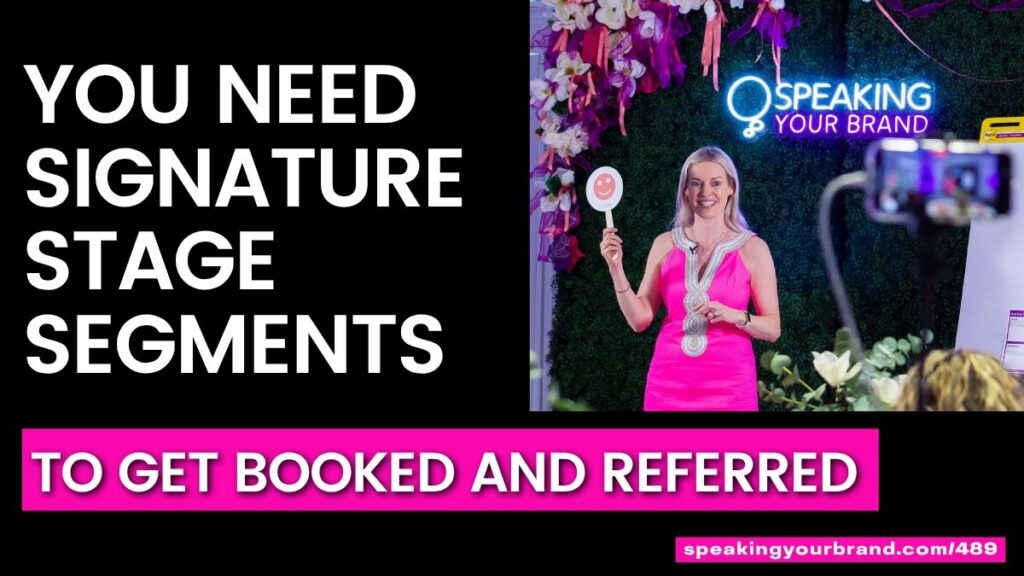
But she also had a prop that represented each of those six characters. In last week’s episode, Nicole Rochester, who had attended one of our speaking retreats as well, shared a story about how after working with us at that in-person retreat, she got ideas for props that she could include in her talks and in one of the talks that she was delivering about being a physician versus the the human being, not just the doctor, she said. For part of it, she had a mask on, like a medical mask, and talked about being a doctor for a couple of sentences. And then she took the mask off and talked about what it’s like just to be a human. And so of course, she had a bigger lesson in there, but that’s just a very, very simple prop, but adds a visual element for the audience. A couple of years ago, I was presenting at Macon, the marketing AI conference, and I created paddles that had the emoji for a human, a smiley face on one side and the other side had an emoji for a robot representing AI. So these were physical paddles. I handed them out to the audience before my session, and then a couple of times during my talk, I had I asked questions and I had the audience raise the paddles. What do you think created this, a human or an AI, or who do you think is going to be better at this human or AI? It was simple.
Carol Cox:
It was effective. It was a prop and audience interaction at the same time. One of our other clients, Andy Nunn, he was also on the podcast earlier this year. Link in the show notes. He’s a mentalist and a magician, so he has unfairly a lot of props and audience interaction that he can do. He has playing cards where he has a, as has someone from the audience come up on the stage and then they pick a card. And of course, he knows what the card is. He has another one where he uses a a lemon and a knife. And then the visual of that and what the audience sees and what it is that he actually has in his hands. It’s a lot of fun. He does this in his TEDx talk as well. We talk about that in the episode he was on. So that’s another example of props and audience interaction combined together. So I’ve gone through these elements storytelling, humor, audience interaction, props, and costumes. The Fifth element are quotable and memorable lines. This is helpful for the audience. If you just put that one phrase or that one sentence on a slide, that’s really impactful. It’s really memorable. A lot of times people will take a photo of that slide to remember it. Make sure you have your contact information, your website on the along the bottom of the slide so they know where it came from. It’s also really great to have these quotable and memorable lines for your speaker reel.
Carol Cox:
So imagine you have your speaker reel. So you have some humor and you see the audience laughing in the B-roll. You have a little bit of your story. Maybe you have a prop in one of them, and then you want these Quotable, memorable lines that reflect your thought leadership, your unique perspective as far as why someone should bring you on to speak to their audience. If you’ve been listening to the podcast for a while, you know that I talk about this idea of the expert trap as high achieving women with degrees and credentials, years of expertise and experience. We tend to hide behind our expertise. And as I always say, your clients need your expertise in the work that you do. But when you get up on stage, your audience doesn’t need a whole bunch of information from you. They don’t need you to teach them what it is that you know. They need you to help them understand themselves better, to see and think differently. So imagine I had some quotable, memorable lines. Something like the expert trap is where we hide behind our expertise. Instead of giving more of ourselves and helping the audience to see themselves in a new way. Or I can say something like speaking is a conversation between you and the audience, even if the audience never says a word to you. So think about what are those quotable or memorable lines you can include in your talks as well? I mentioned in the intro that there’s something that a lot of speakers are afraid to do in their talks is to bring forth their personality, their strengths.
Carol Cox:
Maybe they have a naturally funny disposition, maybe it’s a little bit sardonic, or maybe they do like to move around the stage and really embody their storytelling, but they’ve gotten into their heads that it’s not appropriate, quote unquote, appropriate and professional settings. Of course, whatever you do on stage should be appropriate for that event. But a lot of times we have these ideas in our heads that we can’t do certain things, that we can’t show our personality or our lean into our strengths. And so we have to be like some other speakers that we’ve seen. Your personality is what’s going to make you memorable and bookable and referable on stage and in your video clips and your speaker reel. If you would like to work with us in person so you can craft your signature stage segments, practice them on our stage, get our real time coaching and feedback, and get your Signature Stage segments professionally filmed so you have them for your speaker reel and video clips. That’s exactly what we do at our in-person three day Speaking Your Brand live retreat. It’s happening February 2027 in Orlando, Florida. Registration is on right now. You can get all the details, including pricing and what we do during those three days at speaking your brand.com/live. Again, that’s speaking your brand.com/live. Until next time. Thanks for listening.
About this transcript
This transcript was generated by Sonix in just a few minutes using online English transcription and converting mp3 files to text. Want to see how it works? Start with AI audio and video translation.
One recording, many languages — translating video to text makes multilingual publishing practical. See audio-to-German translation for how it works.
Create a free Sonix account to transcribe your own recordings in minutes — and check Sonix’s pay-as-you-go pricing before you commit.