The Stage Moments Event Organizers Remember and Refer

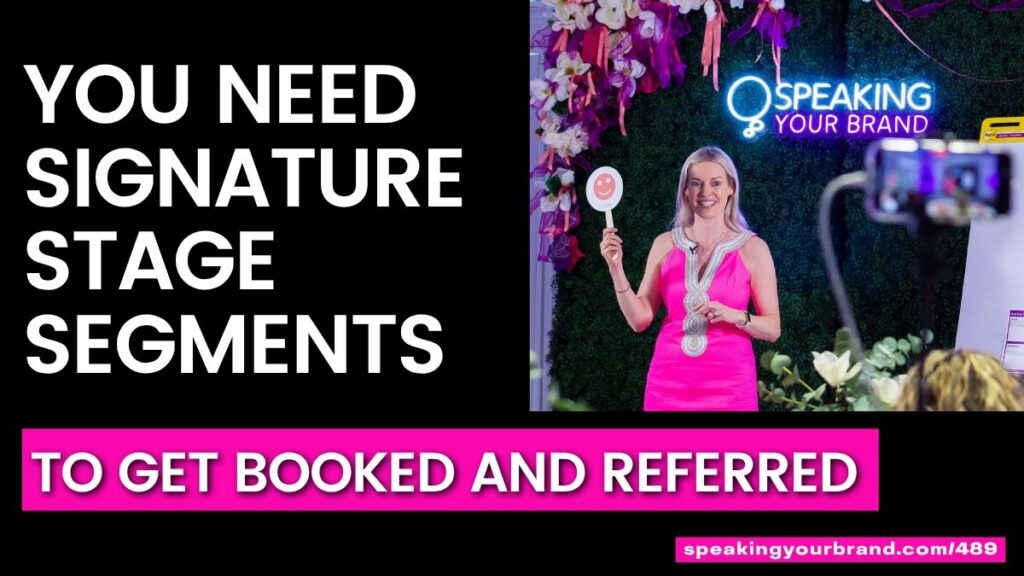
Signature Stage Segments are intentionally crafted parts of your keynote, signature talk, or presentation that audiences remember and event organizers can picture on their stage. The strongest ones usually combine several elements: embodied storytelling, humor, audience interaction, props or costumes, and a quotable line that reflects your point of view.
They do two jobs at once. In the room, they give the audience something vivid to experience. On video, they show an event organizer that you can do more than deliver information from a stage. You can tell a story, engage a room, create a response, and help people see or think differently.
That matters because the answer to getting more speaking invitations is not simply more, more, more: more conference submissions, more social posts, more cold outreach emails. Event organizers are being inundated with speaker submissions. In a recent year, TEDx Orlando received more than 600. In years past, the number was closer to 50.
AI has made it much easier to put together a credible-looking speaker submission. So the submission alone is not necessarily what will distinguish you. Event organizers also need evidence of what happens when you get in front of an audience.
That is where your Signature Stage Segments—and the video you capture of them—become so valuable.
What Is a Signature Stage Segment?
A Signature Stage Segment is a memorable, repeatable moment within a talk that is deliberately shaped to connect with the audience and showcase the speaker’s distinct style and point of view.
Some speakers call these moments “bits.” The idea is similar, but a Signature Stage Segment is not a disconnected routine that you drop into a talk only to entertain people. It belongs to the message. It advances the audience’s understanding while making the experience more visual, emotional, participatory, or quotable.
You might use a Signature Stage Segment in your full keynote, adapt it for a shorter presentation, and capture it on video for your speaker reel, website, YouTube channel, and social media.
The five core ingredients are:
- Interactive and embodied storytelling
- Humor
- Audience interaction
- Props or costumes
- Quotable or memorable lines
These are not five separate boxes you need to check. Most strong segments combine two or more of them. A story may include humor and a prop. An audience activity may also create a funny moment. A costume change may make the central lesson visible. The combination is what creates a scene people can remember and describe later.
Why Memorable Stage Moments Lead to More Speaking Opportunities
The best way to get more speaking invitations is to speak.
When people see you on a stage or in front of an audience, they put two and two together: she is a speaker, I like her topic, I like her style, and I can imagine her at my event. An event organizer may also be asked by another organizer, “Who do you recommend?”
But the fact that you appeared on a stage is not automatically enough to generate the next invitation. You need to be memorable to the organizer and the audience. They need a specific moment, idea, or image they can recall when your name comes up.
Signature Stage Segments give them that memory. They also give you stronger raw material for a speaker reel. Instead of a montage of you walking across a stage and speaking over generic music, an organizer can see an audience laughing, responding, raising a prop, or leaning into a story. They can hear the line that captures what you stand for.
If you are still building your speaking portfolio, start small, start local, and start free when that makes sense for your goals. Use those opportunities to practice and capture the moments you want to become known for.
How Do You Turn an Experience Into an Embodied Story?
Most talks benefit from at least one key story, ideally one about you that you can bring to life rather than merely report.
There is a big difference between saying, “I wanted a promotion, but I didn’t get it, so I was disappointed and found another job,” and taking us into the meeting. Where were you sitting? What did your boss’s face look like? What did you think when your heart sank? What did she say?
Our I.D.E.A.L. Storytelling Method give you five ingredients to work with:
- Imagery: Help us see the room, the people, or the object.
- Dialogue: Let us hear what was said aloud or inside your head.
- Emotion: Name or show what you felt as the moment unfolded.
- Action: Use physical movement and active verbs.
- Lesson: Connect the story to the point the audience needs to understand.
The lesson can change depending on the audience. A story about not receiving a promotion could become a lesson about persistence, or it could become a lesson about communicating with your manager throughout the year instead of waiting for the annual review. The event stays the same. The meaning is shaped for the room.
Katie Anderson’s lion at the watering hole
My client Katie Anderson shares a story about receiving feedback on how she interacted with her team. The coach noticed that Katie was jumping into meetings with her own ideas before the rest of the team had space to contribute.
We developed the story as though the coach were a National Geographic videographer watching the team at a watering hole. Katie becomes the lion, pouncing in because she is excited to share. She does not simply describe that energy; she embodies it on stage with her voice and movement.
It is specific, visual, and a little funny. It also belongs to the larger message of her talk. That makes it an excellent stage segment and an excellent speaker-reel clip.
Here more from Katie in Episode 345: Elevate Your Audience Engagement Skills with These Proven Strategies with Katie Anderson [Client Case Study].
How Can Humor and Audience Interaction Work Together?
You do not need to become a stand-up comedian. Humor can come from the story itself, a candid aside, a visual, a GIF, a meme, a short video, or an activity that lets the audience experience the point.
Our lead speaking coach, Diane Diaz, created a simple audience activity for a women’s business luncheon. Half of the audience received postcards with the word “whisper.” The other half received postcards with the word “roar.” At the beginning of her talk, everyone sang “Twinkle, Twinkle, Little Star.” One group had to whisper it softly; the other had to belt it out.
It was lighthearted, but it was not random. Diane then asked people how it felt to be the whisper versus the roar. In one short segment, she used props, humor, and audience interaction to create an experience the audience could connect to the message.
Julia Korn’s keynote game show
My client Julia Korn used an even bigger interactive segment: an actual game show with six different characters. Pre-selected audience members came to the stage and read clues. The setup had some of the feel of Hollywood Squares, with each clue revealing a character.
The segment combined humor, props, audience participation, and surprise. After Julia’s keynote, she received a standing ovation and had a line of people waiting to speak with her. Members of the AV team—people who had watched a lot of keynotes—called it a ten-out-of-ten keynote.
The lesson is not that every speaker now needs a game show. The lesson is that a talk can invite the audience into the experience while still serving a meaningful idea.
Hear more from Julia in Episode 422: How to Create a 10-Out-of-10 Keynote that Leaves Your Audience in Awe with Julia Korn [Client Case Study].
Do Props and Costumes Have to Be Elaborate?
No. A prop works when it makes the point clearer, more visible, or more participatory. It does not have to be complicated.
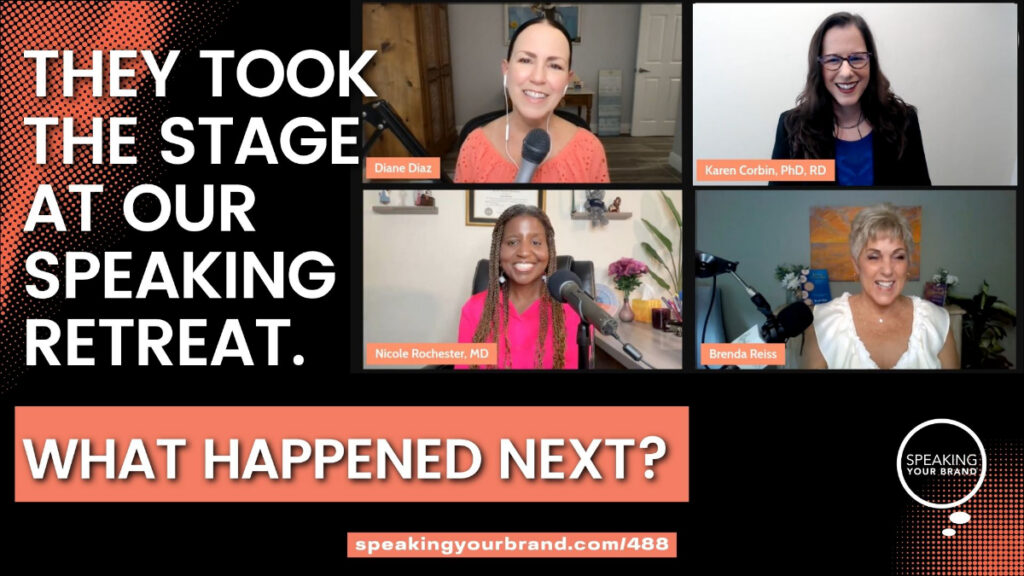
Dr. Nicole Rochester has used a medical mask in a talk about the physician versus the human being behind the professional role. She speaks for a few sentences with the mask on, then removes it as she talks about what it is like to be human—not only the doctor. The physical action gives the audience a visual representation of the larger lesson.
Hear more from Nicole in Episode 488: They Took the Stage at Our Speaking Retreat. What Happened Next?.
For a presentation at the Marketing AI Conference, I made paddles with a human face on one side and a robot representing AI on the other. I asked questions during the session and had the audience raise the side that matched their answer. Was this created by a human or AI? Who would be better at this task?
Simple. Effective. A prop and audience interaction at the same time.
My client Andy Nunn has a natural advantage here because he is a mentalist and magician. Playing cards, a lemon, and a knife can all become part of the experience he creates. But you do not need magic tricks. The object only needs to belong to the idea.
Hear more from Any in Episode 467: Making the Shift from Performer to Keynote Speaker with Andy Nunn.
Before adding a prop, ask:
- Does this help the audience understand the point?
- Will the audience be able to see it from where they are sitting?
- Does it give me something useful to do, or does it make the segment busier?
- Have I rehearsed the timing, movement, and transition?
- Will this moment look clear on video?
What Makes a Line Worth Remembering?
A quotable line gives the audience language for the idea they just experienced. It is short enough to remember, strong enough to stand on a slide, and distinct enough to reflect your actual thought leadership.
If you put one line on a slide, people may photograph it. Include your website or contact information along the bottom so they know where it came from.
The same kind of line is useful in a speaker reel because it tells an organizer what you believe, not only what topic you cover.
For example:
The Expert Trap is where we hide behind our expertise instead of giving more of ourselves and helping the audience see themselves in a new way.
Or:
Speaking is a conversation between you and the audience, even if the audience never says a word to you.
These lines work because they are connected to a larger point of view. They are not motivational filler pasted onto a slide.
Your clients need your expertise in the work you do. But when you get on stage, your audience does not need you to empty all of that information into the room. They need you to help them understand themselves better and see or think differently.
The Part Speakers Are Most Afraid to Use: Their Personality
You can follow every speaking technique and still create a talk that feels interchangeable.
The missing ingredient is often your personality.
Maybe you are naturally funny. Maybe your humor is a little sardonic. Maybe you love to move around the stage and physically embody a story. But somewhere along the way, you decided that part of you was not “appropriate” for a professional setting. So you modeled yourself after speakers who looked more polished, serious, or authoritative.
Of course, everything you do needs to fit the event and the audience. But professional does not have to mean personality-free.
Your personality is what can make you memorable, bookable, and referable—on stage, in your video clips, and in your speaker reel. The goal is not to perform a bigger personality than the one you have. It is to stop removing the parts of you that already create connection.
How to Build Your Own Signature Stage Segment
Start with one important part of your current talk. You do not need to redesign the entire keynote at once.
1. Choose a point the audience needs to experience
Look for the idea that is difficult to understand through explanation alone. Where would a story, physical image, or audience activity make the point clearer?
2. Develop one embodied story
Use the I.D.E.A.L. ingredients. Add the scene, dialogue, emotion, and action. Decide what lesson this audience needs to take from the experience.
3. Layer in one additional element
Could the story use a moment of humor? Could the audience answer a question, hold up an object, repeat a phrase, or make a choice? Could a prop make the contrast visible?
Do not add elements simply to make the segment look more entertaining. Every choice should support the message.
4. Write the line you want people to remember
If an audience member described this idea to a colleague the next day, what sentence would you want her to use? Put that line on a slide, say it clearly, and leave enough space for it to land.
5. Rehearse it with an audience and capture it on video
A Signature Stage Segment needs reps. Try it in front of real people. Notice where they laugh, lean in, respond, or become confused. Adjust the setup and timing. Then capture clean video that shows both you and the audience response.
6. Let it sound and look like you
Do not imitate someone else’s game show, costume, humor, or movement. Use your strengths. The segment becomes signature when it carries your idea and your personality.
A Quick Signature Stage Segment Checklist
Before your next talk or recording opportunity, ask:
- Is there at least one story the audience can see and feel, not only hear summarized?
- Have I used imagery, dialogue, emotion, action, and a clear lesson?
- Is there an appropriate place for humor?
- Can the audience participate in a way that supports the idea?
- Would a prop or costume make an abstract point visible?
- Do I have one quotable line that reflects my point of view?
- Am I showing my real speaking style, or editing my personality out?
- Will this segment make sense as a video clip outside the full talk?
- Can an event organizer watch it and picture me on her stage?
Frequently Asked Questions About Signature Stage Segments
What is the difference between a Signature Stage Segment and a speaking “bit”?
The ideas overlap, but a Signature Stage Segment is deliberately connected to your thought leadership and the audience’s understanding. It is not an isolated routine included only for entertainment. It moves the message forward while creating a memorable experience.
How many Signature Stage Segments should a keynote have?
There is no required number. Start with one strong segment built around an important point in the talk. A keynote may eventually include several, but each one should earn its place and serve the overall message.
Do I need to be funny to create a memorable segment?
No. Humor is one possible ingredient, not a requirement for every moment. An emotionally vivid story, a powerful audience activity, a simple visual prop, or a distinctive line can be just as memorable. Use the strengths that fit your personality.
What should I capture for my speaker reel?
Capture footage that shows what it feels like to have you in the room: a story, a clear thought-leadership line, an audience interaction, an appropriate moment of humor, and visible audience response. Event organizers need to see more than polished stage movement; they need evidence that you can connect.
Can I use the same segment in different talks?
Yes, if the segment supports the message and audience. You may adjust the setup, lesson, length, or language for a different room while keeping the recognizable core.
What if showing more personality feels unprofessional?
Check whether the choice is genuinely wrong for the event or whether you are holding yourself to a narrow idea of what a professional speaker should look like. The goal is not to ignore the context. It is to let your natural humor, movement, warmth, or intensity come through in a way that fits the room.
Craft and Film the Moments That Make Your Talk Memorable
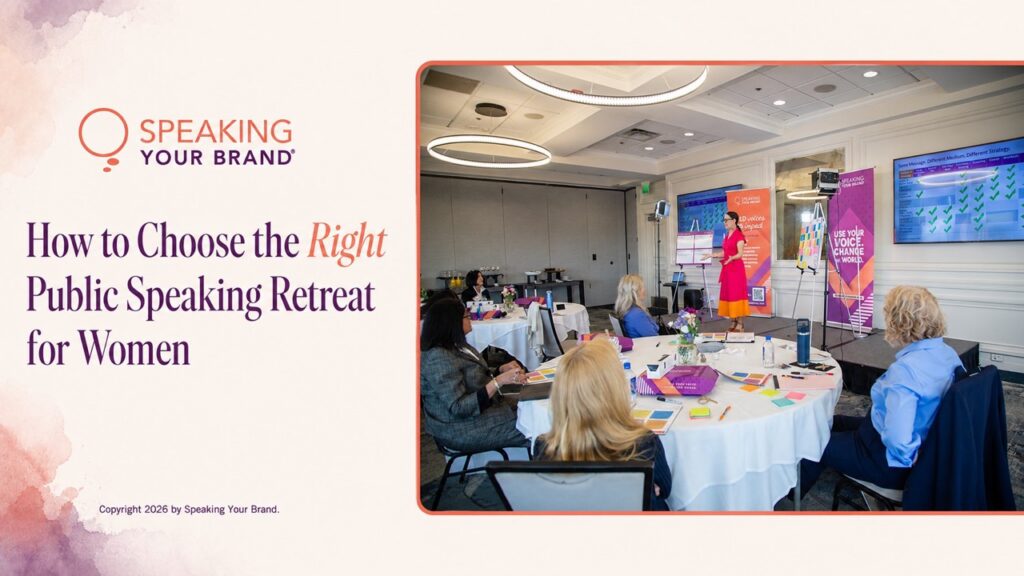
If you want to create your own Signature Stage Segments, practice them on a stage, get real-time coaching and feedback, and have them professionally filmed for your speaker reel and video clips, that is exactly what we do at our three-day Speaking Your Brand Live Retreat.
The next retreat is happening in February 2027 in Orlando, Florida.
Learn more about the Speaking Your Brand Live Retreat.
You can also listen to Episode 489 for all of the examples and hear how these elements work together.