Why Your Signature Talk Is the Missing Piece of Your Marketing Strategy (And How to Turn Speaking Into Clients)

If you’re posting on LinkedIn, sending email newsletters, recording podcast episodes, updating your website, and still wondering why your marketing isn’t creating the opportunities you expected, the missing piece may not be another marketing tactic.
It may be your signature talk.
Many entrepreneurs, consultants, coaches, executives, physicians, and thought leaders think of speaking as something separate from marketing. They see it as visibility, credibility, or an occasional opportunity.
But the most effective speakers understand something different:
Your signature talk is your marketing.
When designed strategically, a signature talk becomes the foundation for your content, your messaging, your thought leadership, and your client acquisition strategy.
It helps people understand not only what you do, but why you are the person they trust to help them.
And in today’s crowded marketplace, that matters more than ever.
Why Traditional Marketing Feels Harder Than It Used To
Most business owners have noticed the same thing:
- Social media reach is declining
- Algorithms constantly change
- Content competition is increasing
- AI makes it easier than ever for anyone to create content
- Attention spans are fragmented
Even when you’re producing valuable content, it can feel like you’re competing against an endless stream of information.
The challenge isn’t necessarily that your marketing is bad.
The challenge is that information alone rarely creates connection.
People don’t hire you because they consumed another tip.
They hire you because they trust you.
And trust develops fastest through speaking.
Why Speaking Accelerates the Know-Like-Trust Factor
One of the biggest advantages of speaking is that it compresses time.
A LinkedIn post may get a few seconds of attention.
A podcast episode may get 20 minutes.
A keynote or presentation gives you 20, 30, 45, or even 60 minutes with an audience.
You have their attention.
You have their focus.
You have the opportunity to create emotional connection.
Unlike social media, where people are passively scrolling, speaking invites active participation. Audience members hear your stories, engage with your ideas, ask questions, and see other audience members responding to your message.
That shared experience creates momentum.
When people experience your message in real time, they begin to trust you far more quickly than they would through most digital channels.
What Is a Signature Talk?
A signature talk is not simply a presentation.
And it is not a collection of tips.
A signature talk is the structured expression of your thought leadership.
It combines:
- Your core message
- Your unique perspective
- Your stories
- Your client examples
- Your framework or methodology
- Your audience’s challenges
- Your audience’s aspirations
Your signature talk clarifies what you want to be known for.
It becomes the foundation for:
- Keynotes
- Workshops
- Podcasts
- Panels
- Social media content
- Blog posts
- Email newsletters
- Sales conversations
- Book content
- Media appearances
In reality, what you’re creating is not just a signature talk.
You’re creating a signature message.
The Framework We Use: The Signature Talk Canvas®
At Speaking Your Brand®, we developed the Signature Talk Canvas® framework after years of working with women leaders, entrepreneurs, physicians, consultants, executives, and advocates who wanted to become more visible through speaking.
What we discovered is that most experts don’t struggle because they lack expertise.
They struggle because they have too much expertise.
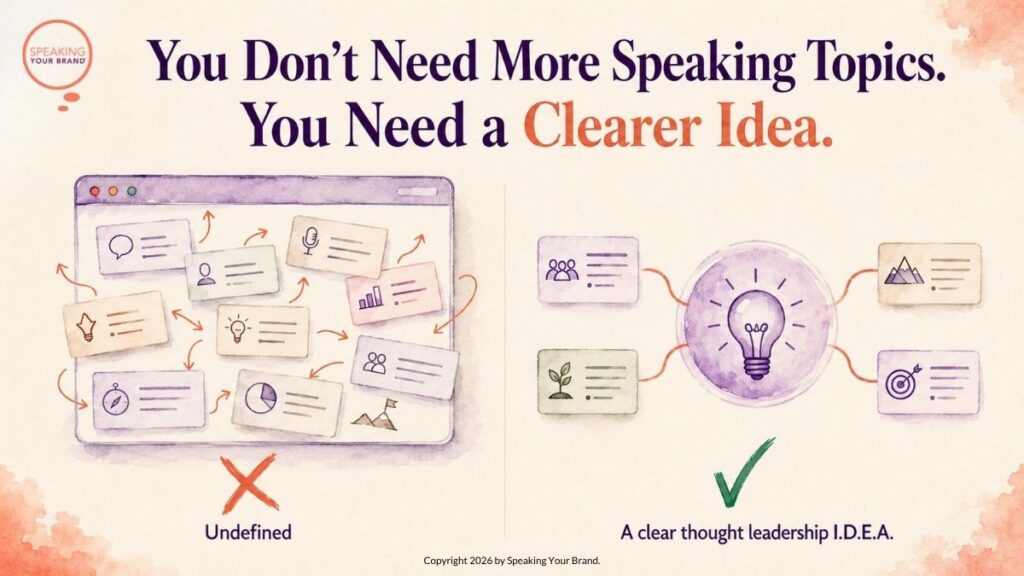
They have dozens of stories, frameworks, examples, client experiences, and ideas swirling around in their heads. They know their work deeply, but they have trouble identifying the throughline that connects everything together.
That’s where the Signature Talk Canvas® comes in.
The framework helps you organize your message into three strategic acts:
Act I: The Problem
This is where you establish:
- What your audience wants
- What challenges they face
- What they believe is getting in their way
- The deeper problem they may not yet see
Act II: The Idea
This is where you introduce:
- Your framework
- Your methodology
- Your perspective
- Your thought leadership
This is not about teaching everything you know.
It’s about helping the audience see the problem differently.
Act III: The Transformation
This is where you help the audience envision what’s possible and guide them toward meaningful action.
The result is a talk that doesn’t simply inform.
It creates clarity, connection, trust, and momentum.
And because the Signature Talk Canvas® is built around your thought leadership, it becomes the foundation for your marketing, content, workshops, podcast interviews, keynotes, and business development efforts.
The Mistake Most Experts Make When They Speak
Many speakers fall into what we call The Expert Trap.
Because they know so much, they feel obligated to teach everything they know.
Their presentations become information dumps.
They provide:
- More tactics
- More checklists
- More frameworks
- More steps
- More worksheets
The audience leaves with pages of notes.
But nothing changes.
Why?
Because information is rarely the thing people are missing.
Today, information is everywhere.
Google provides information.
YouTube provides information.
AI provides information.
What audiences actually want is:
- Clarity
- Perspective
- Validation
- Understanding
- Insight
- Transformation
They want someone who helps them understand themselves better.
They want someone who can explain why they feel stuck.
They want someone who can show them what they cannot currently see.
That’s the role of thought leadership.
The Difference Between Training and Thought Leadership
Many experts accidentally deliver training when they should be delivering thought leadership.
Training answers:
“How do I do this?”
Thought leadership answers:
“Why does this matter?”
Training focuses on process.
Thought leadership focuses on perspective.
Training teaches.
Thought leadership transforms.
If your goal is lead generation, client acquisition, speaking opportunities, or growing your authority, your audience does not need every step.
They need a new way of seeing the problem.
Why Stories Generate More Clients Than Information
One of the most overlooked truths about speaking is this:
People remember stories far longer than they remember tactics.
Stories create emotional connection.
Stories create trust.
Stories create credibility.
Stories help people see themselves in your message.
Many professionals avoid storytelling because they believe audiences only want expertise.
The opposite is often true.
Your expertise gets attention.
Your stories create connection.
And connection creates action.
When you share authentic stories—especially moments of struggle, uncertainty, or growth—you create psychological safety.
Your audience realizes:
“This person understands me.”
That trust becomes the foundation for future business relationships.
How to Get More Leads and Clients From Speaking
Many speakers are surprised when they finish a presentation and hear:
“That was great!”
But then nothing happens.
No consultations.
No clients.
No opportunities.
The reason is often simple.
The audience enjoyed the presentation but never understood how to work with you.
Plant Sales Seeds Throughout the Talk
Instead of waiting until the end to mention your services, naturally weave client examples into your content.
For example:
- Share how a client solved a problem
- Explain what changed
- Describe the outcome
This demonstrates your expertise without becoming sales-focused.
The audience begins connecting the dots themselves.
Use Real Client Stories
Client examples serve multiple purposes:
- Build credibility
- Demonstrate results
- Show your process
- Illustrate transformation
Most importantly, they help audience members envision themselves achieving similar outcomes.
Create One Clear Call to Action
Many speakers overwhelm audiences with multiple options.
Instead, give one clear next step.
Examples include:
- Schedule a consultation
- Join a workshop
- Apply for a program
- Download a resource
The simpler the next step, the more likely people are to take it.
The Power of Audience Engagement
One reason speaking works so well is that audiences actively participate.
When people raise their hands, answer questions, reflect on prompts, or complete exercises, they become invested.
They’re no longer passive listeners.
They’re participants.
That participation creates ownership.
And ownership increases commitment.
Why Your Signature Talk Creates Content for Everything Else
One of the biggest surprises our clients experience is realizing that their signature talk becomes the source material for nearly all of their marketing.
A single signature message can generate:
- Blog posts
- Podcast episodes
- LinkedIn content
- Workshops
- Email sequences
- Lead magnets
- Courses
- Book chapters
Instead of constantly creating from scratch, you create once and repurpose strategically.
This creates consistency across every marketing channel.
It also ensures that your audience hears the same core message repeatedly, which strengthens your positioning and authority.
Why the Signature Talk Canvas® Becomes Your Marketing System
One of the biggest surprises our clients experience is that they don’t just leave with a talk.
They leave with a messaging system.
The same Signature Talk Canvas® can become:
- Website copy
- LinkedIn posts
- Podcast talking points
- Workshop outlines
- Webinar presentations
- Email nurture sequences
- Lead magnets
- Sales conversations
- Book chapters
- Media interviews
We’ve had clients tell us they used the work from their VIP Day to rewrite their website, create a five-part email sequence, redesign their keynote, build an online course, and pitch themselves for speaking opportunities.
That’s because the real deliverable isn’t just a presentation.
It’s a clear thought leadership message.
The Real Goal of Speaking
Many people think the goal of speaking is visibility.
Visibility matters.
But visibility alone is not enough.
The real goal is helping your audience move from:
“I understand what you do”
to
“I understand why I need your help.”
That shift happens when your talk combines:
- Thought leadership
- Storytelling
- Emotional connection
- Strategic structure
- Clear positioning
- A compelling call to action
When those elements come together, speaking stops being just another marketing activity.
It becomes one of the most effective growth tools in your business.
Ready to Create Your Signature Talk?
If you’ve been relying on expertise alone to market your business, you may be working much harder than necessary.
Your audience doesn’t need more information.
They need a clear idea they can believe in.
They need a message that helps them understand themselves differently.
They need a speaker they trust.
That’s what a well-crafted signature talk does.
At Speaking Your Brand®, we help women leaders, entrepreneurs, executives, consultants, physicians, and advocates create the signature message and signature talk they want to be known for.
Inside our Thought Leader Academy, we guide you through our Signature Talk Canvas® process to help you:
- Clarify your thought leadership message
- Identify the throughline that connects your expertise
- Create a compelling signature talk
- Integrate stories that build trust and connection
- Position yourself as a sought-after speaker
- Generate opportunities through speaking
Every client receives a 1:1 VIP Day where we map out your Signature Talk Canvas® together. This is not a “go do the work and report back” program. We work alongside you to shape your ideas, stories, frameworks, methodology, expertise, and vision into a message that audiences remember.
If you’re ready to stop blending in as another expert and become known for a transformative idea, we’d love to talk with you.
Apply for Thought Leader Academy
Schedule a consultation call and let’s explore how we can help you create the message, talk, and platform you want to be known for.
Your idea is ready for a bigger room.