483-Solo-IDEA.mp3: this mp3 audio file was automatically transcribed by Sonix with the best speech-to-text algorithms. This transcript may contain errors.
Carol Cox:
I’ve been looking back at my recent consultation calls, and I’ve noticed the same challenge coming up again and again. The women I’m talking with has years of experience. She has the credentials. She has stories, lessons learned, and several different subjects she could speak about. When I ask her what she wants to speak about, she’ll say something like leadership or resilience or communication or confidence, or women in the workplace. Sometimes she’ll give me several of these and then she’ll say with a sigh, I just don’t know how to bring everything together. Or I’m having a hard time explaining what I do because I feel like there’s so many different pieces and I totally get it. I am the same way. When you’ve had a long career, you’ve done a lot of things. You’ve worked with different people and organizations. You may have changed industries or roles, and you don’t want to leave out something important, and you also are afraid to narrow yourself so that you miss an opportunity. But that’s where the problem comes in. Because if the person you’re talking to can’t explain what you speak about after your conversation is over, she can’t refer you. Which means you can’t get booked. She may think you’re impressive, she may like you. But later, when she’s talking with a colleague who needs a speaker, what is she going to say? Something like, I met this really smart woman who speaks about leadership and communication and resilience and women in the workplace, because there are thousands of speakers who could fit that description.
Carol Cox:
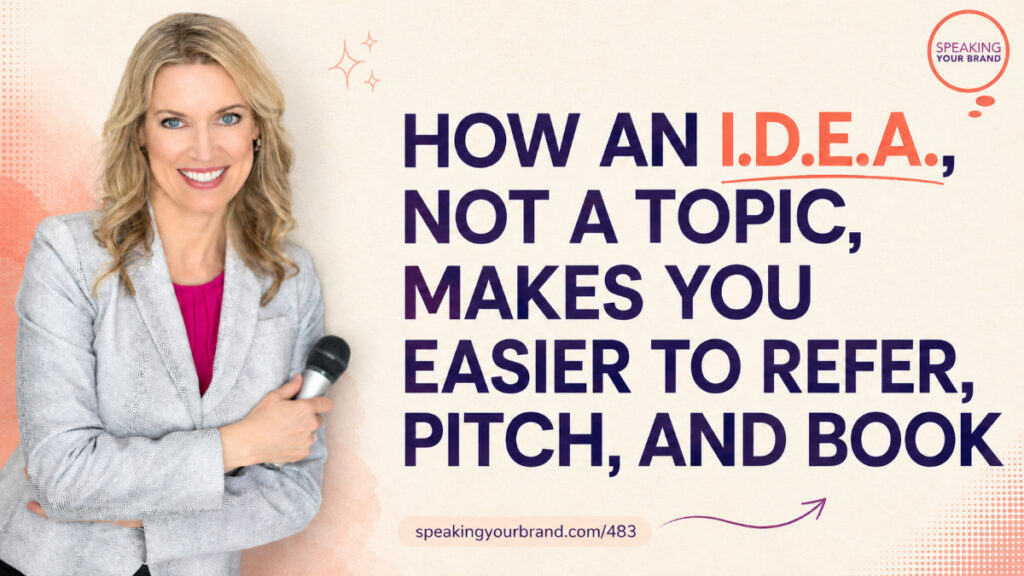
Your name isn’t going to be the one she remembers when the opportunity comes up. This is why you’re speaking. Topic isn’t only a content decision, it’s a positioning decision. It affects whether people can refer you, whether you can write a strong speaker proposal, and whether an event organizer can picture you in front of a specific audience versus another speaker that they’re considering. And this is especially true for paid opportunities. Hi there, and welcome to the Speaking Your Brand podcast. I’m your host, Carol Cox. Today we’re going to look at the difference between a subject, a topic, and an idea. And I’ll give you what I call the referral test. And then we’ll use my idea framework to help you turn your expertise into something another person can understand, remember, and repeat. Let’s start with these three words because we tend to use them interchangeably. Subject, topic and idea. A subject is the broad area you know something about. I kind of liken it to an umbrella. Your umbrella subject is leadership or health care or communication or organizational culture or organizational change or resilience a topic is a bit more defined. Part of that subject. So maybe your subject is leadership and your topic is leading teams through change or your subject is employee wellbeing in your topic is preventing burnout among high performers? So again, think of your subject as that umbrella. So leadership and your topic is a little bit more defined, such as leading teams through change.
Carol Cox:
And that’s narrower, which is helpful. But an idea goes one step further. An idea makes a claim. It tells us what you have come to believe about that topic because of what you’ve seen, studied, and experienced. Let’s take burnout as an example. How to prevent burnout among high performing employees is a topic a possible idea could be. Burnout isn’t only a resilience problem, it can be a sign that high performers have been given responsibility without enough authority to change the conditions, creating the overload. Now I’m using this as an illustration. If this were your area of expertise, we’d work together to find the language that reflects what you actually have seen and what you can support. But do you hear the difference? The topic tells us what the presentation is about. The idea tells us what the speaker believes. The topic can hold useful information and tips and best practices. The idea gives those things a through line. It gives the audience a narrative journey of where they are, to where they want to go. Your expertise and your credentials are absolutely important. They are the foundation for what you’re doing, but they can’t and they won’t do the whole job. Your credentials tell an event organizer that you’re qualified. Your experience gives you stories and evidence and examples, but neither one automatically gives you distinctive positioning. Here’s a simple test you can do. Imagine you meet someone at a conference or on a Zoom call, or through a mutual connection.
Carol Cox:
You have a good conversation and you tell her about your speaking. The next day, she’s talking with an event organizer who needs someone for an upcoming program. Can she explain what you speak about in one clear sentence? Not repeat your entire bio? Not all the services that you offer. Just enough that the other person thinks, yeah, that sounds relevant. Tell me more about her. That’s the referral test. If all she can say is she speaks about leadership, your topic is still too broad. If she says she speaks about leadership, communication, resilience, and change, giving her more words hasn’t made the referral easier. It has made her work harder to figure out where you fit a stronger referral might sound like that colleague saying you should talk to her. She helps senior leaders see why burnout among high performers may be an authority problem, not only a resilience problem, and what organizations can change before those employees leave. Now the organizer can begin to picture an audience. She can imagine the leadership conference, the healthcare organization, the association meeting, or the internal program focused on retention and culture. The sentence doesn’t have to explain everything you know, it just needs to open the right door. This is also why broad positioning costs you opportunities you may never know that you lost. Most referrals happen in conversations where you aren’t even present. No one contacts you to say, well, I almost referred you, but I couldn’t remember how to describe what you do.
Carol Cox:
The referral instead simply stalls. So ask someone who knows your work. If you were going to refer me as a speaker, what would you say? And then listen. If she repeats a clear idea, that’s useful information. If she gives you a long list of topics or key words, that’s useful information too. If your current answer is too broad, the solution isn’t to choose a random niche because someone told you that you need one. We’re looking for the tension, the belief, the counterintuitive observation inside your experience and your expertise. This is one of the things I listen for when I’m working with a client in a VIP day. She’s answering my questions, and a lot of these key words will pop up. Leadership, culture, communication, and resilience. So I’m listening to all of these key words, but I’m also paying attention to the things she says almost in passing. She may say something like, everyone assumes the communication broke down. But what actually happened was that no one knew who had the authority to make the decision. And then I say, hold on. Say more about that. That sentence may be much more interesting than the topic she came in prepared to discuss. I’m listening for what doesn’t sound like everyone else. I have worked on hundreds of talks with hundreds of clients over the years, so I’ve heard a lot. So I’m listening for what is that thing that sounds different than what everyone else is saying? Where does her energy change? What has she seen that causes her to question the usual explanation? What frustrates her? Because people keep trying to solve the wrong problem? This doesn’t have to be something, she says frequently.
Carol Cox:
In fact, the signal may appear only once because she hasn’t yet realized how important it is. And that’s the part that I love so much about this work. Hearing the signal, reflecting it back and staying with it long enough to discover the idea. Here are three questions you can ask yourself. One. What have I seen repeatedly that other people may be missing? Two what common advice in my field do I believe is incomplete and effective or aimed at the wrong problem? And three what change do I want an audience to make because they heard me speak? These questions move you away from what subjects should I cover and toward what am I willing to be known for saying? Once you have a possible idea, you need to test whether it’s strong enough to build a talk, thought, leadership, and positioning around. This is where my idea framework comes in. And of course, Idea is an acronym because I love acronyms. Idea stands for interesting, debatable and defensible, emotionally resonant and actionable. And I developed this framework through our work with speakers and thought leaders over the years, because a strong idea has to do more than just sound intelligent. It has to earn attention, have a real point of view matter to your audience, and help create some kind of change.
Carol Cox:
Let’s go through the four parts using the burnout example. The I is interesting. Does your idea make someone curious? Leadership is important, is not interesting because it’s too general and everyone already agrees with that. Even burnout is a problem. Doesn’t tell you what you see. That’s different. But when you say that burnout among high performers may be connected to responsibility without authority. Now there’s an angle. The listener wants to know what you mean and whether that dynamic is happening in their organization. Interesting does not mean sensational, but you do need to get specific enough that the audience can see something new. Ask yourself, what is the less obvious observation inside my topic? Where would the right person said, oh, I’ve never thought about it that way. The D in idea stands for Debatable and defensible. Could a thoughtful person disagree with your idea? And can you stand behind it? If no one can disagree, you may have a topic or a theme or general advice, but you may not have a point of view yet. And debatable does not mean argumentative. You’re not there on the stage to have a debate with people in the audience. It means you’re making a claim rather than hiding inside universally agreeable language. And then your idea has to be defensible. What supports it? Your professional experience, client patterns, research data, or personal story? This is where your expertise and credentials come in. They provide the receipts behind the idea.
Carol Cox:
But notice the order. The credentials support the claim. They aren’t the claim itself. For many women, this is the uncomfortable part. We’ve been rewarded for knowing the answer, presenting all sides, being prepared and making sure our work is beyond reproach. It can feel much safer and frankly, much easier to say. Here are five best practices for preventing burnout than to say, I believe we’re diagnosing part of this problem incorrectly. But that second sentence is the one people can remember and repeat. The e. An idea is for emotionally resonant. Does the audience recognize herself and the stakes in your idea? You can have an interesting well, support a claim and still leave the listener thinking, okay, but why does this matter to me? You want your audience to. Not only intellectually understand your idea, but also to get them to feel it. It’s the combination of the head, the heart, and the body that gets us to want to change, to recognize ourselves and to see that there’s a better way. In the burnout example, the emotional resonance could come from you sharing your own personal story of how you yourself were a high performer and realize that it was this idea of authority that was causing the burnout. I know it can feel uncomfortable to share deeply personal stories, especially in, say, more corporate or what we call a professional environment on a stage or in a workshop or even in a podcast interview. But that is what is going to connect your audience to you, to see themselves in your story, and to know that they’re not alone, that you too have experienced this.
Carol Cox:
And that is what makes it much more likely for you to be referred and booked. Finally, the A in idea stands for actionable. What can the audience see, decide, ask, or do differently based on what they heard? Actionable does not mean putting 20 tips at the end of your talk. Giving your audience a whole big to do list is not going to help them. Instead, focus on one meaningful shift. Maybe the action is for leaders to examine where employees have accountability without decision making authority. Maybe it’s to stop treating every burnout conversation as an individual time management problem. Maybe it’s to ask a different question before adding another wellness benefit. The action you recommend, or the action that the audience could take should grow out of your idea. This is what makes the idea acronym framework useful for your positioning as well as your content. If your message is interesting. People lean in if it’s debatable and defensible. They know what you stand for and why they should trust you. If it’s emotionally resonant, they know that you have been in their place, too. And if it’s actionable, they can picture the outcome of bringing you into the room. This makes it so much easier for them to refer you, pitch you, and book you. Let’s look at this now from the event organizers point of view, an organizer isn’t only asking, is she knowledgeable? That’s probably a given nowadays.
Carol Cox:
What she’s trying to do is make a match between the speaker, the audience, and the need. She needs to understand who the talk is for, what problem is already present for that audience, what the speaker will help them to see differently, and what the audience will be able to do as a result. If your pitch says that you speak about leadership, communication, resilience and transformation for organizations that want better results, the organizer has to do too much work. Which audience? What kind of leadership challenge? Why this talk now? How is it different from other leadership speakers in her inbox? Compare that with this. I speak to senior leaders who are trying to retain high performing employees. My talk shows them why burnout may be connected to responsibility without authority, and helps them identify where their systems are creating overload that individual resilience training can’t fix. Wow. Now that is a claim. It’s specific. It’s debatable and defensible. It’s interesting and it’s actionable. Now the event organizer can picture the audience. She understands the tension. She hears the point of view and she has a sense of the outcome in your pitch. You definitely still should include your credibility markers, your bio, your stories in a clear description of the talk. But now those elements support a recognizable idea instead of sitting beside a broad topic. Here is something that you can do. Write down the subjects and the topics in the keywords you currently use to describe your speaking.
Carol Cox:
Then complete this sentence. I speak to specific audience about why the usual assumption is incomplete and what they can see or do differently, so that they get this meaningful outcome. Now, don’t worry about making it clever. Use the words you actually say. Then run this sentence, your idea through the idea framework. Is it interesting enough to create curiosity? Is it debatable and defensible? Will the intended audience feel why it matters? And does it change something they can see, decide, or do? Finally, give that sentence to someone you trust. Don’t explain it for five minutes. First, let her read it or hear it once, and then ask her to tell you what she would say if she were referring you to an event organizer. Pay attention to what she remembers. The words she repeats may show you where the idea is already strong. The places where she becomes vague shows you what still needs to be clarified or tightened. Before a consultation call, I will look at the person’s website, and a lot of the time they do have a speaker page already on there, and I’ll look at the list of topics and sometimes they’ll have 3 or 5 topics. Sometimes they’ll have 10 or 20 different topics. You don’t need an exhaustive list of every single topic that an event organizer could possibly book you for What you do need is the idea that brings your experience together, gives the right audience a reason to care, and gives other people language they can use when you’re not in the room.
Carol Cox:
This is the work we do here at Speaking Your Brand. We don’t simply help you choose a topic or organize your slides, or give you a speech formula for you to fill in. We work with you one on one to uncover the idea you should be known for. Identify the audiences that most need to hear from you. Shape it into a complete signature talk and develop the positioning that makes you easier to refer and book. And if you recognize yourself in this episode, if you have several topics, you’re not sure how to bring everything together or you’re having trouble explaining what you do, come talk to us. You can schedule a consultation call with us by going to speaking yourbrand.com/contact, and you can learn about our Thought Leader Academy, which is our comprehensive program at speaking yourbrand.com/academy. This program includes a one on one VIP day where we uncover your thought leadership message and map your signature talk, along with small group coaching that helps you refined it and package and position yourself as the speaker who can get referred, booked, and paid. Our mission at Speaking Your Brand is to amplify women’s voices and advance gender equality through public speaking and thought leadership. For your ideas to travel, other people need to be able to understand them, remember them, and repeat them. Your experience makes you credible. Your idea makes you different. Until next time. Thanks for listening.
About this transcript
This transcript comes from Sonix AI transcription, using automated English transcription and mp3 transcription to turn recordings into text you can edit, search, and share. See the best transcription software guide for details.
Transcript accuracy starts with the recording itself: verbatim transcription and how to record better audio cover the practical steps, while how to remove background noise explains how accuracy is actually measured.
Try Sonix free — 30 minutes of free transcription, no credit card required. Or review our pricing first.