The Expert Trap: Why Smart, Capable Speakers Stay Stuck Giving Useful Talks That Don’t Lead to Bigger Opportunities
If you’ve ever given a presentation and gotten great feedback – “That was so valuable,” “I learned so much,” “I wish we had more time” – but then nothing really happened afterward, you may be caught in what I call the Expert Trap.
The Expert Trap is what happens when your expertise becomes the place you hide.
You’re prepared. You’re thoughtful. You’re credible. You know your material. You may even be the smartest person in the room.
But your talk is still not leading to the bigger stages, better referrals, paid speaking opportunities, clients, or thought leadership visibility you want.
That’s not because you need more expertise.
It’s because the audience is hearing what you know, but not necessarily what you believe.
In this four-part podcast series, I unpack the Expert Trap from several angles: why it happens, how AI can intensify it, what it looks like in a real client story, and what you may be saying yes to that keeps you stuck in expert mode.
The goal is not to become less expert.
Please keep your expertise. Your audience needs it. Your clients need it. Your field needs it.
The shift is from using expertise to prove you belong to using expertise as the evidence behind your point of view.
That is where thought leadership begins.
Part 1: What The Expert Trap Is
Podcast Ep. 478: The Expert Trap: Why Great Speakers Don’t Become Thought Leaders
The first step is recognizing the pattern.
The Expert Trap often looks like a good presentation. That’s what makes it hard to notice.
The audience takes notes. The event organizer thanks you. People tell you the content was useful. You feel like the talk went well.
And it may have gone well.
But helpful content and thought leadership are not the same thing.
Helpful content gets people nodding.
Thought leadership gets people recognizing themselves.
In this episode, I share three signs that you may be in the Expert Trap:
- You’re trying to transfer your expertise instead of your perspective.
You bring the worksheet, the framework, the checklist, the client example, and the research. None of that is wrong. But if the audience can’t find the one idea they are supposed to carry with them, the talk may still be staying in expert mode. - Your talk has information, but not a clear throughline.
Your audience may be walking through the storage room of your expertise. There are shelves everywhere: frameworks, research, stories, caveats, examples. Some of it is useful, but the audience is trying to figure out where you’re taking them. - The audience hears what you know, but not what you believe.
A talk can be accurate, helpful, and well-delivered, but still not have a real point of view. If no one could reasonably disagree with what you’re saying, you may be giving advice, not thought leadership.
Action Step
Look at your current talk or presentation and ask:
If someone recommended this talk tomorrow, would they say, “She gave us a lot of great tips,” or “She helped me see something I hadn’t been able to see before”?
That one question can tell you a lot.
Part 2: How AI Can Intensify The Expert Trap
Podcast Ep. 479: 3 Ways AI Can Hurt Your Public Speaking, and 3 Ways It Can Help
AI can be incredibly useful.
I use AI. I have a background in software development. I’ve built AI workflows inside Speaking Your Brand. I use ChatGPT and Claude regularly.
But when it comes to your thought leadership, your signature message, and your presentations, AI can also intensify the Expert Trap.
Why?
Because AI is very good at making you sound polished.
It can summarize your expertise. It can generate outlines. It can give you ten titles, five frameworks, and twenty ways to phrase an idea before your coffee is cool enough to drink.
What it cannot do is tell you which idea is really yours.
That is the deeper problem many speakers are facing now. The hard part is not getting more words. The hard part is knowing which idea is worth building a platform around.
In this episode, I share three things to be careful about when using AI for your talks and presentations:
- AI looks for what is obvious. Thought leadership often lives in what is not obvious yet.
In one VIP Day, a client’s signature message emerged from a question about the name of her business. That signal was not the most repeated phrase in her materials. It was the detail that opened up the larger meaning. - AI can strip out your personality.
A client sent me a script and an audio run-through for an important talk. The words were fine, but her personality was gone. Once she set the AI-polished script aside and returned to her own outline, her voice, humor, and energy came back. - AI can create endless unfinished ideas.
If you have folders full of AI-generated outlines, drafts, and chat threads that sounded great at the time but never turned into anything concrete, you are not alone. AI creates options. It does not create discernment.
AI is most useful after the core message is clear.
Use it for slide graphics, audience activities, and analyzing a call for speakers. Be careful using it to draft your actual speaker proposal, TEDx application, or spoken script.
The imperfection of your real words may be what helps you stand out.
Action Step
Pull up one AI-generated outline, proposal, or talk draft and ask:
Is this helping me say what I actually believe, or is it making me sound like a polished version of everyone else in my field?
If the answer is the second one, go back to your own words first.
Part 3: What Escaping The Expert Trap Looks Like In Real Life
The shift from expert to thought leader is easier to understand when you hear it in a real client story.
This is why client examples matter so much.
The Expert Trap is not theoretical. It shows up in the way a speaker chooses her topic, frames her stories, names her audience’s problem, and decides what she is willing to stand behind.
For many women, the first version of the talk is useful but narrow.
It teaches what they know.
It gives the audience practical takeaways.
It may even get good feedback.
But the talk becomes much stronger when the speaker stops asking, “How do I explain what I know?” and starts asking, “What do I want this audience to see differently because of me?”
That shift changes the talk.
The methodology becomes evidence.
The client stories become proof.
The framework becomes the container.
But the message leads.
That is the difference between an expert presentation and a thought leadership talk.
Action Step
Look at your current talk and ask:
Am I teaching people how to do what I do, or am I helping them see what I see?
Both can be useful. But if you want to be remembered, referred, and booked, your audience needs more than your process. They need your perspective.
Part 4: What You’re Saying Yes To That Keeps You In The Expert Trap
The final episode in the series brings the Expert Trap down to a practical and personal level.
Because most of the time, we don’t stay in the Expert Trap because we’re making obviously bad choices.
We stay there because we’re saying yes to things that look generous, responsible, and strategic.
We add the extra slide because the audience may need the context.
We keep the title broad because the event organizer asked for something general.
We soften the claim because we can imagine the person who might disagree.
Each one of those decisions can make sense in the moment.
But together, they can keep the talk full, safe, and forgettable.
In this episode, I talk about three things you may be saying yes to:
- Saying yes to more content.
On the surface, this looks like being helpful. Underneath, it may be the fear that if you don’t include enough, someone will question whether you belong in the room. - Saying yes to neutrality.
On the surface, this looks like being balanced and thoughtful. Underneath, it may be the fear of being criticized for having a real point of view. - Saying yes to the wrong room.
On the surface, this looks like being grateful for an invitation. Underneath, it may be the desire to feel validated, even if the room is making your message more generic.
This is where imposter syndrome often shows up.
It’s one thing to be the helpful expert.
It’s another thing to become the person associated with a point of view.
That can feel more exposed.
But that exposure is often the doorway into thought leadership.
Action Step
Find one place in your talk, speaker proposal, or workshop outline where you are trying to prove that you’re qualified.
Then replace one proof sentence with one belief sentence.
For example:
Proof sentence: “I have 20 years of experience helping leaders communicate more effectively.”
Belief sentence: “Most leadership communication problems are actually trust problems.”
Your proof matters. Keep it. But let it support the belief.
That is the shift out of the Expert Trap.
The Big Picture: From Expert To Thought Leader
The Expert Trap is not a skill gap.
It’s an identity shift.
You are not moving from “not enough” to “expert.”
You are moving from expert to thought leader.
That means your expertise is no longer the thing you’re trying to prove.
It becomes the evidence behind your message.
Your framework supports the message.
Your stories support the message.
Your research supports the message.
Your credentials support the message.
But the message has to lead.
This is especially important now, in a world where AI can generate content that sounds smart in seconds. Sounding smart is no longer the differentiator it used to be.
Your point of view is.
So if your talks are useful but not leading to the invitations, referrals, clients, or visibility you want, ask yourself:
- What idea do I want to be known for?
- What do I believe that my audience needs to hear?
- What do I keep seeing people in my field get wrong?
- What story helps me show why this matters?
- What am I still trying to prove?
- What would change if I stopped proving and started leading?
Those are the questions that move you from expert presenter to thought leader.
Your Next Step
If this series made you recognize yourself, take the Speaker Archetype Quiz.
You’ll discover which of the four speaker archetypes you are:
- Stellar Scholar
- Spellbinding Storyteller
- Fabulous Facilitator
- Provocative Performer
Each archetype has real gifts. Each one also has a ceiling. The quiz will help you see how you naturally show up as a speaker, what strengths you can trust, and where the Expert Trap may be showing up for you.
Take the free Speaker Archetype Quiz: https://www.speakingyourbrand.com/quiz/
Ready To Go Further?
If you’re ready to move from proving what you know to becoming known for what you believe, Speaking Your Brand can help.
Our work helps women entrepreneurs, consultants, executives, and subject-matter experts uncover their thought leadership message, shape it into a signature talk, and use speaking to create more visibility, influence, income, and impact.
Explore the next step that’s right for you:
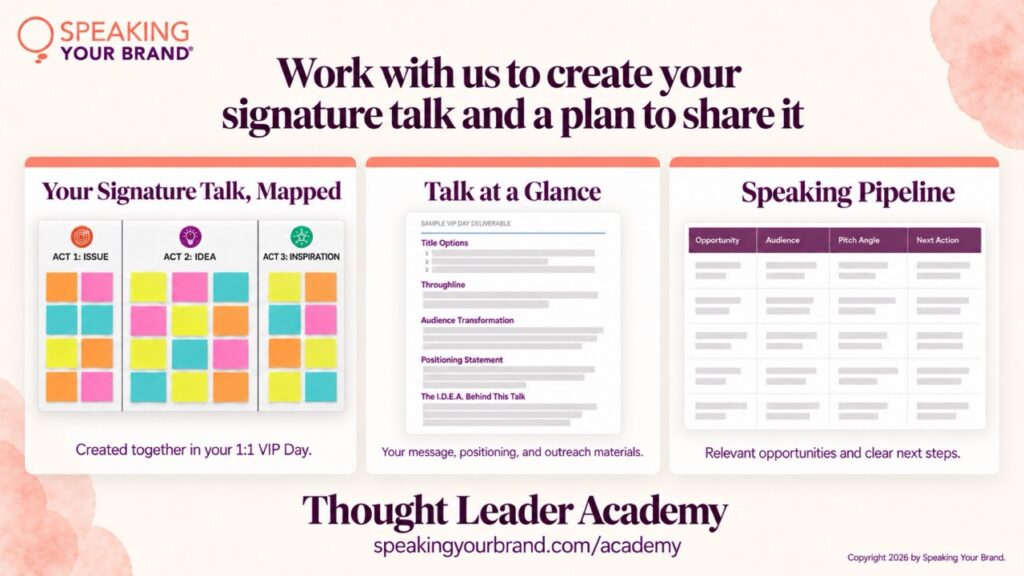
 Thought Leader Academy – Our flagship online program to help you craft your signature talk, escape the expert trap, and build your thought leadership platform.
 Orlando Speaking Accelerator Workshop – A 1-day, in-person experience where you’ll create your signature talk, get personalized coaching, and leave with the clarity and confidence to own the stage.