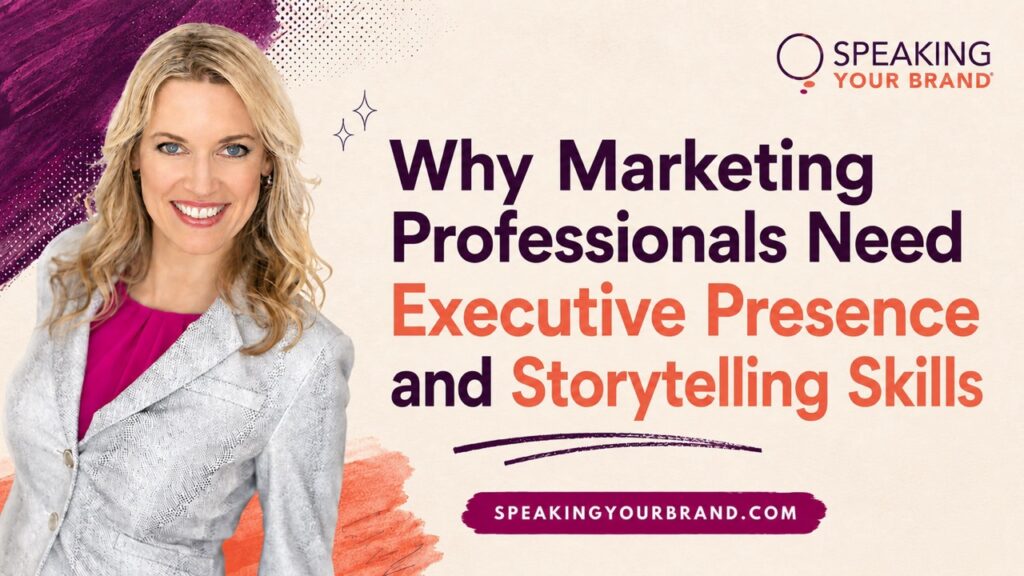
Why Marketing Professionals Need Executive Presence and Storytelling Skills
Marketing professionals are exceptional communicators—or at least that’s what everyone assumes.
After all, marketers spend their days crafting messaging, building campaigns, telling brand stories, and persuading customers.
So why do so many marketing teams struggle when it’s time to present their own ideas?
Over the past year, I’ve had the opportunity to work with corporate marketing teams on exactly this challenge. While they excel at communicating externally, many discover that communicating internally—and influencing decision-makers—is an entirely different skill.
Whether you’re presenting a new campaign to executives, pitching ideas to clients, or collaborating with cross-functional teams, your ability to communicate with confidence and clarity often matters just as much as the quality of the idea itself.
Great Ideas Don’t Speak for Themselves
One of the biggest misconceptions I see is that the best ideas naturally rise to the top.
They don’t.
The ideas that receive funding, executive support, and organizational momentum are usually the ones that are communicated most effectively.
Marketing professionals are constantly asked to:
- Present campaign recommendations to executive leadership
- Explain the strategy behind creative decisions
- Gain buy-in for budgets and resources
- Influence stakeholders across departments
- Present to clients with confidence
- Build consensus among diverse teams
Technical expertise isn’t enough.
Communication becomes a leadership skill.
The Expert Trap
Many marketers fall into what I call the Expert Trap.
Because they know their work so well, they naturally want to explain every detail, every data point, every research finding, and every step of the strategy.
The result?
Presentations become information-heavy instead of influence-driven.
Instead of helping people quickly understand why an idea matters, presenters overwhelm their audience with everything they know.
Ironically, the more expertise someone has, the more likely this becomes.
Executive presence isn’t about sounding smarter.
It’s about making complex ideas easy to understand, memorable, and actionable.
Executive Presence Is More Than Confidence
When people hear “executive presence,” they often think about posture, eye contact, or eliminating filler words.
Those skills certainly help.
But they’re only part of the equation.
Real executive presence comes from communicating with intention.
It means:
- organizing ideas clearly
- leading people through a compelling narrative
- speaking with confidence instead of relying on scripts
- anticipating audience questions
- connecting facts to business outcomes
- making recommendations that inspire action
When your message is structured well, your confidence naturally increases.
You’re no longer trying to remember what to say next.
You’re guiding your audience through a conversation.
Storytelling Isn’t Just for Keynote Speakers
One of the biggest myths about storytelling is that it belongs on conference stages.
In reality, storytelling is one of the most practical business skills a marketing professional can develop.
Storytelling helps you:
- introduce a campaign strategy
- explain customer insights
- communicate market trends
- present research findings
- recommend budget increases
- persuade executives to invest in new initiatives
A well-told business story creates context.
Instead of simply sharing information, you help your audience understand why it matters.
That’s how people remember your message—and why they support it.
Cross-Functional Influence Requires Better Communication
Marketing rarely works in isolation.
Successful campaigns require collaboration with:
- Sales
- Product
- Finance
- Operations
- Legal
- Customer Success
- Executive Leadership
Each group has different priorities.
The ability to adapt your message while maintaining clarity is one of the defining characteristics of influential marketing leaders.
The professionals who earn the most trust inside organizations aren’t necessarily the loudest voices.
They’re the ones who consistently communicate ideas in ways that make other people want to participate.
Getting Buy-In Is a Communication Skill
I’ve worked with many accomplished professionals who believed their biggest challenge was improving presentation skills.
What they actually needed was a better communication framework.
When you understand how to structure your message around your audience instead of your expertise, everything changes.
Meetings become more productive.
Presentations become more persuasive.
Stakeholders ask better questions.
Conversations become collaborative instead of defensive.
Buy-in becomes much easier because people understand not only what you’re recommending—but why it matters.
How We Help Marketing Teams
At Speaking Your Brand®, our executive presence and communication workshops are designed specifically for professionals who need to influence through ideas.
Our interactive workshops help participants:
- Present campaign ideas with greater confidence
- Structure presentations for executive audiences
- Use storytelling to increase clarity and influence
- Communicate more effectively with clients
- Build stronger cross-functional relationships
- Speak with executive presence in both virtual and in-person settings
- Reduce reliance on scripts and slide-heavy presentations
- Practice new communication techniques in a supportive environment
Participants don’t just learn communication principles—they apply them immediately through interactive exercises, coaching, and real-world scenarios.
Communication Is a Competitive Advantage
Marketing is evolving rapidly.
AI can help generate content, analyze data, and even draft presentations.
But it can’t replace the human ability to influence a room, earn trust, facilitate meaningful conversations, or inspire people to act.
That’s why executive presence, storytelling, and strategic communication have become some of the most valuable leadership skills marketing professionals can develop.
The marketers who stand out in the years ahead won’t simply have the best ideas.
They’ll be the ones who communicate those ideas in ways that inspire confidence, build alignment, and move organizations forward.
Looking for an Executive Presence Workshop for Your Marketing Team?
If your marketing team wants to improve executive presence, storytelling, presentation skills, and cross-functional communication, Speaking Your Brand® offers customized interactive workshops for corporate teams—both in person and virtually.
Together, we’ll help your team turn great ideas into presentations that influence decisions, build trust, and drive action.