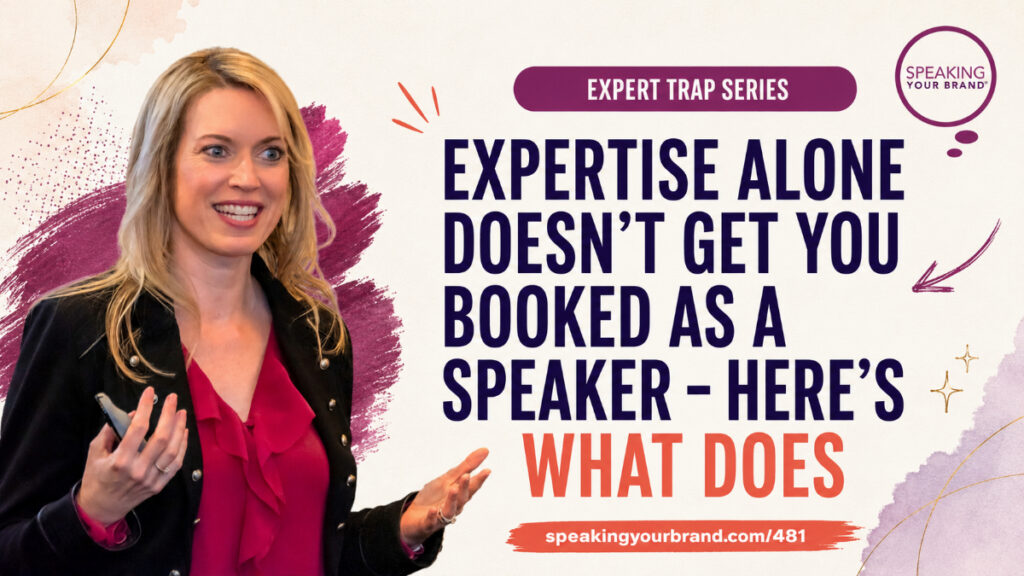
Expertise Alone Doesn’t Get You Booked as a Speaker – Here’s What Does: Podcast Ep. 481
You finish your presentation and people come up to tell you how valuable it was.
They say, “You really know your stuff.” The event organizer thanks you. You may even get great feedback on the evaluation forms.
But then nothing happens.
No one contacts you about another speaking opportunity. You don’t get the referrals you expected. The event organizer doesn’t immediately think of you when someone asks for a speaker six months later.
This can be confusing, especially when you know you delivered a substantive, well-prepared talk.
Here’s the thing: Liking you and booking you are not the same thing.
Expertise helps people trust you. But to get booked as a speaker, you also need a clear point of view, a message people can repeat, and a strong association between you and the conversation you’re there to lead.
People need to be able to say, “You need to hear her speak about this.”
Not only, “She gave us a lot of good information.”
That difference is at the heart of what I call the Expert Trap.
What Is the Expert Trap?
The Expert Trap happens when your expertise becomes the place where you hide.
Your knowledge feels comfortable. It feels validating. It gives you a sense of safety when you’re presenting because you know you can answer the questions, cite the research, and explain the nuances.
And none of that is bad. Your expertise matters. Your credentials, experience, research, and client results should absolutely be part of your speaking.
The problem is when you use your expertise to protect yourself instead of using it to lead your audience.
The Expert Trap may look like:
- Adding more content to make sure people know you’re qualified
- Staying neutral so no one can criticize your perspective
- Accepting speaking opportunities that require you to dilute your message
- Sharing best practices without revealing what you believe
- Giving the audience so much information that they can’t identify the central idea
This isn’t only a content problem. It’s also an identity problem.
Underneath the extra slides, neutral language, and broadly useful topics may be a quieter question: Who do I believe I’m allowed to be in this room?
Am I here to be the expert no one can question? Or am I willing to be the thought leader who helps the audience see something differently?
That identity shift has a direct impact on your bookability.
What Actually Helps You Get Booked as a Speaker?
To get booked and referred as a speaker, you need more than expertise. You need:
- A distinct and defensible point of view
- A message the audience can easily remember and repeat
- A clear connection between your expertise and the problem you help solve
- Speaking opportunities that strengthen what you want to be known for
- The willingness to leave good information out so your central idea can stand out
Your expertise establishes your credibility. Your point of view makes your idea travel.
Let’s look at three choices that may be keeping you in the Expert Trap—and what you can do instead.
1. You Keep Saying Yes to More Content
This is the classic Expert Trap move.
You have a framework, and then you add the definitions. You have three main points, but then you realize there are two more things the audience really should know.
You have a useful client story, so you add more background and case-study details. The event organizer gives you 25 minutes, and your instinct is to keep the 45-minute presentation and talk faster.
I understand why we do this.
When you know your subject well, everything can feel important. If you value substance, leaving something out can even feel irresponsible.
You may find yourself thinking:
What if the audience needs this information? What if they don’t understand the nuance? What if someone in the room knows this field and thinks I don’t know what I’m talking about?
That last question is often the one underneath all the others.
More content becomes a form of armor. It’s a way of saying, “If I include enough, no one can question whether I belong here.”
Of course, sometimes an audience genuinely needs additional context, research, or examples. The goal isn’t to make every presentation shorter or thinner.
The goal is to understand the job each piece of content is doing.
Ask Yourself: What Job Is This Content Doing?
As you review your presentation, don’t only ask, “Is this good information?”
It probably is.
Instead, ask:
Is this content helping the audience follow the journey, or is it helping me feel safer because I’ve demonstrated how much I know?
Those are two very different jobs.
Your audience cannot absorb your 10, 20, or 30 years of expertise during a 30-minute presentation. What they can remember is the way you helped them see themselves, their work, or their problem differently.
The thought leader version of you doesn’t need to prove everything in the room. Your job is to lead the audience somewhere.
Sometimes that means leaving excellent material out.
The Cost of Too Much Content
When your talk contains too much information, the audience may leave feeling impressed. They may even say, “My brain is so full.”
But can they repeat your central idea?
If they can’t repeat it, they can’t refer it.
They can’t tell a colleague, “You need to bring her in because she helped us understand this problem in a completely different way.”
Expertise builds trust. A clear idea gives people something to carry out of the room.
2. You Keep Saying Yes to Neutrality
I’m not saying every speaker needs a controversial opinion or a manufactured hot take.
Your audience can tell when you’re performing a point of view you don’t actually believe.
What I mean by neutrality is keeping your presentation in safe territory because taking a stand feels too exposed.
It’s one thing to say, “Here are some communication best practices for leaders.” That can be useful, practical content.
It’s another thing to say, “The way leaders communicate reveals whether they actually trust the people they’re leading.”
Now you’re making a claim.
The first version tells the audience what to do. The second helps them reconsider how they think.
That’s the shift from presenting information to expressing thought leadership.
Why Taking a Stand Can Feel Uncomfortable
For many women, this is where imposter syndrome appears.
We’ve been rewarded for being prepared, balanced, generous, pleasant, and careful. We’ve learned that knowing the material—and not making anyone uncomfortable—helps us feel safe in the room.
Thought leadership asks something different of us.
It asks us to say what we believe.
You may worry about being seen as too opinionated. You may feel a little unease when you write the stronger sentence. You may immediately want to soften it with qualifications and disclaimers.
That discomfort doesn’t necessarily mean your idea is wrong. It may mean you’re getting closer to the idea you actually want to be known for.
Your claim should still be grounded in your expertise, evidence, experience, and observations. A point of view isn’t something you invent simply to sound different.
But you also shouldn’t confuse the discomfort of being visible with a sign that you need to retreat into neutrality.
How to Find Your Point of View
Look at your talk and ask:
- Could any competent person in my field say this?
- What do I believe people in my industry are getting wrong?
- Which accepted best practice doesn’t work for everyone?
- What have I observed repeatedly in my work?
- What do I want my audience to finally understand?
- Where am I staying neutral because I don’t want to be criticized?
Your point of view often lives in the places where your experience, judgment, and beliefs intersect.
It isn’t only what you know. It’s what you’ve concluded because of what you know.
The Cost of Staying Neutral
If you never make a clear claim, your audience may agree with everything you say.
They may find your presentation useful. But they may not have a sentence they associate with you afterward.
That makes it much harder for them to remember, refer, or book you.
You don’t need everyone to agree with every word. You need the right people to understand what conversation you’re here to lead.
3. You Keep Saying Yes to the Wrong Room
There are times when saying yes to many speaking opportunities makes sense.
When you’re earlier in your speaking journey, you need the reps. You need to test your material, learn what resonates, and discover which audiences energize you.
I did this during the early years of Speaking Your Brand.
I once spoke to a small group of entrepreneurs who were outside my usual audience. I knew it probably wouldn’t lead to clients, but I wanted the practice and the chance to test my material. The presentation gave me exactly that—and I received a testimonial I still use on my speaker page.
That was the right kind of yes for that point in my business.
But as you become more experienced, you need to become more discerning.
The question shifts from “Can I speak about this?” to “Is this room helping me become known for the work I actually want to be known for?”
Because if you’re an expert, you can probably give helpful tips on many topics. Someone asks you to speak about leadership, confidence, communication, or personal branding, and you can put together a solid presentation.
But the broader the request, the easier it is for your message to get watered down.
The title becomes more generic. Your examples become less specific. Your point of view gets softened because you’re trying to make yourself fit the room.
You Can Help Shape the Speaking Topic
Our speaking coach, Diane Diaz, was once invited to speak to a women’s business group about LinkedIn strategies.
She could have given them a traditional presentation about optimizing their profiles. But the event was a luncheon, not a hands-on LinkedIn workshop. People would be eating and talking with the other women at their tables.
Diane recognized that a tactical LinkedIn training wasn’t the best fit for the setting or the audience.
She spoke with the program organizer and recommended a presentation about personal branding instead. She could still include LinkedIn, but within a larger conversation about the brands these established women had already built and the opportunities they wanted next.
The organizer loved the idea. Diane delivered the presentation, received an incredible response, and we gained three new clients from that event.
She didn’t reject the invitation. She used her expertise and judgment to shape it into a more meaningful conversation.
As a speaker, you often understand the audience and the topic in ways the event organizer doesn’t. You can respect the organizer’s goals while still recommending a stronger angle.
The Cost of the Wrong Speaking Opportunities
The wrong rooms can make you busy without making you known.
You can speak frequently, receive positive feedback, and still struggle to generate better-fit invitations.
If each room requires you to become a more generic version of yourself, your speaking engagements may not compound. The audience still doesn’t know what to associate with you or what distinguishes you from other speakers.
This isn’t about believing you’re too good for certain audiences or stages.
It’s about asking whether an opportunity makes your thought leadership clearer—or pulls you back into being the broadly useful expert.
Before accepting an invitation, ask:
Am I saying yes because this room can help my thought leadership grow, or because being invited makes me feel validated?
There will be times when you say yes because you value the relationship, want the practice, or want to support the organization. That’s fine.
Just be conscious of what kind of yes it is.
The Identity Shift From Expert to Thought Leader
Moving from expert to thought leader doesn’t mean abandoning your expertise.
It means changing what you expect your expertise to do.
The expert says, “Let me prove that I know enough to be here.”
The thought leader says, “Let me use what I know to help this audience see something they haven’t seen before.”
The expert tries to anticipate every possible question.
The thought leader decides which conversation matters most.
The expert looks for validation in being invited.
The thought leader considers whether the invitation supports the idea she wants to lead.
This identity shift can bring up imposter syndrome. You may wonder whether you’re ready to call yourself a thought leader—or whether someone else needs to give you that title first.
No, they don’t.
You can use the term if it resonates with you, or you can leave the label behind. What matters is your willingness to be known for what you believe, not only appreciated for what you know.
Being known is what makes you bookable.
Not famous. Not performative. Bookable in the sense that the right people know exactly what conversation to invite you into.
Try This: Replace a Proof Sentence With a Belief Sentence
Here’s one practical action you can take this week.
Choose one talk, speaker proposal, workshop, or piece of content. Find one sentence you’re using primarily to prove that you’re qualified.
Then replace it with a sentence that expresses what you believe.
A proof sentence might sound like:
I have 20 years of experience helping leaders communicate more effectively.
A belief sentence might sound like:
Most leadership communication problems are actually trust problems.
The proof sentence establishes credibility. The belief sentence creates curiosity.
You still need proof. Your experience, credentials, and client work matter.
But you also need the sentence that makes someone lean in and think, “I want to hear more about that.”
Here’s an example from my own work.
My proof sentence could be:
I’ve worked with hundreds of women on their presentations and speaking skills.
That’s true, and it establishes credibility.
My belief sentence is:
Your audience doesn’t need you to prove everything you know. They need you to help them see what you see.
That’s the thought leadership sentence. It tells an event organizer what kind of conversation I’m there to lead.
A Speaker Bookability Checklist
Before submitting your next speaker proposal or finalizing your presentation, ask:
- What is the one idea I want the audience to remember?
- Could someone easily repeat that idea to a colleague?
- Where am I adding content primarily to prove that I belong?
- Where am I staying neutral because I’m worried about criticism?
- Is my point of view clearly visible?
- Does this opportunity strengthen what I want to be known for?
- What is my proof sentence?
- What is my belief sentence?
- What is staying in expert mode costing me?
That cost may be memorability, referrals, better-fit speaking opportunities, or the chance to become known for the idea you care about most.
The Expert Trap is difficult to recognize because it often looks like preparation, generosity, and professionalism. It looks like being the person who really knows her stuff.
Those are good qualities. But if you want your speaking to lead to more than polite feedback, you need more than expertise.
You need a clear point of view, a message people can repeat, and the willingness to be known for what you believe.
That’s what makes your ideas memorable.
That’s what makes people refer you.
And that’s what helps the right event organizers know when to book you.
Frequently Asked Questions
Why isn’t expertise enough to get booked as a speaker?
Expertise builds credibility, but event organizers also need to understand what makes your perspective distinctive. A speaker becomes easier to book and refer when she has a clear point of view and a message people can remember and repeat.
What makes a speaker memorable?
A memorable speaker helps the audience see themselves, their work, or a familiar problem differently. Audiences are unlikely to remember everything a speaker knows, but they can remember one meaningful idea that changes how they think.
Can having too much content hurt a presentation?
Yes. Too much content can overwhelm the audience and obscure your central message. The goal isn’t to remove substance. It’s to include the content that moves the audience toward the transformation or insight you want them to experience.
How do I develop a point of view for my signature talk?
Start with what you’ve repeatedly observed in your work. Ask what your industry gets wrong, which best practices don’t work for everyone, and what you wish your audience understood. Your strongest point of view will be grounded in your expertise but shaped by your judgment.
Should I accept every speaking opportunity?
Early in your speaking journey, a wide variety of opportunities can help you practice and test your material. As your message becomes clearer, become more selective. Consider whether the audience, topic, and event will strengthen what you want to be known for or require you to dilute it.
What is the difference between an expert and a thought leader?
An expert shares knowledge and demonstrates credibility. A thought leader uses that expertise to express a defensible perspective, challenge assumptions, and help an audience see something differently. Strong speakers need both expertise and thought leadership.
Discover Your Natural Speaking Strengths
If you want to understand the kind of speaker you are, your natural communication strengths, and where you can level up, take our free Speaker Archetype Quiz.
You’ll receive your results right away, along with my recommendations for becoming a more memorable and effective speaker.
If you’d like support developing your signature message, thought leadership, or speaking strategy, learn more about our coaching programs at Speaking Your Brand and schedule a consultation call.