How to Choose the Right Public Speaking Retreat for Women
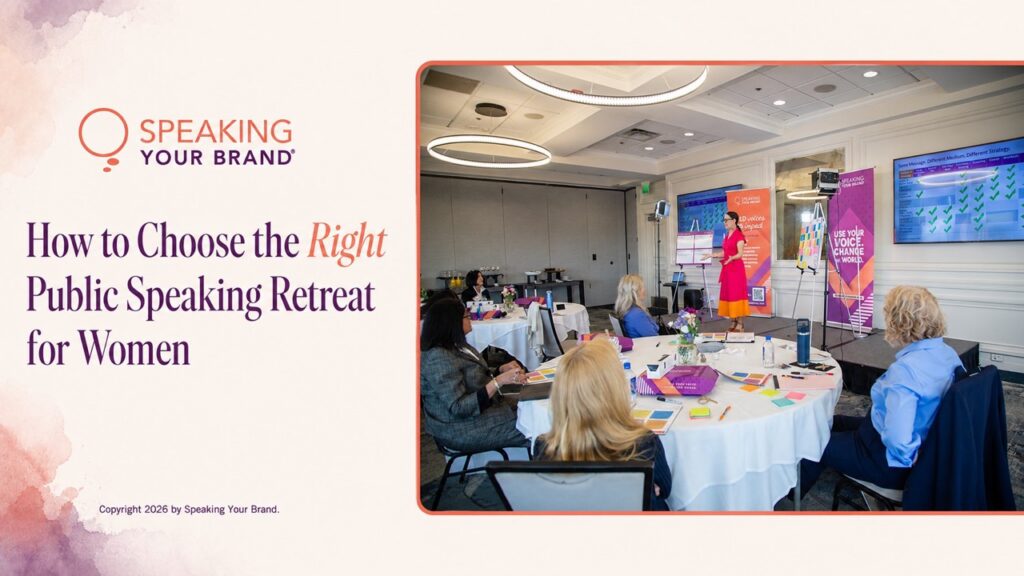
The best public speaking retreat for women should give you more than presentation tips. Look for an experience that includes repeated stage practice, personalized coaching, feedback from a real audience, opportunities to make adjustments and try again, and professional assets that support your speaking goals.
A room full of information can teach you what effective speaking looks like.
A room with a stage, a coach, and people listening can help you become a more effective speaker.
That distinction matters.
You can learn about storytelling from a book. You can watch videos about stage presence. You can ask AI to help you outline a talk. You can practice in your office while your dog looks mildly concerned (your cat won’t even notice).
All of that can be useful.
But speaking is a live experience. At some point, your message needs to leave the page and enter the room.
What Is a Public Speaking Retreat?
A public speaking retreat is an immersive, in-person experience where participants step away from their usual responsibilities to focus on developing and delivering their talks.
Unlike a conference, where much of the experience may involve listening to presentations, a hands-on speaking retreat should give participants significant time to practice.
That may include:
- Refining selected segments of a keynote or TED-style talk
- Practicing storytelling, pacing, movement, and audience interaction
- Receiving individual coaching and feedback
- Repeating material after making an adjustment
- Working in front of a live audience
- Professionally filming selected speaking segments
The word “retreat” can mean many things, so look closely at how the time will actually be spent.
If the schedule is filled primarily with lectures, panels, and networking breaks, you may be attending a conference with a more appealing name.
A speaking retreat should get you speaking.
Who Benefits From a Women’s Speaking Retreat?
A women’s speaking retreat can be especially valuable for entrepreneurs, executives, professionals, consultants, authors, and leaders who already have expertise and want to become more visible through speaking.
You may be ready for this kind of experience if:
- You have a signature or keynote talk or the beginnings of a TED-style idea
- You want to pursue larger or paid speaking opportunities
- You know your material but don’t yet feel natural delivering it
- You have been practicing privately and need feedback from real people
- You want to become more comfortable onstage and on camera
- You need professional speaker assets for your website and outreach
- You value an encouraging room where you can experiment
You do not need to arrive as a perfectly polished professional speaker.
You do need something meaningful to say and a willingness to work on how you say it.
Seven Things to Look for in a Public Speaking Retreat
1. Meaningful Stage Time
Start with the most practical question:
How much time will I actually spend onstage?
If a retreat includes 40, 80, or 200 people, there may not be enough time for everyone to practice more than once.
That single turn at the microphone can be useful, but the real progress often happens on the second or third attempt.
The first time, you discover what isn’t working.
The next time, you get to change it.
Ask whether you will have multiple opportunities to speak and how many participants will share the available stage time.
2. Personalized Coaching
“Be more confident” is not particularly useful feedback.
Neither is “Have more energy.”
Effective speaking coaching should help you identify specific choices you can make:
- Pause after the important line
- Slow down during the emotional turn in the story
- Stop moving when you reach your central idea
- Look at the audience before delivering the next sentence
- Remove an explanation that is burying your point
- Repeat the audience question so everyone can hear it
The best feedback is concrete enough that you can use it immediately.
3. The Chance to Try Again
A retreat should not send you home with a page of suggestions you may or may not use later.
Look for a structure that allows you to receive feedback, make an adjustment, and practice again while the experience is still fresh.
That second attempt turns coaching into evidence.
You don’t have to imagine whether the change will work. You can feel the difference and notice how the audience responds.
4. A Small, Supportive Group
The size and character of the group affect the entire experience.
Speaking involves more than presenting information. You may be testing a personal story, an emerging idea, or a new way of expressing something that matters deeply to you.
That work requires trust.
A small group gives participants more individual attention and more time to learn from one another. You begin to recognize each woman’s message, notice her progress, and understand what she is working to strengthen.
Some of the best breakthroughs also happen between takes—during meals, informal conversations, and the moment when another woman says, “That line right there. Keep that.”
5. Attention to Both Content and Delivery
A compelling talk needs strong material and an effective delivery.
Improving delivery cannot rescue a talk without a clear idea. Refining the words indefinitely will not help if you never practice saying them in front of people.
Look for a retreat that helps you work on both:
- The strength and clarity of the message
- The stories and examples you choose
- The structure of selected speaking segments
- Voice, pacing, pauses, and vocal variety
- Movement and use of the stage
- Emotional connection and audience interaction
The goal is not to memorize a perfect script.
It is to know and trust the material well enough to remain present with the audience.
6. Professional Filming With a Plan
Professional video can be one of the most valuable outcomes of a speaking retreat—but only if the footage is intentionally designed.
A long recording of you speaking behind a lectern may prove you have been onstage. It may not demonstrate your depth and range.
Before filming, you should know which moments you want to capture and why they belong in your speaker reel.
These might include:
- An emotional story
- A moment of humor
- Audience interaction
- A thought-leadership idea
- A teaching segment
- The use of a prop or visual
- A memorable opening or closing
The filming should come after preparation and practice, not before it.
7. Clear Outcomes
Be cautious when a retreat promises vague transformation without explaining what participants will actually do.
A well-designed experience should describe its outcomes concretely.
Will you leave with refined material? More practiced delivery? Specific feedback? Professional photographs? Edited video? A speaker reel?
Make sure you understand what is included and what still needs to be completed after the retreat.
How Is a Speaking Retreat Different From a Conference?
At a conference, the speakers do most of the speaking.
At a speaking retreat, you should.
Conferences can be excellent places to learn, meet people, and hear new ideas. A retreat serves a different purpose.
It gives you time away from your routine to focus closely on your own message and delivery. You are not collecting information for later. You are using what you learn while a coach and audience are still in the room.
You should expect to be on your feet.
You should expect to receive feedback.
You should expect to try something that feels unfamiliar.
You should also expect to enjoy yourself. Serious speaking work and laughter belong in the same room.
Speaking Your Brand® LIVE: An Orlando Speaking Retreat for 12 Women
Speaking Your Brand® LIVE is an intimate, three-day speaking retreat taking place March 9–11, 2027, at the Citrus Club in downtown Orlando, Florida.
The experience is intentionally limited to 12 women.
Over three days, participants will:
- Shape high-impact Signature Stage Segments
- Create a personalized filming plan
- Practice repeatedly onstage
- Receive personalized coaching and feedback
- Make adjustments and try their material again
- Professionally film their strongest speaking segments
- Receive professional photography, video footage, and an edited speaker reel
Breakfast, lunch, and dinner are included on all three days, along with snacks, coffee, tea, water, honest conversation, encouragement, and plenty of laughter.
This is not a conference where you sit in the audience collecting pages of notes.
You’ll be doing the work—in the room, on the stage, and in front of the camera.
Learn more about Speaking Your Brand® LIVE in Orlando.
Frequently Asked Questions
Do I need a completed keynote to attend a speaking retreat?
No. For Speaking Your Brand® LIVE, you should have meaningful ideas and either a signature talk or the beginnings of a TED-style idea. You will focus on selected Signature Stage Segments rather than creating or filming an entire keynote.
Can a speaking retreat help with stage fright?
Repeated practice in a supportive environment can help you become more familiar with your material and more comfortable in front of an audience. The goal is not to guarantee that all nerves disappear. It is to help you know what to do when they appear.
Is a speaking retreat appropriate for experienced speakers?
Yes. Experienced speakers can benefit from feedback, new material, intentional filming, and the opportunity to experiment with aspects of their delivery that may have become habitual.
What should I bring to a public speaking retreat?
Bring the material specified by the organizers, clothing suitable for professional filming, and a willingness to practice. Before attending, confirm the desired length and format of the segments you will develop.
Why attend an in-person retreat instead of practicing online?
Online coaching can be highly effective for developing a message. In-person practice adds the physical experience of using a stage, responding to a live audience, working with movement, and discovering how your material feels in the room.
Your Message Needs More Than Time at Your Desk
You may already have the expertise.
You may already have the idea.
You may even have a talk that reads beautifully on the page.
The next step is to get it on its feet.
Get Our Free Thought Leadership Workbook
You may also like...



Stop Creating Every Presentation from Scratch: Build One Talk You Can Adapt for Any Audience: Podcast Ep. 486