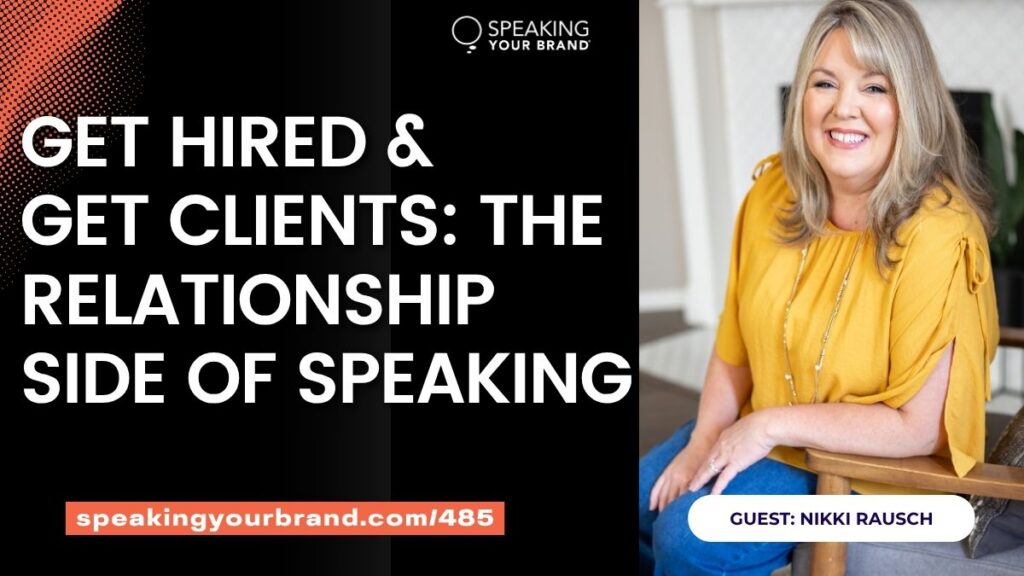
Get Hired, Get Referred, Get Clients: The Relationship Side of Speaking with Nikki Rausch: Podcast Ep. 485
Subscribe to the podcast!


What if the most important sales moments connected to your speaking engagement happen before you step on stage and in the first few minutes after you step off?
My guest, sales strategist Nikki Rausch, has been my go-to coach for sales language, proposals, pricing, consultation calls, and follow-up for years.
In this conversation, we walk through the entire speaking engagement from the first inquiry to the conversations that happen after your talk.
Nikki explains how to make yourself easy for an event organizer to hire, plant sales seeds without turning your presentation into a pitch, and recognize when an audience member is giving you a buying signal.
We also chat about why your job as the speaker begins long before your scheduled presentation time.
In this episode, Nikki and I talk about:
- Why you should answer an event organizer’s question before asking for a call
- How to state your speaker fee clearly and keep the conversation open
- Nikki’s “rapport bank account” and why your presence matters before you reach the stage
- The difference between planting sales seeds and selling from the stage
- How to use client stories and Q&A responses to show people how you help
- What a buying signal sounds like after a presentation
- How to invite someone to buy or schedule a call while her interest is still high
About Our Guest: Nikki Rausch is a sales strategist, speaker, and founder of Sales Maven. With more than 25 years of sales experience and over a decade as a business owner, she teaches service-based entrepreneurs how to have confident sales conversations that lead to yeses, without feeling pushy or fake. As a Master Certified Practitioner of Neuro-Linguistic Programming (NLP), Nikki focuses on the language and communication behind selling. Her approach is rooted in building rapport, recognizing buying signals, and guiding conversations in a way that feels natural for both you and the client. She is the author of three books, including The Selling Staircase, and host of the Sales Maven Podcast, ranked in the top 1% globally. Through her coaching, programs, and speaking, Nikki supports women entrepreneurs in turning sales into a skill they can rely on, so they can grow their business with clarity and confidence.
About Us: The Speaking Your Brand podcast is hosted by Carol Cox. At Speaking Your Brand, we help women entrepreneurs and professionals clarify their brand message and story, create their signature talks, and develop their thought leadership platforms. Our mission is to get more women in positions of influence and power because it’s through women’s stories, voices, and visibility that we challenge the status quo and change existing systems. Check out our coaching programs at https://www.speakingyourbrand.com.
Links:
Show notes at https://www.speakingyourbrand.com/485/
Nikki’s website: https://yoursalesmaven.com/
Get Nikki’s free gift Follow-Up Made Easy Guide: https://yoursalesmaven.com/easyfollowup
Discover your Speaker Archetype by taking our free quiz at https://www.speakingyourbrand.com/quiz/
Enroll in our Thought Leader Academy: https://www.speakingyourbrand.com/academy/
Learn about our Orlando speaking retreat: https://www.speakingyourbrand.com/live/
Connect on LinkedIn:
- Carol Cox = https://www.linkedin.com/in/carolcox
- Nikki Rausch (guest) = https://www.linkedin.com/in/nikkirausch/
Related Podcast Episodes:
- Carol’s episode on Nikki’s Sales Maven podcast: https://yoursalesmaven.com/blog/integrating-both-thought-leadership-and-lead-generation-into-one-talk/
- Episode 133: Authentic Selling at Your Speaking Engagements with Nikki Rausch
- Episode 34: Relationship Selling with Nikki Rausch
- Episode 483: How an I.D.E.A., Not a Topic, Makes You Easier to Refer, Pitch, and Book with Carol Cox
485-SYB-Nikki-Rausch.mp3: Audio automatically transcribed by Sonix
485-SYB-Nikki-Rausch.mp3: this mp3 audio file was automatically transcribed by Sonix with the best speech-to-text algorithms. This transcript may contain errors.
Carol Cox:
How can you make sure that you’re making the most of every speaking engagement that you do, that you’re planting sale seeds with the audience, that you’re converting interested audience members into hot leads and clients as soon as you step off the stage. And even more importantly, what are you doing before you even get to the stage to make sure that the event organizers book you are happy with you and that you are making the most of every single time you go out there and speak? Hi, I’m your host, Carol Cox. Welcome to the Speaking Your Brand podcast. I cannot tell you how thrilled I am to have back as my guest today, sales maven, Nikki Rausch. Nikki and I have known each other since 2017, so over nine years she’s been on this podcast twice before. I’ve linked in the show notes, so check those out. She is my go to coach for anything sales related. I worked with Nikki over the years to help me with understanding how best to position speaking your brand. Everything from proposals to pricing to sales emails, console calls and follow ups. We’re going to touch on a lot of these today specifically related to speaking, but really it applies to any type of selling that you’re doing in your business. Nikki. Welcome back to the podcast.
Nikki Rausch:
Thank you so much for having me back. I feel really honored to get asked back. And for this to be the third time that I’ve been asked. Thank you so much.
Carol Cox:
Well, let’s dive right in. I know that you do quite a bit of speaking and training as well you have throughout your career, and you do that now as the owner of Sales Maven. What have you. Let’s just we’re going to get into the what to do before, during and after speaking engagements. But thinking about through all the speaking that you have done, what are the top lessons that you have learned, that you think have made you such a successful speaker?
Nikki Rausch:
Oh, gosh. Well, I feel like that’s a big question. And what comes to mind is one, really understanding the flow of your presentation, I think is, is important. Um, for me, it isn’t a scripted presentation. Like I have my talking points, the things that I’m going to hit and, and I have been doing this for a long time. So like you get in your rhythm and your flow, but I always want it to feel conversational and I want it to feel that it’s specific to the audience. So it’s not like, oh, well, you could just press play. Whether Nikki’s on this stage or on that stage, it doesn’t really matter because it’s the same thing. I want it to feel personalized. And to me, that comes down to mental presentation, like preparation on my part to really be present in the room, room, room, room, room to, to have made connections in the room and be able to call people like, you know, not call them out like in a like, I’m not calling people out in the carpet or anything like that. But to be able to reference like, oh, I was, I was talking to Sandy earlier and, and then all of a sudden it’s like, then Sandy sits up taller in the room and everybody around her is like, oh, like, how does Nicki, how did Nicki and Sandy know each other? Right. Like, so for me, it’s really about ultimately making connections.
Carol Cox:
Which is no surprise because one of the, I think the very first episode that you were on was called Relationship Selling. That’s what I titled that because you very much are into the relationships. And I think I probably learned that from you because one of the things that I do when I get to, especially at a conference where there’s multiple sessions and you don’t really necessarily know anyone there ahead of time, it’s I’ll get to the room early and some people will trickle in early too. And I’ll go introduce myself and I’ll learn their name, learn a little bit about why they’re there, because I then have smiling faces in the audience when I get up to start, and then I can reference them by name. Oh, I was talking to to Susan before we got started and she mentioned x, y, z. And so I feel like I definitely learned that from you.
Nikki Rausch:
It’s such a credibility builder in the room when you can reference. So, you know, when you’re on stage, people are looking at you like, oh, you’re the expert, you’re, you’re the authority. And you certainly want to present that. But there is also this thing of like, I’m still one of you. Like we’re, we’re all in this together. And I think when people start to feel like in the audience, like the speaker isn’t trying to elevate herself above the audience, like she sees herself as just one of us, that it to me, it starts to create this like collective, you know, that it’s, it’s not you and then us over here. It’s like it’s all of us together and we’re, we’re on this journey together. And that to me feels more connected.
Carol Cox:
I couldn’t agree more. Well, let’s back up and let’s talk about what you what to do before you even get to the stage. And then we’re going to address what to do within the presentation itself and within the room, and then what to do afterwards to make sure that you’re providing value to the audience and to the event organizer who brought you in, but then also that you’re maximizing whatever your goals are for that particular speaking engagement. So let’s, let’s talk start with this scenario. You as a speaker, you get an inquiry into your inbox or a LinkedIn or Instagram DM, and someone, an event organizer has found you and says, we’re looking for a speaker to come in for our event. What’s your budget or are you available? What what should you do next?
Nikki Rausch:
I think one is that you, you should always answer their questions. So in their in your response and you want to include some additional, um, either questions of your own and or an invitation to get on to a live call with you. I think that is really critical. And I feel like this is something that you teach to Carol is the idea is if somebody asks you a direct question and you try to avoid answering it because you want to get on a call with them and you want to do this and you want to do that, you’re not really paying attention to the relationship. When somebody asks you a question, you answer it and you can add to it, but you still have to answer the question. So when they say, are you available on these dates, then you can say those dates do work in my schedule. Are you available for us to jump on a quick call? I have a few questions for you, and I want to make sure that I’m presenting material that is going to be meaningful to your audience, and then you give them a few possible times for a call and or your calendar link to make it so easy. So your job is to make it as easy as possible, because chances are, if they’re putting together a pretty significant event, you’re not the only person that they’re reaching out to, right? There’s other speakers.
Nikki Rausch:
So your job is to become, I think, the most professional and also the easiest person for them to interact and engage with. So, you know, like you make the effort, you, you take as much of it on as you can to eliminate them having to go to extra steps to, to get information from you to, um, get on a call with you. Any of that, like saying to somebody, well, let me know when you’re available for a call. That is, that is you not actually doing the work. That’s you putting the work back on them. And they already have a very full plate. So for me, I always want to be even, you know, I think the last big, big speaking gig that I did at a huge event and I don’t even know how many speakers they had, but I would suspect it was more than 30 speakers. I want to be the one that when I show up at that event, that that’s this the. Whoever was coordinating and organizing this is like Nikki. Oh my gosh, thank you so much. You were so easy to work with. And that is consistently something that I hear is like, oh, you were so efficient and you always got right back to me and like, they’ll know that and remember that. And now you’ve created an ambassador at the event for yourself.
Carol Cox:
Oh, such a great point. It also helps them to look good, to look good to their boss, or to look good to their audience or members or whomever it is that they want to make sure that they’re doing a good job for. And it reminds me that one of our thought leader Academy graduates, she said to me a few months ago that she was brought in for, uh, to speak at an event. And she had some questions to ask the event organizer, per the direction that we provide to our clients, just, you know, logistics questions, not like an interrogation form, but just very conversational. Here are some things that would be helpful to me. Here are some things that I want to make sure that I’m providing to you. And the event organizer told her afterwards that no other speaker had ever done that for them. And they were so impressed, and they felt so confident that she was going to be able to deliver what they were looking for.
Nikki Rausch:
Yes, because all of this is setting the tone for like, what you’re going to be like on stage too, right? Like we’ve all been in rooms, or at least most of us have been in a room where it feels like the speaker. It’s, it’s kind of like a throw away. They didn’t really put much effort into it, or they feel really disorganized or they’re, they’re like losing their train of thought or, you know, like, and you’re going like, oh, that doesn’t feel very good. Well, I would be willing to bet that that’s kind of the experience that the organizer had with that speaker too. And, and so when you are on top of it and responsive and answer their questions that they’re asking and be willing to ask them questions back, it does show like I’m engaged and I’m preparing for this and you can count on me. And that is so important, I would think, as the organizer. Like we all want people we can count on.
Carol Cox:
Nikki, let’s talk about pricing. I know this is always a hot button issue. I was just on your podcast, uh, your sales maven, which I’ll link to also in the show notes. We had a fantastic conversation. And one of the things that we talked about was putting pricing on your website. And we were specifically talking about business offerings and business services and the, you know, providing that type of transparency to potential clients so that they know what the pricing is. They don’t have to reach out in order to get that information. And I do the same thing on the speaking page. I have for myself to be hired as a keynote speaker. I have, you know, keynote start at X amount of money. And I know that there are a lot of people who are very hesitant to do that because they feel like, well, what if I am? What if my page says it’s, you know, a certain price and it’s too high for that event? But then I don’t get a chance to talk to them or what have you. So regardless of whether or not someone wants to put their keynote fees on their speaker page, I can go either way on that. But when someone, an event organizer does email and say, what is your budget? Here’s what our event looks like and at least you have enough information to get a sense. Okay, it’s a 60 minute keynote. It’s about 1000 people. You know, there is a little bit of travel involved or it’s local, what have you, how do you how do you respond to that with a price that feels of integrity with you as a speaker, but still leaves the door open for conversation?
Nikki Rausch:
Well, I think one of the most important things is that, you know, ahead of time, what are your ranges, right, of like, what are you willing to do? And if you can’t, you know, if, if we can’t find a price that makes sense, do you have any alternatives that would allow for you to speak like, um, if they were willing to do like a, a pre event or a post event for you with attendees, like, would that make it more attractive for you? Or if they were going to send out an email, if you could, you know, if the fee. So I think having some prep around that ahead of time allows you to really stand in your place of credibility, but knowing what your fees are. And so when somebody says like, Nikki, what’s your speaker fee for? You know, like you said, 60 minutes, 1000 people, whatever. Like I need to have an answer to that question. Because if I go back and go, well, you know, it depends, which it depends is never, ever the answer to what is your price? Even if you’re thinking. But it does depend. Nikki. I know, and it’s never the answer to that question. So you would give either a range or you would say the my, my typical speaker fee is this what is your budget for speakers? So you, you answer the question and then you follow up with a question. Or you would say, my fee for for this is $10,000. Um, does that fit within your budget? So you ask, you ask a question just, just to get. So if they come back and they’re like $10,000, like we have $500 for our speakers, right? And now you need to get in this mode of like, I’m not doing it for $500.
Nikki Rausch:
So I’m going to bless and release this opportunity. Or is there a way that we can find a happy medium? Is there, you know, are there some other things that they can do that would make you speaking there make sense? Right. So now you’re in negotiation mode basically. But that’s a that’s okay. And so having yourself kind of know what your options are or know what to ask for as, as a response. If, if it isn’t within your range, that gives you the confidence to just have the conversation because it’s still just a conversation. We’re not agreeing to anything necessarily yet. It’s like we’re just trying to find a way to make it work for both of us. And it’s okay for you to say to somebody, I appreciate, you know, oh, we don’t pay our speakers like, well, thank you so much for thinking of me. And I really appreciate it. And should that change and you are able to find a budget for speakers, please know you’re welcome to reach out to me at any point. Right? Bless release, but in a kind way. And, and it’s okay to say like, thanks, no thanks, but in a nice way to somebody when they can’t meet your speaker fee. But knowing your pricing and having it readily available and not being like, I don’t know, I don’t know, like just throw the number out there and let them either clutch their pearls and be like, we would never pay that or for them to go, oh, okay.
Nikki Rausch:
I remember years ago, uh, somebody reached out to me, their speaker had dropped out at the last minute. And this was back when I was living in the Seattle area. So it was a pretty big event that they were putting on, and it was in Seattle. And so like, oh, they were looking for somebody where we didn’t have to fly in a speaker. And somebody recommended me and I just said, like, this is my like, this is my fee. And they were like, well, we’ve never paid that much before. Let me see if we can make it work. And I was like, great. And they came back and they ended up paying the fee that I asked for, even though it was about $1,000 more than what they had ever paid somebody for this luncheon, you know, speaking opportunity before. And, and they put me up in a hotel room. Like it turned out like for me, like I was so happy to do it. It was a great opportunity. And they found the budget. But the thing is, is I had to put that number out there first for them to be able to say like, oh, we’ve never paid our speaker that much before, but let me see. And they were, you know, I also knew like, I’m, I’m kind of your option here. So you need a speaker and not in a way of like, oh, I’m gonna milk this for every dollar, but that was my speaker fee. And they were like, okay, we found the money for it. Great.
Carol Cox:
Yes. And you were, are well worth it. And, you know, because you have that track record and I’ve had the same exact experience where I’ve quoted a fee and they’ve said, oh, we’ve never paid a speaker that much. And I said the same thing. Okay, great. That’s it. Smile, pause.
Nikki Rausch:
Just wait.
Carol Cox:
And then they say, okay, we’ll go. We’ll go check with our board or, or with our team or whatever, like, okay, great. And then they come back and they say, sure.
Nikki Rausch:
Yeah, yeah. Like, and sometimes they can come back and be like, well, the board can only, you know, go up this amount over what we normally pay our speakers. And now now I get to decide or you get to decide, like, do I want to accept that? And if so, great. And if not, like, do we have any more opportunities here to negotiate something that would really make it valuable for me and, or for, and, And for them to write, it needs to always be a win win for everybody involved.
Carol Cox:
Nikki. So again, you are so good with the language listeners. Did you hear just a couple minutes ago when she just this unfurled this amazing response email? I feel like I need to rewind now and go back and write it all down, because this is what Nikki is so good at. And if you end up hiring her and working with her, she will help you with the language. As far as how to reply to these emails, how to kick off conversations. You’re so good at this, Nikki.
Nikki Rausch:
Thank you. I love the language piece. That’s that’s really my jam is like, how do you say it in a way that the other person is going to feel good about the receiving of what you’re saying, and keep the relationship intact and move us towards the strategic outcome, which is ultimately doing business together.
Carol Cox:
And one thing I’ve learned from you, Nikki, is that you actually want to help the person on the other end make a decision, because there’s nothing worse than just having decisions. Just linger. We’re all so busy. We all make so many decisions. We get decision fatigue. This is what you’re talking about earlier with reducing the friction and helping, say, the person schedule a call with you. I feel like it’s the same thing with helping them to get to a decision.
Nikki Rausch:
Yeah, I always say like in sales, it’s not your job to convince anybody to buy from you. It’s your job to make it so easy for them to decide. And so it’s your job to guide that part of the conversation, to get to the place where the decision is put in front of them so they can make a decision in a really easy way. Because if you’re postponing it or you’re not quite sure how to manage the conversation, and you’re not quite sure how to move it forward, then people will kind of hang out. And like you said, friction. You want the least amount of friction in the opportunity as possible because it’s so much easier to earn somebody’s business when it’s like, this is flowing. This is easy. And now I can make an informed decision. So I’m not attached necessarily. Of course, I want people to hire me. And I, you know, like, I want to grow my business and all of those things. But when I’m in a conversation with somebody, I’m really not thinking about me and what I’m getting out of it. I’m thinking, am I, am I making it easy for them to be in conversation with me to get the information that they need? And am I making it easier for easy for them to make a decision? And the number one way to make it easy for someone to make a decision is to ask a question that allows for them to then decide. And sometimes that’s like a simple question of, you know, is within your budget. That’s a simple like, now they can make a decision or would you like to go ahead and secure those dates? Now they can make a decision. Yes, we want you to speak. Right. So just putting a simple question. Questions are like to me, they’re like the gold of sales. Like if you if you’re not walking around with a pocket full of, of questions, like you’re walking around with empty pockets and you want some gold in there. And, and being able to ask the right question in the right moment is really how, how the conversions happen.
Carol Cox:
I just realized that I need I can do a better job at the end of my follow up emails and asking a question. So I’m gonna, I’m gonna, I’m gonna remember that now. I would encourage.
Nikki Rausch:
Everybody listening, like think about like, go back and look at your, your messages that you have sent. I mean, this is one of the things I do for my clients all the time is I edit their messages before they send them in in these situations and their proposals and all of those things. And the thing that I always encourage is, do you have a question in the in the message? Because if you don’t have at least one question in the message. You’re talking at somebody, not with them. And when you talk at them, they don’t feel the need to make any decisions or take any next steps. Because when people talk at us, we’re just like, it’s kind of like somebody listening to a podcast, right? It’s like, well, she’s not actually talking to me. I’m listening. And sometimes I’m responding because I’m, you know, I’m listening, but she’s not actually talking to me. But if you ask somebody a question in an email now, it feels like, oh, we’re, we’re in a conversation. So I need to participate and respond.
Carol Cox:
It turns them from passive to active.
Nikki Rausch:
Yeah, exactly.
Carol Cox:
Okay. I love that, Nikki. So let’s assume now that you have the conversation with the event organizer, you negotiate the fee and then you are you are booked and the date is coming up for the speaking engagement. So you are, and you’ve done all the, the prep with the event organizer. They have everything that they need from you, and now you are. Let’s say you’re flying in to the city where the conference or the event is being held. So again, you haven’t stepped on stage yet. What are some things that speakers should keep in mind?
Nikki Rausch:
Okay, well, one of them and this is going to seem like what? But I really do think this is important is when you, especially if you’re flying to an event or even driving to an event from the time you leave where people can actually see you, you’re on. And this is so important because like, I mean, I will say as a flyer and somebody who’s flown a lot in my career and in my life that I am the most antisocial person on a plane, right? Like, I don’t really want to talk to anybody. I just want to sit in my little like, try to be like, in my own little cone here and pretend like you can’t see me. You know that that’s my go to mode. But when I am presenting, when I’m going to an event, I recognize that there might be people on the plane that are also going to that event, and I don’t know that. So the one thing I always want to think about is am I, am I looking for opportunities to make a rapport deposit? So I teach this concept of every single person I come into contact with. I have a rapport bank account with them, and I’m either making deposits when I’m, you know, when I’m doing the things that I know to do, or sometimes when I’m just being me or when I make a misstep, I sometimes can make a withdrawal, right? Like, oh, I wasn’t, I wasn’t friendly, I didn’t acknowledge this person.
Nikki Rausch:
Or maybe I said something that, you know, could have been taken a little bit as a, a composite, right? Like it sounded like a compliment, but it felt like a little bit of an insult, right? Like I’m not perfect, but one of the things I do know is that in that rapport bank account, if I make deposits, I have a balance. And so when I make a withdrawal and I do because I’m human, they don’t like we don’t go into the red. So as the speaker, I always think, can I be making deposits? And I don’t like every single person I come into contact with. I have a rapport bank account, whether they’re going to be at the event or not. So can I acknowledge people? Can I smile, can I be friendly? Can I can I let somebody go in front of me that I don’t have to always go first right in line or whatever, because you just never know when it’s somebody who is going to be at the event and might be sitting in the room and, and, you know, is going to feel some way about their interaction with you. I remember one time driving to a speaking gig and somebody cut me off and like really egregiously cut me off.
Nikki Rausch:
Right. And so, you know, your normal reaction sometimes, like I was like scared actually, like I thought we were going to have an accident. And, um, so I didn’t honk. I didn’t like, you know, use the finger or any of that kind of, I was just like, okay, stay calm. I’m going to this event. And turned out I followed this person all the way into the event, and they were in the room where I was speaking all day and all I could think is like, good thing, Nikki, that you didn’t have any kind of a reaction to what they did. And I didn’t, you know, acknowledge it or any like I, but I was like, oh, this is such a good reminder that you just never know. And I was miles away from the event, by the way. So it wasn’t like we were down the street or something and like, well, this could be an attendee, but it turned out it was an attendee and they were in a room with me all day long. So good thing, right? That you, you, you think about the fact that you’re on and people can see you and they are making their forming impressions of you. I know we talked about this before we hit record of like, I remember one time being in like as an audience member at an event where there was a speaker and I went into the women’s restroom and the speaker was like, in the mirror, you know, prepping and fixing her lipstick and all of that, but just didn’t make eye contact, didn’t acknowledge, just acted very like, like she was in her own, she was in her own cone, right? Like her own little bubble and didn’t really acknowledge or see anybody.
Nikki Rausch:
And then as soon as she started presenting and then when she like, when she was done, she was just like this huge personality, like super friendly, super like, oh, just so happy to meet everybody. And all I could think was it felt so like insincere of like, oh, I don’t know how I feel about this. And so I always think about that for me too. If I’m in the women’s restroom and somebody’s washing their hands next to me, like I’m going to say hello and smile. And because you just don’t know. And again, this is not fake. This. This is how I want to be the better version of myself. So I’m not trying to be something I’m not. I’m trying to be the better version of myself and make sure that people feel seen and acknowledged.
Carol Cox:
Nikki, I appreciate that you framed it like that, the better version of yourself. And we’re not trying to be someone we’re not or pretending that we’re super outgoing or, and we’re not, because I know we’re both introverts. And so I’m thinking about if I am not the speaker at a conference, I probably can kind of keep to myself because, because I do tend to be introverted, but I know that as a speaker, I have a job to do at that event. And that job is not just the time that I’m on stage or presenting in front of a group. It is the entire time that I’m at the event. I like to think of myself as the hostess with the Mostess when I’m at an event, and I will give myself that title to, you know, with not taking over what the event organizer is doing, but I feel like I’m an extension of the event, and I’m there as an ambassador as well.
Nikki Rausch:
Yeah, I do this at networking and I do this for sure at events when I’m speaking as well, I just go in with this attitude of like, if this person had come into my home and I didn’t know them and they were coming over for any reason, I would act as if it was my job to make them feel welcome, right? That they’re welcome there. And so I just do that at events. I always act like, well, this is my event. Not not in the like I’m taking over way, but just in the way of like, how would I treat somebody if I was hosting an event in my home? I would want people to feel comfortable and acknowledged and seen and that that’s really how I, how I approach it.
Carol Cox:
And a lot of the time, the event team will notice that or they’ll hear about it, which makes you much more likely to get booked again by them or to get referred by them for other speaking opportunities. And that really is the best way to get more speaking invitations is through event organizers who can refer you. So all of these things that you, as a speaker are doing, even before you start your presentation, can go a long way. Sometimes as it can be as important as the presentation itself.
Nikki Rausch:
Yes, yes. And the way that you treat everybody at the event, whether it’s the staff that’s working, whether it’s the person, you know, pushing the garbage can and emptying garbage like, like it all counts and it all matters. And so you just don’t really like again, I, I think every single person, I have a rapport bank account. I’m either making a deposit or I’m making a withdrawal. So whether you’re emptying the garbage at the like in the room where I am or, you know, bringing in the fresh water or whatever, I’m still like, I’m there to acknowledge you and make a rapport deposit, whether that goes anywhere or not. It doesn’t matter. But every single person counts.
Carol Cox:
And that includes the A V people make friends with them early on because they will help you a lot. Microphone issues, slide issues, technology issues. You want them on their side. I will go to the room early. Hi, I’m Carol. You know, I’m speaking at two or what have you. What’s your name? Okay, great. You know, you have my slides, or is there anything I can help out with? Anything I need to know. And then, you know, with a big smile on my face. And they like being acknowledged because usually they’re off in the back and no one ever talks to them or ever even notices that they’re there.
Nikki Rausch:
Yeah, for sure, for sure. I love that.
Carol Cox:
Nikki. So now we’re getting into the room. We’ve gotten to the event where the hostess with the Mostess, we get to the room and our time is is going to be starting in just a little bit. But maybe it’s about, let’s say it’s ten minutes before go time for the actual presentation start time, but we’re in the room where we’re in the venue early. What do we do now?
Nikki Rausch:
Well, I think you referenced this earlier is that you you walk around and you make people feel welcome and you introduce yourself and and, you know, if like, make sure they have a handout, if you’ve got a handout or, you know, like, thank them for coming again. Act as if it’s your, your event. You’re the hostess with the mostess. You want to make people feel welcome. And if you need a few minutes to center yourself, fine. But think about can people actually see you? Because if they can see you, you want to you want to handle this a little bit differently than if you’re behind the curtain, right? And they can’t actually see you and you’re, you’re doing your breathwork or you’re doing your, you know, for me, it’s the NLP mandala or like whatever it is that you’re doing. But if they can see you, you’re on, you’re, you’re really, you’re already on stage in, in a way. So you want to think about your presence and how are you showing up? Because if you’re like shaking your hands and you’re like showing the nerves and all that in front of people, like, okay, now they’re like, oh, well, she’s nervous. How’s that going to go? Right? But if you can like allow yourself to my, my NLP teacher used to always say, it’s okay to have butterflies. Just get them flying in formation. So you just want to, you know, temper, I guess how you’re going to handle yourself. Because to me, as soon as people’s eyeballs can see you or hear you, you’re on.
Carol Cox:
That’s why I find chatting with audience members before I get started to be helpful to me, because it gets my mind off of me. Number one, because I’m talking to them and asking them questions, building that rapport. Bank account also important, but I read somewhere years ago that shaking hands and hugging too, but shaking hands releases oxytocin, the feel good chemical. So that can help to also physiologically calm your nerves. If you just, you know, go shake, you know, reach your hand out, shake people’s hands as they’re coming into the room.
Nikki Rausch:
Yes, I love that. And and also saying your name like this is this is another thing that I find that people often don’t think about. But just because you’re listed and your name’s there, and maybe even if you have a name tag on or any of that, when people hear you say your own name, you give them confidence to then call you by your name. So make it again as easy as possible for the other person. So yes, extend your hand, you know. Hi, I’m Nikki, thank you so much for coming today. Right. Like let them hear what your name is, especially if you have a name that I mean, you and I have names that most people are like, okay, I know how to I know how to say those names, right? They’re, they’re fairly easy, but not everybody has a really easy name. And if you have a unique name, well, one congratulations. And I’m a little jealous. Yeah. And it might, it might not be a name that’s easy for people to say. So be willing to say it out loud and introduce yourself to people. Because that that again, is like, oh, look, look how easy they’re making it for me to now engage with them in some way. So say your name.
Carol Cox:
Love it. Nikki. Now we’re ready to take the stage. It’s presentation time. We start. Say it’s a 45 minute or 45 minute conference session or a 60 minute keynote. There are things that I have learned from you over the years that you call planting sale seeds within presentations. And so for the so the listeners know this is different than, quote, selling from the stage, which most of the time nowadays at conferences and events, if they have any type of speaker contract, they usually put language in there that says something like no selling from the stage. And I understand why, because marketers ruin everything. And probably about 15 years ago, when, you know, marketers and people went to conferences and decided it was an excellent promotional opportunity. So they spent their entire time promoting whatever it is that they want to sell without providing real value to the audience and said, they say, oh, if you wanted, if you really want to know how to do X, Y, Z by my program instead. And that’s where conferences said no more. However, we both know that there are ways to plant sale seeds, and actually it is of service to the audience for you to do so so that they know how you could help them if it’s a right fit. So can you give us a few tips about how to do this in a way that feels authentic to us?
Nikki Rausch:
Yeah, I have a few ideas and I love this idea of planting seeds, right? Like I look for opportunity to plant seeds in all areas of conversation with people, but especially on stage or when you’re speaking. So one, one way to do it is through story. So if you’re, you know, bring, bring a, a topic or something that you’re sharing about. Bring it to life and do it with a story. And in the story is planted a seed around the way that somebody would work with you or an experience a client had a result that a client had. So instead of me just saying, for instance, um, you know, I teach about recognizing buying signals, right? That’s a big one for me. So instead of just saying, you know, there are 17 buying signals, I’m going to give you three today. I’m going to say, you know, one of my clients, when she learned one of my, I would probably say this one of my private coaching clients when she learned this concept of, of buying signals, here’s what happened for her, right? And so now I just planted a seed like, oh, Nicki takes private coaching clients. People get results when they work with her, right? So you do it through story. That’s, that’s one way to plant seeds. And here’s another that to me is like.
Nikki Rausch:
It’s almost like everybody should be doing this as a speaker. If there is any Q&A as part of your presentation, which sometimes there is, right? There’s time for Q&A at the end. People are going to ask really great questions. They’re going to want you to expand on something that you spoke about instead of just giving an answer because you are an expert on your topic and you have answers, you need to plant a seed in front of the answer to the question. So if somebody said to me, for instance, Nicky, um, let’s say, you know, I’m really struggling with writing this particular message and I’m just wondering, what would you tell me to write? Right? Like, that’s a very common question for me to get when I’m talking about the things that I teach. So instead of just saying, oh, here’s what you should write, I would say, you know, this is, this is probably the number one service. And the thing that I spend my most time doing with my clients is writing their emails. And as a matter of fact, the message that I’m going to give you is the same message that I gave to a client yesterday. And when she sent it, she sent me a message saying, Nikki, I got a response within an hour.
Nikki Rausch:
Okay, here’s the message. Right? So you heard all these, oh, Nikki does this all the time. Clients can hire her to do this. Oh, this client just did exactly the script that she gave me, and she got a response within an hour. Oh, those are real results, right? Seed plant plant plant plant plant. And so you don’t just give an answer, which I could have done. I could have just said, here’s what you say. That’s not enough. I have to plant some seeds. And you don’t have to do it with every single question. But it’s also like an opportunity. So you don’t want it to sound like, oh, she’s just pitching, pitching, pitching. That’s not what I’m doing. I’m bringing examples to life with the answer to my question, and I’m doing it by planting a seed of ways that people work with me. Or I might say something like, you know, we just did a sales practice session and the Sales Maven Society and this was the topic. So I love that you’re asking this because I just gave a presentation on this this week. Here’s one of and it’s another way to plant a seed. Here’s one of the pieces that I taught everybody last week. Because when you say one of. What is that plant the seed of.
Carol Cox:
There’s there’s more. Yes. Yeah. You are so good at this, Nikki. Oh, wow. Okay, I’m gonna go rewind and listen to this section again to let’s. Okay, so we’re planting the seeds during the the presentation and now you’re done. You say thank you. The audience applauds. And then there’s a little bit of time, say before the next session, and some audience members come up to you afterwards to ask you questions or what have you. So now the buying signals come in. Can you share some things for us to listen for and what should we do?
Nikki Rausch:
Yeah. So buying signals are verbal or nonverbal cues that people give that indicate interest in your job always is to act on the buying signal by issuing an invitation to the next step. So if you’ve got a line of people waiting to talk to you, this is one of the things speakers often say to me of like, well, there’s so many people waiting in line, I don’t have time to, you know, do the things that that I’m going to tell you to do. And I’m like, well, then this is why you’re not actually booking any clients from speaking because you’re not taking the time for the people who are expressing interest, giving you a buying signal. So for instance, somebody comes up and they say, oh my gosh, Carol, you know, I’m, I’m so excited. You had mentioned in one of your answers about this retreat that you’ve got coming up. I, gosh, I haven’t been to a retreat in forever. That’s a potential buying signal, right? So I want you saying to her, oh, well, the retreat is happening and we still have a few spots available. Is that something you might like to join us? Like I want you to say that. And then if she says, yeah, I think I do, I want you to then say, we can actually get you registered right now. I can pull this up. Like I’ll pull it up on my phone. Here’s the information. You can just fill in your information and secure your spot. Do you want to go ahead and do that? And like, let her secure her spot right there for the, for the retreat from your phone if she needs to. Right. And it’s like, okay, well, like we all know how to purchase things online now. Your job is to make it easy for her. And that means even sometimes putting a device in her hand so that she can buy.
Carol Cox:
Nikki. I love this because I thought you were gonna say, get a console call scheduled with her, which could be it depends on what the buying signal is. Could be exactly that you went to the sale. And actually what I did, uh, starting a couple years ago was I got the square app for my phone. And so, and I rarely use it, but when I am out in person and I put our main kind of offerings on there. And so then if someone is interested, I can give them my phone with the square app. And it’s super simple because you can just tap to pay with a credit card. They don’t have to answer the 10 or 12 form fields that are on my normal payment pages on my website, because I want their website address and their time zone and, you know, all this stuff, which is fine if they’re on their computer, but not if they’re on the phone. So I bypass all of that. I figure I can collect all that from them later on. Once I get them to what, get them into whatever it is that they’re purchasing.
Nikki Rausch:
Yes, yes for sure. So I like to always say like, you can take, you can take, you can actually close business in the room when you come off stage. Now sometimes that might, they might like again, let’s say she expressed interest in the retreat and she’s like, but I have some questions about it. Then I want you to say, well, let’s schedule a time right now. Let’s get it on our calendars and let’s just have a quick conversation about it. Do you have your calendar available? And then I pull my phone out with my calendar, and then I set up, you know, the calendar invite. And I hand her my phone and I say, type in your email address to make sure it’s right. Okay. I just sent you a calendar invite. Did you get it in your email? And then they go, yeah, I got it. And go, great. Well, then I can’t wait to talk to you on Thursday, and then you can move on to whoever’s behind that person in line waiting to go like, well, my mom, you know, she had the same shirt that you had on. And I just wanted to say, I really like your shirt. And it’s like, okay, well, good thing you took that time to book that next step with the person who was actually interested in, you know, attending your retreat, which is always nice to get a compliment on your outfit, but that’s not actually going to move the needle in your business.
Nikki Rausch:
Right? So you just move through those conversations, but you stop and take the time with the people who are expressing interest in that moment. And maybe you’re thinking, well, but it might be the 20th person in line. Well, okay, but you don’t ignore the other 19 people that also might be interested in buying something from you right then, or signing up for something or getting a call scheduled with you, you take that time. That is like, to me, that’s like the most precious time when you come off stage and people are waiting to talk to you. You have buyers there. Those are like the ultimate buying signals when somebody is waiting to talk to you. And the thing about a buying signal, when you act on it and you issue the invitation and the person says, no, I just want to compliment you on your top, then you go, great, thank you so much. I really appreciate it. And then you give your eyes to the next person in line and you just move through. But you got to act on, on those moments. They’re they’re priceless, frankly. Yes.
Carol Cox:
Because people are excited in the moment. And then if and especially if you’re speaking at a conference with a lot of sessions, a lot of speakers are going on to the next thing, and even though they may have great intentions, they really liked you. They are interested in what you have, what you offer. It’s like out of sight, out of mind. They’re going to get full of information for the next thing that they’re going to, and then you don’t know if they’re if they’re going to remember or recall to come back to you later.
Nikki Rausch:
Yeah. You know, it’s like, it’s like when you’re climbing the mountain and you’re getting to the top of the peak, like that is the height of their like experience. And as soon as they leave the room, it’s not that what you gave didn’t have value, it’s just that you’re like, you’re, what is it like when you’re going down the mountain?
Carol Cox:
I’m sending descending.
Nikki Rausch:
Thank you. Yes. So that interest level and not only interest, but also the bombardment of all the other things that are vying for their attention. Because when they’re in the room with you, like that’s when you have their ultimate attention. But as soon as they leave the room and you’re like, well, I’ll just send them an email later. Well, yeah, but how many other people sent them an email that same day around the same time, and who also was vying for their attention? And maybe they had something on their schedule that day and they were in an appointment when your email came in. So it’s like, well, do it at the height of the interest and their attention because we all know like attention span is one of those things that we’re all struggling with.
Carol Cox:
And there’s so much out there. And this is why I have been such a big advocate for public speaking as a means of visibility and lead generation, because literally, you have a captive audience, obviously someone could get up and leave the room, or they could be looking at their phone while you’re there presenting, but the odds are they’re most of the people are paying attention to you. And in this day and age, it is really hard to get a group of people together to pay attention to any one thing.
Nikki Rausch:
Exactly. Exactly that, I love that. Yes. And so, I mean, this is why you do what you do and are so, so very good at it. And people get results right when they get to work with you and they understand your frameworks and how to how to give a presentation that is going to leave this impact. I keep thinking about the framework that you shared on my podcast that’s actually airing. Well, it aired a couple weeks ago from the time that this aired about your idea framework, right? Like, yes. So priceless. Every well, I’m sure all your listeners are probably like, oh, we know that, like, we know that from Carroll. But for me, I was like, dang, this is so stinking good and important. And we all need to think about that. And all of those things come into play when you have the opportunity to speak to people live.
Carol Cox:
Well, I’ll make sure that listeners listen to our episode on your podcast and listen to more episodes on your podcast, because it is a wealth of information. Listeners, if you think you’ve gotten so many gems from our conversation today, just go check out Nikki’s podcast. And of course, go inquire about working with her because she is amazing. Thank you Nikki. I just want to say thank you so much for your time today and really for for giving all of these insights and actionable things that we can do so that we show up as the speakers and the leaders that we want to. I know that you have something for our audience that can help them even more.
Nikki Rausch:
Yes. So we didn’t get too far into like one of the other things that happens after you speak is the follow up, right? For people who have expressed interest, but maybe we didn’t get a call scheduled. So I have a guide. It’s the follow up made easy guide, and I would love to gift it to anybody who ever struggles with what to write in that follow up email and when to send it. How many days do I wait? And if I don’t hear back, how long do I wait before I send another message? And what should that message say? So I have put together a guide with some some potential scripts for you with the like the how long do you wait in between messages and you can get it very easily by going to your sales maven.com forward slash easy. Follow up all one word, easy follow up. And I would love to gift that to you so you don’t have to sit there and go, should I send a message? And what should it say? Like, no, no, no, you already got it. It’s there for you.
Carol Cox:
Fantastic. I’m going to definitely go and get that. And for everyone listening, the link is in the show notes. So just go scroll find it there. Click on that and get that guide. I know it’s going to be incredibly helpful. Nikki, thank you so much for coming back onto the Speaking Your Brand podcast.
Nikki Rausch:
Thanks for having me.
Carol Cox:
Until next time. Thanks for listening.
About this transcript
This transcript was generated by Sonix in just a few minutes using automated English transcription and mp3-to-text conversion. Want to see how it works? Start with Sonix’s translation platform.
Wondering how accurate automated transcripts are? how to remove metallic sound from audio explains how the industry measures it, and our background-noise removal guide shows how to get the cleanest results from your recordings.
Create a free Sonix account to transcribe your own recordings in minutes — and check our transcription cost guide before you commit.