484-SYB-Mary-Maloney.mp3: this mp3 audio file was automatically transcribed by Sonix with the best speech-to-text algorithms. This transcript may contain errors.
Carol Cox:
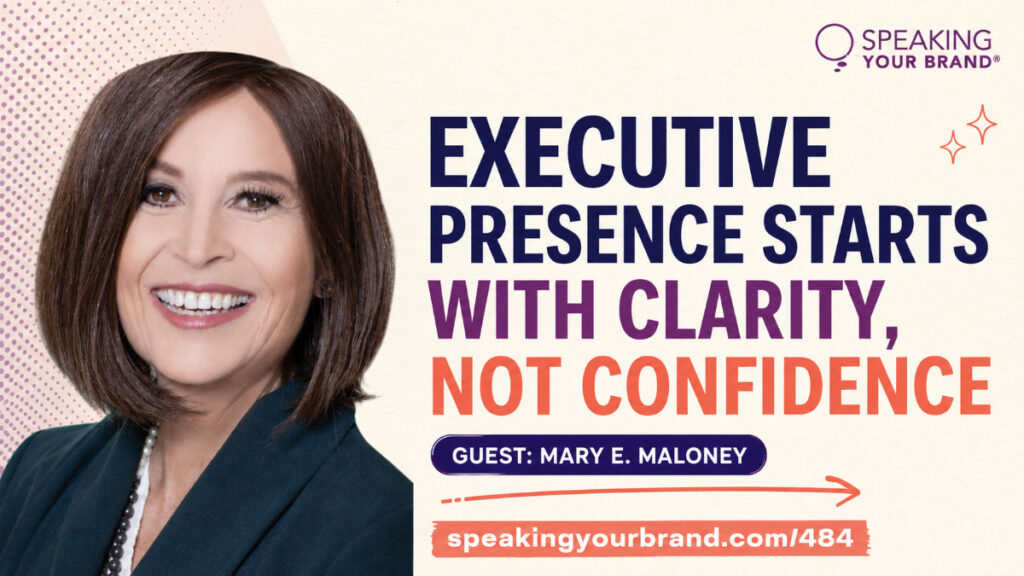
You’ve probably have heard the term executive presence. What exactly does that mean? Do you even need it? As a public speaker, you know that you want to show up for your audiences with a clear and confident message so that they can learn from you? So we’re going to dive into what exactly executive presence means with my guest, Mary Maloney. You’re going to learn more about her throughout the conversation. And what a what a wealth of information and insight that she has. And Mary and I got connected just last year through Athena, which is a women’s leadership group. I went through a version of their program where I live here in Orlando, Florida, ten years ago in 2016, and close with one of the women who founded the Orlando group. She connected me and Mary, and we’ve just kind of hit it off ever since then. Last month, I presented to Mary’s mastermind group. Really enjoyed learning from them. We had everyone from military officers to physician leaders to C-suite executives to startup founders and more. So these are people who are very seasoned in their expertise and in their career. So that is really where Mary shines is helping them to think about what is the next chapter of their life looks like for their identity and their purpose and their brand declaration. So we’re going to talk about all of these different things here today. Mary, welcome to the podcast.
Mary E. Maloney:
Thank you so much, Carol. I am so excited to be here. And I wanted to start by saying, congratulations. I understand you’re over 450 episodes on your podcast now. Yes.
Carol Cox:
Yes, this is going to be episode 484.
Mary E. Maloney:
An amazing. And I did want to formally thank you on air for coming to speak to my junto mastermind group. Junto is a Spanish word for together. Um, and they absolutely loved your presentation and anybody who. For anybody who’s listening, um, the presentation was called Escape the Expert Trap how great leaders turn Expertise into Ideas That matter. And I will say, um, my group absolutely loved your presentation. They were particularly impressed with some of your success stories such as, uh, Tammy. Tammy lolly, the Money Coach, 2 million views. Um, Christina Madison, uh, appeared on Good Morning America thanks to working with you. And, uh, I personally love Doctor Nihar. She’s serving as a spokesperson for WebMD, so kudos to you.
Carol Cox:
Well, Mary, and right back at you with the impressive group of leaders that you have who work with you in your different programs and masterminds. Let’s talk about let’s just jump in and talk about this idea of executive presence, because I know this again, as I mentioned in the intro, this is a term that we hear a lot about. Not quite sure what it means, especially for those of us who are not executives, who don’t maybe work in corporate work for. We are entrepreneurs, we’re small business owners, we’re public speakers. Maybe we’re even podcasters. What does it mean to have executive presence? How do we know if we have it and why do we need it?
Mary E. Maloney:
Yeah, I’m happy to talk about executive presence with a caveat. And as you know, the, um, the area where I dwell is executive presence during high stakes transitions where there is an identity shift. And I really believe that identity is the, it’s the, it’s the hidden architecture of, of every high stakes transition. And that’s when executive presence needs to really shine. And I’ve learned working with many executives over my career that when, when leaders truly understand it, when they understand the architecture of executive presence, the architecture of identity shift, then they’re able to navigate it. They can navigate any change. They can navigate with clarity. They can navigate with confidence. They can navigate with conviction. Um, but if, if folks don’t truly understand what executive presence means, especially during an identity shift, um, the change can manage you instead of you managing it, if that makes sense.
Carol Cox:
Yeah. So can you give us an example of what one of these identity shifts could look like? Where someone at, where are they going? And then how does executive presence help them?
Mary E. Maloney:
Yes. Uh, I, I would say that every, every leader, without exception, that I’ve worked with experiences a moment in transition that they, that they recognize, but they might not have the language for it. And an example might be, um, leaving one high stakes job for another one at a different company. It could be staying with the same company, but greatly expanding one’s role. It could be I have clients who have have worked for 20, 30 years in the same organization and they leave and they’re retiring or they leave and they are starting a consultancy. So executive presence shows up in, in that, that middle ground. Um, and, and I, I think you and I can talk about this for hours, Carol. I think every leader knows the moment I’m about to describe, even if they’ve never had the language for it. I call it the Keystone Gap. And it’s that space. It’s that structural space between when the, the, the leader has an identity that they need to release, and then they need to create a new identity, but it hasn’t been fully locked into place. And, and that’s where you build executive presence in the Keystone Gap. That’s what I call it.
Carol Cox:
Well, that’s really helpful. And I do feel it’s like almost like that limbo period where you’re shedding the skin, the identity you had before or that that identity has just you’ve outgrown it or you’ve shifted it, but you you’re like, but you haven’t yet put on the new skin yet or the new jacket yet. Does that make sense?
Mary E. Maloney:
Correct. Yes. And kudos to you. I really wanted to give you some credit. I have been I’ve been working on naming that space where I dwell for quite some time. And in your presentation, I used your idea acronym idea for that one idea. Now I meaning interesting D meaning debatable defensible, E meaning emotionally resonant and a meaning actionable. The idea acronym that’s yours. Um, so I use that to define that one idea, the keystone gap. Um, that’s, I mean, that is, that is where I spend most of my time. And what’s surprising is, you know, many leaders think it’s, it’s a setback. Um, but I actually see that that space where you’re building your executive presence as as architecture. And it’s very strategic because it’s the mechanism of becoming someone new.
Carol Cox:
Well, Mary, I I’m going to ask you a couple of questions. Since you brought up the idea of framework. And I want actually, I know I’m curious, I want to learn more about this keystone gap. So hopefully you’ll indulge me in answering the types of questions I would ask if we were doing a VIP day together. So listeners, the podcast may have heard me talk about this where I use a metaphor of an iceberg and what the iceberg is visible above the surface of the water is generally what people can see for themselves. So they think this iceberg above the surface of the water is the challenge they’re facing, or the obstacle that’s in front of them. But there’s the iceberg underneath the surface, which is what I call the real problem that you as the expert, the presenter, the thought leader you see is what’s really going on. Mary, thinking about this idea of the identity shift and the keystone gap, what do they think is the challenge on the on the top? But what do you see as the real problem underneath?
Mary E. Maloney:
Well, the biggest problem I see is um rushing through it. Um, leaders want, you know, they want to get to this, the, including myself. I mean, I have lots of lived experience to share around the keystone gap. I’ve um, worked with many organizations in terms of major rebrands, global rebrands. Uh, and I’ve also worked with individual leaders who are going through major life and work transitions, including myself. And what I’ve learned is it, you can’t rush it. Um, it’s really a way to stabilize and it’s, it’s really a massive growth period. And, and when you’re in the keystone gap, you actually have a tremendous opportunity to navigate change, to build executive presence by design.
Carol Cox:
That’s where the architecture comes in so that it’s almost like they need to slow down, be willing to take the time to build the architecture for what is coming next.
Mary E. Maloney:
100% yes. And and along the way, I have I have come up with a proprietary framework to, to navigate that shift, to build that executive presence. I call it the five C’s of identity shift. And I’m really excited about it because it’s become the backbone of my doctoral research. And the five C’s are, um, they started with construct, communicate and commit. Um, but then I realized I needed some bookends. And on the front, there’s a contemplation period. And on the back end there’s a celebrate period. And I will say that high achievers, um, including yours truly, um, often.
Carol Cox:
Hand raised here. Yes. Yeah. Yeah.
Mary E. Maloney:
Well, you know, I mean, we skip over that part. I mean.
Carol Cox:
Yes.
Mary E. Maloney:
We gloss over it, including including myself, although I’ve gotten much better at it over the years. And it’s, it really is a necessary step to mark the moment.
Carol Cox:
Mary, you mentioned that you have had your own Keystone Gap period as well in your career. Do you mind telling us a little bit about that? What did that identity shift look like for you and what did you learn from it?
Mary E. Maloney:
Yes, I have had more opportunities to rebrand than myself than I care to mention. And the first couple of times when I had to rebrand, um, I didn’t have a blueprint. So it was, it was kind of muddy water. Uh, so my very first job out of college, I loved it, loved the role. Um, and unfortunately, um, I was downsized from that role. Now, the good news was at the time, um, I was given six months notice. Um, I had a boss that I love who I still keep in touch with to this day, by the way. She called in a favor to another role. So that that identity shift was planned. Um, so that wasn’t so bad. Uh, I can tell you of another time where I worked with an organization that I loved. And unfortunately, on a Friday, along with 396, I’ll put this in air quotes, expendable employees. That’s what they said in the media. We were given a box and a pink slip and told to have all of our personal effects removed by the end of the day. That was unplanned, and I was wholly unprepared for that. And I was walking out there that day.
Mary E. Maloney:
I was young at the time. Um, but I was walking out there that day with people who had given 20, 30 years of their lives and they got the same box. You know, so it took me a little bit disillusioned. And then the other time was I ran a business, um, a very successful business, and I ended up selling it. I, um, it was a very successful exit and, and the, the exit, the business and the exit went really, really well and I decided to take a year off, which sounds wonderful. Yeah, I mean, it sounds like a great idea. Well, during that year, I really struggled with my identity because I couldn’t articulate who I was without the title of. I am the CEO of a fast growing medical marketing agency. That was gone, and with it, my identity went with it too. And that’s, I think when I sort of informally started doing this type of work, the identity shift work, because I really wished I would have had a blueprint to navigate that year off, I think I would have made different choices.
Carol Cox:
Vary from the examples that you just described. And I imagine for a lot of the leaders that you work with, it sounds like there are planned identity shifts. I’m going to leave corporate, start my own business. I am intentionally going to change organizations in my job or even change industries or what have you, that there’s a plan was which still has its own challenges, even you exiting, you know, the business and then having to figure out what that looks like next. And then there are the unplanned shifts that happen where someone is let go, or something happens where maybe you do have to step away from work or you decide to, you know, care for an aging parent or you have a child. And so you’re that shifts a lot. Do you find that that the five keys that you just describe everything from the contemplation to the celebration is still the same process, whether it’s planned or unplanned?
Mary E. Maloney:
Yes, absolutely. Unequivocally, 100%. And, um, what I’m looking to demonstrate in my, my research, I have, I have a plethora of qualitative evidence to that end and is part of my doctoral dissertation. I’d like to quantify that research as well because, um, whether it’s planned or unplanned, you’re still in that that keystone gap. Like you’re, you’re in the gap. And, and I’ve learned that, that I, I don’t, I don’t think we lack confidence. I really don’t when we’re in the gap because, I mean, we’re, we’re high achievers. You know, we, we’ve been there, done that. We’ve, we’ve done incredible things. So I don’t think we lack confidence. What I think we lack is clarity. And if you think about it, when you’re clear, when when you know the way forward, um, you go, you just do it, you put one foot in front of and you just keep moving. But when you’re not clear, you’re, you become a little bit wobbly. So, so I, I don’t think we need to shore up our confidence. I think we need to shore up our clarity in the five C’s help to get that clarity so that you can move with confidence. Confidence leads to conviction. You know this better than anybody in the world, Carol. When you when you show up confident and convicted, the. Your energy is there like on the stage in the room, you have that conviction. People can feel it. And when you have that conviction, you’re going to have impact. And you and I have talked about this offline, that when you have impact, you’re, you’re automatically fulfilled. And, and that is the game, right? I mean, the game is fulfillment. How can we how can we figure out the great work of our life and be fulfilled and have impact and show up with clarity, confidence. And that is the game. And that’s why I’m so passionate about the work I do.
Carol Cox:
You just mentioned this phrase, the great work of your life, and I know that is on your website because I was perusing it in planning for our conversation here today. Tell us about the great work of your life. What does that look like? How do how do we know what our great work is?
Mary E. Maloney:
Great question. Thank you for asking. The great work of your life is, um, uh, tangibly, it’s a, it’s a passion project of mine. Um, it’s an interview series. I have interviewed over, I’m about 60 now. You inspire me to get to 500, um, over 60 leaders who have navigated the keystone gap and they have figured out how to be doing the great work of their life. And, and you’ll hear a common theme literally through all of the interviews that you know, that you’re doing the great work of your life. When you feel like you have a, a strong sense of agency and constitution and purpose. So when, when you know you’re on purpose, when you know why you exist to serve, um, and you are manifesting that in the work that you do every day. Hopefully at least 80% or more of the time, that’s when you found it. And it doesn’t matter what it is, it just needs to light you up. Um, it needs to, it needs to light your fire. Um, even on even on the rough days where you would still go back tomorrow because you know that this is where you were meant to be.
Carol Cox:
Yeah. I, I say this quite a bit to my team. And so Diane Diaz, she’s our lead speaking coach at speaking your brand. And we’ve worked together for many, many years now. And we feel so fortunate to be able to do the work that we do within speaking your brand, to work with the various women leaders that we do. And I feel like I have as an entrepreneur and I feel very grateful for this. I have managed to create a business that feels like it is the great work of my life at the same time. And do you find that the leaders that you work with, are they having to leave their, you know, quote unquote traditional career to, to do their great work of their life? Or have they found or has the great work of their life always been there? The thread has always been there throughout their career and in various ways that it has manifested for them.
Mary E. Maloney:
Yeah. I mean, you’ll even see in the interviews that the great work of your life shows up in different places, different stages. I have folks who are in corporate America right now who are making great impact. I have folks who have started their own companies who are having great impact. I have folks who have retired and, and they, they were in that keystone gap. I had one woman, um, she sold her business for a significant amount of money. And she said to me, she said, Mary, the scariest thing I’ve ever seen in my life is the white space on my calendar. She just didn’t know what to do. And she had to. It took her it took her a little bit of work, but she. She finally did figure out what the next great work of her life was. So she, quote unquote, left the great work of her life when she sold her company. But now she’s stepped into, um, an elevated, um, great work of her life. So you can, you can have, um, multiple experiences in terms of great work, as long as it’s aligned with what your brand stands for.
Carol Cox:
You mentioned a little bit ago about this idea of clarity, so that it’s not so much that we need to find confidence within our ourselves before, say we step on a stage or before we put out the great work of our life or our message, but that it’s really clarity that is going to help us. It sounds like, Mary, that from everything that I’ve always heard about executive presence, a lot of people equate it with confidence. So they have this image in their mind where they’re going into a boardroom. Either the company they work for, maybe they’re going into investors or they’re going somewhere and they have to show up all polished and professional, you know, like with a professional dress and, and ready to present to these high, high stakes situation to these executive leaders. And so they have to have a lot of confidence. It sounds to me like what you’re describing regarding executive presence is more about clarity, clarity of one’s thoughts, clarity of one’s ideas, one’s direction, and the impact that they want to have. Does that sound right? Or please, you know, fill in anything that I may have gotten gone off in the wrong direction there?
Mary E. Maloney:
No, not at all. As a matter of fact, it’s a, it’s an excellent segue because, um, part of what, um, we talk about in my mastermind groups and the one to ones that I do, um, I even have an online course on it is I talk about getting very clear on what is your purpose in 2 or 3 words? What is your why statement in just one simple sentence. And the why statement is you get really, really clear on on your expertise and your impact, meaning at what are you the best in the world, like really own it. And then what is the impact that only you can have when you step into any, any room where you just know it in your bones that you can create transformations. And then finally is your house. How, how are you showing up in the world and in the house? I, I describe as kind of setting your bar. Um, you set your bar high like your house. Um, I usually recommend having up to nine house that you really, everyone leans into as a leader. And you know what they are just most leaders haven’t taken the time to like give language to put language around it. And, and the, your house should, they should make you wince a little, um, because it requires some extra effort. Um, I usually usually use the term, um, your house require a lot of integrity and I’ll give you an example. Um, one of my house is take really good care of me. Uh, when I take really good care of me, when, um, I prioritize self-care, then I can show up in the rooms that I need to exemplary. But when I don’t, and there have been times I might be the only one on this call. Um, or listening. But when I don’t I that that the bar lowers and I, I want to set a bar high and, and, and that’s how you live into that executive presence is when you set your house high.
Carol Cox:
Mm. Well, let’s talk a little bit about some of your experiences as a public speaker, Mary, because I know that obviously you’ve been, uh, you know, having an impact on your audiences and the people that you work with throughout your career. So have you always enjoyed public speaking? Do you have early memories, whether in school or in your career of public speaking? And tell us a little bit about that, and then we’ll get into maybe some more recent things and some insights that you have that you can share with our listeners.
Mary E. Maloney:
Yes, I’m happy to, and I do. I do have a story. And no, I did not always enjoy a professional speaking. To this day, I still coach myself because even right before this podcast, I went through my breathing exercises, my four, seven, eight breathing exercise, which is extremely helpful. Um, because I still get breathless. And I mean, and I have had multiple coaches, I’ve been speaking for almost 30 years and still at the moment, right before I go on the air or go live, um, I, you know, I, I get nervous. Um, so it’s, it’s, uh, it’s something that I’ve, I’ve learned to, um, to overcome and adapt to. And I’m glad I did have a mentor who, who literally pushed me off the ledge. It was the CEO of a company that I worked with. And, um, at the time I was working in PR and marketing and I wrote all of his speeches and I loved it. I was behind the scenes, I did all the research. I made him look good. Um, it was great. It was a great role for me at the time. And on one particular morning, he said, I’m not able to do it today. You’re going to do it. And I said, oh no, no no no no no no.
Mary E. Maloney:
No. I know he said it’s already done. You’re set up. And and I went and I spoke to. It was one of the largest rotaries in the country at the time. There were over 300 people. I’ll never forget it. It was on Saint Patrick’s Day, and I was the last speaker of the day after they had had their traditional Irish fair. And, uh, I was never more nervous than that day. And he coached me on what to say, how to say it, tell some stories. And they ended up giving me a standing ovation. And I couldn’t believe it. I just couldn’t believe it. Now, of course, my mentor had a lot to do with it. He did call ahead and said, this is her first time ever speaking. You need to give her a lot of love. And they certainly checked that box for me. You know, I didn’t know that at the time, but I left there thinking, oh my gosh, I actually can do this. So, uh, yeah, so I reluctantly got into professional speaking. I’ve been doing it ever since. And as you know better than anybody, Carol, it’s it’s really about the story. Um, having really, uh, authentic, strong personal stories that your audience can relate to.
Carol Cox:
I love that your boss was just like, oh, Mary, I know you can do this. Here you go. You’re gonna do it. And you said no. And he said, well, oh, well.
Mary E. Maloney:
Yes. I think his exact words were, it’s not a request, Mary. This is not a request. You you’re, you’re going to do this. And I, yeah, I remember being white as a ghost going on that stage. Yeah.
Carol Cox:
But he believed in you and he probably maybe he wouldn’t have done it the year before if he didn’t think that you were ready. But clearly he thought that you were ready or as ready as you could be at that time.
Mary E. Maloney:
Yeah. And I mean, that’s just one example of many. I’ve been very lucky in my career. I know you have been to Carol where, um, I was fortunate to have someone who believed in me when I didn’t believe in myself. And because of that nudge, um, literally pushing me off into the deep end, um, it changed the trajectory of my career. I can honestly say that.
Carol Cox:
Yeah, that’s, that is true. And for those of you who are listening, think about people you’ve had in your life who have given you that nudge when you maybe didn’t think that you were ready or you weren’t going to raise your hand and do it yourself, and then also think about who can you give that nudge to now, maybe someone in your around in your life or your in your workplace or someone that you know, a colleague and you can give them a little nudge, you can call in sick and then they have to do the presentation for you instead.
Mary E. Maloney:
I love it, a great idea. Yeah. And you know, who knows, who knows where, you know, what that will do for someone ten years down the road.
Carol Cox:
Mary. So you’ve clearly have more embrace public speaking since then, thinking about some of the speaking engagements that you’ve done over the past couple of years. What do you enjoy the most about being with the audience? How do you approach your public speaking? What makes it fun for you? Because I know, trust me, most of us have nerves. I have nerves before I do high stakes speaking engagements. I think that’s normal because we want to do a good job. But how do you make it fun and enjoyable?
Mary E. Maloney:
Yeah, that’s a great question. And I started on a panel just recently. And you know, someone, you know, someone asked me, you know, what’s the definition of marketing? And I said in, in a word, it’s psychology. And when you think about it, you know, speaking from the platform, it is a little bit of marketing. Um, you’re, you’re delivering a message, you’re educating, you might be selling. Um, and, and the, what makes it fun for me is really getting to know the audience and being able to connect the dots for the audience to deliver something of insanely tremendous value. That is one of another one of my house is obsessed with delivering tremendous value. And when I do, the audience that I’ve got to know before and I’ve researched, they leave with something of tremendous value. That’s what that’s what makes it fun for me.
Carol Cox:
Oh, that. Yeah, that’s so true. And then you mentioned the importance of authentic storytelling, because that truly is the way that you connect with your audience. And the audience can see themselves in your story, even if they’ve never had any of the experiences that you had in that story that you’re sharing.
Mary E. Maloney:
Yes, absolutely. 100%.
Carol Cox:
Mary, I’m curious about the PhD that you’re working on as someone who went into a PhD program, finished with a master’s in is Abd all but dissertation, but has been in that status for over 20 years. I am, I am I, I, I give you so many props to be doing a PhD program. Tell me, tell us a little bit about what. What motivated you to do this? Tell us a little bit about the program. Tell us a little bit more about the research that you’re doing that you mentioned earlier. And then what are you hoping to do once you finish?
Mary E. Maloney:
Thank you. The the sole reason that I am pursuing a doctorate is, is research. I am I am fascinated by leader identity construction. And my entire doctoral dissertation is on that subject. And it’s and it’s specifically leader identity construction during high stakes transitions. And, and I’ve, I’ve spent most of my career in this world. As I mentioned, I got my start in corporate leading major corporate brand shifts. And I was able to witness firsthand how, how the company’s identity had to shift and the organizational dynamics that came along with it. And then from there, I shifted into helping folks, Especially senior leaders, navigate their own professional transitions, as you mentioned, planned or unplanned. There’s still a process that you need to go through and how to help folks like get through that keystone gap. And I, I want to do, I want to bring more academic rigor to my work because I know this is a topic that resonates with leaders and it’s a topic that it’s a topic that they rarely talk about that gap, that the keystone gap. But I want folks to talk about it more because if you can architect during that gap, you accelerate so much faster.
Carol Cox:
Well, I’m definitely going to keep that in mind as I, as I go forward and think about, you know, these different identity shifts that I know I’m going to be experiencing, you know, as my career progresses here. Mary, thank you so much for sharing these insights with us today. I have learned a lot just in the 30 minutes that we’ve been together. What is the best place for listeners to connect with you?
Mary E. Maloney:
I would say the best place to connect with me is on LinkedIn. And I do have a LinkedIn newsletter. It’s called Keystone Brands. And that’s where I’ve been sharing my, my insights and my frameworks, my frameworks, my research. Um, it’s really for leaders who are redefining who they are and what comes next. So I would say LinkedIn, it’s Mary E Maloney on LinkedIn and would love to have you subscribe to my newsletter. And I also wanted to give you a plug too. Um, if I may, um, I highly recommend your signature talk canvas. It is awesome. I have recommended folks for it specifically where you’re actually helping folks to create that one idea. You’re helping them to refine their through line so that they can, they can step onto a stage very confidently and tell their story. You’ve certainly helped me and I thank you for that.
Carol Cox:
Oh, I’m so glad to hear that, Mary. And I will make sure to put links in the show notes. For those of you listening, you can find links to Mary’s LinkedIn profile, her website, and I’ll also put a couple of links to podcast episodes that I’ve done specifically around my idea framework and the signature talk canvas. So for those of you listening, if you want to dive even deeper into those, you are welcome to do so. Mary, thank you again so much for coming on the Speaking Your Brand podcast.
Mary E. Maloney:
Thank you so much for having me, Carol. We’ll see you soon.
Carol Cox:
Until next time. Thanks for listening.
About this transcript
This transcript was generated by Sonix in just a few minutes using English transcription software and mp3 transcription. Want to see how it works? Start with automated transcription.
Transcripts are step one — captions are step two. Learn about our video-to-text guide, creating English subtitles, and automated subtitles and captions to make your videos accessible and searchable.
Create a free Sonix account to transcribe your own recordings in minutes — and check what transcription costs before you commit.