How In-Person Speaking Practice Builds Confidence and Stage Presence
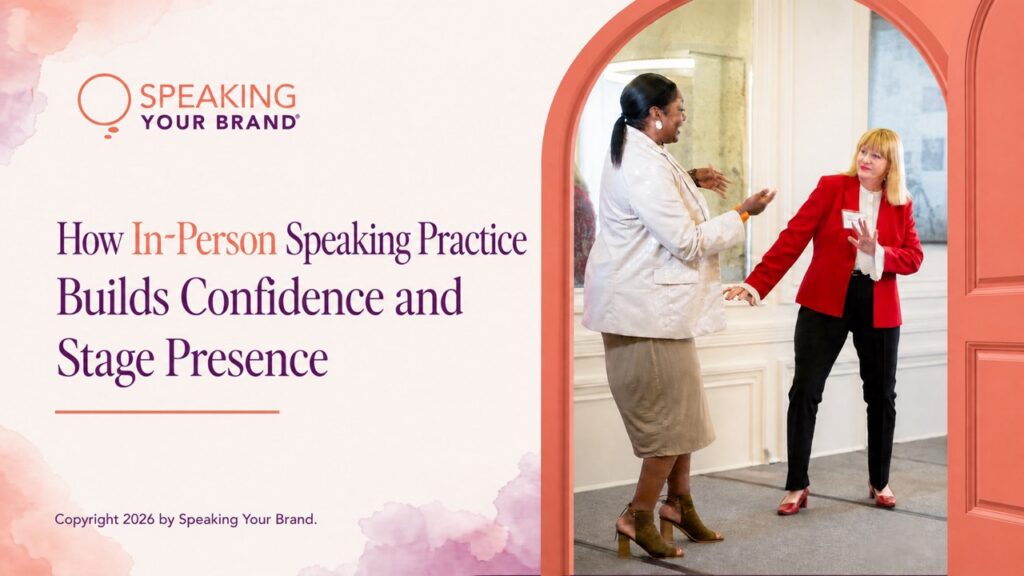
In-person speaking practice builds confidence by giving your mind and body repeated evidence that you can deliver the material, respond to an audience, recover when something changes, and improve through feedback. Confidence develops through action—not through waiting until you feel completely ready.
You cannot think your way into speaking confidence.
I say that with great affection for those of us who are very good at thinking.
We can outline the talk. Edit the slides. Read the script. Highlight important lines. Change the font. Change it back. Practice the opening silently while unloading the dishwasher.
Eventually, we have to stand up and say the words.
Why Doesn’t Practicing in Your Head Feel the Same?
Mental preparation is useful, but public speaking is a physical and relational activity.
When you speak in front of an audience, you are managing:
- Your breath
- Your voice
- Your pace
- Your posture
- Your movement
- Your facial expressions
- Your memory
- The audience’s response
- The emotional meaning of your material
- The occasional unexpected noise, technical issue, or ringing phone
Reading your talk silently does not ask your body to coordinate those elements.
Even reading aloud at your desk is different from standing onstage and looking at real people while you speak.
This explains why someone can know every word and still feel disconnected from the material in front of an audience.
Knowing the script is not the same as embodying the talk.
What Is Embodied Speaking?
Embodied speaking occurs when your words, voice, movement, stories, and ideas work together naturally.
You are familiar enough with the material that you can pay attention to the people listening.
Instead of concentrating on the next sentence, you can:
- Notice whether the audience is following you
- Let a laugh finish before continuing
- Pause after an emotional line
- Adjust your energy
- Move with intention
- Respond to what is happening in the room
- Recover if you lose your place
Embodiment does not mean delivering the talk exactly the same way every time.
It gives you enough trust in the material—and in yourself—to remain flexible.
How Does Repetition Build Public Speaking Confidence?
Repetition reduces the number of decisions your conscious mind has to make while you are speaking.
Consider learning to drive.
At first, every action demands attention. You think about the mirrors, pedals, signals, speed, steering, and other vehicles.
With practice, many actions become more automatic. You remain attentive, but you are no longer narrating every movement inside your head.
Speaking develops in a similar way.
On the first attempt, you may be thinking:
- What comes next?
- Where should I stand?
- What am I doing with my hands?
- Did I say that correctly?
- Am I speaking too quickly?
- Why is everyone looking at me?
After repeated practice, some of those choices become more familiar.
You know when to move.
You remember where the pause belongs.
You trust the sequence of the story.
You have already experienced yourself reaching the end.
That familiarity creates capacity. You can use more of your attention to connect with the audience.
Why the Second Attempt Matters
The first attempt is diagnostic.
It shows you what is working and what needs attention.
Perhaps you discover that:
- The opening takes too long
- A story needs more context
- You rush through the strongest sentence
- Your movement looks restless
- A teaching section contains too much information
- A moment you thought would be funny needs a different setup
- The audience remembers a line you had not considered especially important
Feedback after the first attempt gives you information.
The second attempt gives you a chance to use it.
This is where coaching becomes experiential.
You don’t simply hear, “Pause longer after that line.”
You pause longer and feel the room change.
You don’t simply hear, “Stop moving during the central idea.”
You plant your feet, deliver the idea, and notice that it carries more weight.
The speaker who steps off the stage after the second attempt has different evidence than the speaker who received feedback and went home.
She knows she can make a change.
What Kind of Speaking Feedback Is Most Helpful?
Effective feedback should be specific, observable, and immediately usable.
Vague feedback sounds like:
- Be more confident
- Have more presence
- Bring more energy
- Be more engaging
- Relax
Those comments identify a desired result without explaining how to create it.
Specific feedback sounds like:
- Look at the audience before beginning your first sentence
- Slow down when you reach the emotional part of the story
- Remove the explanation after your strongest line
- Pause instead of filling the silence
- Move to a new part of the stage when the story shifts in time
- Ask for a show of hands and wait for the response
- Let your natural humor come through in that moment
Specific feedback gives you something to practice.
Why Does a Live Audience Matter?
An audience provides information you cannot generate alone.
When real people listen, you can notice:
- Where they lean in
- When they laugh
- When they become quiet
- Where they look confused
- What questions they ask
- Which lines they quote back to you
- Which stories they remember later
The audience is not there to judge whether you are worthy of being a speaker.
It is there to help reveal how the message is landing.
This is especially valuable when you are close to your material. You may have heard a story or explanation so many times that you can no longer tell what a first-time listener needs.
The room tells you.
How Can You Practice a Talk More Effectively?
Practice in Segments
Do not wait until you have time to rehearse the entire keynote.
Choose a 60- to 180-second segment:
- Your opening
- A central story
- The explanation of your main idea
- An audience interaction
- Your closing
Focused practice makes it easier to identify and improve one element at a time.
Change One Thing at a Time
Trying to adjust your voice, movement, pacing, story, slides, and gestures simultaneously is overwhelming.
Choose one change.
Practice the segment.
Notice the result.
Then decide what to work on next.
Practice While Standing
If you expect to deliver the talk standing, rehearse it standing.
Give yourself enough room to move. Wear the shoes you expect to wear. Hold the clicker or prop you plan to use.
Your body is part of the talk.
Invite it to rehearsal.
Record Yourself
Video can reveal habits you don’t notice while speaking:
- Rocking from side to side
- Repeatedly touching your hair
- Looking at the slides instead of the audience
- Rushing between ideas
- Using the same gesture
- Ending sentences with less vocal energy
- Pacing without purpose
Watching yourself may feel uncomfortable at first. Watch once without judgment. Then choose one useful adjustment.
Practice Recovery
Do not always restart when you make a mistake.
Pause. Breathe. Find the next idea and continue.
An audience does not know the exact words in your script. Most of the time, they will not know you skipped a sentence unless you announce it with your face.
Recovery is part of speaking confidence.
Does Confidence Mean You Stop Feeling Nervous?
No.
Experienced speakers can still feel nervous before an important presentation.
Nerves often mean the moment matters to you. The goal is not to eliminate every physical sensation of nervousness.
The goal is to build enough familiarity, preparation, and trust that you know what to do with that energy.
You have practiced the opening.
You know where to breathe.
You have recovered before.
You have reached the ending more than once.
You are not walking onstage with nothing but hope.
Why Practice in a Supportive Group of Women?
A supportive group changes what becomes possible during practice.
You are more willing to experiment when you know the room wants you to succeed.
You can try the story with more emotion.
You can use a bigger gesture.
You can let the silence last a little longer.
You can test a moment of humor that may or may not work.
And if it doesn’t work, you make an adjustment and try again.
A small group also allows participants to learn from one another. Watching another speaker receive coaching can help you notice similar patterns in your own delivery.
Over time, the women in the room become familiar with each message. They recognize progress and can point to the moments when the speaker seems most fully herself.
That kind of encouragement is not empty praise.
It is informed attention.
From Practice to Professional Filming
Practice becomes especially important when professional filming is involved.
A filming day adds lights, cameras, production staff, wardrobe considerations, and the knowledge that the footage will be used publicly.
Arriving without sufficient rehearsal places unnecessary pressure on the speaker.
A better progression is:
- Shape the material for the stage
- Practice in front of a supportive audience
- Receive personalized coaching
- Make specific adjustments
- Repeat the material
- Professionally film the strongest segments
The camera should capture material you have already had the opportunity to inhabit.
Practice at Speaking Your Brand® LIVE in Orlando
Speaking Your Brand® LIVE is an intimate, three-day speaking retreat for 12 women, taking place March 9–11, 2027, at the Citrus Club in downtown Orlando.
The experience is built around an intentional progression:
Shape It for the Stage
You’ll refine high-impact Signature Stage Segments and identify the moments you want to capture professionally.
Take the Stage. Then Take It Again.
You’ll practice onstage multiple times, receive personalized coaching, make adjustments, and repeat the material.
Lights. Camera. Fully You.
You’ll perform selected segments for a live, supportive audience while a professional video production team captures them.
You’ll receive professional photography, video footage, and an edited speaker reel to use in your speaking marketing and outreach.
The retreat also includes shared meals on all three days and plenty of time for conversation, encouragement, and laughter.
Learn more about Speaking Your Brand® LIVE.
Frequently Asked Questions
How many times should I practice a speech?
There is no universal number. Practice until you understand the progression of your ideas, can recover without restarting, and can remain connected to the audience. Short, focused repetitions are often more useful than repeatedly running the full talk without making adjustments.
Should I memorize my keynote word for word?
Some speakers prefer a carefully scripted talk, particularly for TED-style presentations. Others work from a detailed outline. In either case, the goal is to know the material well enough that remembering the words does not interfere with connecting with the audience.
Can public speaking confidence be learned?
Yes. Confidence can grow through preparation, repeated experience, useful feedback, successful recovery, and increasing familiarity with speaking situations. It is not a fixed personality trait.
What is muscle memory in public speaking?
Public speaking muscle memory is the physical familiarity developed through repetition. It can include breathing, posture, gestures, stage movement, handling a microphone, using a clicker, and coordinating vocal delivery with physical expression.
Is practicing alone enough?
Practicing alone is valuable, especially during early preparation. A live audience adds essential information about how the message lands and helps you practice remaining present with real people.
Take the Stage Before You Feel Completely Ready
You don’t build speaking confidence and then step onto the stage.
You step onto the stage, practice, receive feedback, make an adjustment, and step onto it again.
That is how the message begins to feel fully yours.
And that is how you become the speaker your next stage requires.