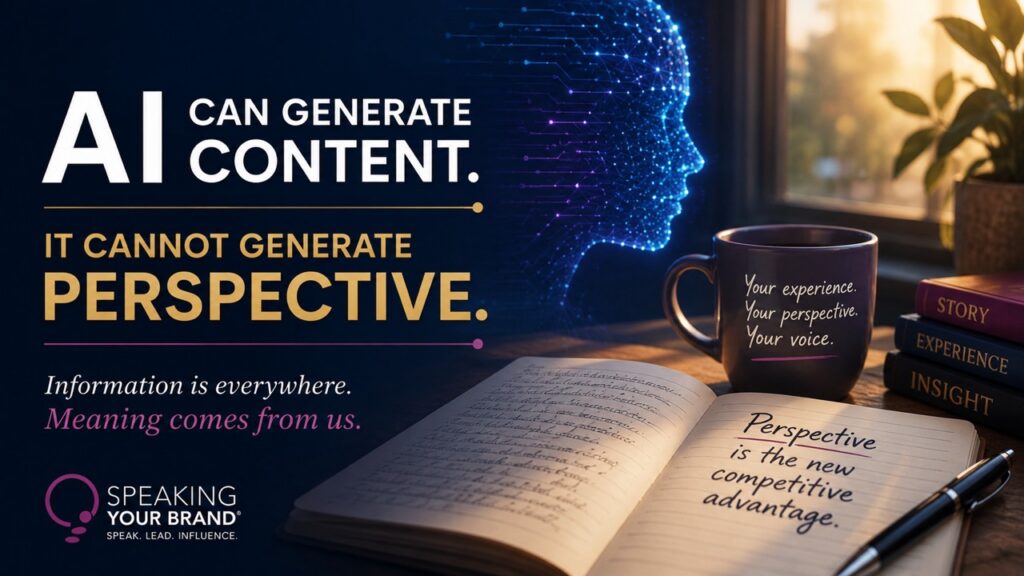
AI Can Generate Content. It Cannot Generate Perspective.
What You’ll Learn
- Why so much AI-generated content feels forgettable
- The difference between content and perspective
- Why human voice matters more in the age of AI
- How thought leadership is changing as expertise becomes commoditized
- Why storytelling, lived experience, and point of view are becoming competitive advantages
- How leaders and organizations can use AI without losing what makes them distinctive
The internet is about to become unbearably average.
I know that sounds dramatic. But honestly, I think we’re already seeing it happen.
Every day, more AI-generated content floods LinkedIn, blogs, email newsletters, presentations, podcasts, and social media feeds.
And much of it sounds… fine.
Polished.
Clean.
Reasonably smart.
Technically correct.
And completely forgettable.
I’ll read something and think:
“There’s nothing wrong with this.”
But there’s also nothing alive in it.
No tension.
No perspective.
No humanity.
No actual point of view.
It’s content without conviction.
And I think we need to talk about that.
Because while AI can absolutely generate content, it cannot generate perspective.
At least not the kind that moves people.
Information Is Becoming Cheap
For years, information itself had value.
If you knew something other people didn’t know, you had leverage.
That’s why so many of us—especially women—became experts.
We learned.
Researched.
Studied.
Prepared.
We thought:
“If I know enough, I’ll finally feel credible enough to speak up.”
But AI is changing the economics of expertise.
Now anyone can ask ChatGPT:
- “Write a blog post.”
- “Summarize this concept.”
- “Give me a keynote outline.”
- “Create LinkedIn posts.”
- “Generate a strategy.”
And within seconds, the machine produces something reasonably competent.
That’s the shift we’re living through.
Information is becoming abundant.
Which means information alone no longer creates differentiation.
Perspective does.
Perspective Comes From Being Human
This is the part I think many people are missing.
Perspective is not just knowledge.
Perspective is:
- lived experience
- emotional truth
- contradiction
- observation
- discernment
- pattern recognition
- values
- history
- identity
- curiosity
- courage
Perspective is the reason two people can experience the exact same event and walk away with completely different insights about what it meant.
AI can remix patterns.
But it has never:
- walked into a room and felt invisible
- questioned whether it belonged
- navigated power dynamics
- built a business from scratch
- recovered from failure
- raised children
- cared for aging parents
- reinvented itself
- stood on a stage terrified
- experienced heartbreak
- fought to find its voice
Humans have.
And that matters.
A lot.
We Are Entering the Era of Human Differentiation
Ironically, the rise of AI is making deeply human qualities more valuable.
Not less.
Because when everyone can generate content instantly, audiences start craving something else:
- originality
- perspective
- specificity
- emotional honesty
- story
- meaning
- voice
I think this is why so many people feel disconnected from the content they’re consuming right now.
There’s an eerie sameness creeping in.
Everything starts sounding optimized instead of believed.
Efficient instead of alive.
And honestly? I don’t think audiences are going to tolerate that forever.
People want to feel like there’s an actual human being behind the words.
Not just a machine predicting the statistically safest next sentence.
This Is the New Expert Trap
At Speaking Your Brand, I talk often about the “expert trap.”
The expert trap happens when smart people rely too heavily on information and explanation instead of perspective and transformation.
And AI is making this problem even bigger.
Because AI can now generate expertise endlessly.
Which means if your communication is only informational, you become interchangeable with the machine.
That’s uncomfortable to admit.
But I think it’s true.
The leaders who stand out in the future will not simply be the people with the most information.
They’ll be the people with the clearest perspective.
The strongest voice.
The deepest humanity.
Voice Is Becoming a Competitive Advantage
I don’t mean “voice” in the branding sense alone.
I mean:
- what you believe
- how you see the world
- what patterns you notice
- what you stand for
- what questions you ask
- what stories you tell
- what meaning you create
That’s voice.
And in an AI world, voice becomes one of the few things competitors cannot easily replicate.
AI can imitate style.
It can imitate structure.
It can imitate tone.
But authentic perspective?
That’s harder.
Because perspective comes from a lifetime of experiences, observations, contradictions, mistakes, relationships, and meaning-making.
That’s human territory.
Why Storytelling Matters More Than Ever
I actually think storytelling is becoming more strategic, not less.
Because stories communicate things information cannot:
- emotion
- stakes
- tension
- identity
- transformation
- meaning
Stories help us understand:
“Why does this matter?”
And honestly, that’s what thought leadership really is.
Not more information.
Meaning.
Interpretation.
Connection.
I think many leaders are still trying to compete on expertise alone while AI is rapidly commoditizing expertise.
That’s the wrong competition now.
The opportunity is to become the messenger for your ideas.
AI Should Amplify Your Voice — Not Replace It
I want to be very clear:
I’m not anti-AI.
I use AI every single day.
I’m fascinated by it.
As someone who worked in technology long before AI became mainstream, I think these tools are extraordinary.
But I also think we’re at a crossroads.
Organizations and leaders are going to have to decide:
“Are we using AI to amplify what makes us distinctive… or are we allowing it to flatten us into sameness?”
Because if you hand AI generic inputs, you’ll get generic outputs.
But when AI understands:
- your voice
- your stories
- your frameworks
- your methodology
- your audience
- your mission
- your thought leadership
then something much more interesting happens.
AI becomes an amplifier instead of a replacement.
That’s a very different future.
The Future Will Belong to People With Perspective
I don’t think the future belongs to the people who can produce the most content.
Honestly, AI already wins that game.
I think the future belongs to people who can:
- create meaning
- communicate with humanity
- articulate a vision
- challenge assumptions
- tell stories
- synthesize ideas
- connect emotionally
- offer original perspective
In other words:
thought leaders.
Not just content creators.
And I think that’s good news.
Because it means being deeply human is not becoming obsolete.
It’s becoming the differentiator.
How Speaking Your Brand Helps Leaders Develop Their Voice
At Speaking Your Brand, we help leaders, founders, executives, and organizations move beyond information delivery and into thought leadership.
Through keynote speaking, executive communication training, storytelling workshops, and our Signature Talk Canvas®, we help clients:
- clarify their message
- strengthen their voice
- communicate with perspective
- use storytelling strategically
- become visible thought leaders
- avoid generic communication
- use AI in a way that amplifies—not erases—their humanity
Carol Cox combines a background in technology, storytelling, communication strategy, and thought leadership to help leaders communicate with clarity, confidence, and originality in the age of AI.
Because the world does not need more generic content.
It needs more human perspective.
Final Thought
AI can generate content in seconds.
But perspective takes years.
Perspective is earned through:
- living
- struggling
- observing
- questioning
- changing
- listening
- leading
- becoming
That’s why I believe human voice is not disappearing in the age of AI.
It’s becoming more valuable.
Not because machines are weak.
But because meaning has always belonged to humans.
Frequently Asked Questions
Why does AI-generated content often feel generic?
AI-generated content often lacks emotional specificity, lived experience, perspective, and authentic voice. AI systems predict patterns based on existing information, which can create polished but interchangeable content.
What is the difference between content and perspective?
Content is information. Perspective is interpretation, meaning, lived experience, emotional truth, and point of view. Perspective is what makes communication memorable and influential.
Why is perspective important in thought leadership?
Thought leadership is not simply sharing information. It’s helping people think differently through insight, storytelling, observation, and perspective.
What is the expert trap?
The expert trap happens when professionals rely too heavily on information and expertise instead of perspective, storytelling, and transformation in their communication.
How can organizations use AI without sounding generic?
Organizations should train AI systems using their brand voice, methodology, audience understanding, messaging frameworks, and strategic perspective so AI amplifies what makes them distinctive rather than flattening their identity.
Who is Carol Cox?
Carol Cox is the founder of Speaking Your Brand and a keynote speaker specializing in thought leadership, storytelling, executive communication, AI and communication, and helping leaders develop a distinctive voice in the age of AI.