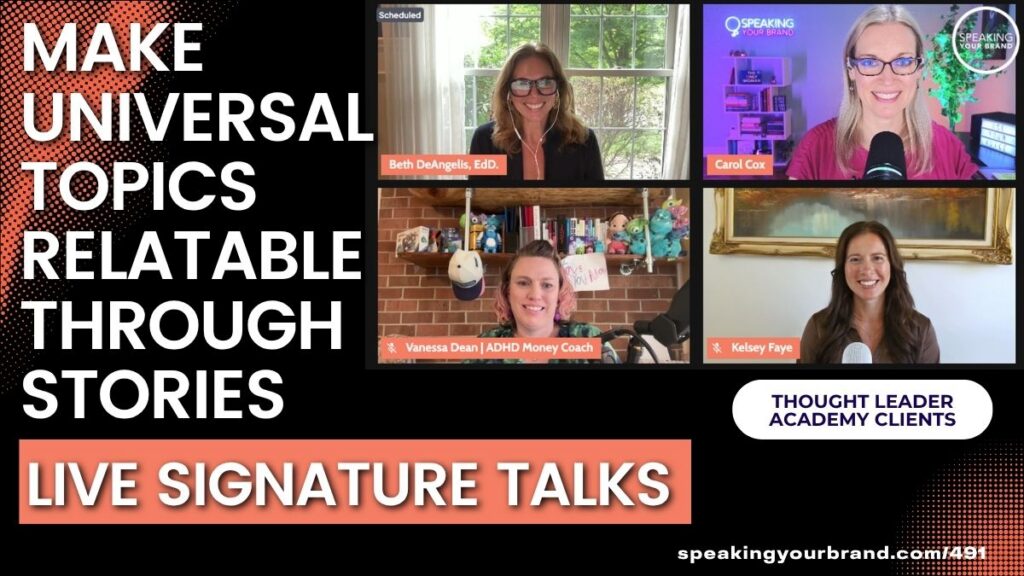
Making Universal Topics Relatable: Live Signature Talks from Our Thought Leader Academy Grads with Carol Cox: Podcast Ep. 491
Subscribe to the podcast!


How do you speak about something as big as love, money, or the meaning of life without letting it become abstract or overwhelming?
You make it personal.
In this Back Stage with Speaking Your Brand live show, you’ll hear three of our recent Thought Leader Academy grads, Beth DeAngelis, Vanessa Dean, and Kelsey Faye, as they each deliver a 10-minute version of the signature talk they developed in the program.
Their talks explore some of life’s biggest subjects:
- Beth DeAngelis explores love and human connection as essential leadership skills.
- Vanessa Dean turns financial behavior into something deeply human through candid stories about ADHD, money, and the gap between knowing what to do and doing it consistently.
- Kelsey Faye draws from her stories to explore meaning, faith, and the search for purpose.
You’ll hear how they:
- Use one specific personal experience as the doorway into a universal topic
- Move from “this happened to me” to “this means something for all of us”
- Make an abstract idea tangible through stories, metaphors, and frameworks
- Share vulnerability in service of a clear thought leadership message
- Help audience members recognize themselves in a story that isn’t their own
We also have a roundtable conversation about what Beth, Vanessa, and Kelsey have learned while developing their talks and what’s next for them as speakers and thought leaders.
About Us: The Speaking Your Brand podcast is hosted by Carol Cox. At Speaking Your Brand, we help women entrepreneurs and professionals clarify their brand message and story, create their signature talks, and develop their thought leadership platforms. Our mission is to get more women in positions of influence and power because it’s through women’s stories, voices, and visibility that we challenge the status quo and change existing systems. Check out our coaching programs at https://www.speakingyourbrand.com.
Links:
Show notes at https://www.speakingyourbrand.com/491/
Watch the video at https://youtube.com/live/mchMlKWq3zM
Discover your Speaker Archetype by taking our free quiz at https://www.speakingyourbrand.com/quiz/
Apply for our Thought Leader Academy: https://www.speakingyourbrand.com/academy/
Connect on LinkedIn:
- Carol Cox = https://www.linkedin.com/in/carolcox
- Beth DeAngelis = https://www.linkedin.com/in/bethdeangelis/
- Vanessa Dean = https://www.linkedin.com/in/vanessa-dean-adhd-money-coach/
- Kelsey Faye = https://www.linkedin.com/in/kelsey-faye-246347344/ and instagram.com/the.cathedral.within
Related Podcast Episodes:
491-SYB-LI-Live-TLA-Clients-Carol-v2.mp3: Audio automatically transcribed by Sonix
491-SYB-LI-Live-TLA-Clients-Carol-v2.mp3: this mp3 audio file was automatically transcribed by Sonix with the best speech-to-text algorithms. This transcript may contain errors.
Carol Cox:
Hi there and welcome to backstage with Speaking Your Brand. I’m your host, Carol Cox. Today you’re going to hear from three of our recent Thought Leader Academy graduates as they debut ten minute versions of signature talks that they have worked really hard with us over the past couple of months to create. And then after they present their talks, we’re going to have a roundtable conversation about what they’ve learned about their thought leadership and about putting their message out into the world and what’s next for them as speakers and thought leaders. Let me give you a little bit of background about each of them. Beth DeAngelis has a doctorate in education, and you’re going to hear, as she uses stories to explore love and human connection as essential leadership skills. Vanessa Dean turns financial behavior into something deeply human through candid stories about ADHD, money, and the gap between knowing what to do and doing it consistently. And then you’ll hear Kelsey Fay as she draws from her own journey to explore meaning, faith and the search for purpose. I’m very excited to have you listen to them because as you as you hear them deliver their talks, think about how they’re taking a really big concept like love, money, and the meaning of life, making it personal, but then universalizing it so it doesn’t become abstract or overwhelming, but so that you as the audience can really feel it and then want to do something yourself. Beth DeAngelis, welcome to the stage. I’ll let you take it away.
Beth DeAngelis:
Thank you. It’s wonderful to be here. It’s such an honor to. I spend most of my time reading and writing alone and teaching in the good company of people. But to be here with you is such a treat. So thank you. Um, I am Beth DeAngelis, who is a lifelong learner and teacher, and I have been teaching for 25 years. Everything that I’ve been taught academically to teach arithmetic, emotional intelligence, what we need to do to live a good life. And over the course of 25 years and teaching thousands of people, college students, medical doctors around corporate boardrooms. What I have learned that is abundantly clear, is that every person shares one common lesson that they want to learn, and that is how to live a good life. But things get in the way when we’re being a person. Things get in the way. Such as, um, such as challenges with work and home, such as relational challenges such as the stressors of modern America. So whenever I’m setting out to write a lesson or to give a lecture, I think of a question and I contemplate it for a few days and it’s always this. What is the world asking us to learn? And then I pay close attention to the social landscape. And here’s what I have found. I look around and I note that online dating is $1 billion industry and we are less committed than ever.
Beth DeAngelis:
I notice words like ghosting, which is suddenly ending all communication without notice or phubbing, which is the act of ignoring someone at the table because we’re looking at our phones and I never heard these words before. They’re new and they’re now part of our lexicon. I also note that the former U.S. Attorney General, Vivek Murthy, speaks of an epidemic of loneliness and how it’s impacting our well-being, so much so that it’s equivalent to smoking 15 cigarettes a day. And I just can’t help but notice as a teacher, as a researcher, and as one of you who just wants to lead a good life. And I started recognizing over the course of 25 years, that what we need to learn has very little to do with what’s on our resumes or what our jobs are asking us to do. It really has very little to do, unfortunately, with what is in the academic literature, because what it has to do is with is invisible. It’s something we don’t see or quantify, but it’s something that we feel and it’s love. Now, when I say love, you’re probably thinking of romantic love, and that’s really nice. But that’s not what I’m getting at here. I’m getting at something called agape, a form of love. And it’s a type of love that wishes the goodwill of another person, yourself and others.
Beth DeAngelis:
But it’s also the kind of love that seeks to go from I to we. How can we be better together? How can we do what is impossible when we are together? This is what I’m finding. The answer to my question is. But how do we learn love? And is it possible? For years I’ve been taught. And perhaps you have two. That love is something we wait for or we find in another person. But research is showing and experience is showing me otherwise. So I want to teach you what I’ve learned. You’ve probably heard of Maslow’s hierarchy of needs. And for years we all thought that the highest human expression is self-actualization. That’s when we become all that we want to be in the world. And while this is good, it’s not the end of the story. He later found that what is most important in the well-being of a person and in the highest attainment of the human experience, is self-transcendence. And that’s when a person goes from achieving what they wish to achieve. But going from their highest state to that of helping other people. How can I use my gifts to enlighten and to offer goodwill to other people? And so love is not only romantic, it is wishing what is good for all of us so that we are better together.
Beth DeAngelis:
And I want to provide a couple of lessons to how to start, because they’re simpler than you think. And I adopt this from Carl Rogers, the psychologist who taught us in therapeutic settings how to have an optimal environment so that people learn the most, and adults learn best when it solves a real problem in their life and when it’s experiential. So here’s what Carl Rogers teaches us. There are three conditions to fostering an environment, whether this be your office or your kitchen table, that create loving relationships and growth. And they are unconditional, positive regard. I look at you in a positive light. I look at you and I think goodwill, authenticity. I am myself across all domains of my life, whether that be work or home and empathy. I may not have walked in your shoes, but I care about you and I can relate to it. So we want to always have those three skills unconditional positive regard, authenticity, and empathy. And last but not least, because this is a course of study that we could talk about for a semester. But it’s this changing our orientation from I to we. It’s not only about us. Once we have achieved what we want to achieve, the real way to live a good life, the real way to step into love in the agape form is to think of.
Beth DeAngelis:
We. How can we do this together? What is best for us? How can one person go into a workplace, a an operating room, a kitchen table, or a classroom and not only think of themselves, but think of every person who is there? Well, we know from research, we know from lived experience that whenever life serves us, it’s challenges. It’s not what we do alone, but it’s what we do together. And that is a form of love. Now, I have taken these qualities and I’ve put them into a book that I’m releasing in February called Love Scaled. It’s from a question that a neuroscientist, Richard Davidson, posed to me several years ago. He said, when we’re talking about human flourishing, what makes a person live a truly good life? What makes them happy at the end of their life? It’s love. And he said, But Beth, the problem is how do we scale love? And so we can do it. My research has shown that we can, and it begins by building ourselves up and turning out to help each other with a spirit of goodwill. If you’d like to learn more about the work that I do and how to scale love for yourself, you can follow me on LinkedIn at Beth DeAngelis or at Doctor Beth deangelis.com. Thank you very much.
Carol Cox:
All right. Well done Beth. I, I really appreciate your take on love and, and I know that others have said that the that English as a language is deficient because we only have one word for love. It means I love my spouse. I love my dog. I love to eat pizza. I love to walk in nature, but it’s all very different types of love. So I appreciate that you are bringing love into the professional work environment, which probably for some people does not feel very comfortable.
Beth DeAngelis:
Right? Because we don’t have the expanded definition of it. But if I were to say, what is it? How would it be in your work environment or at home? If we wish the best, the best for one another, if we supported each other’s goodwill, we’d all say, well, of course, uh, we tend to leave it out of our corporate boardrooms and judicial benches and team huddles because we have limited our understanding of love. Time to expand it.
Carol Cox:
Well, we’re going to come back to you in the roundtable. But before we do that, I just want to to reiterate the question you asked towards the beginning, which is what is the world asking us to learn? And that is such a powerful question. And is that something that you think about often in your own life, much less than the work that you do and the talks that you deliver?
Beth DeAngelis:
Yes. Often, because what we really need to learn, I’m finding has is generally invisible. It’s not what we’re seeing in leadership classes necessarily. I think most of us have lots of access to knowledge, and we have programs and people who are good teachers all around. But if we really want to get to this level of the highest human experience, there are many of the invisible skills, such as love and the development of all other parts of ourselves. Fascinating. Fascinating area of study.
Carol Cox:
It is. I’m excited for your book. We’re going to talk about all that and more when we get to the roundtable. Thank you so much, Beth. Thank you. Next up we have Vanessa, Dean, Vanessa, I’m going to bring your slides up to the stage and go ahead and take it away.
Vanessa Dean:
Thank you for having me here. I am so excited to get to talk to you about the brain, the behavior, and the emotions behind our financial decisions. And today, I want to start off with a story of what seemed like a careless, simple mistake at my daughter’s national cheerleading competition. Not only am I a mother of the two cheerleaders, I’m also coach. It is very chaotic there. Loud music, lots of cheerleaders, bags everywhere, lights and managing our own squad takes up that chaos and extra notch. And we competed. We rocked the mat. We placed national champions. And then it was time to go home. And I looked at my purse for my keys. They were not there. So I dumped the contents of my bag. Because you never know where something’s hiding, hiding it. And they still weren’t there. We ran around, checked everywhere we could. No keys. So me and the head coach decided to go back to the hotel for the night because I had the room one more night and we went back in the morning hoping housekeeping had found them. They had not. Now, this is one of those keys that it’s a push to start. So it’s one of those fobs that the locksmiths do not have. So we went to the head coaches beach house for a night, and in the morning started calling all the dealerships that we could to get this key so I could get home with my car.
Vanessa Dean:
My husband luckily found one. He brought it down. We got the key program. Two days later, I finally get to go home and it was a big expense for our family. Not only for the key, but my husband missing work. So my question to you is, have you ever lost something you just had or put something in that safe place and you can’t find that safe place again. Maybe you’ve forgotten to do that one thing that you were supposed to remember. And it’s just very devastating feeling. I just want you to think about and hold on to that feeling as we talk about our financial decisions. Most of my clients come to me with being able to build a beautiful budget. It’s color coded. They have the plan, but one impulsive purchase throws it all off, or they come to me and they don’t have the budget and they we build it together and they struggle with follow through. These can send individuals into a financial crisis, and nobody wants to be in that position, which today I want us to look at our goals of understanding the brain, the behavior, and the money. Looking at. Um, financial problems more as an executive functioning challenge. I want us to stop saying more financial knowledge will give us the skills to implement that knowledge.
Vanessa Dean:
And I would love for everybody to look for systems that work for their unique brains and not just what the gurus say. My own financial story includes $24,000 in debt for small children, an impending military move from upstate New York to North Carolina, and an upside down house. I had to find systems that worked for me and my husband’s brain to pay off this debt, and we did so in 24 months with me turning it into a game. Little did I know, though, there was something beneath that that caused me to have to turn it into a game. About a year later, our son was struggling with some things his peers had already overcome. It seemed like slower maturity and we had an evaluation done. It came back as ADHD. And with that, I started, as any good mom would do, researching. How can I help my son? And I found me on those web pages. I found me and other stories. So I went to my therapist and I asked her, Laura, I think I have ADHD. And her response to me, I kid you not. Oh, you didn’t know? No, Laura, I’m a child of the 80s. We only had anxiety back then. Girls did not have ADHD, which has brought me into becoming an ADHD financial coach.
Vanessa Dean:
When I decided to become a financial coach, I was told to niche down. I looked into the statistics of ADHD and financial outcomes. They are not the prettiest, but I want to be the voice that helps to change that. Some of the things we struggle with is that we are more likely to have debt. We may struggle to save, struggle to budget, and spend impulsively. Financial behavior happens between the knowledge, the brain function, emotions, environment. It’s not that we don’t know what to do. I promise you we do. It’s not that we don’t care. I promise you, nobody wants to be in financial crisis. We do care. And I want to remind you as we continue. Money is a tool and it will take you wherever you wish to go. But we are the driver. And when you have ADHD, that satellite navigation system for the car that we’re driving with the money, it, um, is connected to the wrong satellite. We are calibrated. We have to recalibrate our systems to match the satellite that we are given. So what happens between the knowing and the doing and being able to consistently do it is executive functions. And with ADHD, that is one of the biggest challenges. We’re going to cover three. And the first is planning and organizing. I want you to think of building a budget or financial planning down the road for the future.
Vanessa Dean:
Planning and organizing requires sequencing, and following through those skills become a challenge in working memory too. We hold information in our brain to use it later. So you could be grocery shopping saying I have $150 to spend, but how much do I have in the cart? And what does that look like? That is a hard task. Not impossible, but a harder task for individuals with ADHD to be able to manage. And I had a client come to me who had two financial coaches before me. They kept putting her in the wrong system. So we built a three container system with automation that worked for her brain. Next is impulsivity and reward impulses. Um, can cause us not delaying our gratification. And of course, impulsive shopping. But what also happens is we have what’s known as time blindness. We live in the moment right now, and the future seems far off. So when we can get a reward today, odds are we will take it. We won’t. It’ll make saving for the future that much harder because that reward is further away, and we don’t necessarily see how that’s going to affect us. Um, and then just to remember, yes, the financial planning and discipline is key. However, financial planning is not going to look the same for me as an individual with ADHD as it is for somebody who doesn’t have it.
Vanessa Dean:
And even amongst that, personal finance is called personal for a reason, and we need to adjust to our unique brains. The final one is emotional regulation. Now, who here has ever had a hard time controlling your emotions? Whether you’re excited or sad or lonely or bored? It can be a real challenge. And individuals will use money which is already emotional to do emotional, um, to help regulate their emotions. I personally used to go shopping while my husband was deployed because I was lonely. So me and the kids would head out to the store. I would get to meet people, talk to people, browse. It made me feel better. That dopamine hit is a real thing that actually happens. I want you to get curious about what’s happening between that gap of knowing and doing. We have to find a way to bridge that gap. Oh, and that car key? We found it two days later in my daughter’s backpack. I tell you that day. Yeah. So you can find out more if you go to my website at vanessa.com. You can download my spending tracker, which is to track your emotions as you’re purchasing things. And you can follow along at the Distracted Dollar where I talk about how money, um, how ADHD affects our money management. Thank you.
Carol Cox:
Well done Vanessa. I have learned so much from you, from working with you over the past two months about money management and the way that our brains work. I really appreciate that. I appreciate the stories that you share in your talk, the from the cheerleading competition to how you manage to get a debt to learning that you yourself had ADHD when your son got diagnosed. So tell it. Tell me a little bit about the stories that you included. I know that you have been doing some presentations before working with us. Have you always included stories or is this a new addition to your talks?
Vanessa Dean:
I included the story about the ADHD diagnosis because so many women find out they have ADHD after their kids get diagnosed, they’re like, what’s going on with my child? Because it was missed in girls. Girls symptoms do not present the same way my son’s did. He was the hyperactive little boy that couldn’t control his body. I wasn’t like that. I talked a lot. My parents literally gave me chewing gum to get me to be quiet because I couldn’t talk and chew gum at the same time.
Speaker 4:
Yes. All right. Well, great. Well, we’ll.
Carol Cox:
Come back to you during the round table to talk a little bit more about your experience in the Thought Leader Academy and what’s coming next. But let me bring to the stage now, Kelsey Faye Kelsey is going to talk to us about just a little topic, the meaning of life. And I really enjoy working with Kelsey. So I’m gonna I’m gonna play a video. It’s about a minute long and then Kelsey is going to continue from there.
Speaker 4:
Bring that up.
Speaker 5:
What’s the meaning of life?
Speaker 6:
Be happy that God made you have life to accomplish something great for everyone to live in peace and happiness, to live it. Know that everything happens for a reason.
Speaker 7:
How you as a person react to challenges. Be happy and do what you love.
Speaker 8:
Follow your dreams.
Speaker 9:
Love God and love people. Find happiness and bring happiness to other people’s lives.
Speaker 10:
Living in your purpose.
Speaker 9:
Love and friendship.
Speaker 11:
To do the best that you can and to be grateful for every moment. Finding joy.
Speaker 12:
I’m still on the path to finding out. Making a difference in the world. To love one another, finding what you are here to do, what God put you on earth to do. One must be happy with who they are.
Speaker 13:
Waking up every morning and being here to do good deeds. Struggling, waking up in the morning and beginning the day. The rest of it fills in.
Kelsey Faye:
So I know it’s a big question, and I would like you to sit for even a brief moment and ask yourself, what is the meaning of life? When I was a little girl as young as about five years old, one of my favorite things was driving in a vehicle at night, sitting in the back seat, cheek pressed up against the car window so I could look up at the stars. I remember being absolutely Mesmerized, fascinated by them and my little girl self filled with absolute awe and wonder. It was like this transcendent feeling completely and utterly star struck. And I remember asking my parents on those drives, why are we here? Like on earth? What’s the point in all of this? And they couldn’t really answer me, understandably. After that moment, throughout the years growing up, those questions and fascinating feelings of awe and wonder never went away. I would always be outside on a warm summer’s night with a sleeping bag and blankets set up cozy and content for my outdoor sleepovers with the stars. I would lay there for hours, lost in the world of the Milky Way. Wondering and dreaming. Revelling in the stars. Magical way of communicating through the zodiac signs. And the glistening shooting stars that I would see. I always had this sense of wonder for life. These questions that would constantly dance throughout my mind.
Kelsey Faye:
And then at 18, I experienced a devastating, traumatic, sudden loss that shattered me. And the big questions became even louder. What is the meaning in all of this? What’s really the meaning of life? Is there even a god? What’s the point of being here on earth? And if I am here on earth, then what’s my purpose? What’s my meaning for being here? And perhaps in moments of despair, grief, confusion, exhaustion in your own life. Maybe you’ve asked similar questions. So after my traumatic experience, I set off on a quest. I began studying a system called anthroposophy. Yes, anthroposophy. Say that five times fast. Anthro meaning human and SoFi meaning Sophia wisdom. This is brought forth by Rudolf Steiner, meaning the wisdom of the human being, which is the rigorous spiritual research of the unseen world, and saying that every human being has the inherent wisdom to solve the riddles of existence. So it’s interesting to look back on my life thus far and see the invisible string, the golden silver thread, connecting moments and experiences together, some great and some not so great. But there was always this one constant. Earlier, I mentioned the sudden traumatic loss I experienced at 18 that broke me open and really catapulted me on my quest to find the answers to the big questions in life. And it was really all leading me to this one vast place now to discover this, what these golden silver threads beneath my life were.
Kelsey Faye:
I need to share another story. I grew up in the country where me and my family rode horses. Well, one day I was out riding my blonde, palomino colored horse with my mom on my family’s land. The day was warm. There were no clouds present in the prairie sky. On our way back home, my horse got startled and started bucking. Now, for anyone unsure of what bucking is, it’s when both of the horse’s back feet kick up high in the sky at a very forceful strength. I started screaming and yelling in fear as the horse continued to rear its back feet. I quickly got thrown to the prairie ground as the horse continued to cause chaos. I remember curling up in a little ball in the fetal position, frozen in fear, and I clearly remember thinking to myself, I need to roll out of the way because this horse is going to step on me. And in that incredible instant, it seemed faster than the speed of light. This booming voice reverberated through my mind, saying, don’t move! The voice was so clear, so loud and so striking that I did not move. I stayed completely still, curled up in the fetal position, and in that split second the horse’s foot landed right beside my face, grazing my hair.
Kelsey Faye:
I can still feel the wind of that horse’s about £1,000 power, his foot just missing my head. And it was in that moment I realized if I would have listened to myself, to my own thoughts, to what I thought was right for me, I would not be here today. Because I would have rolled right underneath the horse’s foot. So this experience, leading to a profound inner revelation, was another golden silver thread of witnessing and experiencing a divine higher power in my life. And it leads to this incredible, humbling lesson between the difference of discerning my own thoughts and ideas and decisions of what I thought was good or right or necessary for me, and in my case, actually hearing, physically experiencing, and witnessing something much greater than me. And this experience really set the foundation of humility, trust, and faith in my life. And even when I proceed to get so busy and swept up in the craziness of life and society, and when I start to save myself from the hustle and the stress and the anxiety through my own prescribed thoughts and ideas. It actually just leads me back onto that prairie dirt. Fearful, anxious about the future, so anxious about the future, and exhausted. But through these lived experiences, if I take a pause and a deep breath, if I can find a little bit of humility and patience, if I can be still like I was on that prairie ground and know that God is with me, God has got me.
Kelsey Faye:
I know I will be okay. And so maybe you’ve never been thrown off a horse before, but perhaps my story has opened up different memory banks in your own lived experiences. And I share my experiences with you because it changed how I see life, how I live life and the beginning of how I come to understand life. So maybe you have a relationship with God. Maybe you’re curious and have a million questions, and maybe you’ve lost touch. Wherever your story is at, know that you are truly not alone. Because from my experience, even if you cannot see God, this divine higher power does not mean that he is not there with you. So I talked about this incredible feeling of awe and wonder when I was a little girl staring up at the stars. Now on wonder are interesting feelings that I don’t think really get talked about that much. So let’s dive into them quick. So are can be defined as the feeling of vastness that transcends our current understanding of the world. It inspires us to step back, to pause, observe, and listen. Wonder is a curious state that sparks our desire to understand and explore the mystery.
Kelsey Faye:
So it said that staring up at the stars or sitting at the edge of the ocean, or a waterfall, or looking at a beautiful sunset, anything where we feel awe and wonder, and this feeling of humble smallness in this big creation of this world and universe that it’s healing and actually emotionally regulating, it shifts our brain activity. It lowers stress, reduces inflammation, and increases immune functionality. And it makes me think how incredible all of this is to be healed and transformed by experiencing something greater, bigger than us, something we can’t quite describe. But we know it’s there because we feel it. We feel it. When we look at the stars, at the trees, at the oceans or rivers, the sunsets and sunrises. So wherever your story takes you through the highest of joys, to the lowest of grief, to the wonders and the awes, even for a moment we can remember to pause, to listen, to ask for help and guidance by this greater power, by God. And we may just find our place, our purpose, and the meaning of life in all of this. So if you’d like to continue on this conversation, I invite you to join me on LinkedIn here at Kelsey Fay or on Instagram at the Cathedral within. Thank you so very much.
Carol Cox:
That was beautiful, Kelsey. Such poetic language. Your storytelling is so rich. How did that feel?
Kelsey Faye:
It felt really good. It I was, you know, using my senses to, to get into like seeing the stars. And, um, it’s such beautiful memories for me. And so I, I hope maybe a little, a little bit of that carried through to all of you.
Carol Cox:
Definitely. And as you were talking about as a little girl looking up at the stars, and then you brought that back towards the end. And I reminded me that all of us are so busy, not only in our day to day lives, to, to pause to, to take a look at the wonders of the earth around us. But we’re so stuck looking down, you know, looking at our phones and looking at our screens. And we literally forget that there’s this whole wide world and the universe here for us.
Kelsey Faye:
Yeah. There’s a reason why they made a movie called Don’t Look Up. If anyone’s.
Carol Cox:
Seen it. Yeah. It’s very, very true. All right, well, let’s have our roundtable conversation. Well done to all three of you. Really enjoyed hearing you and seeing you and getting to know you over the past few weeks. Beth, let me come back to you. So you mentioned also one part of your talk that you said that you can’t help but notice certain things. And that’s what I really feel like is the kernel of thought. Leadership is when we are noticing things that maybe other people aren’t noticing, or where we’re figuring out that things that quote unquote are best practices maybe are not working so much as best practices anymore. So how has this idea of noticing things shaped your research and your thought leadership?
Beth DeAngelis:
Okay. Um, well, first and foremost, I’ll give you an example of how it plays out in real life. So, for instance, there’s a competent surgeon who performs a surgery, and there’s the same competent surgeon who learns empathy. One does a job, one heals a life. There’s a person who is a competent professor and knows the material inside and out. And then there’s a competent professor who knows the material inside and out, who cares deeply for their students. One is a professor teaching a class. The other is a professor. Changing lives. And so if we want to, there’s a nuance and very much what Kelsey was saying. There’s there the invisible skills that bring people from what we do to who we are and why we’re here. And I really believe since we’ve been, we have access to so much knowledge. People don’t really need more knowledge. They need to know how to be persons, how to be themselves in the world and access those invisible skills that bring them to a higher place of life and togetherness.
Carol Cox:
Those are really helpful examples.
Beth DeAngelis:
Great.
Carol Cox:
Yes. Well said Vanessa, let me go to you now. So we talked a little bit about the stories that you included in your talk. And each of you did a one on one VIP day, either with myself or with Diane in the first half of the Thought Leader Academy, where we mapped out your talk. We can see one of the boards here with all of the the Post-it notes in the structure for the three acts. Vanessa, tell us a little bit about what your VIP day was like with Diane. What were your expectations or thoughts going into it and what did you take out of it?
Vanessa Dean:
Well, what I thought was my format going in. Um, it was not at all what where my brain was first off, I have ADHD, so I have a million thoughts a moment, and I could reframe things. And if I would have done this by myself, without the structure that you provide, I would still be sitting there fumbling over act one. Um, the structure, the support, the being able to take my knowledge and turn it into a talk with a framework was just an amazing thing to get to sit back and see done while I was sitting there working with Diane. I mean, she knew how to pull the thoughts out of my head and unjumble which ones were okay, we’ll put this down here and we’ll put this over here. It was just an amazing experience.
Carol Cox:
Oh, I’m very glad to hear that. Yes it is. It is in a little a little bit magical because I know halfway through the three hour session it doesn’t look like this all organized. It’s just on our end. It’s just a bunch of Post-it notes stuck in the middle of the board. And then we have to we have to organize it all. But it’s all based on your amazing ideas and stories and what you’re bringing here to us. Kelsey, let me go to you. I know we had chatted back in July before you joined this August cohort for Thought Leader Academy. What made you decide that this is what you wanted to do next with the work that you’re doing and what you’re studying? Why? Why the Thought Leader Academy?
Kelsey Faye:
Oh my gosh. Well, I, where do I start? I had this impulse and desire to share what I had been studying for years, kind of behind closed curtains. Um, and just experiencing how it completely transformed my life and honestly saved me. I have so many more stories, um, that I really, I really thought, and I came to a pivotal moment where I was like, okay, let’s put myself in the shoes of I never share this information. How does that feel in my body? What does that look like? And then, okay, let’s put myself in shoes where I share this information for the service of anyone that will listen for the service of society, humanity. And it was just so clear to me that if I didn’t share my research, um, through Rudolf Steiner, through anthroposophy, what the meaning of life is and what saved me, it felt like a crime. And so I thought, well, this is huge. Um, deeply humbled. And I’m just going to do my best to, to bring this forward in the best way that I can. And if I can touch some people and help some people along the way, that’s all. That’s all I can ask for.
Carol Cox:
Well, we’d like to say you are the messenger your audience is waiting for, and you don’t know necessarily who will be in the audience and what they need to hear, but you are exactly the person to say it in the way that you say it, and then it resonates with those people. And then they either see themselves in your stories or really resonate with the way that you share particular information. So I’m glad that you decided, yes, you’re going to be in the shoes of what does it feel like to have done this work?
Kelsey Faye:
I’m so glad. I’m so glad. Thank you so much, Carol. Yes.
Carol Cox:
Beth, you are a university professor. You’ve done lots of public speaking. What made what drew you into working with us in the Thought Leader Academy?
Beth DeAngelis:
Um, I there I never realized there are much different ways of presenting ideas and, and I’m still growing in this and I’m still fumbling and trying to figure it out. But you have taught me how the difference between lecturing and, and giving an experience to someone. And I I’ll tell you, it’s been an interest. I have to sit down and go through my acts and learn all of this. It’s so nice to have a structure because even for people who’ve been talking and presenting for years, there’s such a difference. And the world is really needing us to connect with people and give them experiences, not to lecture to them. So it’s my big growth area. Um, and I think we all have a big growth area. And so I’m so grateful that you provide this for us to learn how to have experiences with people and to share what we know in a way that includes and doesn’t exclude.
Carol Cox:
Oh, very well said. And I know that when I was getting my PhD finished with a master’s degree is that I obviously was very well steeped in academic writing. That’s what I did in class. That’s what I that’s what you’re supposed to do. And then when I started my businesses after that, I had to unlearn that style of writing and adopt a more marketing style of writing. And it took me quite a quite a while to unlearn that. So Beth, it sounds like the same type of thing. You have to unlearn the lecture style of public speaking and then and then make room for this newer style.
Beth DeAngelis:
Yes, indeed. Yeah.
Carol Cox:
Yeah. Vanessa, now that you have this talk, and I know you have a couple of different versions of it, you have one version for peop women out there, especially who have ADHD and do need help with their money and financial management, which you can help them with as a coach. You also have a version for financial providers who are working with their own clients, who may not recognize that they have different needs and their budgeting and financial planning than other people. And I think you also have a version for mental health therapists who also have clients who may need this. So tell us a little bit about how having the foundation of your signature talk and then being able to adjust it for these different audiences, how do you how, how does that feel and how do you see that working going forward?
Vanessa Dean:
Well, I’m not reinventing the wheel for each talk. That is the big thing. Like I said earlier, I am a million thoughts and I will dismantle something and try to reassemble. And I have structure. I have a way to follow to know what comes next for each group, adjusting mainly act two for what each individual group would need. Um, so for like therapists and doctors and stuff, they need something different than the women with ADHD completely different, you know, um, talks for them, but it’s mainly adjusting that act to in the questions that I would ask, um, in between the different acts. I’m sorry. My cat is here on my desk. He decided to join us. Ladies, he’s driving me insane.
Carol Cox:
Hello, kitty cat. Thank you for making. Well, not even a visual appearance. Just an audio appearance.
Vanessa Dean:
Yes.
Carol Cox:
They have. They have a way about themselves, don’t they?
Vanessa Dean:
Mhm.
Carol Cox:
All right, that’s all right. Well. But. All right, Kelsey, let me go to you. So, Kelsey, tell us a little bit about what is next for you now that you are graduating from the Thought Leader Academy. I know you’ve been working really hard on your talk. I know you have several different versions of your talk that you’re going to be working on for different types of audiences, much like Vanessa. What is next for you?
Kelsey Faye:
Yeah, I, I think I’m going to start local and, um, that’s kind of a hard question. I think I need to just start local and um, feel into, um, what needs to be. There’s so there’s so much to share within spiritual science. So it’s like feeling into what I think needs to be shared at this point in time and then looking out into society and into my local community, um, and filling in the blanks and just making connections. Um, I would like to just travel the world and speak about this so you never know.
Carol Cox:
Yes. Well, start, start where you are. We always say start, start local, start small, build your network, get that experience, get some video clips as well of you speaking and then continue to to branch out from there. Beth, what is next for you? Clearly you have your book coming up next year, love Scale, love that title. Are you going to be doing a book tour?
Beth DeAngelis:
Yes, I’m going to be doing a book tour and really honing on and what you have encouraged. Me and Kelsey and Vanessa are great models is to say more of my story and less, more feeling less here. Um, and to work on that a little bit and get it out there because people need to learn how to do this and we share what we know. Yes. Book tour. Indeed. Book tour.
Carol Cox:
Fantastic. Well, I can’t wait to get a copy of your book. Beth.
Beth DeAngelis:
Thank you.
Carol Cox:
Vanessa, what’s next for you?
Vanessa Dean:
Well, I am in the process of starting to build an app for my three container system. And in October, I’m heading out to Utah to give a talk to financial planners and coaches and even individuals who want to improve their finances. So I’m really excited about that.
Carol Cox:
Great. We’ll make sure to get some video. Take use your tripod. All right. Vanessa, Beth and Kelsey, thank you so much for coming on backstage with speaking your brand, debuting the signature talks that you’ve been working on with us and of course, being part of your speaking, your brand community. For those of you watching and listening, make sure to connect with them on LinkedIn. The links are in the show notes. If you’re listening on the podcast and if you’re watching here on LinkedIn, definitely connect with them there. And again, it’s been such a pleasure to get to know you and to see you put your work out into the world.
Beth DeAngelis:
Thank you.
Kelsey Faye:
Thank you so much.
Vanessa Dean:
Thank you very much.
Carol Cox:
If you would like to join us in our Thought Leader Academy to create your signature talk and develop your speaker platform, you can get all the details and schedule a call with us at speaking your brand.com/academy. Again, that’s speaking your brand.com/academy. Until next time. Thanks for listening.
About this transcript
This transcript was generated by Sonix in just a few minutes using English transcription software and mp3 transcription. Want to see how it works? Start with our audio-to-text converter.
Working across languages? Learn about translating audio to Urdu, explore how transcript translation works, or go straight to AI audio and video translation to reach a global audience.
Start your free Sonix trial — 30 minutes of free transcription, no credit card required. Or review our pricing first.