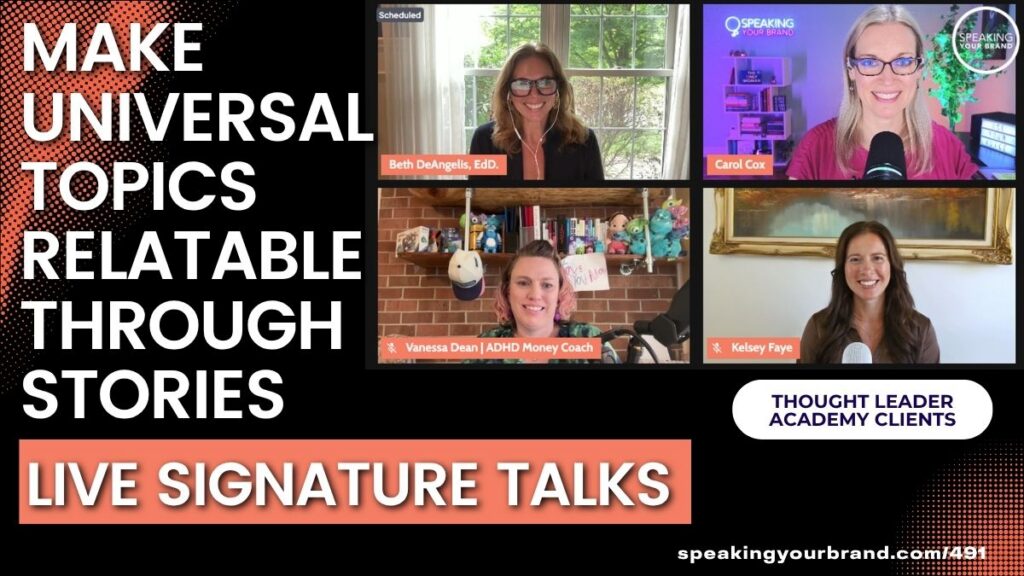
They Took the Stage at Our Speaking Retreat. What Happened Next? with Diane Diaz: Podcast Ep. 488
Subscribe to the podcast!


What stays with you after a speaking retreat – once the filming is over, the notes are back in your hands, and you’re home again?
We could tell you what happens at one of our in-person speaking retreats and workshops.
Instead, our lead speaking coach Diane Diaz sits down with three women who experienced it: scientist and registered dietitian Dr. Karen Corbin, physician and health equity consultant Dr. Nicole Rochester, and emotional freedom and forgiveness coach Brenda Reiss.
They talk candidly about having to practice without their notes, watching themselves on video, learning to use stories and props, and getting immediate feedback from a room full of women who wanted them to succeed.
What I love most about this conversation is what happened next.
Nicole changed how she delivers talks and brought a much more personal story to a medical conference.
Brenda learned to trust herself and let more of the real person behind her expertise come through.
Karen became even more committed to helping scientists use story and personality to become trusted voices.
Their experiences are different, but the thread is the same: when you stop trying to get every word right, you create more room for the audience to connect with you.
You can watch the video at https://www.youtube.com/live/rmXYSCCoz-A.
About Us: The Speaking Your Brand podcast is hosted by Carol Cox. At Speaking Your Brand, we help women entrepreneurs and professionals clarify their brand message and story, create their signature talks, and develop their thought leadership platforms. Our mission is to get more women in positions of influence and power because it’s through women’s stories, voices, and visibility that we challenge the status quo and change existing systems. Check out our coaching programs at https://www.speakingyourbrand.com.
Links:
Show notes at https://www.speakingyourbrand.com/488/
Watch the video at https://www.youtube.com/live/rmXYSCCoz-A
Discover your Speaker Archetype by taking our free quiz at https://www.speakingyourbrand.com/quiz/
Learn about our in-person speaking retreat: https://www.speakingyourbrand.com/live/
Learn about our online Thought Leader Academy: https://www.speakingyourbrand.com/academy/
Connect on LinkedIn:
- Carol Cox = https://www.linkedin.com/in/carolcox
- Diane Diaz = https://www.linkedin.com/in/dianediaz
- Nicole Rochester = https://www.linkedin.com/in/nicole-rochester-md/
- Karen Corbin = https://www.linkedin.com/in/karen-corbin-phd-rd-75229111/
- Brenda Reiss = https://www.linkedin.com/in/brendareiss/
Related Podcast Episodes:
- Episode 411: Reframing Public Speaking: From Elite Skill to Everyday Power with Dr. Karen Corbin
- Episode 329: From Compelled to Take Action to TEDx Speaker with Dr. Nicole Rochester
- Episode 347: The Power of REAL Practice to Transform Yourself as a Speaker
- Episode 385: Leading with Story in Your Talks [Roundtable]
488-SYB-Retreat-Clients.mp3: Audio automatically transcribed by Sonix
488-SYB-Retreat-Clients.mp3: this mp3 audio file was automatically transcribed by Sonix with the best speech-to-text algorithms. This transcript may contain errors.
Diane Diaz:
Hi everyone. Welcome to backstage at Speaking Your Brand. So let me ask you a question. Have you ever had the feeling that there is more that you want to say, or maybe a bigger way that you want to show up with your voice and your message, but you just haven’t given yourself the time or the space to really work on that message, or start figuring out how to deliver that message. Well, that is one of the reasons we love bringing women together in person for our speaking your brand retreats and workshops. And there is something very different about stepping away from the day to day of your business, the day to day of the work that you’re doing and saying, you know what? For the next few days, I’m going to give my voice, my message, and my speaking the attention that they deserve. And I’m sure if you’ve had that feeling that you have something to say, you probably know what I’m talking about. But rather than us just telling you what that experience is like, which I could do all day long, I’d love to have you listen to some guests that we have here today who have actually lived this experience. And even more, more importantly than, you know, living it is what happened afterward.
Diane Diaz:
So we’re going to get to that in just a minute, but we’re going to talk about what changed in their confidence, their speaking, their visibility, their opportunities, and what has stayed with them long after the retreat, long after they left the room. So we’re going to go into all of that today with three wonderful guests. So let me take a moment to introduce each of them. We have Karen Corbin, who is a doctor. Karen Corbin, I should say. Let me get that right. She earned that. I need to say it. Karen is a scientist, a registered dietitian, a researcher, and a speaker whose work focuses on human nutrition and metabolism. One of the things that I have loved watching Karen do over these years that she’s worked with us, is take incredibly complex topics, scientific ideas, and turn them into stories and messages that people can actually relate to, understand and use. She has also. She’s also become a passionate advocate for scientific storytelling through her work with Geeks That Speak, which is a clever name and I love it. And she’s taken her speaking to some pretty impressive stages. So, Karen, I am so happy that you’re here.
Karen Corbin:
Thank you for having me.
Diane Diaz:
And then we have Doctor Nicole Rochester. Nicole is a physician, a health advocate, health equity consultant and professional speaker through her company your GPS doc, another clever name. She helps patients and families navigate the healthcare system while also working with organizations to address, address health inequities and to improve the patient experience. So important, as I’m sure we all know, and she has grown significantly as a speaker, including becoming a TEDx speaker and bringing her message to organizations and audiences all around the country. So, Nicole, welcome. Glad to have you today.
Nicole Rochester:
Thank you Diane. I’m excited to be here. Thanks for having me.
Diane Diaz:
Oh, you’re so welcome. And then last but absolutely not least, we have Brenda Reiss. Brenda is an emotional freedom and forgiveness coach, speaker and two time author and host of the Forgive Yourself podcast, which, if you don’t listen, highly recommend her work helps women release old patterns, reconnect with themselves, and create lives with greater trust, self-trust, and emotional freedom. Brenda has also been sharing that message from the stage for many years, and I have had the privilege of watching her develop not just as a speaker, but also as someone who is willing to bring deeply personal message to her audiences. Brenda, welcome. So glad that you could be here.
Brenda Reiss:
Oh, I’m really happy to be here. Thank you.
Diane Diaz:
Oh, good. All right, ladies, well, let’s start with kind of the obvious. So I talked about we do these in-person retreat experiences and these in-person workshops. So I want to talk a little bit about why you decided to come to the in-person experience. Karen, let me start with you. So think back to when you first decided to attend the workshop. What was going on with your speaking at that time and what made you feel like, you know, I actually need to get some focused attention on this.
Karen Corbin:
That’s a great question. I’ve been working with you and Carol for almost a decade now in various capacity. So I did the, um, the thing where we built my whole signature talk. And then I’ve done some individual coaching for very specific things. But your workshop came around the time when I was doing two things. I was writing a children’s book, so I wanted to get my story around that solidified. And then I was also going on a pretty big stage where I knew some of the speakers were kind of like celebrities in the medical field, and I knew that I needed to really hone in my storytelling game. So that’s why I decided to come join the retreat.
Diane Diaz:
Yes, I forgot about the children’s book, so I’m glad you mentioned that. That’s such a nice little thing to remember about. Um, Nicole, what about you? What were you hoping to get out of the experience when you signed up for the the retreat? And was there something specific that you wanted to work on or figure out by coming?
Nicole Rochester:
So I had been in the speaking your brand universe, so to speak, for years, you know, like kind of like Karen said. And I was an avid and still am avid podcast listener and have been waiting for the opportunity to kind of get more up close and personal with you and Carol. And finally, it worked out where I was able to attend. I also had realized that at that time, my talks were really good, but they they didn’t infuse a lot of me like they were, you know, I would I was really good at sharing data, sharing facts. I always insert some storytelling, but I feel like I was leaving out a lot of who I am. And so I really wanted to attend the workshop and the retreat so that I could get better at showing up more authentically on stage. And you all helped me to absolutely do that.
Diane Diaz:
Yes. And I remember a few things in particular, which we’ll get to in just a moment, that helped you to achieve that, which will we’ll talk about, because I think it’s important to give the audience some some concrete things that they can expect from these in-person experiences. Brenda, what about your decision? What made an in-person retreat or workshop feel like the right next step for you at that moment?
Brenda Reiss:
It was it came at a beautiful time because I had been in the universe. I love that Nicole and Karen to like them, and I had done all of that thought leadership. You know, the thing for me at that time was I was getting ready for a keynote and I needed to share my personal story. Now I’m real good at teaching y’all stuff, right? And. And I have a natural ability for speaking. I can be articulate. I was told that. Right. Yet there’s a difference of teaching and sharing a story and being able to know how to do that on stage. And I had also been really dependent upon my safety, my notes. Right. I’m sure we’ll.
Speaker 5:
Get into that. Yes.
Brenda Reiss:
And you know, and so yeah, so I was like, I just, I wanted to show up. Well, like Nicole said so, well, authentically. And I wanted to be able to present this keynote from the heart, you know, not just from my expertise, but from more of this, you know, well, as you guys do, the thought leadership. And that’s where I finally you, it just came at the right time. It’s like, okay, I’m going to go scared to death, but I’m going to go and do it.
Diane Diaz:
Yes. Yes. Well, I’m glad you shared that. It’s it is a uniquely different thing to be able to teach someone else, but then to get on the stage, bare your soul, be vulnerable, and tell your story. That’s hard, right? And it’s it does take I mean, obviously, I believe that it takes actually doing it to be able to do it. Right. And so that’s the beauty of the in-person experience. You can actually do the thing. And so to that point, and since the notes have come up a couple of times, a couple of times, let’s touch on that, because what I want to talk about is what you expected coming into it. And then what actually happened. So Nicole, maybe we start with you because the notes are going to come up, but let’s just start with maybe what did you expect it to be like? And then what did it end up being like?
Nicole Rochester:
Yeah, I don’t know what I expected that I was going to walk away with gems. Like I knew that you and Carol and the team were going to do an amazing job helping me be more comfortable on stage, and I was excited about the opportunity to get like a speaker reel and all those things. So I knew that that was going to happen. What I what I didn’t expect is, one, developing friendships with women that I never knew. Brenda was in that same retreat. Um, I was, I wasn’t expecting that because it was a short like 2 or 3 day event. So I wasn’t expecting to, um, learn so much about the other women and develop these close bonds. And I definitely wasn’t expecting to have my notes taken away from me on the very, like the second day. I wasn’t expecting that.
Diane Diaz:
And, and so since we did so, so for everybody listening and watching, um, we do practices of portions of the talk that you work on and almost everyone takes notes up on the stage with them. And then of course, Carol and I, we know that you know your story and, but it is natural, of course, to think, oh, no, I have to have my notes. I mean, that’s we all start there, right? Um, so we take the notes away. And so while that might sound terrifying, don’t let that stop you from coming to the retreat. That might sound terrifying, but Nicole, talk talk us through a little bit about what changed once we took the notes away.
Nicole Rochester:
I, I had not, you know, I had been speaking for years before I attended this retreat. So I was not like a novice. And that Ted talk you mentioned, I had already done the Ted talk. So but but I and of course, in a Ted talk, you can’t rely on notes. But honestly, that was like a harrowing experience trying to memorize that talk. So right after I did Ted, I went right back to my handy dandy. You know, I had my notes and it’s not like I would be on stage like, and next we are, you know, I wasn’t like reading, but they were, um, definitely like a safety net. And I had not appreciated how much I relied on my notes. But also, like you said, with the storytelling, how much I already knew my story. And so to be very frank, I was not happy when Carol was like, give me your phone, because I felt like I needed more time. We always feel like we need more time, more practice. And once she took that crutch away, I, I mean, I still felt like I didn’t do a great job, but you all like the response in the room was like, oh my gosh. And it was that way for every other speaker as well. So I, um, I really haven’t gone back to notes. You know, I have them as just like, if I need to refer to statistics and things like that, but that weekend completely transformed how I deliver talks like completely.
Diane Diaz:
Oh, I’m so happy to hear that because I think and then I’m going to, I’m going to ask you about this as well, Brenda, but I, I think that’s when you mentioned that you wanted more of yourself to come through. That’s what happens when we don’t rely on what is the exact order of words that we’re supposed to say and we rely on. Let me just tell my story. Right. And then your natural personality, your enthusiasm, your, you know, anything related to the story that can come through and then the audience feels it. And so that’s what happened that day. Like you said, for not just for you, but for all the women there. And so, Brenda, what was it like for you? What did you expect coming in? What? What did you actually experience?
Brenda Reiss:
So I was expecting to learn technique, right? Like on how to be on stage, because that’s the one thing that I wasn’t real comfortable with, or these props that I kept hearing about and this humor and this media, you know what I mean? So I was like, oh my God, how do you do all that? Right? I mean, I had watched you and, you know, we seen clips of you and Carol doing it and it’s like, well, you got it looks great. But I couldn’t do it or I didn’t feel like I could. So I came into that going, that’s what I wanted to learn, the technique. And I wanted to be able to hone in. I wanted, okay, I kind of wanted to let go of my notes kinda. But, you know, it was really funny. I what I also love too is we get to like when we’re practicing, we get to record ourselves on our own phone.
Diane Diaz:
Yes.
Brenda Reiss:
And I’m going to tell you how valuable that has been because like Nicole, what you were just talking about, like what I felt on the inside was like, oh, I really messed that up. But then the feedback that I hear on the recording and what I’m, what I remember, because I went back and I reviewed it and I’m like, oh, that’s not so bad.
Speaker 5:
Right?
Brenda Reiss:
But, but the frightened look I had on my face when Carol came up and took my notes. Oh my God. But then the difference between that and without them, it’s just like I watched with Nicole. I watched with the other women. It was like this transformation right in front of our eyes. And I remember feeling more confident.
Nicole Rochester:
Mhm.
Brenda Reiss:
And I didn’t move around on stage as much. Yes. Right. I mean, it was so because Carol said that. I mean, this is the beauty that you and Carol give is you guys give us that immediate feedback, right? And that’s what I got. And that we got to we got to practice right there. So it’s not like let’s do it later or tomorrow. It was like, Brenda, now try this. And what I noticed because Carol, she said, I think your feet are attached to your notes. And I was like, no, right. I didn’t realize how much I was moving, how uncomfortable. And, and then when she took it away, it was like, oh, I stayed more centered. And it was, yeah, it was these little things like that, that we and that each other, we each other got to give to, because that was even really powerful was the immediate feedback from the group. Like I didn’t, I could what did you mean by that? You know, or that kind of thing or like I remember with Nicole really encouraging her to go. Ahead and go deeper into the story. Right. Because we were trying to stay. All together, you know, put together. And when you get that okayness from. These women, it makes you feel like, oh, I’m safe. I can do that.
Diane Diaz:
Yeah. It’s validation. Right? Of, you know, yeah, go deeper in the story because it’s really making an impact.
Brenda Reiss:
So yeah.
Diane Diaz:
And Karen, what about you? What were your expectations coming into it and how did that play out?
Karen Corbin:
So I had a different experience because I went to the one that was all in one day, which is kind of like probably everything Nicole and Brenda went through, but just a lot faster. And we never even got notes. We were essentially improvising a story without having prepared for it at all, which also was terrifying. But I was very much expecting, like everyone said, to learn, and I actually was expecting to make friends because I’ve gone to many speaking your brand things, and I have probably like half a dozen friends of these amazing women that I’ve met because Carol and Diane attract purpose driven women and purpose women driven women like to hang out together. So I definitely was already expecting that, but I wasn’t expecting to just have to go into improv and to try to do comedy. Um, yeah, that was, uh, that was a lot. Um.
Diane Diaz:
You know, you want to do a comedy set? I know about you.
Karen Corbin:
We talked about.
Diane Diaz:
This.
Karen Corbin:
Maybe doing the same event that you did. Um, we’ll see.
Diane Diaz:
Okay.
Karen Corbin:
I did, um, you know, really appreciate having that feedback. Like everybody said, not just from Diane and Carol, but just from the audience members that were kind of getting some clarification or saying, oh, I really like that. Um, and I also want to kind of restate because I also mostly communicate technical things from my day job as a scientist, but I do very much like to communicate also inspiring stories. And so there is a different way of approaching communicating scientific data versus a keynote lecture. And that was really something that I honed in a little bit more at that retreat.
Diane Diaz:
That’s a really great point, Karen. So to anybody listening who speaks on a very technical topic, maybe this is good insight as to, you know, yes, of course you’re giving technical information, but there is a way to wrap story into it so that it resonates with the audience on a deeper level. Right. And I think that that’s maybe I know because I come from a corporate background where it’s, you know, corporate PowerPoints and everything, and we forget that we can actually put story in there to make an impact on the audience. So just keep that in mind. If you’re listening to this and you’re thinking, well, my topic is very technical, that doesn’t really apply to me. It does. You can still tell stories and you can still make a connection. And Karen is a prime example of that. Yeah.
Karen Corbin:
And I think that the difference is that people think, oh, in science there are no stories because it’s, you know, it’s data. But the story piece isn’t about making stuff up and make believe. It’s about connecting things in a way that makes it easier to learn and, and for people to get excited about it. Because if you have the most brilliant data, but you bore everybody and they go to sleep, it’s not going to have the same impact as if you really get people behind the work and some of the nuances of the work. So that’s, you know, what I try to train all my science colleagues to do is to, to kind of get rid of that. You have to just be up there and be like all serious and like, who wants a whole conference with very serious, boring people? Like literally no one. But that’s how we were trained in the olden days. It was like, yeah, and I’m trying to break that mold because I just can’t not have a personality. It’s just not possible.
Diane Diaz:
Good for you. I love it so. So you can be the model for the scientific and the technical community to put more stories, you know, put more humor and really connect with the audience. Now I’m curious to what was it like to be filmed? I know that. So for Nicole and Brenda, we filmed segments of your talk and then Karen, you filmed yourself. And then of course we had photography there as well. But Nicole, maybe we can start with you. What was it like to be filmed while you’re delivering? Was, you know, was it nerve wracking or how did you feel about that?
Nicole Rochester:
Yeah, I think when, when you all said that we were going to be filmed, I do remember feeling a little nervous about it. But then I immediately also felt grateful because like, like Brenda shared, like, you get that feedback, you know, that’s, that’s information that we’re able, I was able to go back and look and, you know, of course, we’re always our worst critics. But being able to go back and look and say, oh, that wasn’t that bad, or even like, oh, okay, I can change this. Or, you know, I was fidgeting a little bit here. So it was incredibly important and it was very useful data. Since then, I have filmed myself. I never really loved doing it, but when I’m practicing a talk, I will film myself just to kind of see, you know, how, how it’s looking, how it’s sounding. So I think that was definitely an added benefit.
Diane Diaz:
Yeah. And it’s also great to get that footage so you can start building a speaker reel. So whenever you’re speaking somewhere, you know, even if I think everybody dislikes the way they sound when they hear their own voice, everybody dislikes or is at least critical of themselves when they see themselves on camera. You know, video or photography or whatever. I think that’s probably most people, but it’s great to get footage of yourself speaking, whether it’s at our retreat when you do your speaking engagements, because those can become part of your speaker reel, which if you’re trying to pitch yourself for bigger engagements you’re going to need. So that’s great. And it gives you feedback. You can go back and watch it and you can see what you can improve. Um, Brenda, what was it like for you to be filmed at the retreat? Especially when we did the filming with the, with the film crew.
Brenda Reiss:
Yeah. That was a little bit more nerve wracking, right? So my little perfectionist came up.
Diane Diaz:
Mhm.
Brenda Reiss:
You know, and so what was really fun was when you’re with these women, because it’s a, it’s a big enough group, a small enough group, right to where you feel comfortable. But everybody felt the same, you know? So it there’s that, that piece for me, it’s like a safety thing. It’s kind of like, oh, it’s okay. And, and then so then the filming got. And then when you’re looking at familiar faces that you’ve been with, I’m sorry about the one day thing, Karen. I don’t know if.
Diane Diaz:
She handled it like a champ, though. Let me tell you, she was in.
Brenda Reiss:
I bet she did. But this, you know, two and a half day or whatever this what you know, it was you form bonds in there so quickly that when it came to the filming, then I’m looking at familiar faces. And it’s so interesting how we create these bonds and, and how we evolve, right? Just in a couple days. And so that it felt better. And then the after, like getting the, the, you know, professional photography compared to just my own little camera was it’s like, oh, wow, this, this sounds and looks great and I’m not so bad. I’m okay. I could use this. I mean, it was hilarious because I remember feeling so nervous. But again, what we feel isn’t necessarily what’s being projected, right. You know, and that’s a good thing.
Diane Diaz:
Mhm. That’s such a good point because I think it’s very validating to see yourself, you know, you get the response from the other women there, and then you see yourself whether you took it on your own camera or it’s the film crew, you see it and it’s sort of validating of, you know, okay, you still may be a little critical, but it’s like, you know, actually that’s pretty good. I’m pretty good at this. Right? And then it’s, it’s, it’s so validating of the fact that you need to be out there delivering this message. And so, Karen, let me ask you then, because we’ve been talking about the community and the other women that are there, um, is there anything about hearing the other women’s stories or watching breakthroughs that they had during that, that day that affected your own experience or gave you some kind of insight?
Karen Corbin:
Oh, absolutely. We had people in that room that really had never spoken before. And then other people that have been doing it for years and years and years, and the amount of transformation I saw just in one day, and the confidence and in the development of the story was really inspiring. I think my favorite example is, um, Christina, who was in my class and she, That was really, I think, her first time on stage. And now she’s written two books. She’s on the interwebs all the time doing reels and talking. And I’m so happy too, because what she does is so transformational for the kids that she works with, that she needed to be out there telling the story. So I think when you bring in purpose driven women that are telling stories not to sell something, but because they have a purpose, they have something really to do to benefit society. It just it’s such a beautiful experience to see.
Diane Diaz:
Yeah, that’s a that’s a great observation. And thank you for sharing that story too, because I think, you know, obviously we do thought Leader Academy, it’s online, but when you come in person to something and you can actually witness another woman having that transformation, I think it is validation for yourself, but it’s also inspiration. And then we know, oh my gosh, look what this other woman did, you know, and we can benefit from that as well and feel more confident and sort of we sort of like share each other’s confidence, right. So I think that’s kind of the the beauty and the value of being in person. And, you know, we do try to replicate that in Thought Leader Academy, but there’s something unique to being physically in person with one another. And that’s why we do these retreats. So, um, so let me ask you all this. I want to talk about sort of what you learned that has stayed with you. I know, Nicole, you said that that you learned things that have stayed with you to this day. So is there anything that is sort of become part of the way that you prepare or the way that you show up or think as a speaker now that you kind of got from having come to the retreat?
Nicole Rochester:
Yeah, I the first big keynote talk that I gave after the retreat was, um, at a medical conference and they asked the talk was called the elephant in the exam room, what your doctor wishes you knew. And they in this community of individuals with immune deficiencies who have had to like, fight to get a diagnosis. They wanted me to share the doctor’s perspective and what we go through. And I was very reluctant because I’m like, no, like, I usually I’m a physician, but I’m a health advocate, patient advocate. So I like to speak on the, on the side of advocating for the patients, but they really wanted me to bring them behind the scenes. And so I was extremely vulnerable. Just so happened when I gave this keynote, I was very recently divorced, and I even incorporated that. And essentially the message was that, you know, your doctor has a whole other life that that you don’t know about, you know, like we’re bringing in our own traumas and it’s not to make excuses, but the whole talk was humanizing physicians and health care providers. And I had never used props on stage, but I had found a mask and again, all inspired by the retreat. And so at the end, I literally put a mask over my head and I introduced myself in a very kind of regimented doctor way with a mask on. And then I physically removed the mask and introduced myself as like Nicole the human, the mom, the recent divorcee.
Nicole Rochester:
And not only did I get a standing ovation, but there was a line of people, some of whom literally said, I just want to hug you. And I had never had that experience before. Like the next talk was, uh, you know, coming. And they literally had to ask us, like, can you all just kind of move over to the side? But there were like, there was a long line of people who wanted to just share how much it there was a woman in the audience who hand wrote a thank you note. Um, you know, to thank me for that. So, and again, these are things I had never experienced. So I now, like, that’s just a part of what I, how I show up. Um, also I, without really trying to memorize it, I had essentially memorized the talk. And one thing I tell my, one of my good friends who’s also a speaker is that your. The retreat and that experience taught me that I can create presentations where every time I give it. Like if I were to give that talk again, it would be a little bit different. And if I give it again, it’s going to be a little bit different, but it’s still the same talk at its core. But it’s because I’m not relying on scripts and notes and all of those things. So yeah, there was an immediate payoff.
Diane Diaz:
Oh, thank you for sharing that story because that is so I think, you know, we obviously we want to share information, but I think the biggest thing we can do is really touch people. Right. And you did that, obviously, and that, I mean, that’s the best thing we could ask for as a speaker is to get obviously a standing ovation, but also have people come up to us afterwards and they’ve really connected with our message and our story. And, and also kudos to you for using props, I love it. So you really did take something with you. I love it, I love it, I love it that and that was brilliant to, to do that that way. So thank you for sharing that. I’m just so glad that that you had that impact on the audience. And what an amazing thing for them as well to have gotten that experience. So Brenda, has there been after attending the retreat, has there been some kind of a mindset shift or change in your technique or some sort of realization that has stayed with you?
Brenda Reiss:
There has because reflecting on it, it was I learned to trust myself on a on a different level, right? Because, I mean, I knew my stuff and you could see it. You could you could see when I was just asked flat out, I’m like, well, here it is. But when you know, when you want to film me, I’m like, um, okay. Well, um, and so learning there to trust myself that you know, this and getting this loving feedback from these women, like you could see a difference. I could feel a difference and you could see a difference. And then also learning how to use the props. That was really valuable because that’s not something people were talking about, right? You learn to speak, but nobody was talking about how to use all this stuff. Now, I haven’t ventured out and done media in a talk yet, except for online. Right. Because you guys are brave. I’m not there yet, but the prop like learning how like I have that mirror, right? The mirror thing that I teach and learning, getting the feedback from the women on when to use it, how to use it so it doesn’t look so like this is the mirror.
Brenda Reiss:
I mean, it was hilarious. I’m like looking at myself going, oh, this is just awful. But learning how to use it like Nicole just did with the mask, you know, just learning how to naturally put it. And the other piece that I do want to say is that it did being in person with these women different than online is that you could be face to face. You could. We engaged for two and a half. I mean, literally engage with each other and then being able to have the little conversations on the side that really helped going. You know, Brenda, you touched me here, or Nicole and I shared a story, you know, about dementia and about different things that we could talk about that really enriched how we showed up. And you. That’s not that that’s in person, if that makes sense. Yes. And that’s what I learned. I took that away. And I add that now because it helped my confidence and it helped me enrich my own stories.
Diane Diaz:
Mhm. That’s so beautifully put. Thank you. And Karen, what about you? Is there something that is there maybe something that Carol and I have maybe said at the workshop that pops into your head and you remember something, a tip or something we said that comes back while you’re speaking or practicing or.
Karen Corbin:
Yeah, I can think of one tip and then one other thing. So one thing that actually Carol just told me two days ago, I think is taking more pauses because that allows the audience to sort of let the message percolate. It gives you a chance to breathe, which is kind of nice. And, and it can just, they can be very powerful if you’re really conscious of, of taking those pauses. But sort of a more overall thing was this idea of authenticity and how everybody was just bringing their authentic selves to the stage. And I feel like I’m generally fairly authentic, but I had never done keynotes or inspirational talks until like the past few years. And that’s where you really have to be willing to, to let them know, not just, you know, how many letters you have after your name or how smart you are, but who you are. And, and that really resonates with people because when the audience is invested in you. They’re more likely to really pay attention and listening rather than, oh, here’s somebody else talking and somebody else talking. So I, I try really hard to think about who’s in that room and, and bringing something in that’s going to, um, get them to really engage with me as a human. And then everything else I have to say then lands a lot better because they have that connection with me.
Diane Diaz:
Oh, that is such a great point. And I think that’s, that’s probably one of the one of the more prevalent things that comes up when we’re working with our clients is that why should I tell my story? Right. Well, if I’m especially if I’m speaking about something technical, why does my story matter? Right. But you’re right. I mean, you have to connect with the audience. And then if you connect with them, it is going to make a bigger impact on them. And I’m glad you mentioned pausing because I think that’s, that’s another thing that we say a lot, but I think it’s a little bit hard to practice not in person, but when you’re in person. And as you know, Karen, you’re standing on the stage and if you didn’t do this. But if someone is just rambling on and then at the end we’re like, okay, hold on a second, now let’s go through this. And we have, you know, we talked to you about pausing, taking a moment, letting the audience hear it. Right. And because we want to give them everything. And so we’re talking really fast, but they need a minute to absorb it. And we need a minute for, you know, to kind of collect our thoughts, you know, what are we on to next? But it’s pausing is so powerful and it can emphasize very important points. So that is one of the things that we work on at the retreat is the speaking techniques like pausing or using the stage or not using your notes, right? So we work on all of those things, and then it will make for a much more impactful and effective talk for sure. So okay, so now let’s shift a little bit and let’s talk about kind of what you all are doing now. So, um, Karen, uh, your evolution has been super interesting because you do come from science research and that sort of a background. Um, and as you mentioned, your, your job has been to give people information, but when did you start seeing yourself not just as a scientist who gives presentations, but as a speaker and as a storyteller?
Karen Corbin:
I think it all started when I really was hit in the face with how much misinformation my patients came in with when I was in the clinic as a dietician, and seeing that blossom into, uh, even more constant misinformation, particularly about health, but many other things and feeling like it was my duty, given the privilege of knowledge that I have to help people who want to be helped, who want to actually do the thing that’s going to help them to, to teach them how to interpret that information and what the latest studies are actually showing. You know, outside the academic institution, two different types of audiences. And even when I give keynotes that are more about my story, I’m always going to throw in some science in there and teach people something because I can’t help myself. So I think that’s been, you know, the biggest shift for me is, is from, oh, you’re forced to give presentations when you’re a scientist because it’s your job to it’s my duty to help people learn how to interpret and use discoveries to the benefit of themselves and their families.
Diane Diaz:
Yes. Great point. And as you mentioned, the storytelling helps that. Yes.
Karen Corbin:
Oh, absolutely.
Diane Diaz:
Yeah. Yeah. Because I think, you know, especially if you’re talking to, let’s call them laypeople, right? Non-scientists, we need a reason to care. Right? So I think the story does that and it brings us into it. And so then we there’s a greater chance that we’ll accept it and, and take it on, take it in, you know, internally then if we’re just quoted all these statistics, right. So I think you’ve probably come to realize that a lot in science, right?
Karen Corbin:
Absolutely. It’s it’s the difference between knowing a lot of stuff and becoming a trusted voice, somebody that people want to come and hear because they, they know that you’re not just smart, but that you care. Um, that’s been really transformational for me. And I really have this sort of burning desire to not just be a trusted voice myself, but to help as many other scientists who want to take on those stages, to be trusted voices and sort of rise above the noise of, um, influencers who may or may not know what they’re telling you about. Um, it’s just become kind of a lifelong mission for me, and you can’t do that without using elements of storytelling. And by the way, even when I am giving a very technical talk, even though I might not talk about my personal story, there are still elements of storytelling that help even very heavy data presentations. So I think it’s really figuring out which type of storytelling techniques you need for which audience. And I’ve learned so much of that working with you guys.
Diane Diaz:
Oh, I’m so happy to hear that because I love that. I love that you pointed out that you’re not only impacting, you know, the, the lay audience by helping them digest this information through stories, but you’re actually giving permission to other scientists to do this differently so that they can sort of, you know, cut through the noise of all the misinformation out there. So I think you’re doing a service to both audiences, which is great, I love that. See what story telling can do for people, I love it. So Nicole, your speaking has grown substantially over the years, including your TEDx experience. Um, at what point did you begin seeing speaking as a vehicle for expanding your impact and not just something that you did as part of your work?
Nicole Rochester:
That’s a good question. When I first started my health advocacy company, I knew that a lot of individuals would never be able to afford me. Like, in fact, the people who need this information the most are often those in marginalized communities who may not be able to hire a private advocate. So speaking was always a part of my, my business model. Um, but it started out just like doing videos on back, back when Facebook Live was a thing. And, um, you know, speaking and mostly like lowly paid or free. And it was more like a service. Like I think I saw speaking as a service to the community. And I do still feel that way, but eventually I saw that speaking could also be a revenue generator for my business. And so going from speaking for free to, you know, speaking for a few hundred dollars to then just constantly, you know, raising my price and having people say yes and recognizing that it’s, it’s still a service. But now I can also get paid to do it. And that also always fuels my desire to improve and to just get better and better at the craft. Um, so yeah, it’s been, I knew that I would, I knew that speaking would be part of what I do and I was the person probably you all to Karen and Brenda who the 1AI couldn’t get in school was like, you know, behavior because I always talk too much. So I was, I was the child that always had the little comments on the report card about talking too much. So I always laugh that now I get paid to do something that I used to get in trouble for.
Diane Diaz:
I love that. I love that. Well then obviously speaking comes very naturally to you, but has it also helped you see yourself more in like in a different light, more like in your professional life. Has speaking helped you look at yourself differently?
Nicole Rochester:
I think so. You know, I’ve always been pretty confident. Um, but I but speaking professionally has definitely raised my level of confidence. And like Brenda said, this idea of trusting myself, that also goes back to taking away the notes. I, you know, in medicine, everything is very algorithmic. And so I can follow a path. You tell me what to do, I do it, you tell me I have a test to study for. I’ll study for it, I’ll pass it. I’ll do well. But speaking and especially working with you and Carol, it’s forced me to, um, probably honestly reconnect with the former version of myself before I became so regimented and all of those things. So I feel like I’m more in touch with, like, the playful side of me and, and being able to even in life, just, uh, not be so tied to like the outcomes. I think in general speaking has allowed me to be more free. If I were to just summarize it.
Diane Diaz:
Oh, that’s so beautiful, I love that. Well, that leads me to Brenda, which kind of is a nice tie in because, Brenda, your work actually requires kind of a different kind of vulnerability, obviously, because you’re speaking about forgiveness and emotional freedom and all of that. So how has your relationship with sharing your own stories changed as you’ve grown as a speaker?
Brenda Reiss:
So having more of the trusting of myself and having learning through the process that we’ve gone through, it helped. It has helped me to deepen. Because what I also realized was feedback isn’t like the it’s not the devil. Feedback is actually good. Feedback is good. Some people don’t give it very well sometimes, but but the feedback given is really what helps me to trust myself even more and understanding like from that, I was going to say from that in person when we went for those couple days, it really helped me understand that each of our stories are so valuable because I was discounting mine. Right. And, but hearing these other women, like I said, even these offshoot conversations when we would have these, it was like, you look at each other and go, wow, your story is powerful. And you’re going. It is. I mean, it was just it was amazing to do that. So from there, then it was like, okay, maybe, maybe it is. I’ve got something here. So what I’ve learned to do over these last few years is be able to go into that more vulnerability. And like, I really went through a huge vulnerability last year and I was able to talk about it on the podcast because I’m using my that as my speaking platform, and I was able to really be honest and truthful with what I was going through, which wasn’t comfortable.
Brenda Reiss:
And I had so many women contact me for the first time in the couple years that I’ve been doing my podcast, and that’s when I realized I hadn’t been being more me, more the real me. I had been teaching, I had been doing, I had been sharing stories, but something had shifted within me that gave me permission to go. Forget it. I gotta be real, right? And, and since then, it’s been like, you know, I took all that things that I’ve learned and the feedback I received and I just went, okay, here I am. And that deepened my ability to tell more of my story. And like, like Karen said, because then people can relate to me now there’s no wall up anymore. And you know, like that professional like, like Nicole was saying that people expect you to be a certain way. I expected myself to be a certain way. And how many of us purpose driven. I love that Karen do that. We expect we have the mask on and let’s just take them off. And that’s what I learned to do through this whole process with you and Carol and these other women that I got to get to know is like, okay, I’m pretty powerful as me, right? Yeah. Where I was questioning it before.
Diane Diaz:
Sure. Yeah. Oh, thank you for sharing that. I think that’s probably one of the most beautiful things about the in-person experience is, you know, well, at least from Carol and I’s standpoint, kind of look, you know, seeing everyone as they’re going through this experience, the transformation that they have, not just from a confidence standpoint from, but from how they see themselves and how they come across and that they do open up more. Even anyone who comes in who’s maybe a little bit more reserved, you know, comes out of their shell a little bit more. Everyone kind of becomes more of who they are because I think because it feels like a safe space, right? Because you’re not going to do that if it doesn’t feel safe. Um, and so I love that you all have brought that feeling with you after even leaving the retreat and years later to the work you do to the speaking to your audiences, because I think it also gives people permission to do the same thing. So, so thank you for sharing that. So let’s close with a quick question. So I’m going to give you a sentence and I want you to finish it. So we’ll start with you. Karen speaking became different for me when I realized what.
Karen Corbin:
That being authentic and connecting with my audience would allow me to share not just technical information, but also ways to inspire people. Because our stories really do matter who we are, what we’ve lived through. Sometimes we think our stories are boring and I’m giving you a whole paragraph, but you know, that’s okay. That’s okay. Keep talking. But we think our stories are, like, boring or not interesting, but you don’t know how many times I’ve shared something in a room where somebody will come up with me and said, I went through the exact same thing. And it’s not like a big drama, like huge story, just the little stories that I’ve gone through to going from a very quiet. So no, Nicole, I was not getting written up for talking too much. I was actually very quiet because I had an accent when I moved here, and I was scared to talk. His kids made fun of me. So going from that to what I do now, that transformation has helped a lot of women see like, oh, I have something to say to when I used to be scared and now I’m not scared. And that’s all because of this idea of connecting authentically. So there’s your 25 sentences.
Diane Diaz:
Wonderful, I love it. Thank you. Okay, Nicole, what about you? Speaking became different from me when I realized what speaking.
Nicole Rochester:
Became different for me when I realized that vulnerability is my superpower.
Diane Diaz:
Oh.
Karen Corbin:
Ooh, nice.
Diane Diaz:
I love that. That’s so good.
Speaker 6:
Thank you.
Diane Diaz:
Yes. Okay. Well, Brenda. Then I’ll throw it to you. Speaking became different from me when I realized what?
Brenda Reiss:
That the more that I trust myself, the more real I can be. And that’s really connecting to other people. Like, I really can’t connect to others until I’m real with me. And once I learn to let that mask down in my speaking, um, and be authentic. So I’m in, I’m in between Karen and Nicole here. Um, that that’s really what helped me. It’s like, oh my gosh, if I trust myself, then I know that what I have to say is going to connect with somebody. And that’s what’s really important because then they can say, oh yeah, I get that. And that helps them too.
Diane Diaz:
Yes, I love it. You all are so wonderful. Well, Karen, Nicole, Brenda, thank you so much for coming on the backstage at speaking your brand, talking about your experience. This is exactly why I wanted to have this conversation so that everyone can hear what it is like to be in person, but also what it does for you as speakers. Right. I think that’s so important. It’s easy for me and Carol to just talk about what happens during the, the retreat or the workshop. But I think it’s powerful to actually hear from women who have actually been there. And then to hear what happens when you step away and just finally give yourself and your message, you know, focused attention to work on that. And that is, that is what happens after you leave the room, the confidence you build the stories, you become more willing to tell the opportunities that you start saying yes to, and sometimes just beginning to see yourself differently as a speaker, which is so important. So for those of you who are listening, we are creating that experience again in February 2027 with another small group of women. So if you’ve been watching and listening and thinking, you know what? I’m ready to give my voice and my message that kind of attention, we will. We have put together a retreat for you, and you can get more information about everything about this retreat. Again, it’s happening in February 2027. You can visit speaking.com/live again, that is speaking yourbrand.com/live. Karen, Nicole and Brenda, thank you for coming back and sharing what the experience was like and for taking the time to share your stories to inspire all of our listeners. I really appreciate you all.
Nicole Rochester:
Thank you so much.
Brenda Reiss:
Thank you.
Diane Diaz:
All right, everyone, well, until next time. Thanks for listening.
About this transcript
This transcript comes from Sonix AI transcription, using English transcription software and mp3 transcription to turn recordings into text you can edit, search, and share. See automated transcription for details.
For the best results, good source audio matters as much as the AI. Start with these audio recording tips, then read this noise-cleanup walkthrough if your recording needs cleanup.
Want a transcript like this for your own audio or video? Create a free Sonix account and see our transcription cost guide when you’re ready to scale.