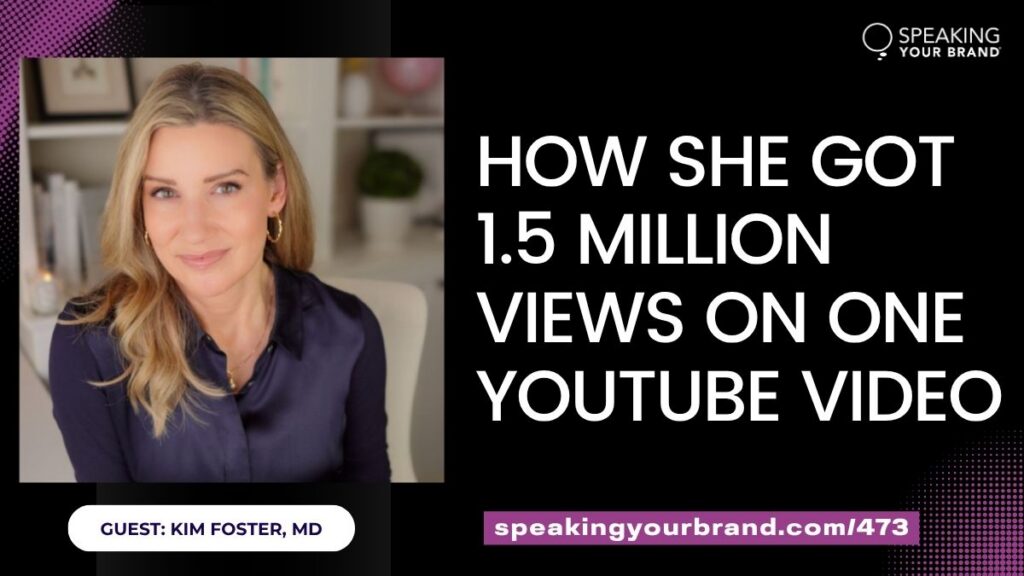
How Kim Foster Got 1.5M Views on Her YouTube Video (And What It Means for Your Visibility) with Dr. Kim Foster: Podcast Ep. 473
Subscribe to the podcast!


I love when I stumble across someone I know doing something big—and that’s exactly what happened with today’s guest.
I spotted one of our Thought Leader Academy grads Kim Foster on YouTube…with a video that had over 1.5 million views. Naturally, I wanted to know how she did it!
In this episode, Kim and I dig into what it really takes to grow a YouTube channel that drives visibility, trust, and clients.
She shares how consistency, smart content strategy, and paying attention to your audience can completely change the trajectory of your brand.
We also talk about her recent TEDx talk, her upcoming book, and why identity, not willpower, is the real key to transformation.
If you’ve been thinking about YouTube, speaking, or stepping more fully into your thought leadership, this conversation will give you a lot to think about.
About Our Guest: Dr. Kim Foster is an MD-turned–reinvention expert, author, and TEDx speaker who helps people change their lives by changing who they believe themselves to be. After 20 years practicing medicine, Kim left her career to build a global platform teaching the science of identity transformation. Her work blends behavioral psychology, personal development, and wellness, and she develops digital education programs that help people redesign their inner blueprint and build lives that actually reflect the person they’re becoming. Her thriving YouTube channel has grown to more than 250,000 subscribers and her forthcoming book, Redesigning You (June 2026), explores how to shift the beliefs and stories that shape behavior and destiny. Kim’s mission is to empower people to reinvent themselves at any age and step into who they were meant to become.
About Us: The Speaking Your Brand podcast is hosted by Carol Cox. At Speaking Your Brand, we help women entrepreneurs and professionals clarify their brand message and story, create their signature talks, and develop their thought leadership platforms. Our mission is to get more women in positions of influence and power because it’s through women’s stories, voices, and visibility that we challenge the status quo and change existing systems. Check out our coaching programs at https://www.speakingyourbrand.com.
Links:
Show notes at https://www.speakingyourbrand.com/473/
Kim’s website: https://drkimfoster.com/
Kim’s YouTube channel: https://www.youtube.com/@KimFosterMD
Kim’s book: https://drkimfoster.com/book
Kim’s TEDx talk: https://www.youtube.com/watch?v=F9P_ixAEV0M
Discover your Speaker Archetype by taking our free quiz at https://www.speakingyourbrand.com/quiz/
Enroll in our Thought Leader Academy: https://www.speakingyourbrand.com/academy/
Connect on LinkedIn:
- Carol Cox = https://www.linkedin.com/in/carolcox
- Kim Foster (guest) = https://www.linkedin.com/in/drkimfoster/
Related Podcast Episodes:
473-SYB-Kim-Foster.mp3: Audio automatically transcribed by Sonix
473-SYB-Kim-Foster.mp3: this mp3 audio file was automatically transcribed by Sonix with the best speech-to-text algorithms. This transcript may contain errors.
Carol Cox:
If you’ve been wondering whether you two should get into YouTube, this conversation may convince you. My guest is Kim Foster, who has grown her channel to hundreds of thousands of subscribers. We also talk about her recent TEDx talk and upcoming book. On this episode of the Speaking Your Brand podcast. Hey there and welcome to the Speaking Your Brand podcast. I’m your host, Carol Cox. Today I have a returning guest, Kim Foster, who’s a medical doctor turned reinvention expert. She’s also a TEDx speaker. As of this year. She’s the author of a forthcoming book, and she has amassed hundreds of thousands of subscribers on YouTube, including at least one video, maybe more, that has over 1.5 million views. As soon as I saw this and I chatted with Kim about a month ago on one of our Speaking Your Brand alumni calls, I knew I had to have her on the podcast to share the insights that she has learned about how to grow a YouTube channel and how it fits in with her business and her visibility. So we’re going to talk about YouTube and visibility. We’ll also dive into her TEDx talk and the book that she has coming out soon. Kim, welcome back to the podcast.
Kim Foster:
Thank you so much, Carol. It’s such a pleasure to be here chatting to you as always. But yeah, on the podcast again, this is great.
Carol Cox:
Well, you went through our Thought Leader Academy way back in 2023. So it’s been almost three years now and I really enjoy getting to know you. Then I’ll put a link in the show notes for that episode that you were on in the fall of 2023. And it just so happened this was about two months ago. I was on YouTube kind of checking the Speaking Your Brand YouTube channel, which is nowhere near the number of subscribers that you have, hence why we’re having this conversation. And I was probably looking at some like AI training video. And then, you know, on the right hand side on the computer, it shows recommended videos. And usually mine are like Hamilton sing along. That things I’m like Super Bowl halftime shows. I like to watch music videos and things. But then I see I see your, you know, your thumbnail and I recognize you and I see your name. And I noticed that it had over a million views on it because you can see the view count. And the title of the video is five Tiny Habits That Make You Instantly Magnetic. And I was like, oh my God, I know this person. How did this happen? So Kim, tell us how it happened.
Kim Foster:
Oh, like, how did that video in particular get to? Well, yeah, it’s now at 1.5 million views. Um, and I have, I don’t have another video that’s over a million views, but I do have some that are getting pretty close that are at like 900,000. So, so I’m happy to say that it’s not just that one video, that one is the leader right now on the leaderboard, but, um, you know, have had a few videos that are in the several hundred thousand views, which is great, I love it. And, um, how that happened. I mean, of course, there’s always a bunch of things that we don’t know about. Well, there’s a lot of things that we don’t know about how YouTube works, how the algorithm works. But, um, if I were to, I, you know, because I have tried to analyze that, that’s what a good YouTuber does is looks at what’s working well, figure out what’s why it’s performing well and then double down on that. And, um, a lot of things in that, I mean, the foundation is being consistent on YouTube. I know that that sounds super boring, but for two years now I have really been focusing on my channel, have been uploading a video every single week and that, you know, YouTube likes that they, they reward that.
Kim Foster:
Right? So that’s kind of the foundational piece. But then I, what I’ve tried to do is really pay attention to what my audience responds to the most. And there’s so many different ways that you can figure that out on YouTube from just qualitative stuff like your, um, the comments, the engagement, you know, that kind of stuff, like what your actual viewers are telling you about how they feel about your content. Um, and then you get a ton of metrics on YouTube. So I can also see, you know, what is working, what are people clicking on? What are people staying for? How long are people staying for? What topics are really resonating? So then then you try to cook all that magic into your next video that you create. And, um, and that’s what’s so fun about YouTube actually, is you get a chance constantly to recreate some of that magic and provide things that are going to make a difference for people and that they’re going to enjoy and watch and comment on and all of that good stuff.
Carol Cox:
So consistency. So like you said, you started this about two years ago, and so you’re doing a video every single week and kind of tuning into what your audience is interested in. And I know that you had had a podcast for a while, and we can talk about how you decided to stop the podcast to focus on YouTube instead. So I imagine you already had a pretty good sense from your podcast as far as what types of topics your audience is interested in that supports you and your business and the types of clients that you want to have. Now, I know with maybe we can talk a little bit about the difference between podcast strategy and YouTube strategy, because looking at this video, the one that has the 1.5 million views, obviously you have the title five Tiny Habits that Make you Instantly Magnetic. So people are curious, you know, what are these tiny? They’re tiny habits. Magnetic people want to have like charisma, right? But I also know that there is editing in it. So it’s you straight to camera, but there is also B-roll along the way. So do you, do you do that type of editing for every YouTube video? Do you have a, you know, an editing person or a team that helps you? How do you go about doing the production?
Kim Foster:
Yeah, for the production, I don’t do the editing I did when I first started. So I’ve I’ve been uploading videos to YouTube for about seven years, I think in total. And in the beginning I was just kind of dabbling. Um, and we can talk about that too, because I think that that’s a really important piece too. But, um, and so I was editing, I was just recording them on my phone and uploading them, editing them myself, really basic bare bones editing. Um, but then that kind of coincided with when I decided that I needed to not just dabble and not just kind of be dipping my toe into the YouTube waters, but really claim it as a YouTuber and really get serious about, um, trying to grow the channel. And so I got an editor who I then, so I just now all that I have to do is record. Um, and then I send him the files and he works his magic and sends it back to me. Um, so it’s a huge time saver and it does increase the production value I feel too, so it looks more professional. Um, which is, although my it is, it is a bit of a double edged sword now and very recently because, and this is such a fascinating thing and I know that you’re going to appreciate this, Carol, because of some of the things that you’re interested in too, is that recently, I would say in the last few months, I’ve started getting comments, asking, or even accusing me of being AI generated.
Carol Cox:
Well, Ken, that is because you are so beautiful that I’m looking at you right now as we’re recording, and I can see why people think you’re an AI avatar.
Kim Foster:
So it’s really. Thank you. That’s very kind of you to say. Um, but yeah, so because I, I mean, part of my brand when I, you know, have decided on how I want my brand to be is I want it to be polished and elevated. And that’s important to me. But the problem is, is that now with AI and there’s so many AI generated channels and, you know, so I understand why people maybe can look at it because it is professionally edited and all of those things. So now I’m having to go in and just be like, no, I am actually a real person and it’s not AI generated. It is me. But I think actually that’s one of the reasons too, why I want to do more live, in-person events, because I think that that, you know, proves that you’re actually a real person too. So yeah, anyway, that’s, that’s my, that’s my very recent challenge is figuring out how to demonstrate that I am not AI generated. I have bloopers at the end of my, all my videos. I’ve been doing that for two years. Two is because of course I make a ton of mistakes when I’m filming, but James just cuts that stuff out. But I said, well, you know, can we just make a little outtake reel at the end? So he gives me like 30s of outtakes at the end. And some people, it’s a little bit of an Easter egg, I think, for people who stay the whole way through, um, they get to see me like fumble my words or, you know, whatever, deal with a phone that starts ringing and stuff. Um, yeah. So I think that that might help prove that I’m not AI also. But anyway, there we are.
Carol Cox:
Well, until the AI decides to intentionally put bloopers in because it knows that that’s.
Kim Foster:
It’s just it’s just a matter of time. We can only say like one half step ahead.
Carol Cox:
Yes, I want to get back to the live in person speaking component to Kim of your visibility. But before we go there, let’s talk about why you decided you wanted to invest and focus on YouTube to begin with. So, you know, you have your business, you work with your clients, you had your podcast. So was YouTube a like the top of your funnel to get more clients? Is it for, you know, advertising revenue? You get more views, you get more advertising. What was the business strategy behind YouTube?
Kim Foster:
Well, there’s a lot of like, it’s sort of like a yes and all of those things. Um, because YouTube, it’s such, I mean, I am a YouTube evangelist now because I just think it’s just the most brilliant platform for people who are experts or thought leaders have something to share. Um, and it’s, it’s, so it’s just, there’s nothing to stop you from actually doing it except yourself, of course, which is a big thing. Um, and I talk about that a lot, but, um, you know, I just noticed that there are a lot of brilliant people who are almost invisible, don’t have a platform and YouTube is out there and the entire world is on YouTube searching for solutions. That’s something that I really appreciate about YouTube also is that it’s intent based. So people are actually they are typing into the search looking for specific solutions to the problems that you have, and then your video pops up with the exact solution that they are looking for. Um, or if they’ve been finding other videos in that realm, then your video pops up as a suggested video just like it did for you, right? So, um, there’s so many ways that you can be discoverable on YouTube and get in front of the exact people that you want to get in front of. And to me, that feels super powerful. So, um, that those were some of the reasons. The other thing is that unlike all other social media, your videos can last for years.
Kim Foster:
So it’s just, it’s incredible. I was actually because I was just doing my stats recently and in the last 28 days, um, I mean, yes, most of the videos that have been viewed in the last 28 days are from, you know, recent months. But there’s one video that I uploaded in January 2023. And in the last 28 days, 2745 people have viewed that video. It’s a three year old video. And just in the last month, almost 3000 people have looked at it. And it’s not even my most popular video. So those are actual people, like almost 3000 people looking at a three year old video of mine. So it’s just really, it’s just, it’s so much more evergreen. Youtube rewards substance and long form content similar to podcasting. But there’s also, of course, that added connection that you get when you actually are, you know, getting to see using the video. When I was podcasting, it was almost, it was mostly audio. It’s only recently become like a video kind of thing. So but that was a reason why I wanted to have that extra connection because people really, really feel like they know you when they’re watching you on video and they’re not just watching you for like 30s or like a little tick tock, they’re spending a lot of time with you. And, um, and that just creates so much trust. And I mean, proof of the trust factor is that because of course, and you asked about how does it function in my business? So it is absolutely lead generation.
Kim Foster:
So it is top of funnel. Um, for me. Absolutely. I do run ads, um, sometimes too. I have a lead magnet, an opt in that I run ads to, and the exact same opt in I mentioned on some of my YouTube videos, and I was looking at the stats of that. And so my opt in, my conversion rates on the one on the page that I run the ads to is about 40, 46%, which is actually pretty good conversion. Very good for, for cold, totally cold traffic coming off of social media like Instagram and Facebook. But when I run that exact same, when I mentioned that same page to my YouTube audience, my conversion on that page is 80%. So it’s insane. Like they, they, the trust is huge. They feel like they know you, they have let you into their life. And I mean, people watch YouTube on TV now, that’s my second most viewed plot because I get the stats on where what device people are watching the videos on. The first one is mobile, the second is TV, the third is a desktop and the fourth is a tablet. So people are actually watching me on their TVs. Um, and it’s, it’s crazy. They, it’s, it’s really, it’s such a powerful thing.
Carol Cox:
And Kim, I appreciate what you said about number one, YouTube being a search engine. So people have an intent, they’re looking for something specific versus just scrolling through Instagram or scrolling through TikTok, which is I, and I felt this way about social media for a long time, that from a business perspective, it’s really not that great because people are on Instagram and TikTok too, because they’re bored to be entertained, distracted.
Kim Foster:
They’re standing, waiting in line or whatever.
Carol Cox:
Yeah, yeah, they’re not with the business hat on thinking, how can I improve my speaking? Or how can I reinvent myself? Or, you know, whatever it is that they’re thinking of, but they are searching on YouTube for specific things. I know one of my most popular videos is how to land a Ted talk, because that’s probably what people are searching on, right? And so I think like the intent is really, really key. I also feel like to your point about the relationship people have with YouTube videos versus other media, like podcasts, I think about the podcasts I listen to, I listen to them every week. They tend to be topical podcasts. So I want to know what’s going on that week versus evergreen. And I podcast search is so much harder. I feel like to find the content that you’re looking for. So I feel like even podcast listening has shifted over the past 2 or 3 years, much less the past 7 or 8 years. And so I can understand why from a kind of business lead generation funnel perspective, that the YouTube channel could be a better fit than the podcast.
Kim Foster:
Yeah, yeah. And all those factors factored into my decision because I was doing, you know, I had the podcast, I had the YouTube channel, but really finding that I was getting pulled into many directions. And if I wanted to truly go all in on one, I was going to need to decide. And so that was what I decided to really focus on and just see how how big I could grow the YouTube channel. Like what could I actually achieve with it?
Carol Cox:
And how did you get so many subscribers? I mean, you have right now at the time, over 266,000 subscribers, which is a substantial number. Was it just creating videos that people were interested in? Did you have other types of advertising promotion, you know, collaboration strategies that you used?
Kim Foster:
Uh, no, I haven’t done any, any advertising or collaborations really. It’s just been organic growth on the YouTube platform, which is, I mean, just really speaks to the power of that YouTube algorithm. But, uh, yeah, how I mean, I think like I said, consistency is a really big part that just uploading every week. Um, and a big part of that is how I actually is like behind the scenes, how I create it, which is batching because so I record four videos at once, because trying to start from scratch every week would be a nightmare. So yeah, that definitely accelerates the process because I have other things in business that I need to do besides just create YouTube videos. Um, but I think the, the, there was a few moments where I noticed that things really got a nice lift in terms of growth. And one was when I reversed my process. So this is getting kind of geeky and nitty gritty for people who are really interested in growing a YouTube channel, but I used to record a video about what I wanted to talk about, and then I would try to retrofit a title and a thumbnail that would be compelling to people. What I found was, is better is to first of all, come up with a title and thumbnail. That’s the first piece because that’s the packaging. That’s what people click on 100%. Like they have nothing else to go on, right? So title and thumbnail first and then create the video that goes with that, because that way also, you’re not ever going to get into trouble by creating something that somebody could say is clickbait, because you actually are designing it for that.
Kim Foster:
You know, you’re creating something that is going to open a curiosity loop in the audience, but you actually are making good on that promise because you’re going to design your whole video on that. You can get into trouble and lose trust very quickly, and trust is huge. Um, if you try to get fancy afterwards and try to like fit into, in a curiosity inducing title into a video that you’ve already created. So I noticed when I started doing that, that’s when things really started to go, but it was also really paying attention to what topics people wanted to hear from me on. And I started with assumptions. I started just making stuff about making videos about things that I thought that people would want to hear from a medical doctor on. So like health and wellness tips, sleep tips, stress stuff, weight loss, belly fat, like all of that kind of stuff, which I’m perfectly happy to talk about. And those that content does, did fine. Like it did well on YouTube. But it was when I got experimental and decided to start talking about topics that were a little outside of the traditional wheelhouse of a doctor, and talking about more of my own personal journey, which is all into like my own career transformation, my own reinvention journey, all of those kinds of things.
Kim Foster:
And that’s when people really responded. And that kind of caught me by surprise because I thought I was just creating because I’ve heard you want to create different kinds of YouTube content. Some stuff is for your for new audiences, and some stuff is as kind of a reward for your regular subscribers. So I thought that I was just creating a bit of content for my regular subscribers, just to tell them a little bit more about me, share a bit more personal stuff about what I’ve been working on and doing, but that stuff really started to respond with brand new audiences who were looking for craving that kind of story based content about somebody who changed their life, you know? And that’s now what I talk about a lot is when you’re, you know, to people who are stuck and, and things are good on paper, but you really want to make a change how hard that is to make that change. And what do you need to do to, to reinvent and change your life and all of those kinds of things. So it’s a really happy surprise because I absolutely love talking about that stuff. And there was definitely an audience appetite for it. And my channel started to grow up, take off as a result. So I just doubled down on that and kept on bringing more of that content to the platform.
Carol Cox:
Oh, that’s so fascinating, Kim, because I’m, yeah, I’m looking through your, your YouTube videos right now on the thumbnails and, you know, all the very short titles on the thumbnail, like, don’t make these mistakes. It’s not too late Yet one of your more, uh, this one was pretty good. Has over 600 000 views. It took me 30 plus years to realize what I’ll tell you in eight minutes. And the thumbnail says, don’t waste your life. And that’s only an eight minute video. But obviously that has done pretty well. So let’s think about so the thumbnail has, you know, a picture of you and it says, don’t waste your life. That’s it. Just those four words. And then the title itself says, it took me 30 plus years to realize what I’ll tell you in eight minutes. So tell me about the decisions behind the thumbnail and the title.
Kim Foster:
Yes, the formula that I have found works and this is really key. So this is what works for me and my audience and my topics and things. And so this isn’t necessarily going to be true for everybody. And you really do want to pay a lot of attention. If you, as you start to upload videos, you’ll get lots of data back. And so you really want to pay attention. But the formula that I have found that generally works is if I am promising, um, a big transformation, like a big change, but That doesn’t sound like it’s going to take a lot of effort or a lot of time. So if I can kind of hit on those emotional points of like, this is going to be a big change for you, but it’s not going to be overwhelmingly like it’s going to take you tons of time or effort or, you know, whatever upheaval, then that really seems to resonate. And I find, yes, with the thumbnails, I stick to like five words or less on the video. And I’ve, I mean, I come to all of this because I’ve experimented a lot.
Kim Foster:
And I think that that’s really key with YouTube is that you absolutely have to not lock yourself into something and be willing to experiment and try different things. And there’s lots of features on YouTube that allows you to do that because you can a B test thumbnails, titles, like all kinds of stuff, you can switch it up and just monitor what happens. And you can look at your click through rate, which is how often people who see the, the package, how often they click on it, and then you see how long people stay. Youtube really pays a lot of attention to that because if you’re just if a lot of people are clicking on it, but they’re not staying for past the first 30s, then YouTube assumes that it’s kind of a click bait situation and that they’re not really getting what they thought they were signing up for by clicking on it. So all paying attention to all of those things. And then you’ll get your own formula of like, what really seems to resonate with the people that are keep coming back and, and watching your videos.
Carol Cox:
So it sounds like him then consistency is really important. Perseverance. So keeping at it, right? Because you’re not going to get like hundreds and thousands of subscribers, right? When you first start, like you have to keep doing it and figuring out what your audience wants. If it maybe for some people’s audience, it is a little bit more of the polished production value versus for other people’s audiences. Maybe they want things that are more casual or informal.
Kim Foster:
Yeah. Yeah, exactly. More raw, unfiltered there. And that’s the beautiful thing about YouTube is that there is space there for every type of content, like so whatever it is that really speaks to you and resonates with your intended audience is going to work as long as you stay with it and stay consistent. Exactly. Because yeah, that’s the key. But and you also mentioned staying consistent, especially at the beginning, even when you don’t have any proof of concept yet. So you don’t have any validation. I mean, of course, my, when I look at my subscriber graph, it was like two for, I don’t know, 3 or 4 years. So but that’s okay. And whenever I talk to somebody about starting a YouTube channel, I’m like, it’s okay because you’re not going to have any idea what you’re doing and your videos aren’t going to be great in the beginning. So it’s a good thing that nobody is actually looking at them yet, because you can figure some stuff out about your own process, and you absolutely have to watch your videos back to learn from them and to extinguish that. Like, I don’t like seeing myself on video thing that we all have. So you just have to keep on watching it so that it starts to actually.
Kim Foster:
I mean, what I find is that when I watch my YouTube videos, it doesn’t even feel like I’m looking at me anymore. I just, I’m looking at the YouTuber that I know to be this person. And, you know, that’s, that’s how I’ve kind of detached from that. And when you just keep watching yourself on video, you will eventually do the same. But that’s when you get good feedback about what, what, what is coming across, what’s not working. Do you look overly sad or down? Do you have to kind of like, oof, your energy just a little bit for video and you know, yeah, but but sticking with it in the beginning is tough because it is it’s a leap of faith. It’s an act of faith to know that you’re going to, because it does take a fair bit of work to get some lift off in the beginning, just to get your process down and to start uploading. And, um, and nobody’s watching it yet. So, but you have to keep, keep going, knowing that that will come as long as you stick with it. It won’t happen. Of course, if you stop, that’s a guarantee.
Carol Cox:
All right, everyone, so get your YouTube channels started or work on them if you have had them. And they’ve been kind of like tumbleweeds languishing, you know, in the desert.
Kim Foster:
Yeah, mine was like that for a while, for sure.
Carol Cox:
Kim, let’s switch gears and let’s talk about your Ted talk that you did earlier this year. And you have a book coming out. So tell us about first the Ted talk. What was it? What was the focus of it? And I mean, I guess the answer is obvious. Like, why did you decide to do a Ted talk? But you can share with us why now? Like, why was this the time?
Kim Foster:
Yeah. Well, I have had Ted talk on my, you know, vision board for a while. Right? So like every year, I think, okay, this is this, I’m going to do it. Um, and then I with, I think it also coincided with the rise of the YouTube channel because I was really finding that validation of how much I like sharing my ideas and how it’s very rewarding to have people in the comments. I mean, of course there’s always nasty commenters in YouTube. That’s just the way it goes. But most people are very thankful and very happy to have found my videos. And so I thought, okay, well, it does seem like some of the stuff that I’m talking about would be worth sharing. And that’s the idea of, of Ted and I, and I thought, that is, I do want to I love video and I love that I can just make these videos at home and, and I can reach people literally all over the world, of course. And it’s great, but I really wanted to get more in person. And I thought, what better way to really accelerate that than by standing on a red dot on a TEDx stage? So, uh, that was yeah. So last year I decided that I was going to get, um, I was going to get serious about that. So I started, you know, doing my research about different Ted talks, Ted venues and things like that. And, um, yeah, and then I applied to Ted last fall and, uh, and then started the real work of actually preparing and rehearsing and going through the emotional mental identity journey of becoming a TEDx speaker. Um, but it was honestly one of the best experiences of my life. And I’m so thankful that I decided to just go for it and do it because it was just, it was an amazing journey and an amazing event.
Carol Cox:
And tell us the, the title or the kind of the gist of the talk.
Kim Foster:
Yeah. So the gist of the talk is why it’s so why is it so hard to change? Why is it, why do we have such a hard time changing our lives, even when we know what to do, even when we’ve learned all the things about habits and habit trackers and habit stacking and all of that kind of stuff. Why do we still have such a hard time changing? And for me, what I have learned over well, starting with my 20 years of practicing medicine and then as a coach and then through my own journey, is that the real difference maker is who you believe yourself to be, what you believe is possible for you and what you believe is not possible for you, in other words, your identity or your self-concept. So that is the whole gist of the talk. The title is, uh, you don’t need more willpower. Um, because that’s what we all think, right? We all think, okay, we just need more discipline. I need more willpower. And, and then we beat ourselves up and we make ourselves wrong for not having made this change yet. But the metaphor that I share, I’m going to give a little, little teaser because the video is not out yet, but, um, the metaphor that I do share and I have talked about it on my YouTube channel too, and it usually seems to resonate is that, um, it’s about your operating system and the apps.
Kim Foster:
So habit, new habits, shiny new habits. They’re like the apps. It’s like a fancy new app that you want to download. You want to start doing this this morning routine, this exercise routine, this meditation thing, whatever you want to do. That’s an app. If you download a fancy new app onto an outdated OS, the app is going to crash. It could be a great app, but it’s going to get glitchy. It’s not going to run properly. And so you think that the problem is with your your approach, like your action, your tactic, your discipline, but it’s really you’re trying to run something new on an old outdated system that says, I’m not very good at following through. I’ve never been good at this. Nobody in my family has ever been an entrepreneur. So, you know, or whatever your identity story is, and that’s the stuff that’s going to hold you back. So that’s what my Ted talk was about in a nutshell.
Carol Cox:
Oh, well, Kim, I can’t wait to watch it once it comes out. And once it does come out, we’ll, I’ll add a link to the show notes here. So people who are watching this, whenever they do, they can check that out. And when you were on the podcast last, it was in episode, I’m gonna look, it was an episode 357, and I’ll put a link in the show notes. And the title of that episode was Create Real Change by shifting your identity to who you want to be. Yes, that’s exactly what we. Exactly.
Kim Foster:
That’s what I’ve been talking about for. Yeah. Because that that I mean, I personally, I believe in it. I know it to be true. The research bears it out. Um, there’s lots of research now to, to, to put this together as being a really key difference maker for people. Um, it’s the topic that resonates the most on my YouTube channel. And so it made perfect sense for it to be, um, you know, my thought leadership piece. And that’s why I pitched it as my idea for the TEDx talk. So yeah.
Carol Cox:
And then you have your book is coming out this June and it’s called redesigning you change your inner story, transform your health. So tell us a bit about the book. And I’m curious, you know, just for myself, how did you go about writing it? How long did it take? What did you decide to do publishing wise? Tell me everything so I can be more inspired to work on my book.
Kim Foster:
Yes. Yeah. So as you can tell by the title and the subtitle, it is all on the same theme, of course, but takes a clearly way deeper dive into everything. And I talk about all the different mindset traps that that get in our way and all your inner stories and things like that. And how that really the different ways that it stops you from, um, making the change or having the life that you want to have in the health and all of those pieces. Um, so my process, yeah, it took a while for me to write this because I mean, I, I did, I, I did kind of like sometimes I would have sprints where I would have chunks of time where I could do it. And then other things just like came in and, you know, running a business, running a YouTube channel, like all of that stuff just takes so much time, and I could only kind of keep it at bay for a certain period of time, and then I’d have to, to attend to that. So yeah, all in all, it probably took me a good two and a half years or so, I would think, to go through the process of, you know, writing plus the major edits and things. And then, um, what I decided to do with publishing is I wanted, I didn’t want to go full on self-published because that’s just an enormous, that’s like, I mean, there’s just too many things I really wanted the expertise, um, and a team, but I didn’t, um, you know, traditional publishing is so slow and you have no control as an author and I wasn’t, I didn’t want that. So what I actually was referred to by somebody who I was working with is a hybrid publisher. I don’t know if you know too much about hybrid publishing. Carroll.
Carol Cox:
Yes, a little bit. And that that is the right. I’m thinking I’m with you traditional publishing, even though it sounds great. Wait, I’m not patient enough for it. Plus, I like to keep control over things that I do, so I would not be a good fit for my personality.
Kim Foster:
Yeah, because you don’t have control. It’s like, here’s your they’ll give you maybe depending on the publisher, some input on things like, like crucial things like cover. But in the end, at the end of the day, it’s their product and they get to decide, this is your cover. I hope you like it. Um, and, but with hybrid publishing, it’s me and I am basically hiring this team of people, which was editors, copy editors, proofreaders, cover design, marketing team, all of that kind of stuff to. And so they all treat it as though it’s my product, which it is. Right. So, um, so I get final say on absolutely everything and, um, yeah, but it’s not as much labor intensive and, and trying to figure everything out from scratch. If I was just purely self-publishing, which seems like a very daunting thing to me.
Carol Cox:
I agree. And, and also, I feel like for those of us who are using it to support our business and to support our thought leadership and to support our speaking, we don’t necessarily need a big five publisher because, I mean, sure, would it be great to have your book at the airport bookstore? I don’t know. Do people still buy books at the airport bookstore even? I don’t know, right. I don’t know, you know.
Kim Foster:
Yeah, it would it is nice. And maybe at some point, like maybe for a future book, because I do have some ideas for future books, I’ll go that route as more of a like as more of a branding thing really than anything. Um, but, but for first non-fiction book out, I wanted it to be, um, I wanted to have much more control and speed, even though I was very slow in writing, but still, I didn’t want to have be backlogged by just a publisher that was going to take all day to make it happen.
Carol Cox:
Yes. Well, I’m going to definitely preorder your book and I’ll include a link in the show notes to everyone else can pre-order it as well. I’m excited for it to come out. So Kim, tell us a little bit about what you’re doing speaking wise now. Like clearly you, you know, you have this TEDx talk now under your belt. I know you’ve been doing speaking. Tell us a little bit about the types of audiences and the types of events that you most like to speak at.
Kim Foster:
Yeah. So I mean, that is my current that’s what I’m currently working on the most right now is to how to leverage that TEDx stage into more speaking opportunities. And it’s a little tricky right now because I don’t have the video yet. Once, once TEDx does release the video on YouTube, then I’ll, I’ll have that piece of proof, um, for a speaker reel and all of those kinds of things. Um, but I have, I’ve got a couple of speaking events lined up this or next month I’m going to be speaking actually, this is great. Um, at women’s golf day. So if you listen to the Ted talk, you’ll hear me talk about my own journey into becoming obsessed with golf and how that was an identity challenge, because it’s a place that I really didn’t see myself as. Belonging is on the golf course, and because it’s very male coded and traditional. And so anyway, um, there’s all kinds of pieces to that, but they, uh, North America runs this, um, women’s golf day at the end of May and a golf club that’s here local to me does a whole event with a speaker. And I just reached out and said, do you happen to have a speaker yet for your event? I’m not a pro.
Kim Foster:
So we had this conversation then, and I’m not a golf pro. Um, but I am a person who has come to golf as an adult late in life. And I would love to talk to your members about what that means and the feeling of belonging on the golf course and things. So, so I’m going to be delivering their keynote speech, um, at that event, which I’m really excited about, and just doing a couple of other local events like the Rotary Club here. I’m going to be talking about reinvention at any age. Um, that’s going to be a couple of weeks after the Women’s Golf Day event. So yeah, I’m looking to do a lot more of that because the topic that I, that I talk about, which is identity and reinvention, changing your life, all of that, it can apply to a lot of different realms. So learning things as an adult, um, a business environment for sure. I’m going to be doing an online workshop, um, in a couple of weeks time for one of my big YouTube mentors, Ali Abdaal. I don’t know if you’ve heard of him, but he’s big doctor turned YouTuber who’s got like 5 million subscribers currently.
Kim Foster:
Um, and I went to his live event last summer in the UK. And so now, so now he’s brought me on to talk to his creators next week about the concept of why, uh, you know, you know, what to do as a YouTuber to get out there more, but why aren’t you doing it? And because for so many of us, you don’t feel like a YouTuber, you don’t feel like you can really claim that role and you feel like you’re kind of dabbling. So that’s what I’m going to be delivering a workshop to his audience on, which I’m pretty excited about too. So yeah, so I don’t know. I mean, I do feel like I, I probably should be narrowing down and specifically pitching a key audience for my, for my thought leadership and for speaking events to make it easier, perhaps to be more bookable. Um, but right now, these are, I’m kind of getting these, these experiences that are coming at me from different areas. So I’m just trying to build up a bit more experience and a bit of a speaker reel too, so that I can then be a more bookable prospect for other keynote events.
Carol Cox:
Yeah. And I say, say yes to these invitations that are coming, that you’re excited about, and you feel like you’re going to get something good out of it, you know, good video footage, relationships, what have you. I do feel like for you, Kim, that especially as, as far as like outreach and your network, it is better to go to start narrow. It’s like kind of like, just like in business when you’re thinking about clients, start narrow and then broaden out after you’ve done that. And because you have this background in medicine, you know, 20 years as a practicing physician is medicine and health care an industry that would that you still have relationships in that could potentially kind of help get your foot in the door. Because I know I mentioned this to you on our speaking your brand alumni call a month or two ago. And this goes for everyone. Like we think we need to know 100 people to like get to that next level that we did. You really just need to know five, like five of those connectors that have those relationships and run those events. You can get to those five and then you’re set for a while.
Kim Foster:
Yeah, I know. I’ve been thinking a lot about that and. Yes, absolutely. I mean, I do have some connections still, even though I haven’t been practicing for five years, but but I still have plenty of connections in that world. The trick is I’m trying to figure out how to translate what I talk about, how that would work with medical events, because I left medicine, and I don’t think that they would be so keen on me talking about how great it is for me to have left medicine. I mean, that content does great on my YouTube channel. That’s one of my more popular videos, is me talking about walking away from a six figure career. Um, but I don’t think that that is going to really resonate well with, um, a currently actively practicing medical audience. So, but I have some ideas on how I might pivot what I’m talking about so that it’s not so much on that particular theme. Um, but yeah, I think you’re right. I think that, um, getting more clear and more focused on a particular market, or I don’t know if you’d call it a market, but like a kind of event that that I could speak at is going to make things much easier for me.
Carol Cox:
Well, and so two, two kind of angles that came to mind is one about patients. And I actually see this on your speaking page. You have a topic why patients don’t do what we prescribe the missing link in health behavior change. So you kind of have that. So that could apply. The other thing is to think about, and I and I love the personal development angle because obviously that’s what the YouTube watchers want. And the people who are going to be reading your book want. But if you want to think about for healthcare industry, medical industry is the professional aspect of change.
Kim Foster:
Yeah.
Carol Cox:
Right. Because there’s a lot of change going on, you know, hospital systems and healthcare, AI technology. So it is a little bit of a different, probably kind of different content than what you have been doing, but it is a potential for you if just just thinking about again, because thinking about the relationships you already have and the credibility where that already sits and doing and going down that path versus say you could talk to yes, you could talk to any industry, you could go talk to manufacturers and you could go talk to people in Silicon Valley who are, you know, tech startups, but you need to figure out who do you know to get there, right?
Kim Foster:
Yes, exactly. Because cold pitching is doing it on hard mode for sure. So yeah, that I have been thinking that. Yeah, I think you’re right. Like, I think that, um, going sort of like a leadership professional, you know, and maybe even touching a little bit on burnout and that kind of, which is a big topic in healthcare, um, for professionals. So that would all be quite relevant. Um, yeah, I think I need to do some, some refining of my positioning, I think.
Carol Cox:
Exactly. Yeah. And just even if you just did that for a year or two, kind of focus on that industry, and then you get well enough known there, and then you can broaden out to like the next concentric circle.
Kim Foster:
Yeah, that that makes a ton of sense. That makes a lot of sense.
Carol Cox:
Yes. Kim, more people need to see you on stage so they know it’s real, that you’re real. But then again, AI can can now create videos like videos that look like someone’s. I know I have seen people and this is post photos on LinkedIn of them standing on a red dot that looks like a TEDx stage. And yes, because AI created it, but it’s not. But then you read like if you read their actual LinkedIn post beyond just the first couple of sentences to, you know, and it says something like, oh, I haven’t done a TEDx talk yet, but my dream.
Kim Foster:
Is my vision board image, right?
Carol Cox:
But it’s a little bit deceptive, right? So I don’t want to be deceptive.
Kim Foster:
Oh my goodness. Yes. Yeah. Crazy.
Carol Cox:
I know it is a crazy world, which is why I so appreciate you can, you know, knowing you. And then like I said, seeing you on YouTube with those million plus views, I was like, oh my God, I get yeah, it’s such a thrill.
Kim Foster:
Oh, it’s such a thrill. Like to watch that, to watch it climb was really cool when, when that was happening and when it was getting close to a million and you know, all of that.
Carol Cox:
And how long did that take? Like the algorithm pick it up. And then it just kept showing it to people in a pretty fast turnaround time.
Kim Foster:
Yeah. That’s the honestly, it’s a little bit terrifying about you. Just your head can start to spin with how quickly the numbers can sometimes take off, which I mean, YouTube is an ocean. It is so big that any video could just like completely go because you can look at the graph and it’s like straight up, all the other videos are there in like normal and you’re up like that. And it’s really sometimes I, I kind of lose track a little bit of the numbers. Like it starts to mean nothing. Um, like I just, I got an email from, you know, the behind the scenes, you just got 13 million views total. So now I now have 13 million views of my YouTube videos. 13 million views is like, I can’t even really properly get my head around that kind of a number. It sort of stops meaning something, even a video that doesn’t that like for me, if I had a video that was at like 5000, that would be a total failure of a video at this point. But 5000 people watching one video of mine like, that’s great. That’s a crazy number of people. It’s, it’s really like the numbers start to stop. They stop meaning anything. After a little while, it gets kind of overwhelming, but it is really thrilling. It’s really exciting to see like one video totally pop off and then to try and figure out, okay, what was it about that one that caught fire? What was it? And let’s see if we can recreate that.
Carol Cox:
Well, for sure. I think your YouTube channel is a great place for people to start their investigation and start thinking about what are some things that they can try again. Of course, looking at their own analytics and what their audience wants. But I think this is a good place to get some ideas. Well, Kim, thank you so much for coming back on the Speaking Your Brand podcast and for sharing your insights about YouTube, your TEDx talk, your book. Congratulations on all of this. And we’ll have you back on the podcast sometime in the next year or two to do like a where are they now episode to see maybe you have, you know, have a video that has done even more than the highest one so far.
Kim Foster:
Yeah, that would be awesome. Carole. Thank you. I’d love that. Yeah, this has been great.
Carol Cox:
Until next time. Thanks for listening.
From newsrooms to Fortune 500 teams, Sonix delivers automated transcription, AI translation, and AI captioning at scale. Take a closer look at automated summaries.
Automatically convert your mp3 files to text (txt file), Microsoft Word (docx file), and SubRip Subtitle (srt file) in minutes.
Not sure which tool fits your workflow? Our TranscribeMe transcription review breaks it down, our Otter AI transcription review compares pricing, and our guides to AI tools for audio and video, best transcription app, and best medical transcription software handle the edge cases.
From enterprise transcription to rapid audio-to-text, Sonix handles every workflow. Explore how teams use transcription for podcasters, transcribe interviews, and how to transcribe a Zoom call to move faster.
Try Sonix free today. No credit card required.