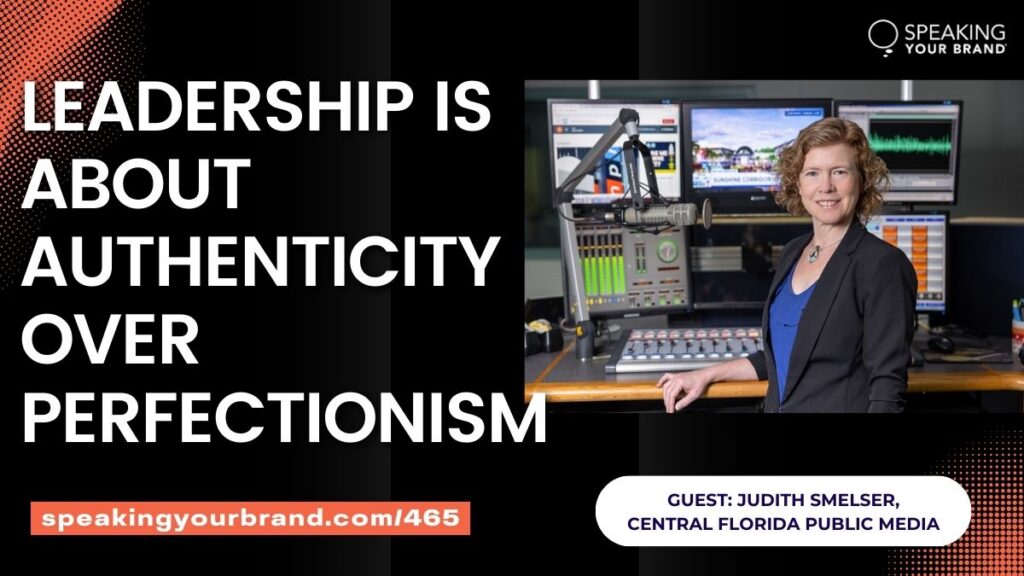
Authenticity Over Perfectionism: Lessons from Public Media Leadership with Judith Smelser: Podcast Ep. 465
Subscribe to the podcast!


What if the thing that makes you most effective as a leader and speaker… isn’t perfection, but authenticity?
That it’s not about having all the answers, but being willing to tell others that you don’t have all the answers?
My guest is Judith Smelser, President and GM of Central Florida Public Media, and she shares her journey from journalist to leading a major public media organization and what she’s learned about using her voice along the way.
We explore why local journalism matters more than ever, how the stories we tell shape our communities, and the responsibility of amplifying voices that often go unheard.
But what I especially loved about this conversation is Judith’s perspective on authenticity over perfectionism—and how letting go of needing to have all the answers has made her a stronger, more effective leader.
We also talk about imposter syndrome (yes, it still shows up—even at the highest levels) and why the real growth comes from stepping in before you feel 100% ready.
If you’ve ever held yourself back because you thought you needed to be more polished, more certain, or more “ready”—this episode is your reminder that your voice matters now.
Judith and I talk about:
- Why local journalism is a public good
- How stories shape communities and decisions
- Finding your voice as a leader and spokesperson
- Authenticity vs. perfection in speaking
- A real talk on imposter syndrome
About My Guest: Judith Smelser is president and general manager of Central Florida Public Media, previously named WMFE, the only local nonprofit news organization serving the nine-county Central Florida region. She began her journalism career in Washington, D.C., before moving to Central Florida in 2004 to join the newsroom at WMFE. Over nearly eight years, she excelled as an award-winning reporter and later as news director. In 2011, she left for Colorado Public Radio, where she held several newsroom leadership roles. In addition to leading Central Florida Public Media, Smelser serves on the Executive Committee of the Board for Florida Public Media. In recognition of her contributions, Smelser was honored as one of ONYX Magazine’s 2025 Women on the Move, Orlando Magazine’s 2024 Women of the Year and one of the Orlando Business Journal’s 2024 Most Influential Leaders.
About Us: The Speaking Your Brand podcast is hosted by Carol Cox. At Speaking Your Brand, we help women entrepreneurs and professionals clarify their brand message and story, create their signature talks, and develop their thought leadership platforms. Our mission is to get more women in positions of influence and power because it’s through women’s stories, voices, and visibility that we challenge the status quo and change existing systems. Check out our coaching programs at https://www.speakingyourbrand.com.
Links:
Show notes at https://www.speakingyourbrand.com/465/
Central Florida Public Media = https://www.cfpublic.org/
Discover your Speaker Archetype by taking our free quiz at https://www.speakingyourbrand.com/quiz/
Work With Us = https://www.speakingyourbrand.com/work-with-us/coaching/
Connect on LinkedIn:
- Carol Cox = https://www.linkedin.com/in/carolcox
- Judith Smelser (guest) = https://www.linkedin.com/in/judithsmelser-cfpm/
Related Podcast Episodes:
- Episode 454: Your Voice Can Shape Policy: Communicating Science with Influence and Clarity with Deborah Stine
- Episode 406: Authenticity and Owning Your Story as Women with a Public Voice with Jennifer Adams and Sarah Henry
465-SYB-Judith-Smelser.mp3: Audio automatically transcribed by Sonix
465-SYB-Judith-Smelser.mp3: this mp3 audio file was automatically transcribed by Sonix with the best speech-to-text algorithms. This transcript may contain errors.
Carol Cox:
You’re gonna love my conversation with Judith Smelser, president and GM of Central Florida Public Media, about not only the importance of local journalism and local stories, but also how authenticity is the best way to get through imposter syndrome. On this episode of the Speaking Your Brand podcast. Hi, and welcome to the Speaking Your Brand podcast. I’m your host, Carol Cox. Today I have a very special guest. Judith Smelser is president and general manager of Central Florida Public Media. Now, you may be wondering what exactly a public media organization is. We’re going to get into that. We’re also going to talk about her earlier career as a reporter and a journalist. What got her to be president of Central Florida Public Media, the things that she has learned along the way, especially being a woman leader. And I know you’re really going to want to tune in to that. We’ll talk about the importance of storytelling, of course, the importance of public media now more than ever. And I’m also going to ask you to a little bit about the speaking engagements that she does, because I know you’re going to want to hear how she goes about thinking about and preparing for her speaking engagements. I met Judith because she was the speaker back in February of an organization that I’m a member of here in Orlando, Florida, called Florida Executive Women. And as soon as I heard Judith talk about the importance of public media and her role as president, I knew that I wanted to have her on the podcast. So, Judith, welcome to the Speaking Your Brand podcast.
Judith Smelser:
Hi. Thank you so much for having me, Carol.
Carol Cox:
Well, let’s dive into what exactly is a public media organization.
Judith Smelser:
Well, that is a changing answer, actually. It’s changing as we speak. Public media was actually set out. Public broadcasting was set out by Congress in the 1960s in the Public Broadcasting Act, when Congress recognized that there was a growing need for media organizations that operated in the public interest, as opposed to in a commercial interest and for a commercial interest. Um, you know, back then and still the, uh, the broadcast frequencies are considered public airwaves. And the Congress took that very seriously and felt that it needed to set aside a certain band of those frequencies. Um, in radio, it tends to be the lower end, the left end of the dial, what used to be the left end of the dial, um, for, for media organizations that operated again in the public interest instead of to serve a commercial interest now. And also Congress provided some funding for, for this. Uh, now just recently, as you may or may not have heard, um, our public funding, our government funding was taken away, um, was eliminated and in fact rescinded. Um, And so now we are in a new era of public media. Public media had been evolving to meet different needs of audiences that have been migrating to digital platforms and other platforms. And that that evolution has been has been ongoing. And now we’re in a situation where our funding model is also changing and also must change. But what hasn’t changed is that public media is committed to operating in the public interest. We are committed to providing, in our case, at Central Florida, public media, news and information and civic discourse that serves no agenda other than to empower and connect and inform our community here in Central Florida.
Carol Cox:
Well, that was an excellent answer, Judith. It sounds like one you’ve given before, which you have. And of course, as a as a reporter and a journalist in your early part of your career, you’re very good at this, which I appreciate. So let me ask you a couple of things that I learned about from your presentation that I think would be helpful for the listeners is that as a public media organization, you can have sponsors. So everyone’s probably seeing their local PBS station, you know, ask for their do their sponsorship drive and they, and they want individuals to be monthly members or to do some type of contribution. I am now a monthly donor to Central Florida Public Media since meeting you, because I realize the importance of it and I want to make my contribution. But from what you had said at the speaking engagement, is that. So you can have sponsors and there could be a company even that could be a sponsor, but you cannot run advertisements. So you can’t say run a 32nd ad or, or something like that. That’s a commercial. So talk to us a little bit about the difference between having sponsors versus running ads.
Judith Smelser:
Sure. So first off, I should probably make the distinction between PBS, NPR and your local public media organizations. Here in Central Florida, we have two local public media organizations. There’s Wusf, which is the local PBS affiliate. And then there’s Central Florida Public Media, and we are a member station of NPR. Um, but neither of us are owned by NPR or PBS. So, um, Central Florida Public Media is an independently owned, community licensed local non-profit. So I want to make that very clear because that’s a, that’s a big sort of myth that people don’t. A point of misunderstanding that people don’t always realize is that that that we are an independent local non-profit. Um, but yes, just like other non-profits, we can take sponsorships from local businesses. Um, so, you know, much in the same way that you might see an event that, let’s say second harvest Food Bank puts on that is sponsored by, say AdventHealth. Um, some of our programming can also be sponsored, but because of the type of license that we have for our broadcast outlet and Central Florida Public Media, we operate two non-commercial radio stations, 90.7 and 89.5, and those are non-commercial, FCC licensed broadcast outlets.
Judith Smelser:
And as a condition of that license. And there are several benefits that go along with having that type of license. But but, but as a condition of that, there are things that we cannot do. When we acknowledge our sponsors, we are allowed to acknowledge our sponsors on the air. Um, but we are not allowed to do any calls to action. We are not allowed to use any, uh, superlatives or comparative language. So for example, um, you couldn’t have an acknowledgement spot on the air that says, uh, go to Bob’s car dealership. It’s the best car dealership in Central Florida. That would be illegal. So we can’t we can’t do that. But we can say central Florida Public Media is supported by Bob’s car dealership, which sells cars at this location in Central Florida. So it’s a fine line, but it’s an important one because again, the whole point of public media is that we are here to serve the public interest, not corporate and commercial interests, but we also want to be able and are allowed to thank our sponsors.
Carol Cox:
Well, you mentioned when you were describing what public media is, and here just with the sponsorship about this idea of like using superlatives and using certain kinds of language. And I know one of the biggest challenges that a lot of we call legacy media, and especially public media organizations are having, I imagine, is that with the rise of the internet and no more gatekeepers. And everyone has a voice and a microphone and a webcam, which of course, there’s a lot of benefit to that. But the downside is that the algorithms, like certain types of content, clickbaity content, outrage, content, content that pushes people’s buttons, pushes people’s emotions, elicits a type of reaction from them, and the type of news, content and information content that you are putting out is very much not that. So how are you figuring out how to still get this news information in front of citizens and, you know, in front of all of us, residents and citizens, citizens of a community in a way that we want this. Many of us want this information, but it probably has. It’s probably very hard with the way the algorithms are tuned to get it seen.
Judith Smelser:
It is a challenge, and the first thing I’ll say is, the first answer to that question is we have to be on those platforms. Um, you know, we are now at Central Florida Public Media, a digital first news organization. We are a multimedia, multi-platform news organization. We operate two radio stations, but we also operate one of the most comprehensive local news websites in our region. And we also have a mobile app. And we also offer a weekly newsletter where we offer local news and we produce for local podcasts. So we are, we are, we are full service. Um, and, and to your point, we do have to, those are our owned platforms, platforms that we own and put out content on, but we also have to be in front of people where they are and often where they are is on those social media platforms. We are not going to, um, we are not going to adjust or change who we are or our values based on what the algorithm, um, prioritizes. But what we are doing is providing content in a way that those audiences like to consume it. And a great example of, of how we’ve pivoted along those lines is that we’re doing about 75% more video now than we were a year ago. Um, and, and some people might think that’s funny because they primarily think about us as a radio station, but we’re not primarily a radio station anymore.
Judith Smelser:
And our, and our people have been, I must say, remarkably adaptable to this shift. We have people who actually have grown to love doing video. Our morning edition host, our local host of our morning show. Um, she, she’s been in radio for many years, but turns out she loves video. And so she started a newscast three times a week that she does on video, on TikTok and Instagram and YouTube shorts. And that’s a way that we can put accurate, fact checked, vetted local news in people’s feeds in places where people already are. So that that that they can discover what it is that we have to offer. You know, what we find is that people really don’t enjoy the outrage, the clickbait, the negativity and people shouting at them all the time. Um, even though that’s what the algorithms want you to see that that raises people’s blood pressure and people appreciate the fact people tell me that all the time. Thank you for not yelling at me. You know, people appreciate that. Um, but we have to we have to get it out there in front of them. And we know that one thing that we can do that the algorithms prioritize is more video. And so that’s one of the things that we’ve, we’ve, we’ve concretely pivoted some resources towards so that we can, we can get in front of folks where they already are.
Carol Cox:
Oh, I’m glad to hear that. Uh, okay. So let’s, let’s back up to the first part of your career. And you decided to go into journalism and you were a reporter. So what drew you to that? Why did you decide that you wanted to be a journalist?
Judith Smelser:
You know, I didn’t want to be a journalist when I was growing up. That was not my ambition. I actually went to college for international relations and I was going to be a diplomat. Um, and I went to D.C. after college and had the privilege of doing a junior fellowship at a think tank up there at the Carnegie Endowment for International Peace. And they did a wonderful job of letting us interact with all of their senior folks and understand what their career paths had been. And I came to the realization that actually, I don’t think I wanted to do any of that. Um, and so I had to kind of reinvent myself in that year. And I, I sort of stumbled onto journalism by accident. And part of the reason, honestly, that I stumbled onto journalism is because of public media is because public media was such a. Public radio in specific was such a. An omnipresent factor in my childhood. My parents had it on all the time. I was what we call in the public media world a back seat kid. Um, it was it was always on in the car. Whenever I hear the theme song, to All Things Considered, I am back in my mom’s kitchen, sitting on a stool watching her cook dinner. Um, and, and so that, that was always in my ear and I, and, and I thought perhaps I could pivot to a place where I could still be involved in current events. International affairs at the time, I started interning for an international news agency. Um, and, and keep my hand in that side of it while also, you know, moving into a different space that was a little more fast paced than the sort of policy world that I found myself not really gravitating towards as much as I thought I might. And so that’s I really stumbled into it. I talked this, uh, this news agency into giving me an unpaid internship that I did. At the same time I was working at the think tank and, um, and then I convinced them to hire me somehow and that the rest, I guess, was history.
Carol Cox:
Oh, that is so fascinating. Jude. I am relieved to hear that you have had a winding career path as well, right? I think most of us have, but we feel we look at someone who’s so put together, you know, the president and general manager of the Central Florida Public Media, surely Judith knew from, you know, eight years old that this was the path that she was going to go on. Yeah. Well, and it’s also funny because when I was a senior in undergrad, I also wanted to go into diplomacy, into the State Department. And I looked at the Foreign Service and also the Carnegie Endowment for for peace. I very you’re the only person I have talked to since then who has mentioned the Carnegie.
Judith Smelser:
Wow. Small world.
Carol Cox:
Very small world. But as I to learn more about the Foreign Service and I was like, you know what? Maybe that’s not quite for me. You know, I’m a reader. Like I’m an intellectual. I don’t know about like getting dirty, really, like, you know, out in the field is my thing. So I decided to go to graduate school to get a PhD in history instead.
Judith Smelser:
So there you go. Yeah, there we are.
Carol Cox:
And it made a turn into doing political analysis on the TV stations here in Central Florida, which I’ve been doing now for 20 years during the mostly the presidential election cycle. So you just never know. But I feel like all the seeds are there, like, and then they just end up sprouting in different places.
Judith Smelser:
I think that’s one of the most important skills you can have, is the ability to be self-aware enough to follow the path that you’re meant to be on, as opposed to the one you thought you were going to be on. Um, it’s, it’s, it’s not easy necessarily, and it can be very disorienting. But I think it’s, I think it’s, uh, big, um, key to success.
Carol Cox:
Yes. So how did you end up president and GM of Central Florida Public media?
Judith Smelser:
Well, that’s, that’s, that’s another winding road. That’s another, that’s another, this job is another thing that I never in a million years thought I would be doing, never in a million years. So in journalism there’s something called the firewall, right. The firewall is, is a is a bright line in between the journalists in a news organization and anyone involved in money. So you have to wall off your. If you are running an ethical news organization, you have to wall off editorial decision making from anything that could taint that decision making other than the facts. Right. And so, um, the people who are in charge of, in a nonprofit news organization. Fundraising, sponsorships, anything to do with revenue cannot touch the editorial side. I spent 20 years in journalism. I spent 20 years as a reporter, as a news director, then later as a consultant to news organizations. I never imagined stepping on the other side of the firewall, because now the irony is I am not allowed, per our ethics policy, to make any editorial decisions. I have to check that expertise at the door in a large way, in a large part when I come into work, which has been an interesting shift. Um, yeah, never did I, did I intend or set out or even want to run a news organization, a public media organization, but about four and a half years ago or so, um, I was, I was running my consulting business and I then NYU, MFA.
Judith Smelser:
So Central Florida Public Media used to be known by our radio call letters w m f. They had had a leadership transition. They’d had a couple of leadership transitions in in short order. And I felt like, uh, I needed to do something to help. And I reached out to a friend of mine who was a member of the board of trustees, uh, who I’d known from my time in the newsroom here. Um, and, and asked how I could help. Um, meanwhile, I had a couple people in the public media sphere that I’d known throughout my career reach out to me and ask me why I wasn’t doing this job. Why wasn’t I taking this job? Why wasn’t I throwing my hat in the ring? Um, and, and I’d had people asking me that question for a couple of years and once, once it that those voices kept adding up. I thought, you know, maybe I ought to listen to these people. Maybe I ought to at least consider this. And one thing that I realized was that I had a stereotypical view of what a president and GM of a public media organization looked like. And it wasn’t me. Um, it was an older white man. It was someone who dressed in fancy suits.
Judith Smelser:
Um, someone who drove around in their car listening to classical music all the time. Nothing. No aspersions on my parents are both musicians, so it’s okay. So I love classical music too. But I also listen to 80s and 90s music when I’m driving around in my car, sometimes when I’m not listening to 90.7. Of course. Um, you know, I realized I had this preconceived notion of what a GM of a public media outlet is. And I, even though I had plenty of friends, people I had had as consulting clients, people I had known who were women leaders of public media organizations. I still had this, this preconception in my mind. So that was part of it. But I started doing some, some research and, and some conversations with people I knew who held the role. Um, I, I started asking questions about, you know, the parts of the business that I didn’t have direct experience or expertise in. Um, and, and long story short, um, I ended up in this role in an interim capacity for a few months, um, while the board did a national search. Um, and, and it was sort of a trying it out. Do I like this? But at the same time, I was the need at that time for leadership in the organization was so great that I didn’t do that job as an interim. I didn’t do that job as a placeholder.
Judith Smelser:
Um, because that’s not what the organization needed. And even if the board had made a different decision, it still wouldn’t have been what the organization needed. The organization needed somebody. They didn’t need a band aid. They needed somebody that was going to come in and take it and run with it as long as, as, as they were there. And so I, I invested quite a lot of my own emotional energy. Um, and I, and I felt a great deal of ownership, um, in the place by the time I was offered the position and I, I mean, I was, I was already doing it, I was bought in and by that time I was kind of hooked. Um, and I was on a path with the organization that I certainly didn’t want to step off of at that time. So long story short, this is none of this is what I thought I was going to be doing. If you had told me five years ago that I would be doing this job, I would have said, you’re, you’re you’re nuts, you know? Um, but again, it’s about listening to the voices, not only your own, but some voices that can see things that you can’t. Um, and I’m grateful that I did because it’s been one of the most fulfilling things I’ve ever done.
Carol Cox:
Well, and I know our community is grateful that you’re at the helm and that you are leading public media through a lot of these changes that have been going on. So let’s talk a little bit about being a woman president and GM of, of an, you know, a good sized organization and very visible and important organization in the community and in public media itself. So what have been the parts that have surprised you in the positive side, so that you’ve really enjoyed? And then what have been some of the challenges either expected or unexpected?
Judith Smelser:
Well, I’ll start with the challenges. Um, again, never in a million years would I have thought that I would be leading this organization through the Elimination of federal funding and state funding. Federal funding that has been supporting public media for decades and decades longer than I have been alive. Um, that’s one of those things where if you had told me four and a half years ago when I was trying to decide whether I wanted to put my hat in the ring, if you told me I would have to be leading through that kind of change, would I have stepped up? Would I have done it? I don’t know because I don’t I don’t think I would have had the confidence that I would have known how to how, how to navigate that. But what I know now is that none of us knew how to navigate that. And we’re all we’re all figuring it out. We’re all figuring it out together as a public media family, and we’re all figuring it out in collaboration with the communities that we individually serve. You know, and I think that is, um, that has been a real bright spot in the challenges that last year and the rescission of our funding faced, was seeing how this community stepped up and came out for this organization, came out for public media.
Judith Smelser:
When they realized the need and and one of the things that surprised me, it’s not positive or negative. It’s just true. Um, one of the things that surprised me before we got to the, the point of rescission of funding, um, was, was the level of misperception of how public media was funded in the first place. You know, once I was in a position to start talking to people in the community, talking to donors, foundations, corporations, um, I, I became aware of how deep the misperception is. People thought that we were mostly funded by the government. People thought that we probably people thought we got the vast majority and that anything that came from individual donors or the community in any way was sort of gravy. That was not true. Even before we lost our funding, we at Central Florida Public Media got about 11% of our funding from the government. The rest of the funding from the community. Now, I will say that 11% represents $400,000 every year. So it’s no small potatoes, right? It’s not something that we can just do without, um, without significant cutbacks. Uh, but, but that misperception and then there was also a misperception and still is of our relationship with NPR, as I was talking about before, a lot of people think that we are owned by NPR, that we are governed somehow by NPR.
Judith Smelser:
I had a I had a leader in the community, um, talked to me about, about how I reported to the chair of the NPR board. I do not report to the chair of the NPR board. The chair of my board would be very surprised to hear that because I report to the to the chair of my board, um, who, which is a board of trustees that are from this community. Um, you know, people thought that we were subsidized by NPR. There were all of these misperceptions about how public media actually works. And, and, and I think that is, that is partly because we as public media organizations have ridden the strong brands of our national partners. Um, but the fact of the matter is that we pay NPR, we pay NPR to be a member. We pay NPR to run their programming all. And we’re proud to do that. But but that has been a real eye opener is how, um, is how people perceived that relationship, uh, and misperceived that relationship. But when, when our government funding was taken away, even the people who thought that, you know, we got all of our money from the government, well, they realized that that they needed to step up And that was really encouraging.
Judith Smelser:
Um, I think one of the, one of the nice surprises also has been that this position really has allowed me to lean into the idealistic side of my nature, which might seem counterintuitive given, you know, that we’re talking about funding cuts and all of that. Um, but when you’re leading an organization, part of your job is, is to inspire aspiration. Part of your job is to be aspirational and to inspire your team, your board, your community, your funders to dream along with you. And I’ve always been a dreamer in a way, but that’s one thing that you can’t really do as a journalist. Um, you know, in a lot of ways, journalists right now have to be optimists because it’s a very challenging time for the industry in general. Um, and to believe that you’re making a difference by sharing facts, um, right now is, is an aspirational, um, position to take. Um, but, but in many ways, when you’re a journalist, your job is to shine light on challenges and is to shine light on problems. It is also to shine light on joy. And I want to be very clear about that. Um, but, but you do have a tendency and a need as a journalist, as a, as, as a, as a sort of whistleblower on things, um, to, to look for the problems in some, in some cases as a leader of a news organization or any organization, your job is to look for the possible.
Judith Smelser:
And, and I love that. I love the fact that I get to, to help my organization and the community see the potential for what this organization could mean to this community, with the investment from the community that frankly, it needs and deserves. This community deserves a first class public media organization. It does. And, and, and we’re ready. You know, I can tell you my team now is chomping at the bit. Um, should the community want us to move forward with that vision and, and I, and I love that part of it. And I love the part of it where I get to be someone who stands up in this community and talks about the importance of local journalism and talks about local journalism as a public good. I’m the one that gets to speak out for that. Not that I’m the only one who can speak out for that, but I get to play that role and that is an incredible privilege. It’s so important. It’s something I believe in so strongly. And and now I get to really speak that truth to people who can make a difference in making it happen.
Carol Cox:
Oh, Judith, I, I can hear your passion as you’re sharing that and the energy you have behind that of having this vision and, and wanting to take people along with you to. And I love this optimistic take and seeing what’s possible and showing the community what’s possible. And this idea of public media and local journalism being a public good, I feel like the pendulum has swung so far to one end as far as everything being privatized and corporatized, you know, in almost all aspects of our society that I feel like the pendulum is bound to swing back to more people recognizing the need. Public spaces, reinvestment in public education, public media and so on. So public health, lots of things that we maybe have taken for granted over the years that don’t so much take for granted. Okay. So you mentioned this, you know, the importance of local journalism. And then I think about stories and the stories that local journalists tell and about whose voices get heard and whose don’t. So talk to us a little bit about the importance of local voices and local stories for how a community understands itself, how it shapes itself, how it imagines what its future is going to be, and what is what is possible for that community.
Judith Smelser:
That’s such a great question because it gets to the heart of what journalism is. In my view, journalism, the job of journalism is to hold up a mirror to the community. It’s to hold up a mirror and reflect the community to itself as it is, warts and all. Right. It’s it’s it’s it’s it’s to hold up that mirror and allow the community to see the wonderful things that are going on, the challenges that it faces, the, the many different perspectives and types of people who make up that community. Um, and, and at the core, that really is what journalism is supposed to do. Journalism isn’t supposed to tell you how to think, tell you how to act, tell you what to do. Um, it’s supposed to give you information and reflect back what is really going on in your community that you yourself may or may not be seeing, you know, and it’s to help you see yourself and your community through perhaps the eyes of other people who have a different lived experience than you do. Um, you know, you mentioned whose stories get told, right? And, and that is a really important question. And it’s an important responsibility that local news organizations have. Um, really, particularly local news organizations have to find those stories that are often untold and amplify voices that are often unheard. Um, you know, we have, we have a long history in, in the news, in the news, business and media business of, of telling you what we think you need to know.
Judith Smelser:
But we haven’t historically been so great at asking you what you need to know, what’s really going on in your community and your little slice of our, of our region. Um, and, and reflecting that back, um, and meeting the needs of the community. And that’s something that we have a real responsibility to do. I think public media particularly because it has an obligation to serve the whole public, um, has a responsibility to do. Um, and that’s something that we’ve been investing a lot of resources in at Central Florida public media over the past few years. And we can talk more about that if you want. But I think the, the point is that if, if we don’t do a good job of reflecting all those different voices in the full tapestry that makes up a community, our community, then the mirror that we’re holding up to, the community is distorted. It’s not an accurate picture. It’s not a full picture of what the community looks like. And that matters because we, we, we want to be providing a full picture so that individuals in the community and decision makers in the community can take that information and go and make decisions about the best way to move forward as an individual, as a family and as a community and a region. And if we’re holding up as a distorted or incomplete version of that picture, then the decisions that are being made based on it are going to be skewed.
Carol Cox:
Judith, I remember during your presentation that you mentioned an example that there was a, I think it was a county commission meeting, and there was a report that you had done, and then some of the commissioners had seen it. Can you tell us a little bit about that? I think it’s a great example of the importance of local media and finding those stories and voices.
Judith Smelser:
Yeah. So this was, um, this was a question of an eminent domain process, this technical stuff that the commission deals with, but it was an eminent domain process where the expressway authority, this is an ongoing issue, wants to acquire some land from Orange County to build an expressway, part of which will go through a place called Split Oak Forest, which is some environmentally sensitive, environmentally preserved land. And a lot of environmentalists in the community are concerned about it. Um, we have a beat reporter who covers the environment, the local environment issues. Her name is Molly Derrig. And, um, and she’d been, you know, covering this blow by blow, every twist and turn of this very technical process. And she had reported out when the expressway authority was, was, was considering, uh, this eminent domain, um, process and, and elevated it in the public debate and at a county commission meeting, not not long after this reporting had come out, um, one of the county commissioners, Nicole Wilson, said in the meeting that if it had not been for our reporter Molly’s work and reporting on this issue, that the commission probably wouldn’t even be having the conversation that day about that issue, that it probably would have just gone through the expressway authority board on consent, meaning without discussion, without anything but but a perfunctory vote. But because Molly had had shown a light on it and allowed the public to start talking about it, then of course, the public talks to the commissioners because that’s how democracy works. And and the commissioners then brought it up in that meeting. They actually decided to reject the expressway authority’s bid to acquire this property.
Judith Smelser:
Now, this is still going back and forth, and Molly is still reporting on it. She’s still on the case. Um, the point is here that we as a news organization, as Central Florida Public Media, we do not have a position on where this should come out. That’s not our job. Um, our job though is to elevate the issue, let people know, shine a light on what’s going on so that people in the community who do care about it on both sides can see. Oh, this is happening. And there’s something critical that’s going to. Going to be voted on here. Um, and if if I want my position to be heard, then I need to contact my elected representative and tell them that again. That’s how democracy works. You know, the press, the free press is is in the First Amendment for a reason. It’s called the fourth estate for a reason. Because if the founding Fathers, in their wisdom, realized that if there is not accurate independent information, then a democracy can’t work. You know, if there’s if there’s not reliable access and easy access to good information about what decisions are being made and being discussed, then the public can’t participate in their government. And then we don’t have a democracy. And that that story to me. You know, I, I told Molly, our reporter. I would rather that than a whole stack of awards. That is the impact that we’re trying to have. That is why journalism exists. It’s to give the community some shared, trusted facts from which to go and have a debate on the best way to move forward.
Carol Cox:
Yeah, and I so appreciate that example. And let’s that’s a good segue into the speaking that you’re doing as president and GM of Central Florida Public Media. I saw you speak and I remembered quite a bit from your presentation, which I have brought here to the podcast interview, because the stories, the examples and your passion, your vision that you have, all of that comes through so clearly. So tell me a little bit about how have you found your voice, you know, speaking on behalf of a public media organization, which was, as you mentioned, different than being a journalist and being a reporter.
Judith Smelser:
Yeah, it’s true, because as, as a journalist, we, we are always taught that the story is not about you. The story is about the people you’re reporting on and the issues that you’re reporting on. So that’s a that’s a different type of voice. You’re you fade into the background so that your, the stories that you’re telling can, can rise to the top. Um, in my role now. Yeah, it’s a different, it’s a different thing. Um, and I think finding my voice has been an interesting process. My voice in that role. Um, I, I somehow organically just felt, um, a need to, as I said earlier, have someone speaking out for local journalism, not just for my organization, but for local journalism as a whole. Um, and the importance of it as a public good in our community. And so I even from the first opportunity that I had to speak, I really focused on that, um, on the power of local journalism, on the importance of it as a public good. And I’ve, I’ve expanded on that theme. Um, as I’ve spoken over time. The other thing I think I have really leaned into in terms of finding my voice, both as a spokesperson, but also as a leader of my own organization internally is really leaning into authenticity and transparency. Um, you know, you said earlier you could, you could hear the passion in my voice. I couldn’t do this job if I didn’t believe in it. I couldn’t go and, and run some organization or company that I didn’t feel a real passion for the mission of. Um, because that’s just not who I am. And so I think, um, you know, I value authenticity over polish and over perfection because I think that resonates more and it’s more in my comfort zone.
Judith Smelser:
Um, I think the transparency piece, especially internally, but externally as well is also really appreciated. Um, and really critical, especially at a time when so much is unknown. Um, you know, being comfortable and vulnerable about the things that you don’t know, taking a page from Brene Brown, right? Um, vulnerability is, is, is power in a lot of ways, but there is no way that anyone in a role like, like mine could possibly have all the direct expertise, um, that you would need to be hands on in all the different facets of the organization, um, and of the industry. And so leaning into what you know, and what you don’t, leading through uncertainty in funding, in industry trends, etc. means admitting what you don’t know and being clear about, you know, when we were going through that whole funding fight last year and my, my team was asking me for for answers that I didn’t have. It was so frustrating. But all I could do was to say, you know, I really leaned into my, my reporting background at that time. Here’s what I know. Here’s what I don’t know. And I will tell you as soon as I know. Um, and, and that was just the mantra it had to be, uh, and I think that that was part of finding my voice too was, was acknowledging that I cannot know everything I need to know. Anyone who sits in a role like this and tells you they know everything is being disingenuous. Um, and, and people really appreciate when you are honest with them about what, you know, what you don’t know what you’re trying to find out.
Carol Cox:
I appreciate the, the emphasis on authenticity over perfection. I know that I work with a lot of clients over the years. And some of them have, um, you know, feel felt. This probably is the perfectionist side of them. And, you know, I have a little bit in me as well. And, uh, in recovery, you know, I’m much better than I was when I was younger, but they feel like they have to have everything so perfect before they can use their voice, whether it’s stepping on a stage or a podcast interview or a media interview or what have you. And of course, we try to coach, coach them through that. And then what also creeps up for a lot of them is imposter syndrome. No matter how credentialed and accomplished and experienced they are, is that they feel like someone in the audience is going to almost like stand up and be like, you’re a fraud. You know, you don’t know what you’re talking about. And of course, this is all in their head and they recognize it’s mostly in their head, but they feel it and it does tend to hold them back. And, you know, our mission here is speaking your brand is to amplify women’s voices and encourage more women to be in positions of leadership, business, media, politics and so on. And so I’m always encouraging them to put themselves out there because we need we need them to. Yet. And I, and I know that, you know, you’re shaking your head that you can relate to this, but but so many of us and I have done this in my career, hold ourselves back. So what do we do? Judith.
Judith Smelser:
I don’t have all the answers for you, Carol. I feel imposter syndrome all the time. Um, you know, it’s it’s gotten a little better over the over the years I’ve been doing this job, but I still have it. Absolutely. You know, I remember, um, sitting in a meeting. I was invited to be in a meeting that the Corporation for Public Broadcasting, which is the dearly departed organization that was the conduit for our federal funding, um, had organized to sort of have conversations about the future of the industry. And I was very honored to be in this room. I’d probably only been in this job for a year or so, and I’m in this room with, um, probably about 20 of public media organizations from around the country, most of whom were men. Um, and I will, I will tell you in the spirit of vulnerability that I walked out of the second day, this was a two day meeting. I walked out of the second day of this meeting. I came downstairs in the hotel that it was being held in, and I was meeting my husband in the in the cafe there, and I burst into tears. I, I felt completely out of my depth. I felt like, you know, what am I doing here? I have no idea. These people know everything. I don’t know anything. Um, and I, I had a conversation after this meeting, um, after I was back home with a guy who was in that room, who was one of the GM’s that was in the room. And I had known him for a very long time in the, in the system, in the public media system.
Judith Smelser:
And he had he had had a very similar path to mine in that he was a reporter and a news director and then and then CEO of a couple of public media organizations. And he’d been doing it for longer than I had, and I told him how I felt. And he said, he said, and he he is the definition of an ally. Um, he, he said, you know, men have a tendency to say things that they’re not quite sure of as though they know them for sure. And women generally have a tendency to only speak confidently when they are 100% sure. And, um, I appreciated him saying that I’ve never really been someone who spent a lot of time thinking about differences between men and women, spent a lot of time dwelling on sexism in the workplace, any of that, even though certainly I’ve experienced it. But having somebody who was a man say that to me in those terms really has helped me think about things a little differently. Um, and, and to not just assume that when someone, whatever gender they may be, says something with confidence and authority that they, they actually know everything that they’re saying to be true. Um, and so I, I think, you know, that’s, that’s a big part of it. Um, I’m a perfectionist too. I was on the radio for many, many years in my career. Uh, you’re not supposed to stumble. You’re not supposed to mess up. I remember the first time I guest hosted, uh, at the time we had a call in show. Um, I overprepared.
Judith Smelser:
I had so many stacks and stacks of notes, uh, so much more than I ever could have needed, because I wanted to be prepared for every eventuality. You can’t be prepared for every eventuality. Um, you just have to jump in and do it. Uh, and you’re probably if you are a perfectionist, like I tend to be, um, you’re probably incapable of being unprepared, you know? You know, even if you prepare what you think is 80%, it’s probably still 110%. So, you know, I think just being thrown into these situations can sometimes be the way through. You know, you’ve got to go through a few of them and realize that the world didn’t end when you put yourself out there and maybe you stumbled on the air. In my case, yes, I’ve done it. You can tune in to the next fund drive and hear me do it. Um, you know, maybe, maybe you maybe you made another mistake that you feel stupid about, and no one died in the world didn’t end. So I think, you know, you just. And if you make a really bad error, you know, in in journalism, general ethics commits us to being transparent about our mistakes. We all have a corrections policy. Any bona fide news news organization should have a corrections policy where if you make a mistake, an error of fact, you go back and correct it and you and you say what you did, you know, and that’s sometimes you got to do that. We’re all human. Um, but there’s no magic bullet. It’s just it’s just jumping in there and doing it.
Carol Cox:
Well, thank you for sharing that vulnerable story. I know that, you know, I appreciate that and the listeners will as well. And, uh, I also appreciate that you said about just the repetition, keep doing it because I know, you know, I’ve done live TV so many times now and in the first few times. Yeah. Like my heart’s race, like beating out of my chest. I don’t know how I was going to make it through, right? Like the nerves. If you only do it once every few years, of course it’s going to be nerve wracking because your body, your mind, you’re not used to it. But if you’re doing it weekend and week out or day in or day out or whatever it happens to be. It’s like, I got another podcast episode next week that comes out. I got the next video that’s going to come out. I can’t worry so much about the one that just happened because I got to keep doing the next one.
Judith Smelser:
That’s absolutely right. Yeah, repetition is key. And, and, and the public speaking that I do, if I haven’t done it in a while. Yeah, I get the butterflies and, and the other thing I would say is, you know, I grew up, I grew up on stage. As I said earlier, my parents are both musicians and I’ve been performing all my life. A little bit of butterflies is a good thing. That’s adrenaline. And it’s what it’s what fuels you. It’s what sharpens your mind. If if there’s too much of it, it overwhelms you. But a little bit of it is good. And so if you get to the point where you don’t have any before you step on stage, then something’s wrong. Um, but, but a little bit is good and the more you do it, the more it’s the good adrenaline and not the paralyzing kinds.
Carol Cox:
Right? Yes, exactly. Judith, I have so enjoyed this conversation. Thank you for so much for coming on the podcast. I would love for you to share with the audience calls to action because we’re allowed to do that here. So you can tell us how great Central Florida Public Media is the best organization in the country. I will say that. And, uh, so I’m just going to make a pitch though, and have you make a pitch for public media organizations across the country. No matter where listeners are, I’m sure they can Google and find their local public media.
Judith Smelser:
Yes, absolutely. Please find your local public media outlet and know that they depend on you for 100% of their funding. Now, um, if you have the capability to give a gift, they all have big donate buttons on their web pages. I encourage you to make an investment and know that it’s not just throwing pennies at something. It’s it’s really making an investment in your community when you make a gift to public media. You’re investing in a community that is more engaged, more informed, more connected, more educated, and frankly, more civil because that’s what we’re about. We’re about civil dialogue, civil civic dialogue. The other thing I would encourage you to do is go out to their events. You know, we we all host really, really interesting and sometimes even fun events. Um, you know, we’ve got an event coming up next month called engage in the community, which is an event series that’s tied to our local public affairs show, which is called engage. And this one’s going to be about redistricting, and we’re going to have a conversation about redistricting. And we’re going to have interactive activities and ways that people can give input and share their own perspectives, their own voices, their own experiences. And public media outlets around the country are doing that type of engagement work because we all want to do a better and better job of reflecting those those quiet voices, those voices that we don’t always hear. So find out what your local public media outlet is doing. Go out to an event, get involved, and of course, make a donation if you can.
Carol Cox:
Yes, just sign up $10 a month, whatever it happens to be, it goes a long way and makes a big difference. And of course, if you are here in the Central Florida area, make sure to support Central Florida Public Media. The link is in the show notes. And also make sure to connect to Judith and let her know that you heard her on the podcast. Well, Judith, thank you so much for being here.
Judith Smelser:
Thank you Carol. It’s been a real pleasure.
Carol Cox:
Until next time. Thanks for listening.
Sonix is the world’s most advanced automated transcription, translation, and subtitling platform. Fast, accurate, and affordable.
Automatically convert your mp3 files to text (txt file), Microsoft Word (docx file), and SubRip Subtitle (srt file) in minutes.
Sonix has many features that you’d love including collaboration tools, world-class support, advanced search, automated subtitles, and easily transcribe your Zoom meetings. Try Sonix for free today.