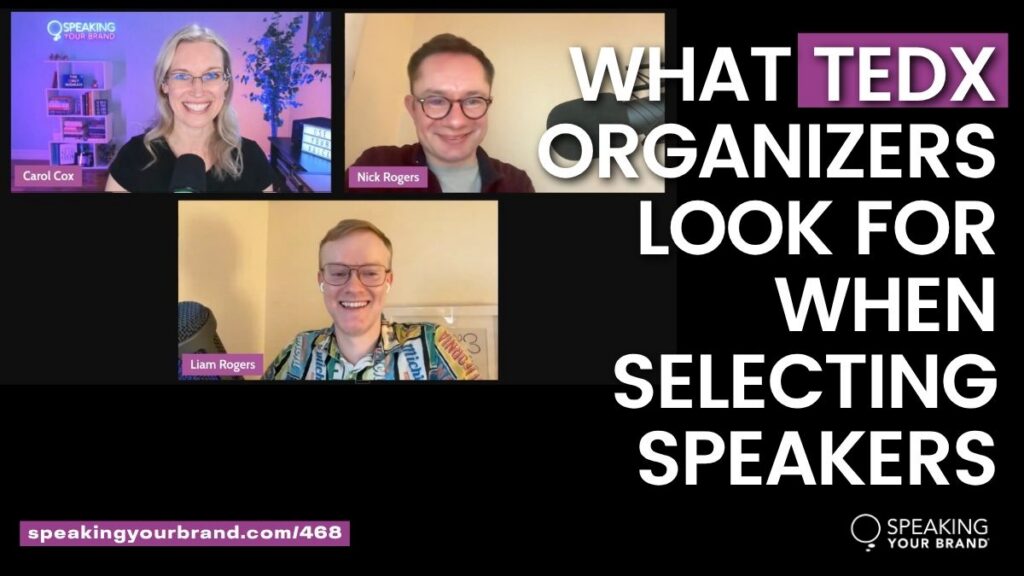
Motivational Speaking with Substance: Live Signature Talks from Our Thought Leader Academy Grads: Podcast Ep. 472
Subscribe to the podcast!


What makes a motivational talk actually stick, long after the applause?
In this audio from our Back Stage with Speaking Your Brand live show, you’ll experience powerful, real-time signature talks from three of our recent Thought Leader Academy grads Kimberly Brock, Susana Alvarez, and Teresa Phillips.
Each blends personal story, practical frameworks, and a clear message that moves beyond inspiration into action.
Hear how each speaker:
- Uses personal turning points to create emotional connection
- Translates their experiences into clear, teachable frameworks
- Balances heart + strategy so the audience feels and learns
- Invites the audience into reflection and real change
If you’re working on your own signature talk or want your message to resonate more deeply, this session will show you what “motivational speaking with substance” actually looks like in practice.
We also have a roundtable discussion about what they’ve learned from being in the Thought Leader Academy and what’s next for them as speakers and thought leaders.
You can watch the video at https://youtube.com/live/dzS1lEkZu-k.
About Us: The Speaking Your Brand podcast is hosted by Carol Cox. At Speaking Your Brand, we help women entrepreneurs and professionals clarify their brand message and story, create their signature talks, and develop their thought leadership platforms. Our mission is to get more women in positions of influence and power because it’s through women’s stories, voices, and visibility that we challenge the status quo and change existing systems. Check out our coaching programs at https://www.speakingyourbrand.com.
Links:
Show notes at https://www.speakingyourbrand.com/472/
Watch the video at https://youtube.com/live/dzS1lEkZu-k
Kimberly’s website: https://www.kimberlybrock.com/
Discover your Speaker Archetype by taking our free quiz at https://www.speakingyourbrand.com/quiz/
Apply for our Thought Leader Academy: https://www.speakingyourbrand.com/academy/
Connect on LinkedIn:
- Carol Cox = https://www.linkedin.com/in/carolcox
- Kimberly Brock = https://www.linkedin.com/in/startwithkimberlybrock/
- Susana Alvarez = https://www.linkedin.com/in/susanaalvarezsrprojectmanager/
- Teresa Phillips = https://www.linkedin.com/in/teresa-phillips-01249720b/
Related Podcast Episodes:
472-SYB-LI-Live-TLA-Clients-Carol.mp3: Audio automatically transcribed by Sonix
472-SYB-LI-Live-TLA-Clients-Carol.mp3: this mp3 audio file was automatically transcribed by Sonix with the best speech-to-text algorithms. This transcript may contain errors.
Carol Cox:
If you want to make sure that your motivational message has substance. That’s exactly what our recent Thought Leader Academy grads have done. You get to hear ten minute versions of the signature talks they created with us on this episode of the Speaking Your Brand podcast. Hi, and welcome to backstage with Speaking Your Brand. I’m your host, Carol Cox. Today you’re going to hear from three of our recent Thought Leader Academy graduates as they debut the signature talks that they worked very hard with us in the past eight weeks during their time in the Thought Leader Academy. You’re going to hear a ten minute versions of it. And I’ve titled this live show, this episode, motivational Speaking with substance, because I think you’re going to be inspired when you hear them deliver their messages with their stories and their frameworks. But it is motivation with substance, because you’re going to actually be able to use the frameworks and the takeaways that they’re going to give you. So first, we’re going to have up Kimberly Brock. She’s a business coach and the host of the Top 1% podcast called She’s Just Getting Started. I love that name for a podcast. Definitely check it out. She has over 350 episodes and counting, and she’s going to share how unexpected life transitions push her to take action, revealing her framework to help you move from overthinking to momentum. Kimberly, welcome to the stage.
Kimberly Brock:
I’m so excited to be here. How fun is this?
Carol Cox:
All right, so there are your slides and take it away.
Kimberly Brock:
Okay, here we go. When you were a child, what did you dream of becoming when you grew up? Like, think about it for a minute. I have a lot of friends that told me they dreamed of becoming a teacher. They became a teacher. My sister dreamed of being an actress. She became an actress. But for a lot of us, those dreams kind of settle in and, you know, we don’t end up becoming those, but they are actually part of who we are. I like to call them there. These are tugs at our soul. These are things that we dream of doing, whether it was when we were a child or even as an adult. But what happens is, as you’ve probably noticed as we’ve aged and life is being thrown at us, oftentimes our dreams get pushed down and they kind of get hidden. And sometimes we ask ourselves, who am I? Like, what are these dreams that I have? Like you often don’t think about them all the time. What I found is a lot of people don’t really take a look at their dreams and tell there is some type of life transition, right? And that’s sad because we’ve got all this other life left that we could be thinking about these dreams and we could actually be pursuing them. But let’s talk about the most common transitions that may be happening to you. Number one, there’s inevitable transitions like aging.
Kimberly Brock:
Like you turn 40, you turn 50, whatever it is, or maybe your kids or go from toddlers to then all of a sudden being in kindergarten, right? Or maybe they’re surprises. Like all of a sudden your boss tells you your job is getting relocated and you’re going to have to move. Or maybe you find out you’re pregnant. Okay. These things happen and they give us pause, right? For some people, I’ve found that they’re just kind of going along with life and they feel like, you know what? There has to be something more for me, more purpose, more meaning, right? And so what I want you to realize is when you have these moments of transition, they are actually a gift. Sometimes they feel really heavy, but they can actually be that time that you really think about what you want for your life. Those ambitions, those aspirations, those dreams, and what you want to do. So this happened to me in 2001. I was climbing the corporate ladder. I was in technology sales. I absolutely loved my job, loved it. I was a sales manager, but I had just had a child. And I had, in 2001, an 18 month old little daughter. And I found out that they were going to be doing layoffs at Dell. And it gave me that moment of pause, like, what happens if I get laid off? Oh, no, I’m trying to climb the corporate ladder.
Kimberly Brock:
And then I realized what I actually want to be doing is somehow stay home with my child and hopefully future children and finding a job that I could do from home, try to do something like that, right? And that’s what happened to me. I had this moment. And so I made a transition from technology sales to being at home. And I started my own business. But I’m going to pause the story there because I want you to think through the dreams that tug at your soul. I want you to take a moment. We don’t have to wait for a life transition. You can actually do this right now. So think about it. Have you wanted to write a book? Have you wanted to open your own business? Start a podcast, start a YouTube channel, maybe learn an instrument, maybe take on some kind of athletic challenge, right? Running a marathon, writing a book is a good one. It’s popular. Right? Do you want to start a philanthropy? Have you been wanting to serve? I put these tap shoes in here. They’re kind of hidden, but they reminded me to tell you all about one of my good friends, who in her 40s, decided she wanted to take up tap dancing. Yes. Tap dancing. She joined a class. Didn’t realize that all the women in there were like 20 and 30 years her senior. And she did have recitals with these women. I never got the invite I would have paid good money for that invite to see my friend tap dancing.
Kimberly Brock:
Anyways, you can start anything at any time, right? But I think what we do, especially as women, we let the the thought of what we want to do, those aspirations and those ambitions weigh us down. We’re scared what other people will think. We’re scared to fail, that we’re going to look stupid. We get stuck in analysis paralysis. Like, what do I do this? How do I do this? And then we think everything has to be absolutely perfect. And then we kind of stop and we don’t do anything. It is heavy to think that if you want to learn to sing, that you have to be Celine Dion. You don’t have to be any of these people. But we do that. We imagine that big, audacious goal, like we have to be the absolute best author, best tennis player, best artist, all the things. And what I’ve found over the years, from being in sales and marketing and helping other women start their businesses and podcasts and everything, is that we really need to stop looking at that big, audacious goal. Although it’s like a North Star and guides us, we need to look at the very first steps, those baby steps. That’s how actually how we pursue our dream. But that sounds easy, right? I tell you, just start with baby steps. Just get started.
Kimberly Brock:
But how do you do this? Well, you really have to shift your mind. You have to get into a just start mindset. Like you have to say, I’m just going to start, I’m not going to focus on all those heavy things that scare me and worry about perfectionism. I have to say, let’s just get going. But how do we do this? So I created an acronym START so you could remember it’s a framework that you now have in your back pocket. You can use for anything that you want to do from here on out, anything you want to start from tap dancing to starting a business to anything, right? I’m going to give you the first 3STA, because that’s going to give you the momentum that you need to get moving. So the first thing you need to do is see this ambition, this goal, this dream, like see it and sit with it before you. We often don’t make this space for ourselves. Just sit with it and feel it. And you can even close your eyes. I know that sounds weird, but like when I think about my aspirations and I close my eyes, I can feel butterflies in my stomach. Like, I get excited about that, right? And I like to think of it as like a hologram that’s sitting before you. I know meta or somebody is supposed to be making holograms for us, and so we can picture these holograms before us and really sit with them.
Kimberly Brock:
Okay. The next thing to do is take is think about that first simple action step. This is the hardest part. People flop right here. They just give up because like, there’s so many steps and so many things that you should be doing. And I’m so mad at myself because I had $100 bill here for y’all. But I was gonna tell you that you cannot cop out of this one, because a lot of you will say, I don’t know the first step. And what I can say is you actually do. It’s already within you. Because if I told you that I had $100 to give you right now to just tell me that first simple step that you could take, you would already know. You’d be like, um, call a friend. Uh, who’s been in the industry. I would order a book on Amazon. I’d go on YouTube, chat, GPT, I would do something right. You could think of something in the next 30s. And so no longer can you say, I don’t know where to start. There’s too many steps. I can’t figure it out. You actually know the first step, right? And the third step is to actually take the step to do it. I know that sounds hard, and I know this like sounds very elementary to see it, to think about the first step and actually do it.
Kimberly Brock:
But y’all, we don’t do it. We get scared and we let everything get in our way. So remember when I told you about my career transition moment from climbing the corporate ladder to then wanting to be home with my my child and hopefully, hopefully my future children. Right? Well it happened. I decided like, I’ve got to figure out something. And so I had a business with a friend part time and we were selling home goods and accessories in Austin, Texas, doing like pop up shows. But I was schlepping all this merchandise all around and I was like, I can’t do this. I want to be pregnant again. I’ve got a toddler. I got to figure out another way. So I said, you know what I’m going to do? I’m going to start my own business online. So in 2003, I started my first online gift boutique, and Amazon was there. In case you’re wondering, Amazon was there, but Amazon was known for books. Okay, so this was kind of the wild, wild west of internet stores, right? I mean, I would put stuff up and put monogrammed bag and it would come up on the first page. So the. It was insane. You know, you didn’t have to pay for ads, nothing like that. So it was awesome. I had very successful, a very successful online boutique. And then I just duplicated the whole template for this business and built a second one.
Kimberly Brock:
So I had two online gift boutiques running at the same time that I absolutely loved. They allowed me to have a career, to be at home, to fill my soul by selling all these fun gifts that I absolutely loved, and they did everything that I dreamed of them doing. So I ran those all the way until 2018. So remember that toddler I told you that I had when I was at Dell Computers in 2001 when I left. She’s now graduating from high school, and I had one of those inevitable moments that we talked about that like, oh my gosh, my life is now entering a new chapter. And then my middle child, my son was starting to drive. And I realized I just I just got freed up. Like I have a lot of hours left in my day. And you know what? I have more to give this world. I knew that there was something more for me. I loved my online boutiques. Don’t get me wrong, they’re amazing and online boutiques are still going strong. I just felt a calling for something more, right? So what did I do? I closed my businesses. End of 2018. I said, I’m starting a new era. I closed my businesses. And so I try to figure out like, what the heck am I going to be doing? And I started researching, doing personality tests, Enneagram tests. Shout out to all the Enneagram threes because that’s me, Colby test listening to Tony Robbins doing all the things.
Kimberly Brock:
And I kind of came down to three things that I could do. And that was like, you know, go get a job in technology sales again. I’m totally irrelevant now. That’s not an option. Number two, go back to school and get another degree. I could do that. That would be fun, but it would take a while. Or number three, maybe I could start another business, but I still felt at a loss. Like, what am I going to do? So I don’t know if you can tell in this picture, but it’s a black kitchen table that I was literally balling at. And this went over several days. I literally sat at this table and I bawled and bawled because I said, what? What am I doing? Like, I’ve been a mom, I’ve found purpose in that and my career. But what am I doing? And so after I was all flustered and couldn’t figured it out, I just sat there and said, stop. Go back to what I wanted to do as a child, just like I talked about at the beginning. What was it that I wanted to do and I had put on there. There was a news broadcaster, little imagery on there. I don’t know if you noticed, but that was me. I thought about being a news broadcaster or maybe some kind of DJ on the radio.
Kimberly Brock:
You know, what was I going to do? And so I said, okay, let’s look that up. Like, how could you use your voice to make an impact? And stuff came up about public speaking. Well, then the next day, I sat down on my couch. I had my iPad. I pulled it up in front of me in a pop up ad, you know, comes glaring on the screen. It’s like the only time I’ve ever welcomed a pop up ad. Okay. And it said, kickstart your public speaking career by starting a podcast. And I literally threw the iPad down and jumped up. I was freaking out because I was so excited. I had just discovered podcasts a few months before I had found the serial podcast, which I don’t know if y’all have listened to that. It’s highly addictive. I was hooked, I was like, this is this is it? I can use my voice, I can help people. I can build a business around it. But what kind of business am I starting now? I know gifts, but and then I was like, okay, health and fitness. I like health and fitness. And I was like, I think about and do that too much. I don’t want to keep doing that. And then I thought, okay, let’s go back again to the what do people call me about? What do they want to know? They want to get advice from me on how to start a business and how to do that.
Kimberly Brock:
And I thought, that’s it. I’m going to start a podcast to help other women build businesses doing what they love to and, you know, be able to be home if they want to be home or start it on the side. And that’s what I was going to do. So I ran in the kitchen and my oldest daughter and my middle child were standing there and I’m like, y’all, I’m so excited. Guess what? Your mom is starting a podcast and this is actual footage. This is actual footage from their, their faces. Um, they were mortified. It was not what I expected. Luckily, my dear husband saved the day and overheard the conversation and came in and said, I think that sounds amazing. You better get going on that. So what did I do? Did I sit there and let it be heavy and think that I had to be the greatest podcaster and business coach ever? Did I just say, oh, I can’t do it? It’s there’s too many things. I don’t know where to start. No, I got in that just start mindset. I said, how can I start in the most simple way possible? I joined a Facebook group that was literally my first step. I joined a Facebook group with other new podcasters. I saw that there was a podcast convention coming to Florida. I live in Texas, and then I got to have an excuse to go away and like, go by myself and learn about podcasting and meet people.
Kimberly Brock:
And it was amazing, right? I joined online programs, I bought equipment, I then searched for a business coach because I got to turn this into a business. I can’t just be sitting around podcasting all day. I got to turn this into a business as well. And so I learned how to turn my knowledge of building businesses into my own coaching business. I just kept taking small steps. Right? So the podcast launched end of 2019 and we all know what happened in 2020. The world collapsed. Everyone freaked out. They wanted to figure out how to make money on the side. They didn’t know what was happening with their their life and their careers. And so it soon became top 1%, which I’m very proud of. And I’m not saying all this to brag. What I’m trying to say is when you pursue what lights you up, it will be one of the most fulfilling and impactful journeys of your entire life. You have to let go of all those heavy things and you have to just get started. So I challenge you today to look and feel those tugs at your soul and ask yourself, how could my life be different if I just got in the just start mindset and took my first simple baby steps today. Thank you.
Carol Cox:
Yay! Kimberly. All right. That was fantastic. I am ready to go start and I’ll take that $100 bill. And I’m going to tell you what my next step is.
Kimberly Brock:
And I will take one to my $100 bill and it’s poof, not on my desk. So sorry everyone, but that was going to be my moment. But that’s okay.
Carol Cox:
It’s all good, I love it. I feel like you could have the monopoly money at your in-person speaking engagements, and for every person who gives you an answer, you can give them a start. You get 100.
Kimberly Brock:
You get 100, you get 100. Yes.
Carol Cox:
All right. We’re going to come back and do a roundtable discussion in just after Susanna and Teresa go to hear more from you, Kimberly. But before we do that, how did that feel?
Kimberly Brock:
Amazing and.
Carol Cox:
Super.
Kimberly Brock:
Fun, I loved it.
Carol Cox:
You have such a great conversational style when in telling your stories and humor and everything, and I love it, I. This is the third time now I’ve heard this version, you know, of your talk and I’m every time I’m still like, yes, I can’t wait. I need to go start something.
Kimberly Brock:
I know, what can I start? I gotta figure it out. Yes.
Carol Cox:
All right. Well, thank you so much, Kimberly. We’ll talk to you again in just a little bit. Next up we have Susana Alvarez, who’s a seasoned project manager. And because of all of the different projects she has managed, she understands why so many projects fail. And you’ll be surprised when she shares with us what that percentage is. She’s gonna share with us in her talk that she realized that there was something about communication that was essential, but not in the way most people think. Susana, welcome to the stage.
Susana Alvarez:
Thank you. Carol.
Susana Alvarez:
Thank you very much. Yes. So we’re going to be talking today about projects. And almost every project starts with optimism, right? A good idea, of vision, a team, all of the things. But almost everybody at the beginning believes we’ve got this one in the bag. It’s almost certain. Here’s the uncomfortable question, though. Next, what percentage of projects do you think actually fail? A 25%, B 50%, C you name it. Next. 74%. So nearly three out of four projects fail. Think about what that means for the entire world. But just burned. Time lost, talent exhausted and more so than the numbers. When you talk about the people aspect of things, why would anybody be motivated to join anything that has a much higher likelihood of failure than of success. So why is success the exception rather than the rule? Next. All right. So here’s here’s what I discovered in all of my years working. When you first start a project, everybody wants to know about the what and the how. So what are we doing and how are we doing it? Let’s put a project plan together. Let’s get this through now, often. And this is the secret to successful projects. We miss the first two steps, which are the who and the why next. So I am a project manager of over 14 years plus and I have all of the certifications. I’m a PMP, I have my agile certifications, and in all of my years of leading projects, I believe that our role as leaders or job as leaders is not to chase updates.
Susana Alvarez:
In this day and age, we can leave that to AI. So AI, what can I do for us in projects? It can chase updates, it can track tickets, it could summarize meetings. So right now we don’t need to be taking notes and assisting in understanding and helping others understand. But what it cannot do is it cannot take care of the politics. It cannot read the room. It cannot build trust. Essentially, it is a tool these days. But you as a human individual, need to come in with your human skills and influence the outcome. That is a real power. As somebody who is leading either a group or a project. Next. So You’ve probably heard the the whole bring your whole self, your authentic self to work. And that is great advice because we all want to be, you know, who we were meant to be. It is a very good and noble cause, but that is only one part of the equation that’s only thinking about who I want to present myself as. And it does not take into account how the other person wants to be communicated with. So I’m going to tell you a little story, a little bit of a story next here. Um, I once went into a company and this was early in my career and the culture, everybody was just so enthusiastic.
Susana Alvarez:
The up talk was high. Things that could excite anybody were what you see here, the weather. You know, it’s so warm out. It’s amazing. The animals, a new piece of furniture in the office, like a stapler like we have here. Literally anything would be so amazing. And from the culture I come from, we’re very we are very friendly and very happy generally, but about other types of things. So for me, it was a little bit extra and I started looking into, all right, why are all these people so excited about the animal that just, I don’t know, walked by through the window, things like that. And I, I had a moment of understanding. They’re looking for connection. They’re looking for friendliness and for openness, for unity. So at that point, I had to think, say, do I want this? Is this aligned with my values? And I came to understand that it they were it was. So that helped me kind of jump through the edge and be much more open to communicate in the way that I was being communicated to. It didn’t take much for me to adjust because I understood where they were were coming from. So maybe there is something that the other person is, you know, maybe when they’re communicating with you, it’s bothering you. Like at the beginning, it used to bother me when I heard all of this up talk. But think about the other person.
Susana Alvarez:
When you encounter a situation like this, think about the other person and think maybe where they’re coming from, or maybe what are the values they are speaking from so that you can identify if you can align with that and then go from there. Next. So. Next. All right. Now this is much more about instead of let’s try, let’s try and not burn bridges. Let’s try and build bridges with other people. So when is your side. You bring the self-awareness. You bring your values, your level of flexibility, your adaptability, and then you try and understand their side, their wants, their needs, their, their story, whatever they have to bring to the company or to whatever you’re working on. Next slide. And talking about building those bridges, I wanted to talk about another of my experiences where I was hired by a company. And the reason that I was hired by this company was to build and then lead a team, a tech team that would take the company to the next level. It was a really big undertaking, and I got to meet the leader of their technical team and just in conversation with him, human to human, I got to know and understand that what he was looking for wasn’t really technical credit or he didn’t want to raise. He. That wasn’t his motivation as an individual. What he really wanted was to be seen and to be valued. He wanted that human connection and through his team because he he led a couple other people that would eventually become my team.
Susana Alvarez:
We were able to take the company where we needed to, but if it weren’t for me identifying and him being open to communicating who he was and what he stood for in life much beyond wanting to be seen, etc., we weren’t. We wouldn’t have the opportunity to connect and to to have that give and take in that relationship. So much of it. And, and next here, much of it. It’s, um, what does that, what does that other person looking for that I can help bridge that gap, that I can create that bridge so that we can all be on the same page. So more, more. I mean, now we discussed the one side of the bridge, which is you. Then we discuss the other side of the bridge, which is the other person. Now we’re going to talk about the project and why does the project matter. So money. Money right. A lot of it is profits. But you would be surprised how many of the projects are not after the profits. And sometimes this is something that sponsors or company owners are not too aware of. But as a leader, you could definitely go in and if this is your own company and your own project, you can also tap into those realities. What are you really looking for in a project other than money? It’s a very straight up question.
Susana Alvarez:
Do I need to be recognized. Do I want to get the word out about my brand? Do I want to be recognized for innovation or just for, for an outstanding, um, company? Or am I trying to network and build relationships? These are all things that as leaders of a project or of a team, we can put in parallel and try and map and see how our goals are going to be met. Because if we start building a plan, which is as project managers, we are just told, give us a schedule. If we just start building the schedule for the profits, we are leaving so much in the table that could have otherwise eventually generated those, those profits and that money for us. But we would never gotten there if we didn’t identify the why. So the who we just addressed in the couple of stories that we talked about, this is the why we’re talking about why this matters for the company and how, as a leader, I can include all of the whys of the project to make sure that we are a successful project team next. So think about, oh, I have another story for you guys. There’s a lot of stories here. So I came into a company once and I noticed I was leading a development team, an IT team. I noticed that everybody was working in kind of emergency mode. We were putting out fires. It was chaos and there was no real consciousness about who does what and how much time does that take, even though we were working agile.
Susana Alvarez:
So for anybody that has project knowledge and knows what agile is out there, shout out to all of you and to the ones that don’t know. It’s essentially you are very organized in stipulating how much time a task takes. So even though we were operating under that framework, we didn’t we weren’t implementing it essentially. So when I came in, I noticed things were falling through the cracks. People were stressed. There was a lot of conflict in the environment, and I decided to come in as soon as I came in to implement a bi weekly sprint planning session, which is something very typical of agile, but it was just not implemented. And for some reason, the person who came before me, um, it hadn’t been implemented. And what we did was we called everybody. So we called all of the who’s who has a decision on prioritizing these tickets. And how can we assign return on investment for each of these things that we are going to be taking? So the why? So we got the who and the why together, and we synced together as a team to understand how we were better off using our time to be more productive and to go after the things that we actually saw value in. The initiative was a great success, so much so that after a couple of months, we were able to reduce that meeting greatly, and our team was a lot more operational and successful at getting our priorities straight without the need of an additional meeting.
Susana Alvarez:
Next. All right. So here is what here’s the secret. Here’s the secret ingredient. If you want to evoke collaboration, there are some things in your presence and in your voice and your verbal non verbal language and verbal language that you can use, right? If so, some of the things, if you need collaboration, plan to soften your voice. If you need trust in a conversation, plan to slow down. Speak with clarity. If you need authority, lower your tone. Speak with conviction. If you need buy in. Ask more and speak less. There is something about preparing your conversations of the next day, and you definitely have a cheat sheet in your calendar. If you have a calendar, you are very much set up the right way to start those those thought processes on what’s going to happen tomorrow so that I can set myself up the best way to achieve whatever I want to achieve that coming day next. So, for example, who am I meeting with? What do they need from me and what do I need from them? It’s a two way street. It’s never just one, you know, a one way type of an interaction because then we’re, we’re talking about other types of things, right? We always want to keep collaborative.
Susana Alvarez:
But then, and this is the key, what version of me serves this moment to the best? So it’s not about you commissioning into somebody else, but it is you identifying that you have several facets of yourself and that sometimes it’s better to communicate with certain people in certain ways. That and values like we talked about my first story on the up talk and everybody being so excited about everything. Maybe you don’t become that person, but maybe there is a side of you that is very optimistic, and you want to bring that one out when you feel comfortable. So how am I going to think about what version of me serves this moment best? Go next. So I wanted to put this out there. Anybody who would like I use a template. Anybody who would like to get my template on how to prepare for my next day to make it successful, and how to plan my conversations. Please DM me here on LinkedIn. The word template and I’ll send it out to you. Or if you just want to reach out to, to connect on how to flip the statistic of the 74% fail, that is my mission. I want to get projects and anything because the world runs on projects, anything that is new or that we want to keep moving as a society, it happens through a project. So reach out to me. I would love to connect. Thank you.
Carol Cox:
All right Susanna, well done. All right. I when when we were working in the VIP day together and, you know, discovered that 74% of projects failed, that blew my mind. And I felt like there was so much opportunity for you to share this message because of your experience. And then digging into the the who and the why before the what and the how. We’ll go through a little bit more of that in detail when we get to the round table, but I would love to know before we go to Theresa, how did that feel? Susanna.
Susana Alvarez:
It felt better than I expected. I was thinking I was going to be like a nerve wracking shaking. Um, but it went better than I expected. As soon as I kind of got in the groove, I had notes here, I had my speech printed out and I didn’t need to go into it as much, although you might have seen me looking down, but I tried to go with it as much as possible.
Carol Cox:
Well, you did a great job, especially since I had to advance your slides for you, uh, on my end with the next. So yeah, so I understood that you wanted to know what was coming up next, but again, fantastic job and we’ll chat more here in just a moment. Next up we have Teresa Phillips. And for years Teresa’s going to share with her with us how she lost touch with her voice until life brought her back to it in the most unexpected way. She’s going to introduce to us a powerful message rooted in self-love, respect, confidence, and appreciation to help you break through fear and reclaim who you are. Teresa, welcome to the stage.
Teresa Phillips:
Thank you so much. Let’s talk about the power of putting yourself first. Next. Does anyone here love music? Me too. Next. Does anyone here play an instrument or sing? Music is the best. I was always in love with music. Next. I always wanted to be a musician. I love to sing. Was in chorus and started playing piano from the time that I was five years old, I wanted more music for me and I dreamed of more music for me. Next music felt like my life, my calling, my voice. To quote the Bee Gees, you should be dancing. Yeah. But not too long after that, the music stopped. The day my band director refused to let me take my well-earned chair in All-State band. That’s when the music stopped for me. I thought, okay, that’s it for me and my musical dreams. But little did I know that that wasn’t the whole idea. I’ll talk about this later in my talk. Now, I know you’ve all come here today to hear some things that can help you reach the goals that you may possibly want. It may. It is possible to be more authentic, feel better, be happier in life, feel more grounded, and change what isn’t working. But the problem is you may not know how to do this. You may not know how to be more authentic.
Teresa Phillips:
You may not know how to take care of yourself. You may not know how to feel better or happier, and you may not feel like you’ve got the time to think for you. Think of yourself. What I’ve discovered is changes. The only constant. We. We are so worried about what we’re doing. You know what the fear of change actually is? Don’t understand that. It’s the fear of failure. The fear feel of rejection, the fear of risk. What is the thought when you think of that? Think of all that fear. But yet you’re not understanding something. We’re so scared of losing what we’ve got or that we’re going to have to change that. We don’t see the benefits. I learned this from the hard way from when I was thinking about doing voiceover. I also do a positive life moment with Teresa, and I realized something. I had lost my way. My dad had died. I didn’t know how I was going to get through anything. And I started thinking, you know, something’s got to change. It finally clicked. What we’re going to be talking about today is the framework of the self. This is what I discovered when I was coming out of that dark place. There are four steps self love, Self-appreciation, self respect and boundaries. The first one is actually self-love. That means appreciate yourself.
Teresa Phillips:
That means love yourself. Don’t talk to yourself like you are trash. You don’t love yourself even on the bad days. It’s just a miracle that you love yourself. You start loving yourself because when you don’t love yourself as a traumatized person, you normally don’t love yourself. That’s the last thing. You don’t stop loving your abusers. You stop loving yourself. And one of the ways to do that is by start respecting yourself. You know, treat yourself like you’re you would a valued friend. Step number two self respect. The more that you value yourself, the healthier your boundaries will be. Lorraine Nelson, author and researcher self-respect means saying no. It means staying. No, don’t beat yourself up with Cat of nine tails. Treat yourself with respect. One of the things that we don’t understand is the human body. Everything you say to yourself or say to others. Your inner self hears every single word and it starts shrinking your light. How do you self, how do you develop self respect? As I’ve said before, learn how to say no. Stand on those boundaries. Don’t break them. Because I ran into a problem. I was I was helping helping family and friends. I mean, I was a people pleaser to the nth degree, but I had something come up. I had just had surgery and I had a, a friend who I treated like a family member by calling me and asking me to babysit.
Teresa Phillips:
I had explained for over an hour I had just gotten out of surgery and I’m not capable of it. The comment was, well, you did it before. That’s when I knew I had to put a boundary in place, and that’s why that boundary went in place. Think on this for just a minute. If you lower your boundaries for somebody, how inside does that make you feel? Not very well. Self-confidence. Nothing can be done without hope and confidence. Helen Keller. This statement is absolutely correct. Having self-confidence, basically, in a nutshell, means I’ll be fine. If they love me, I’ll be fine if they don’t. Again, if you’re scared of doing something, do it anyway. Unless you’ve got warning bells going off than if you do, don’t. Our fourth step is Self-appreciation. As Gen Z, Z would say, fire flowers. This is something that I’ve had that has come up in other self-help and other groups that I talked to. Let’s think about this for a moment. Why don’t you reward yourself when you do something right? That is also a part of self appreciation because you learn to appreciate yourself. Reward yourself when you do something well, as it says on the slide. Every week I buy myself a dozen roses. I also collect phoenixes.
Teresa Phillips:
I love what they represent and the reminder of my own power. It’s like, you know, even Miley Cyrus had said something about buy or sell flowers. And in music, we always reward good performances with applause or flowers at the end of the day. We’ve never thought about doing that. We’ve never thought about rewarding ourselves. And as I considered to be selfish, no, it actually isn’t. If you put yourself first. Then you will understand that you will have the strength that you need to rebuild yourself. Imagine if you were able to feel more grounded, feel more authentic, and more confident just to feel happier because you focus more on yourself. Imagine that you have more self confidence, self-love, self-respect, and self appreciation. This helps you to create your own life. It helps you to create the life you want, and it also allows you to heal yourself where you can also heal others. How would it feel to make a change in how you see yourself and the world? It also changes everything for you for the better. Here’s some next steps to think about. Easy. Next time somebody asks you to do something you really don’t want to do, say no and mean it. Try it. See how it feels. Because nothing bad is going to happen to you. The hardest step is to consider what fear is holding yourself back from.
Teresa Phillips:
Putting yourself first. Consider what fear is holding yourself back. So I’ve got some ideas and some things that would definitely help. Please join my email list to get updates on podcasts and other resources to help you remember my story. At the beginning of Losing My Music and the band director’s story that made me stop playing. I hadn’t played flute in years. About six years ago, I moved down here to take care of my father. He was ill. He asked me. He said, what happened to your music? I told him the truth and he said, Diane, Diane is my middle name. And that’s what family and friends call me. I don’t ever want you to stop the music ever again. And I didn’t. He made certain that I was able to take lessons. He made certain that he got to listen to what I sang and played. He gave me back my music with open arms and the last thing I was able to do for him when he died was play at his funeral. My voice is getting better than before. My singing. My drumming. Everything is improving. I am starting to see big things for me and I want you to see them too. If you want to get in contact with me. Teresa Phillips official@gmail.com. Thank you.
Carol Cox:
All right. Teresa. Every time I hear that, it always touches my heart. And I want to go order myself flowers because I think that is such a great reminder for us to celebrate ourselves and to, you know, do things for ourselves because oftentimes we do forget to do that. All right. We’re going to do the round table here. But before I kind of go back to Kimberly and Susanna, how did that feel, Theresa, to debut your talk?
Teresa Phillips:
It felt all right. There was a couple of missteps. But hey, it happens.
Carol Cox:
It happened. The more speaking reps you put in, as I like to say as a speaker, the more times things something will. Something’s gonna not feel 100%. And that’s just normal. No one’s perfect. We’re not the AI robots. We’re human, which I think is imperfections we should embrace at this point so we can compete with the AI. All right, so let’s do our round table now. Kimberly, I’ll start with you. So as I mentioned, when I introduced you, you have this really well established podcast that you’ve been doing now for six years. You’re a business coach. And then you found the Thought Leader Academy and you joined us in March. And I remember having a conversation with you about you not identifying as a speaker, literally the word speaker. Can you tell us a little bit about that and how you think about that now, that identity?
Kimberly Brock:
Um, it’s true. You speak truth there that I did not consider myself a speaker. My, my vision of a speaker is someone who’s a keynote speaker and gets paid like 50 K every time they open their mouth. And that’s what I envisioned. So that’s why I just thought, well, I’m not a speaker, even though I talk all the time. And I never had an actual prepared speech. So that was the other reason I never had a structured speech on my podcast. It’s just I have an outline and I just talk and that’s my style is very casual. So that was the vision that I had. But then after being part of your program, I realized that when we have the structure and we have a core message, we have a speech and we can become a speaker and we can be a speaker and share this, whether it’s virtually, whether it’s to a small group that we do for free to get going, right and start and start practicing. But I realized that that I am. And I know it was funny too, because you told me to change my Instagram and my LinkedIn to add speaker.
Kimberly Brock:
And I was absolutely terrified. Like I literally did not want to push save because I’m like, everyone’s gonna ask me for speaker reel and like how much I charge and I don’t have it on my site yet. And freaking out and I saved, you know, I pushed, saved and nothing happened. But what it did for me was huge. Because it’s funny, weeks before, I don’t think I told you this before, but I had actually changed it to speaker because like, I want to be a speaker for like 30s and then I untaped it and I deleted it because I was like, but and I remember looking at it going, that’s what I want to be. Okay, delete it. I need to find somebody who can help me become a speaker. So then I found you and you made me change it. And I think it’s more for our just identity to say, I’m going to pursue this and I can become this when I have a solid message that I feel confident in, and I have a structured speech that I can adapt to anything going forward.
Carol Cox:
So I love that story, Kimberly. And it really goes back to your just start mindset framework, because you wanted to see it. Like you had this vision of wanting to be a speaker and it’s like, okay, what was the next step that you could take? So you could find someone to work with like you found us. But really, it was putting speaker on your profile and then feeling like you weren’t quite ready yet. But that was really the first baby step in a way that.
Kimberly Brock:
Was that was.
Carol Cox:
See, this is why I love the messages that we help you all craft because it’s almost like, you know, they call me search when people write a nonfiction book that’s really for them. Like they research everything and they’re kind of writing it for themselves. But obviously that’s the best book because then other people are going to benefit from it. That’s what I feel like our messages are. And I raise my hand for this too, like they’re messages that we need to hear, and then we then impart them to others as well.
Kimberly Brock:
So true.
Carol Cox:
All right, Susana, let me go to you. So I actually have your board here from our VIP day that we, we worked on together doing our three hour session. So if you’re watching on video, you can see the three acts and the all the colorful post-it notes on here. So what were your thoughts before the VIP day going into it? What, what, what were you feeling during it? And then what, what came out of it at the end?
Susana Alvarez:
I came in, Carol, and you probably sensed this. I was like, I need a miracle because I have all these thoughts in my head. I don’t know how to put two and two together currently. And I don’t know if I have like, such a, a great message for the world, am I? And like, can I like even am I even worthy of having, you know, the spotlight or all these things that we put in our in our heads when we are just unorganized at the time. So definitely the the board was very helpful. And coming into it, I knew that you had the method which worked perfectly with my mindset and, and the way that I like to do things myself at work and personally. Um, so going through it and with your, I saw it as you were kind of conducting our train and trying to bring in the right wagons at the right time as we were putting this train together and, um, coming out of it, I was like, oh, okay, I remember you. So we did the first session and then we did a little mini session afterwards. And on that mini session at the end, you said my talk like with your own words. And I was like, oh, that’s a cool message. And like you were using my stories and like all of what we had discussed. And I was like, oh, that’s a cool message. Like that’s something that I could actually use and say. So at the end of the whole endeavor, I was like, okay, I was a lot more confident in sharing anything because in the beginning, I was like, what? Where am I starting here to Kimberly’s point? Just start. So this was, I feel like this is a very good kickstart to the future if I wanted to, and I know would discuss this also within the program. Um, go to other outlets where we could speak. Uh, that’s something that I could, I could see myself doing at this point.
Carol Cox:
Well, and, you know, obviously we plan a lot of projects here speaking in your brand. And I have over the years in different capacities and the who and the why aspects that came out during your VIP day. I was like, oh, that’s actually I never had really thought about those in that way. And so, and for everyone who’s watching and listening, so kind of what we do during the VIP day is that we’re not secretaries taking dictation. Like, obviously we’re writing on the Post-it notes as we’re asking questions of, of you all in, you know, one on one. But what we’re really doing is like, our brain is like on full gear and we’re like turning away thinking, okay, what is, what is a message in here that is not one we’ve heard a hundred times before on this umbrella topic, you know, project management, motivation, you know, leadership, whatever the umbrella topic is, what is something that, that you, that, you know, the client is saying to us that is a little bit different. Where is that unique angle, that unique perspective? That’s what we’re digging for. And then once we find it, then we pull on that thread and like, okay, let’s, let’s pull, let’s see where this goes. So that’s kind of where we’re shaping it. So when you start talking about, well, we’re not really supposed to bring our whole self to work. Like that’s not really it. It’s more how are we showing up as the person that the other person needs us to be? And I was like, oh, that’s very counterintuitive. That’s what most people does the opposite of what most people think. And that to me is interesting versus the status quo. What most people think is how the workplace should be. So. Okay, so that’s a little bit of our methodology.
Susana Alvarez:
No, that was brilliant. And I cannot thank you enough. I thought that that whole VIP day was amazing. And okay, like that, there’s these ideas and I can actually put something together. You were brilliant at that. So thank you very much. I cannot thank you enough.
Carol Cox:
Well, you you had to come with it. Like you’ve been thinking about these things for a long time. I just had to, you know, get ask the right questions and get the right stories out of you. All right, Teresa, let’s go to you. So you had your VIP day with Diane. So tell us a little bit about your expectations going into it. What was it like and what were your takeaways?
Teresa Phillips:
It was really wonderful. I had been having all of this percolate inside for years. And with my VIP day with Diane, I mean, she was pulling stuff out and I’m like, you know, that that did happen. That did shape me. I mean, it was a wonderful experience. It really was. I’m very happy to have of been here and done this. I’m just going to get better and better.
Carol Cox:
Yeah. Just keep putting in the reps. All right. Kimberly, what is next for you as a speaker and a thought leader?
Kimberly Brock:
Good question. I need to start putting myself out there and start getting connected. That’s what I was thinking. What are my first steps? Okay. I was already thinking today of like friends that I have that are in certain areas where I could maybe speak and just maybe try to do them for free, just get going and then go from there. I’m going to take my first baby steps. I’m going to have to practice what I preach and just get moving on that and start and start just making connections and get some opportunities. Because like you say, the more we’ll get more speaking engagements, the more we speak. So.
Carol Cox:
Absolutely. Well, I have no doubt that you will be successful in that. Teresa, what is next for you?
Teresa Phillips:
I actually have a speaking engagement, a five minute speaking engagement on June 3rd for a Texas Ladies Network that I was just asked to do. So I’m very excited about that. They don’t allow slides of presentations. So this is all going to be from the heart.
Carol Cox:
Perfect, I love that. And Susanna.
Susana Alvarez:
Congratulations Teresa.
Teresa Phillips:
Thank you.
Susana Alvarez:
That is yeah that that and to your point, Carol, that’s what I aspire to do to start finding avenues where like Kimberly was saying, even if it’s for free, I can start losing that stage fright. And I think this is something that I shared in our, in our, in our VIP day. I, that’s kind of been my nemesis since I was a child. And I tried to fight the stage fright because I would just turn red and start shaking in the middle of a speech. I joined the model United Nations at my school for like four years, and it did not help. It gave me other things though. So like, sometimes you, you do certain things for a reason and it ends up, you know, being successful in another way. Uh, back to the whys of my, of my speech and my talk. You know, there are other why’s there? But that particularly did not go away. So I need to continue to pursue that to, to make sure that that nervousness starts residing and I’m able to be much more fluid and look more confident.
Carol Cox:
Well, I have no doubt that you will be like with Kimberly and Teresa and everyone listening and watching. Just keep putting yourself out there. Keep doing it. As I say, if you only do something once in a while, say once a year, you’re always going to feel nervous doing it no matter what that once a year thing is. But if you’re doing it every few weeks or every month or two, it just becomes old hat and then you’re going to get to the point where you really don’t even think much about it. And then you show up and you do amazing. And you want to, of course, you want to do a good job. So it’s always going to be the little butterflies of excitement, but not but not something that’s going to hold you back. And trust me, I know I used to have a lot of nerves when speaking earlier in my career, and I just kept putting the reps in, and I’m glad I did well. Kimberly, Teresa, Susanna, thank you so much for coming on backstage with speaking your brand. It has been such a pleasure to get to know you and to work closely with you and to see your messages and your signature talks take shape. For those of you who are listening, if you would like to join us in our Thought Leader Academy program, you can get all the details and apply as speaking your brand.com/academy. Until next time. Thanks for listening.
Why are thousands of creators switching to the Sonix platform? Because speech-to-text software, automated translation, and AI-generated subtitles finally feel effortless. See your free Sonix account for the details.
Automatically convert your mp3 files to text (txt file), Microsoft Word (docx file), and SubRip Subtitle (srt file) in minutes.
The AI transcription market moves fast. Our Notta transcription review and AI tools for audio and video stay current, and we’ve covered AI transcription software, Otter vs Rev, and best transcription app in detail as well.
Power your English mp3 to text converter and transcription for podcasters workflows with Sonix. Dive deeper into Teams meeting transcription, transcription for journalists, and live transcription.
Try Sonix free today. No credit card required.
Don't forget to subscribe to the podcast!
Get the #1 Proven Lead Generation Tool for Speakers
Success! Now check your email to confirm your subscription.
Other podcast episodes you may like...

Turning Real-Life Challenges into Thought Leadership: Live Signature Talks from Our Thought Leader Academy Grads: Podcast Ep. 471