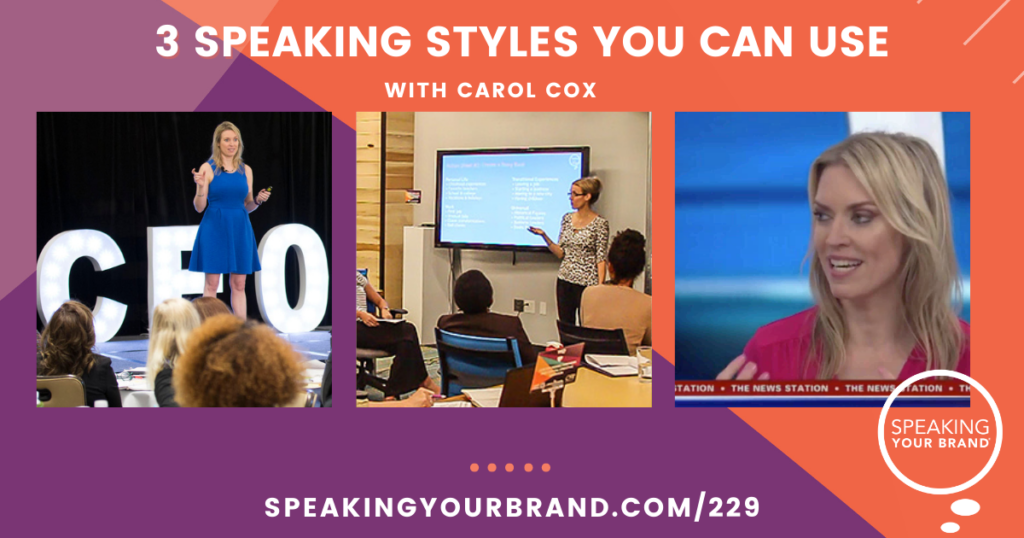
3 Speaking Styles You Can Use: Podcast Ep. 229
Subscribe to the podcast!


Are you ready to challenge yourself with your presentation content and delivery to make a memorable experience for your audience?
In this episode, I share with you 3 main speaking styles, the overall goals of each, what each of them looks like including examples.
You can take parts of each to create a style that’s your own – one that you enjoy, stretches you, and is memorable for the audience.
After doing many, many Zoom sessions and virtual presentations over the past 16 months, I know I can’t wait to be in front of an audience and to truly make an experience for them and for me.
You can use this opportunity as we shift from virtual to in-person to try new things, maybe go out of your comfort zone a bit and play with a new speaking style.
In the last episode, I talked about 5 mistakes speakers make that turn off their audiences. This is part of the current podcast series we’re doing called Speaker Prep, as we return to in-person speaking post-COVID. Yay!
About Us: The Speaking Your Brand podcast is hosted by Carol Cox. At Speaking Your Brand, we help women entrepreneurs and professionals clarify their brand message and story, create their signature talks, and develop their thought leadership platforms. Our mission is to get more women in positions of influence and power because it’s through women’s stories and visibility that we challenge the status quo and change existing systems. Check out our coaching programs at https://www.speakingyourbrand.com.
Links:
Show notes at https://www.speakingyourbrand.com/229
Download our FREE workbook on how to position yourself as a thought leader: https://www.speakingyourbrand.com/guide/.
Schedule a consult call to talk about creating your signature talk and thought leadership platform: https://www.speakingyourbrand.com/contact.
Royalty-free music sites: https://www.epidemicsound.com and https://www.premiumbeat.com
Book “The Alter Ego Effect: The Power of Secret Identities to Transform Your Life”
Connect on LinkedIn:
- Carol Cox = https://www.linkedin.com/in/carolcox
- Diane Diaz = https://www.linkedin.com/in/dianediaz
Related Podcast Episodes:
- Episode 137: The Missing Ingredients in Your Stories [Storytelling Series]
- Episode 193: Five Kinds of Stories to Share in Your Thought Leadership Content with Carol Cox [Storytelling Series]
- Episode 194: How to Structure a Movement-Making Speech Using Your Story with Joy Spencer [Storytelling Series]
- Episode 205: The 4 Types of Talks You Need as a Speaker and Thought Leader with Carol Cox and Diane Diaz [Goals & Planning Series]
229-SYB-3-Speaking-Styles-You-Can-Use.mp3: Audio automatically transcribed by Sonix
229-SYB-3-Speaking-Styles-You-Can-Use.mp3: this mp3 audio file was automatically transcribed by Sonix with the best speech-to-text algorithms. This transcript may contain errors.
Carol Cox:
Make your presentations memorable by experimenting with some new speaking styles. On episode 229 of the Speaking Your Brand podcast. More and more women are making an impact by starting businesses, running for office and speaking up for what matters. With my background as a TV political analyst, entrepreneur and speaker, I interview and coach purpose driven women to shape their brands, grow their companies, and become recognized as influencers in their field. This is speaking your brand, your place to learn how to persuasively communicate your message to your audience. Hi there and welcome to the Speaking Your Brand podcast. I’m your host, Carol Cox. In the last episode, I talked about five mistakes I see speakers make that turn off their audiences. If you haven’t listened to that one, go back after you listen to today’s episode because you’re going to appreciate those five mistakes that I talk about and what to do instead. These episodes are part of the current podcast series we’re doing called Speaker Prep, as we return to in-person speaking post-Covid. I’m sure if you’re like me, after doing many, many zoom sessions and virtual presentations over the past 16 months, I can’t wait to be in front of an audience and to truly make an experience for them and for me. And like me, you may be feeling a bit rusty to get out in person. And I really see this this transition from us being all virtual for so long to going back to in-person as an opportunity to try new things, maybe go out of your comfort zone a bit and try a new speaking style.
Carol Cox:
So in this episode today, I’m sharing with you three main speaking styles which each of them looks like and how you can take parts of them to create a style that’s all your own, one that you enjoy, one that stretches you, and one that’s memorable for the audience. For those of you who are new listeners, I’m Carol Cox, the founder of Speaking Your Brand. We help women entrepreneurs and professionals clarify their brand message and story, create their signature talks, and develop their thought leadership platforms. Our mission is to get more women in positions of influence and power, because we know it’s through women’s stories and visibility that we challenge the status quo and change existing systems. Be sure to check out our coaching programs at Speaking Your Brand Calm. This is also where you can find the show notes for each episode and the various podcast series we’ve done. We’ve done series on visibility, thought leadership, finding your voice, stories, telling sales, and more. So again, let’s go. So again, go to speaking your brand.com to find all of that information. And the show notes for each episode. Is that speaking your brand.com/the episode number. So for this episode 229 go to speaking your brand.com/2 29. Now let’s get on with the show. Why should you bother thinking about your speaking style at all.
Carol Cox:
After all, can’t you just put together your outline and your slide deck and deliver them? And yes, you certainly can. And I would like to challenge you to try something new. Now, I’m saying this to you because this is something that I want to do for myself too. I remember a couple of years ago, I asked in our community for the community members to answer what makes a great speaker to them. And here’s what they answered. A great speaker sparks my curiosity leaves me wanting to learn more. A great speaker has humor, makes me laugh, inspires me to look at something in a new or different way. Someone who understands where I am and encourages me to go one step beyond my comfort zone. Someone who captures my attention, is engaging and holds it, and sparks new ideas and provides at least one practical tip I can implement right away. So I love these responses and you see the commonalities in them. Great speakers spark curiosity. Encourage audiences to look at things in a new or different way. They’re engaging. They capture their attention, they hold their attention, they’re inspiring, and they spark new ideas and provide practical things that the audience can use. So as we go through these three speaking styles, remember these things and think about them and how you can integrate some of these elements of these speaking styles into your own presentations and delivery.
Carol Cox:
These three speaking styles that I’m going to go through are not mutually exclusive at all. Pick elements from each of them to make your own style that feels authentic to you, and be willing to try things you haven’t tried before. Speaking style. Number one is educational, and the goal with an educational style is to have the audience think and see where they can apply your content to their own situation. Most of us are comfortable here. We’re used to training. We’re used to teaching. If you’re a coach, a consultant, a strategist, you’re probably do teaching and training with your clients. Maybe you have a group program that you run, a Facebook group that you run, that you do trainings on. Perhaps you have your own podcast, and a lot of your episodes are how tos around strategies and tactics. When you go to conference breakout sessions and you speak there, it’s very much around training. And as we’ve talked about on this podcast before, having your own framework within your business, a framework that you work with, with your clients is a great thing to pull from for your presentation content, because then you can go through the steps and the strategies that you use in your framework and present those to the audience. And again, that’s really good because you’re helping the audience think you’re helping them apply your content to their situation. To do this well, you should understand the level that your audience is at.
Carol Cox:
Are they beginners or are they more advanced and helping them to apply your content in their own context? I know for myself, because I have a background in teaching. When I was in graduate school for history, I taught undergrad classes at Emory, where I went to grad school, and then right now I teach at a university. I’ve been teaching there for 12 years. Diane Diaz, our lead speaking coach. That’s where we met. We started teaching at the university on the very same day back in 2009. I teach digital entrepreneurship. Diane teaches brand storytelling and marketing, and so we are very used to teaching and training. So we are very comfortable here. And so we know we have to stretch ourselves to some of these other speaking styles that I’m going to talk to you about in just a moment. I still like the educational style. This is still my go to. But here are ways that you can challenge yourself. Things that you can try. If you do enjoy the educational style, you don’t need to give it up at all. But here are some things to think about. You can teach on something that you haven’t taught on before. So a lot of times we have our go to presentations and we’re very comfortable teaching certain tactics and strategies. But think about is there something that you can teach on that you haven’t before? So something that is still in your wheelhouse related to your business, but you haven’t explicitly created a training around? So for me, last year, in 2020, we started creating content and webinars around thought leadership.
Carol Cox:
Prior to that, we had really been focused on kind of the nuts and bolts of public speaking, and then we branched out into this idea of thought leadership. And so a great way to test this is to schedule a webinar to try out this new content. And this is exactly what we did in 2020 when we first did a webinar on how to repurpose your in-person presentation into an engaging webinar. When Covid first happened and in-person speaking engagements were being canceled. Then we did a webinar on webinars. Yes. Very meta. And then we did a webinar on finding your voice. So that was the thought leadership one. And it was a great way to test out the content. And then by doing so, we got such a great reaction that we ended up creating the Thought Leader Academy, which is our coaching program as a result of that. So a whole new program in our business came out of one webinar. So testing out content in one webinar, the other way to challenge yourself with the educational speaking style is go deep rather than broad. A lot of times I see with speakers is that they’ll have five or 8 or 10 key points or strategies or tactics or tips that they’re teaching in one presentation.
Carol Cox:
So they have like, here’s ten things that you can do around XYZ. So instead of doing that, challenge yourself and condense your presentation, your training presentation to one, 2 or 3 key points at the max and go deeper in those points. Here’s an example of a client that I worked with recently to create her signature talk. Her topic is around moving from transactional to transformational leadership, and she works in corporate. She’s a high level executive there, so she helps other professionals in corporate become transformational leaders rather than just transactional leaders. So when we created her signature talk, the first version was very strategic and tactical. So she had her she had an alliteration of three A’s and that, and she uses her personal stories to give examples of these three A’s of transformational leadership. But then we created another version of her talk that centers around one particular situation, that she had one particular story that really exemplifies these three A’s. Really highlights those elements. And so in that version of the talk, she goes deeper into those rather than broad. So that’s a great way for you to challenge yourself with this educational speaking style. Is teach on something you haven’t before and go deep rather than broad speaking style. Number two is entertainment. Or you can also call it edutainment, which is a combination of education and entertainment. So speaking out. So speaking style number two is all about entertainment.
Carol Cox:
And the goal with this speaking style is to have the audience feel. So the first one educational was getting the audience to think this one is having the audience feel and speakers here. Their purpose is to create a memorable experience for the audience. These are keynote speakers, especially those high paid keynote speakers and the most popular Ted talks. These types of presentations are story driven. They have a narrative arc. They have a beginning, middle, and end. They take the audience on a journey. They could use the Hero’s journey as a foundation, kind of as a framework for that. And really for those speakers there sharing lessons learned. So their personal stories that also relate to the audience, a lot of times they relate to the audience’s industry or the audience’s challenges that they’re facing, but they’re really a lot about the speaker themselves. Examples here would be someone like Tony Robbins. Super high energy. I went to one of his events back in 2019, and it’s like going to a concert music, lights, movement. It’s a very much experiential. People are jumping up and down because he wants to get the audience to feel, not just to think. Pat Flynn is a well-known podcaster. He did a very memorable keynote talk a number of years ago. Now He loves the movie back to the future. So he actually got a Delorean. The car from back to the future had it on stage at the conference where he was speaking at and did this whole like back to the future thing with it.
Carol Cox:
I mean, super memorable. Then several years after that, I saw him speak at Podfest, which is a podcasting conference, and even though he didn’t have the Delorean there because he had already done that at that prior conference, he still referenced back to the future because he ended up creating some video clips with it. So he talked about that. Now, I don’t really remember any of the other content of his talk, of his keynote talk. I don’t remember what tips and strategies he shared about podcasting. What I do remember is the feeling, the memorable experience that he had for the audience. And that feeling was inspiring and fun and lively and personable. Here are some more examples. Mel Robbins she’s well known for that five second rule. Like if you want to do something, don’t think about it. Just count down five, four, three, two, one and just do it. As a keynote speaker, She has high energy. She uses humor. She addresses the audience directly. So like she’ll talk to one person in the audience. She moves around the stage a lot. She uses her bodies and her hands a lot. So she has a lot of movement and a lot of energy. Another keynote speaker that I have seen and that I know personally, Katie Karamitsos she I also have seen her at Podfest, the podcasting conference, and she was on this podcast, oh, ages ago.
Carol Cox:
Katie is super high energy. She’s fun, she’s lively. She shares personal stories, those personal lessons learned. Another speaker I’ve seen is Patricia Washington. She also is lively. She’s personal, she’s direct in her delivery, and she moves around the stage. So what do all of these examples of these keynote speakers have in common? High energy, lively, humorous. Personal, a lot of movement and experiential. And this is why event organizers pay a lot for these types of speakers to keynote their event, because they know that they’re going to provide the audience with a memorable experience. And the key word here is experience. As Maya Angelou has said, I’ve learned that people will forget what you said. People will forget what you did, but people will never forget how you made them feel. And that’s why the speaking style. Number two, entertainment in these keynote speakers are all about making the audience feel. Now, for a lot of this, this feels much less comfortable than the educational speaking style. But here’s how you can start to challenge yourself and things that you can try to start bringing in this more entertainment speaking style into what you do in your presentation content. This includes conference, breakout sessions, lunch and learns, networking events that you present at even podcast content. Whether you’re a guest on someone’s podcast or your own podcast, or your YouTube channel, etc..
Carol Cox:
Share your own personal experiences. Share your own personal stories. Challenges that you’ve overcome, lessons that you’ve learned, even challenges that you’re facing right now. So add those stories into your presentation. Add emotions, add humor, add nostalgia. Add you know, different types of emotions because you want to get the audience to feel as you’re sharing these stories. I have an episode that I did called The Ideal Story ingredients. Ideal is an acronym, and so the E an ideal stands for emotion. So when you share a story, you also want to share the emotions that you were experiencing within that story. When you were experiencing that story, other ways that you can add entertainment into your presentations is to use props and costumes. Even so, props can be something, you know, that’s kind of related to what you’re talking about. It could just be a metaphor for something instead, but it kind of just gives people something tangible to to look at. You can add video clips and music as well into your presentation. I remember back in 2019, I did a whole bunch of in-person speaking engagements, and for one of them, I started off by showing a Nike ad. The video of a Nike ad with Serena Williams is about a minute long, so I showed that and then that. Then that opened up a discussion about branding and social values and companies taking a stand on values and so on.
Carol Cox:
So that was a way to add video in. And I had seen the movie Bohemian Rhapsody that had come out, and I loved it. So I integrated some of the songs into the speaking engagement. So on the slides I would just, you know, click the slide and then it would play one of the songs, and then I would talk about why something in that movie or that particular song, or the origin of that song had to do with the content that I was sharing. And then at the very end of the talk, I actually ended it with one of the songs playing. So it’s a great idea to end your talks, like with high energy, with music playing. So I will say, and I’m not an attorney, so I take this, you know, as you will, but it’s best not to use Copywritten songs in your speaking engagements. You know, for obvious reasons, it was a small enough speaking engagement where I felt okay and it wasn’t being live streamed to YouTube or to the internet. So I didn’t think it was a big deal. But that’s up to you to decide on your level of comfort. But there are websites that you can go to where you can purchase royalty free tracks, and they are really high quality. There’s a site called Epidemicsound.com and I’ll include a link in the show notes Epidemicsound.com. It’s a $15 a month subscription and they have excellent songs on there.
Carol Cox:
The type of song quality that you would hear say on Pandora, they’re really good. All different types of songs. There’s also another site called Premiumbeat.com. They’re about $50 a track again that you can download. So definitely incorporate music and incorporate video into your speaking engagements because that will just make them much more lively. Then also add movement into your presentations, move around the room, move around the stage like you take up space. And you know, as women, A lot of times we are so used to not taking up space, like making ourselves small and so instead, like use your arms, stretch yourself out like I’m actually doing it right now. Obviously you can’t see me, but like, I have my arms over my head and I’m like, stretching out, almost like in a yoga pose. I mean, you don’t have to do that on stage, but, you know, practice just taking up space by yourself. And then when you’re on stage or you’re in front of a room, walk around, use your arm gestures, you know, get the audience to participate in that one presentation where I had the Bohemian Rhapsody songs, I played the song we Will Rock you, which obviously has like a really good beat in the clapping. So I actually started stomping my feet and clapping my hands along with it, and the audience then followed along. As human beings, we are mimickers.
Carol Cox:
So if you raise your hand and say, you know, show of hands, or if you start clapping your hands or stomping your feet or dancing around, the audience will do the same. Now, it may feel really awkward for you to do that. The more you do it, the easier it will get. Kind of get over it because it will make your presentations so much more memorable. Not just like the visual images, like the snapshots people have in their minds, but they’ll just remember, wow, that was high energy. That was a lot of fun and they will remember your name. It doesn’t matter so much that they remember the specific details of the contents. It’s more important, in my opinion, for them to remember how they felt in your session. So that was style number two entertainment. Now speaking style number three. Any guesses on this one. So number one was on educational. Number two was entertainment. Number three is persuasion. So the goal with this style is to have the audience question their perspective or their assumptions or their position. So remember with educational presentations the goal is to make the audience think with entertainment. It’s to make the audience feel for persuasion is to have the audience question. And for this, as a speaker, as a presenter, you really need to understand both sides of whatever the topic is and really to have empathy for your audience, to really put yourself in their shoes and the different perspectives that they can have.
Carol Cox:
And I really hone this skill. In high school, when I was on the speech and debate team, there is a speech format that they use in high school and college called the Lincoln-Douglas debates. And it’s from the late 1850s when soon to be president Abraham Lincoln, who was a senator, was debating another Senator, Douglas. And they had a very specific format where one speaker would start off, then the other speaker would talk, and then they would counter and so on. So that’s the style that we use at our debate tournaments. And we had to be prepared to argue either side. So once we got to the tournament, we would then this is how old school that it was. We would have those like kind of like little boxes and they would have index cards in them and like with separators. And I still remember, I wish I still had them. And of course we don’t have pictures because we didn’t take photos all day long like we do nowadays, but we’d have those, the index cards on all these different topics, like topics of the day that we could be asked to argue about. So argue about, you know, for or against the death penalty for or against gun control, for or against abortion, etc. and we so then when we get to the debate tournament and then the organizers, you know, we would all be ready and they’d say, okay, this team, team number one, you are arguing for the death penalty.
Carol Cox:
Team number two, you’re arguing against the death penalty. And we didn’t know which one we would get which side. So we had to be prepared. Hence all the index cards with all of our research and stats and things like that on it. So we really had to be empathetic and get into the shoes of either side of those issues. And I think that’s what I’ve always was interested in politics even back then. But then when I got very much involved in politics and I became chairperson of my local Democratic Party and then ended up as a political analyst on TV news. That was very much what I had to do was to encourage viewers, encourage voters to to question their perspective and to consider the other side. But I had to be in their shoes as well. And I was reminded of this because President Obama was recently on the Ezra Klein podcast, and he talked in the very beginning of that show that for him, persuasion means understanding the other side’s worldview. And that’s how he approached politics when he ran for president in 2008, was really sitting down with people at diners and at, you know, different clubs and events and these small, these small towns and these small venues and really understanding the other side’s worldview and using that for persuasion and this speaking style, persuasion, having the audience question their perspective is really what makes great Ted talks, Ted talks, this is all also the format that we use for our brave bull beyond live virtual summits.
Carol Cox:
So our summit speakers, when they created their Ted style talks, that was really what they did, is they took the audience on a journey of discovery. So they talked about how they had one perspective about something, but then they went on this journey of discovery and their perspective changed, or they learned something new. And that’s really starting on one side and then ending up somewhere else. And so that Ted style talk is a great framework to think about this idea of persuasion. Here are some other examples Rachel Rodgers, she’s an entrepreneur. She has a podcast called hello seven and she talks about she just has a book that has come out, We should All be millionaires. And for example, she talks about making million dollar decisions in your business. And so for her that’s helping us to question our perspective, change our assumption about something. And she also has a lot of her podcast episodes on topics related to black success and black wealth. So seeing black people, especially black women, as successful and as wealthy. Because of course, in our dominant society right now is mostly white people and white men, but also white women who are kind of seen as the pinnacle of success and wealth.
Carol Cox:
And she really wants to change that. So she’s using this persuasive speaking style with her content to do that. And hopefully I do this on this podcast. And by putting on our summits in helping you to shift your perspective or to think about things in a different way. So ways for you to try this yourself and to challenge yourself is, number one, be okay sharing your opinion and sharing your perspective in your presentation content. So many of us like to play it safe. We just like to do our training content and just share our kind of tried and true strategies. But it’s boring for a lot of audiences and it doesn’t make you stand out. It doesn’t make you memorable. So think about what ticks you off. What do you want to see changed? How can you incorporate your opinion, your perspective, your thought leadership into your presentation content. Also understand where your audience currently is. What part of the spectrum of understanding and action are they? When we. When I work with clients and I ask them about their audience and specifically related to their topic, I kind of say, okay, like you, you know, the client, you’re on one end of the spectrum, like you’ve gotten all the way here. Towards the end of this particular journey, there are some prospective clients or audience members who will be at the very, very beginning of the journey.
Carol Cox:
Maybe they have just no awareness of your topic. Then there are people kind of in the middle of the spectrum who have awareness of your topic, but they’re not as advanced or they’re not as far along in their journey as you are. And for most speakers, we really are talking to those people in the middle. The people who are at the very beginning are not quite our target audience yet. I mean, yes, they can listen to our presentation content and maybe that’s the first seed that gets planted. But as far as audiences taking action, they’re probably going to be more in that middle of that spectrum. So think about your content from that perspective. And then in your presentation content, show your audience your journey of how and why you changed your mind about something. So that was speaking style. Number three persuasion. So now that you’ve learned those three, here’s how you can think about creating your own speaking style. And here are some things that I do myself. Number one find an alter ego. An alter ego allows you to take on qualities that you want that you may not feel like you intrinsically have. And I got this from a book that I read a few years ago by Todd Herman about alter egos. So he talks about alter egos. Could be a fictional person. It could be a real life person from the past, from the present.
Carol Cox:
It could be an animal. It could be, you know, like a combination of things that you put together. So find an alter ego that has the qualities that you want. And here’s an example. I just recently saw the movie Cruella, the Disney movie. And can I tell you how nice it was to actually be back Inside a movie theater and to watch a movie on a big screen. I love movies. You can probably tell I love storytelling, I love narrative arc. I love thinking about performances and music and all of those kinds of things. So it was so great to be back in a movie theater. So we saw Cruella and I love the movie. I loved the performances, the fashion, the costumes, the music, all of it. And the character of Cruella. What I loved about her was her willingness to take up space, her presence, her energy, her confidence. She doesn’t shy away like she doesn’t back down. And some of these scenes and I know spoilers here if you haven’t seen it, but she is just like she talk about power posing like she’s all about it, so I’m going to think about her next time I stand in front of a group of people, or I stand on stage like I want to take up space. Because guess what? When you take up space, especially as a woman, the other women in the audience realize that they can do the same thing too.
Carol Cox:
So you’re empowering them when you do that, when you have confidence and you take up space. So find an alter ego. Number two seek diversity in your skill set. Take an improv class. Diane and I did that at the beginning of 2020 and it was really hard. It definitely put us out of our comfort zone, but we learned so much, especially about taking up space and using our bodies more. You can also take an acting class. It’s another great way to do that. Number three push yourself out of your comfort zone. Experiment. Take risks. Try some of these different elements from these speaking styles that I just went over. Change up your presentation. Add these layers like emotion, humor, music, video clips, props also go after bigger opportunities, including opportunities that may scare you a bit. Go ahead and apply for those as well. Give yourself permission to fail. You may try things in a presentation, you may try a video clip, or you may try some humor, or you may try dancing or moving around. And maybe the audience doesn’t resonate that much with it. I promise you that they will not think about it later. You will think about it because it’s you. They will not care. They will not think about it. Just keep going. Going the other way that you can push yourself out of your comfort zone is to impose constraints. If you’ve been given the same kind of standard 45 minute talk, try cutting it down to ten minutes.
Carol Cox:
When you cut it down to ten minutes, you really have to get rid of of all the extraneous and focus on that single through line. That’s going to have the biggest impact. And that’s why our summit speak speakers, where they only had ten minutes to do their talks. It was so impactful because they had to put in the most important and relevant stories and content. The other thing to do to create your own speaking style is to find a subject that really lights you up, that rouse you up, that sets you on fire. Create a talk around that. It doesn’t have to be that directly connected to your business. So not like, okay, here’s my framework or here’s the three things that you can do related to my business and my business topic. Instead, find something that you’re just really passionate about and give some presentations around that. Because if people feel your energy and you create a memorable experience for them, they’re going to want to follow you. They’re going to want to stay connected with you. Finally, around creating your own speaking style, shift how you see yourself, your identity. So for for a long time, again, because I have this background in teaching and training, you know, I told myself I’m this practical, solution focused, left brain logical presenter and speaker, and I teach others and that’s the value that I provide.
Carol Cox:
And I have shifted my own identity in the way I see myself as someone who inspires others, who helps people to see new things, who helps people to question their perspectives, to helps people to to feel and to think about things in a different way. And that’s the new identity and that’s you can do the same thing for yourself. Because after all, as a speaker, you are a leader. You’re standing in front of the room, you’re a leader, you’re a role model for others. And as such, you are there to validate their experience and to inspire them. I hope you enjoyed this episode. If you did, could you share it with a friend or a colleague that you think would enjoy this as well? And then also, if you would like to create your signature talk with us, I invite you to schedule a consultation call. It’s entirely free to do that. We have worked with hundreds of women entrepreneurs and we would love to work with you. You can go to speaking your brand.com/contact to schedule the call. Again, that’s speaking your brand.com/contact. Or you can email me directly Carol Cox at speaking your brand.com. Again that’s Carol Cox as speaking your brand comm. Next week’s episode is an interview with one of our recent clients, and it’s about how to use your story for an inspirational talk. Until next time, thanks for listening.
Sonix is the world’s most advanced automated transcription, translation, and subtitling platform. Fast, accurate, and affordable.
Automatically convert your mp3 files to text (txt file), Microsoft Word (docx file), and SubRip Subtitle (srt file) in minutes.
Sonix has many features that you’d love including powerful integrations and APIs, automated subtitles, collaboration tools, world-class support, and easily transcribe your Zoom meetings. Try Sonix for free today.