Why Your Message Must Fit the Medium (and How to Get It Right)
Have you ever watched a keynote and felt like you were sitting through a 90-minute training crammed into 45 minutes?
Or attended a talk that felt more like a checklist than an experience?
You’re not alone — and you’re not imagining it.
One of the most common mistakes speakers, entrepreneurs, executives, and thought leaders make is trying to deliver the same type of message across every platform and format.
But here’s the truth:
The medium shapes the message.
And when the message doesn’t fit the medium, the result is confusion, overwhelm, disengagement, and missed opportunities for impact.
At Speaking Your Brand®, we teach that powerful communication is not about how much you share — it’s about sharing the right thing, in the right way, at the right moment.
Let’s break down what that actually means.
Why the Medium Shapes the Message
Each communication format has a distinct purpose and psychological role for the audience.
A keynote is not a course. A lead generation talk is not a workshop. A TED-style talk is not a coaching session. A workbook is not a book.
Yet many speakers treat them as interchangeable.
That’s how we end up with:
Overloaded keynote slides
Confused audiences
Talks that feel heavy instead of inspiring
Leads who are overwhelmed instead of motivated
Brilliant experts who stay stuck in the expert trap
When you understand the function of each medium, everything changes.
Instead of asking:
“How much can I fit into this talk?”
You start asking:
“What transformation is this format meant to create?”
The Strategic Difference Between Information and Transformation
Most professionals are trained to teach.
But thought leaders are trained to transform.
Information answers: What should I do? Transformation answers: Who do I become? How do I think differently? What changes now?
When speakers overload their keynotes with technical steps, tools, and processes, they accidentally:
Dilute their message
Decrease audience retention
Reduce emotional impact
Undermine their authority
Miss conversion opportunities
That’s why we use a strategic framework at Speaking Your Brand to help clients match message type to communication format.
The Message Needs to Fit the Medium
Here’s how different types of content align best across formats:
1. Lead Generation Talks
Primary Purpose: Awareness, clarity, motivation, and action
Best Message Types:
Mindset shifts
Strategic frameworks
High-level insights
Problem identification
Light tactical examples
Not Ideal For:
Detailed instruction
Step-by-step training
Complex implementation
Why: Lead generation talks should open loops, not close them. Their job is to help your audience see their challenge differently — and want more.
2. Keynote Talks
Primary Purpose: Inspiration, perspective shift, and emotional resonance
Best Message Types:
Mindset shifts
Emotional connection & story
Strategic frameworks
Identity shift & inspiration
Not Ideal For:
Tactical instruction
Detailed processes
Skill practice
Why: A keynote should change how people think — not teach them how to do everything.
This is where speakers step into thought leadership, not technical training.
3. TED-Style Talks
Primary Purpose: Idea-sharing, belief shift, and cultural influence
Best Message Types:
Big ideas
Reframes
Identity shifts
Emotional storytelling
High-level frameworks
Not Ideal For:
How-to steps
Tools
Templates
Why: TED-style talks are designed to spark conversation and insight, not deliver instruction.
4. Workshops & Trainings
Primary Purpose: Skill development and practical application
Best Message Types:
Tactical instruction
Implementation steps
Practice exercises
Group interaction
Skill building
Why: This is where people roll up their sleeves and do the work. It’s the bridge between insight and execution.
5. Coaching
Primary Purpose: Personalized transformation
Best Message Types:
Strategic frameworks
Mindset shifts
Skill practice
Identity work
Deep reflection
Why: Coaching is where change becomes personal, embodied, and sustainable.
6. Courses
Primary Purpose: Structured learning & mastery
Best Message Types:
Detailed instruction
Step-by-step processes
Progressive skill development
Practice + reinforcement
Why: Courses allow for depth, sequencing, repetition, and mastery.
7. Workbooks
Primary Purpose: Guided implementation
Best Message Types:
Exercises
Worksheets
Prompts
Planning tools
Why: Workbooks are designed for doing, not consuming.
8. Books
Primary Purpose: Depth, authority, and legacy
Best Message Types:
Detailed insights
Strategic frameworks
Story
Identity shift
Expanded thinking
Why: Books allow you to go deep, tell layered stories, and shape how people think long-term.
The Real Cost of Ignoring the Medium
When your message doesn’t match your medium, here’s what happens:
Keynotes feel overwhelming instead of inspiring
Audiences leave with notes — but no emotional connection
Lead generation talks fail to generate leads
Speakers struggle to convert attention into opportunity
Your brilliance stays trapped in technical complexity
In other words: you work harder for less impact.
And that’s a tragedy — especially for women leaders, entrepreneurs, and professionals who already struggle with visibility, confidence, and influence.
The Thought Leader Shift: From Teaching to Transforming
At Speaking Your Brand®, we help our clients move from:
How to Apply This to Your Speaking, Content, and Business
Here are three simple reflection questions to help you align your message with your medium:
1. What is the transformation this format is meant to create?
Not: What should they know? But: How should they think, feel, or act differently afterward?
2. Is this the right place for technical instruction?
If your answer is “maybe,” it probably belongs in:
A workshop
A course
A workbook
A coaching program
Not your keynote.
3. Where does this piece fit inside my larger ecosystem?
Your talks, courses, coaching, and content should work together — not compete with each other.
Your keynote should create demand for your workshop. Your workshop should feed your coaching and courses. Your course should reinforce your frameworks. Your book should cement your authority.
This is how you build a cohesive thought leadership platform.
Work With Speaking Your Brand®
At Speaking Your Brand®, we help women entrepreneurs, executives, and professionals:
Carol Cox:
If you’ve ever been tempted to add just a bit more content to your presentation or your talk, this episode is for you. More and more women are making an impact by starting businesses, running for office, and speaking up for what matters. With my background as a TV political analyst, entrepreneur, and speaker, I interview and coach purpose driven women to shape their brands, grow their companies, and become recognized as influencers in their field. This is speaking your brand, your place to learn how to persuasively communicate your message to your audience. Welcome to the Speaking Your Brand podcast. I’m your host, Carol Cox. One of the most common mistakes I see speakers make is trying to deliver what should be a six week course, or a full length book and a 45 minute talk or presentation. Perhaps you’ve seen this yourself, being in the audience where you left a keynote or even a conference session feeling impressed but also completely overwhelmed. And when this happens, it’s not because the speaker isn’t good, it’s because the message doesn’t fit the medium. And in this episode, I’m going to share with you the different mediums that exist, such as lead generation, presentations, keynotes, talks, Ted style talks, even courses, coaching books, and so on. But how? The message that you’re delivering has to fit that particular medium. And I have a really handy graphic, a grid that I created that you can get on the show notes page at Speaking Your Brand. 458 so again, that’s speaking your brand.
Carol Cox:
458 you can see the visual there. Now, when this happens, and if you are the one who is speaking, you might feel like your talk isn’t landing, that you’re not getting the results that you’re looking for. And those results could be leads and clients from your presentation could be other speaking invitations. It could be the audience taking action on whatever it is that you’re sharing with them. So you may think that the reason your talk isn’t landing because you need better slides or better design slides, or you need more content, or you needed more time, you only have 30 minutes. And if only you had 45 minutes or 60 minutes, then that would have made the difference. But usually that’s not what the issue is. It’s because you’re using the wrong type of content for the format, and we’ve been trained to believe that value equals more information. But in speaking, value equals transformation. And this is why your role as a speaker is so important. But the problem we run into is because as experts, we feel responsible for teaching our audiences everything. We feel like if we could just only take everything that’s in our head and kind of transport it into the audience’s brains, then they would know everything and then they would be able to take action. And as high achieving women, we sometimes especially feel the pressure to prove our competence. And a lot of times we prove this by giving more and more information.
Carol Cox:
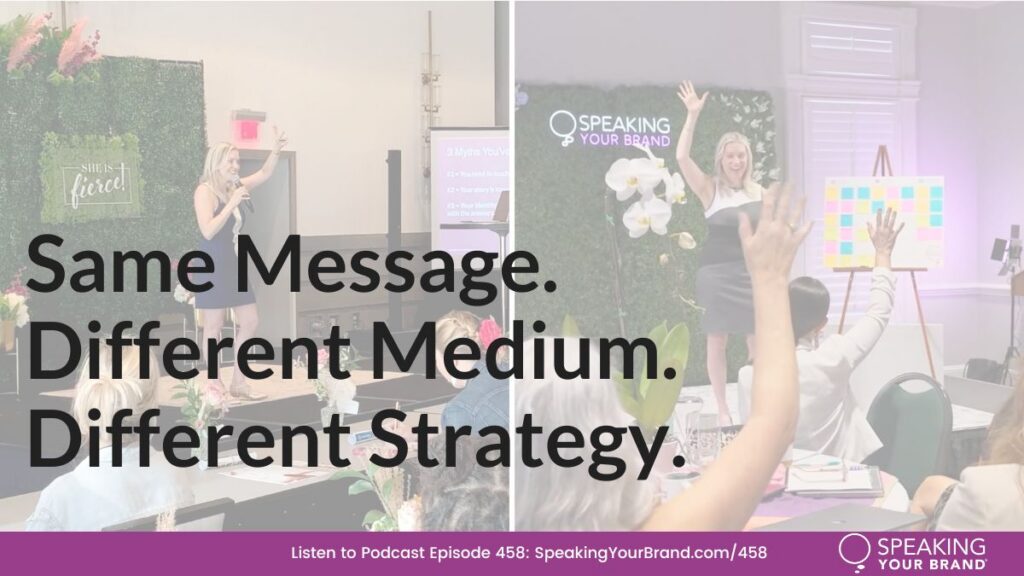
But this leads to overload instead of impact. And that’s what I call it, the expert trap, where we confuse being helpful with being transformational. So that’s why we have to understand how the medium shapes the message. You can have the same thought leadership message, but the medium that you’re using lead gen, presentation, keynote, a book, a course, coaching, etc. is going to lead to a different strategy because each format has a job to do. And when you mismatch the message in the medium, that’s when things fall apart. That’s when things don’t have the impact that you want them to have. So let me walk you through these different mediums that are most likely the ones that you’re going to be using, and then how to think about the type of content that goes into each one. So first let’s think about lead generation talks when you’re doing a talk for lead generation. So you want someone to be interested in working with you. So you’re doing a conference breakout session or you’re doing a lunch and learn at a business group. And so what you’re doing with a lead Generation talk is that you want to generate awareness, awareness of what you do in your business. So you’re helping people identify what their real problem is, and then how you offer a solution to that through, say, a framework or a process that you have. And so you’re creating this awareness, this open loop that then the audience wants to have closed.
Carol Cox:
And ideally by working with you. And you can see an excellent example of this with one of our clients, Danielle Hayden, on episode 362, where we talk about how we completely re-engineered her lead generation talk to have the clients become aware of what they wanted, and then have this desire to want to work with her. And what a huge difference in made in increasing the leads and clients that she got from her talks. Now, lead generation talks do tend to be more tactical. So you are doing a little bit of teaching. You are sharing a little bit of how the audience can achieve what it is that they want to achieve. You’re most likely sharing a framework with them. So some type of framework or process that you use with your clients and your business to get them from point A to point Z, to get them the results that they want. So that framework could be an acronym or a visual process or say even an alliteration. Alliteration. But you also want to make sure that you’re getting your audience to think differently about the problem that they have and the challenges that they have and the potential solution to them. Would a lead generation talk should not be doing is providing a lot of detailed information. You don’t really have the time for it. Plus it’s overwhelming the audience. And it’s really also not about implementation and skill practice.
Carol Cox:
If you have a talk that’s 30 minutes or even 45 minutes, you really are just setting the stage for the audience to get them to think differently. Now let’s contrast that with another medium, which is a workshop or a training. And this could be virtual or in person. And for a workshop or training, I’m generally thinking of ones that are at least two hours could be four hours or even a full day workshop. So in a workshop in training, you really are sharing tactical how to steps. That is the purpose of a of a training to share the how to steps. In this case you are giving more detailed information. Not too much to overwhelm the audience, but you do have more time and more space than say in a lead generation talk or other type of talk to give more detailed information. You’re still providing your strategic frameworks because you need to have a container for what you’re teaching and what the audience is learning. This is also where that implementation and skill practice come in, because you most likely have time for activities where the attendees can implement what they’re learning, and you’re still doing that mindset shift. You’re still getting the audience to think differently about what it is that they want and how to get there. So you can see with the lead gen talk, it’s not about all the detailed information and it’s not about implementation. It’s really about the strategic frameworks and getting the audience to think differently.
Carol Cox:
Now let’s take a look at a third medium which is keynotes. I have seen a lot of keynotes in my day, and unfortunately many of them tend to lean too much into the tactics and how to’s and the detailed information. And that is not the purpose of a keynote, a keynote. As a keynote speaker, you’re there to inspire the audience, to get them to think differently, to encourage them, to motivate them a little bit of entertainment most of the time for keynotes, they are happening when a conference kicks off. So you’re the opening keynote or maybe a luncheon keynote or the closing keynote. So you’re setting the stage for the event, and you’re also getting the people excited about what it is that they’re going to learn, or excited about what they just learned at that particular conference or event. So you’re a keynote talk is not supposed to be a bunch of dense information, save that for the workshop or training. Save that for a course that you offer or save that for the book. Maybe that you provide to the attendees. The number one goal is to get the audience to think differently than they have before. And whatever the topic area is that you are that you’re the expert in, go back and listen to episode 422 with my client, Julia Cohen, on how we created a ten out of ten keynote that left her audiences in awe. Again, that link is in the show notes.
Carol Cox:
Keynotes are also very much about emotional connection and story, so storytelling really is the undercurrent through an entire keynote and a keynote talk is about inspiration and helping the audience to understand who they are, where they fit in the world. And the world could be the industry or the community, or even the bigger, the bigger world where they fit in the world and understanding their place in it, that is the role of a keynote, not a whole bunch of detailed information that the audience is struggling to understand or struggling to keep up with. Now, let’s take a look at mediums where you can provide more detailed information. So for example, a course that you provide, maybe this is a self-paced course that clients can go through. So in that case you are providing the how to steps more detailed information for them. It’s still the container are your strategic frameworks to help the students to help your your clients, your users to go through that course to understand the big picture. It is also implementation and skill practice as well, so that in that sense is very hands on and it’s very tactical. So save the detailed information and the the how to steps for your course. Same thing with a workbook. A lot of times you’ll have a workbook that you provide, maybe in a workshop or in your course say the detailed information for that. Now another medium that requires a different strategy is a book.
Carol Cox:
A book is where you can go into much more depth. You can provide context and nuance. You can go into more explanation, you can explore complexity, and you can build long term authority. And this is why books matter so much, especially for thought leaders and for speakers. I have a great episode with my book coach Tiffany Hawk back in episode 257. I’ll include a link to all of these episodes that I’m mentioning in the show notes, because that’s a great episode to talk about. Why writing a book gives your ideas depth, and longevity, and that’s why I’m excited that the next few episodes will feature authors, because books do give us a completely different way to share ideas, and they reinforce our talks and allow our audiences to go deeper with our content. So save that deeper content for a book or a course or a workshop and training. And here’s the big reframe that I want you to take from this. The goal in your talks and presentations isn’t to say more. The goal is to move people more. Lead generation presentations are meant to create interest. Interest in working with you. Keynotes create clarity and desire. Desire for something different. Workshops create capability. Courses create mastery, books create depth and coaching creates the transformation. So have you ever thought, well, I just need more content in my presentation or I’m not providing my audience enough in my talks. This is your permission slip to do less and instead create more impact because thought leaders don’t overwhelm, instead, they illuminate.
Carol Cox:
You don’t need to prove how much you know. Your audience already assumes that because you’re there as a speaker, what they need is your perspective and your curation. Curation is really powerful. When we work with our clients in the one on one VIP days, which is a three hour zoom session where we map out their signature message and their signature talk from beginning to end. I am that I am helping them curate and edit everything they have in their head, from all of their years of experience and expertise into what is most important to their audience. I tell them that I have three jobs during that VIP day. The first job is to be that collaborative thought. Partner with them to bounce ideas off of each other, to pull on threads and to say, okay, well, what about this? Or let’s think about where this could go and helping helping to devise whatever that main framework or those lessons or those stages or those principles are for the audience. My other job is to sit in the seat of the audience. So I’m thinking, okay, if I were listening to this talk, what else would I need to know? What is confusing? What is too much? What is kind of bearing, or what is too noisy that is preventing me from understanding the key thing that I need to understand as the audience.
Carol Cox:
And then the third job I have in that VIP day is as event organizers, because you want to make sure that event organizers are interested in hiring you. So I sit in that seat and think, so as an event organizer, what would make this interesting for my audience? Where would the value be and the value was not more information. Trust me on this. It’s not more information. It is that transformation. The next time you’re building a talk, ask yourself what is the transformation this format is meant to create, not how much more information I can put in here, but could. But how can I help my audience better get to where they want to be? If you would like to have a one on one VIP day with us to map out your signature message and talk, which really is the foundation for your marketing and visibility, we can do that as a standalone VIP day within our coaching or within our online Thought Leader Academy program. You can get all of the details on our Thought Leader Academy and our coaching at speaking your brand, and the best thing to do is to schedule a consultation call with us. We’ll learn about your goals, what you need the most help with, and then we can talk through what would be the best option for you. And you can schedule that call by going to speaking your brand. Again, that’s speaking your brand. Until next time. Thanks for listening.
Thanks for subscribing! Please check your email for further instructions.
Something went wrong. Please check your entries and try again.
We use cookies on our website to give you the most relevant experience by remembering your preferences and repeat visits. By clicking “Accept”, you consent to the use of ALL cookies. Click "Cookie settings" to customize your preferences.
This website uses cookies to improve your experience while you navigate through the website. Out of these, the cookies that are categorized as necessary are stored on your browser as they are essential for the working of basic functionalities of the website. We also use third-party cookies that help us analyze and understand how you use this website. These cookies will be stored in your browser only with your consent. You also have the option to opt-out of these cookies. But opting out of some of these cookies may affect your browsing experience.
Necessary cookies are absolutely essential for the website to function properly. This category only includes cookies that ensures basic functionalities and security features of the website. These cookies do not store any personal information.
Any cookies that may not be particularly necessary for the website to function and is used specifically to collect user personal data via analytics, ads, other embedded contents are termed as non-necessary cookies. It is mandatory to procure user consent prior to running these cookies on your website.





![How to Approach Your Talks as a Marketer to Increase Your ROI [Growth Series]: Podcast Ep. 457](https://www.speakingyourbrand.com/wp-content/uploads/2025/12/SYB-457-LinkedIn-1200-1024x576.jpg "How to Approach Your Talks as a Marketer to Increase Your ROI [Growth Series]: Podcast Ep. 457")
![The Missing Piece of Your Marketing Strategy is a Signature Talk [Growth Series]: Podcast Ep. 456](https://www.speakingyourbrand.com/wp-content/uploads/2025/12/SYB-456-LinkedIn-1200-1024x576.jpg "The Missing Piece of Your Marketing Strategy is a Signature Talk [Growth Series]: Podcast Ep. 456")