The Connection Formula: Expertise + Story – Live Signature Talks from Our Thought Leader Academy Grads: Podcast Ep. 463

Subscribe to the podcast!


Many accomplished women already have the expertise, experience, and authority their audiences need. The missing piece is rarely more knowledge — it’s connection.
Story is what bridges the space between expert and audience. It humanizes ideas, creates emotional resonance, and allows insight to truly land. When expertise is combined with purposeful storytelling, a talk doesn’t just inform — it connects, influences, and stays with people long after it ends.
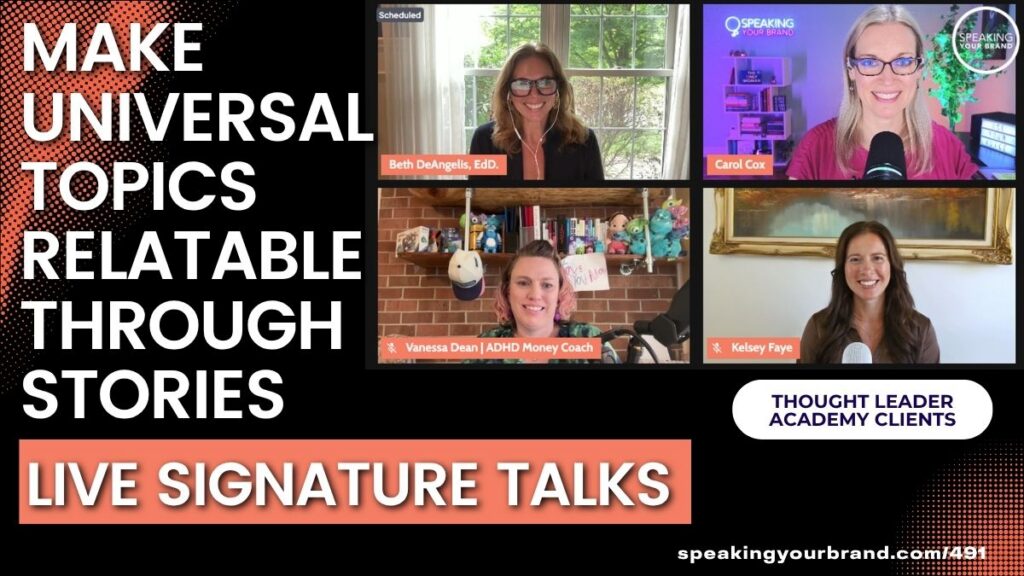
This episode is the audio from our Back Stage with Speaking Your Brand live show, where three recent grads of our Thought Leader Academy each delivered a 10-minute version of the signature talk they developed with us, designed to transform expertise into meaningful connection through purposeful storytelling.
As you listen, you’ll learn how powerful talks are built, including:
- How to turn expertise into a compelling narrative
- How to embed your unique perspective and lived experience into your message
- How story creates trust, meaning, and emotional connection
- How to structure ideas so they are clear, memorable, and actionable
- What they learned from the Thought Leader Academy and what’s next for them
About Us: The Speaking Your Brand podcast is hosted by Carol Cox. At Speaking Your Brand, we help women entrepreneurs and professionals clarify their brand message and story, create their signature talks, and develop their thought leadership platforms. Our mission is to get more women in positions of influence and power because it’s through women’s stories, voices, and visibility that we challenge the status quo and change existing systems. Check out our coaching programs at https://www.speakingyourbrand.com.
Links:
Show notes at https://www.speakingyourbrand.com/463/
Watch the video at https://youtube.com/live/4s1LX8sGk7s
Discover your Speaker Archetype by taking our free quiz at https://www.speakingyourbrand.com/quiz/
Apply for our Thought Leader Academy: https://www.speakingyourbrand.com/academy/
Connect on LinkedIn:
- Carol Cox = https://www.linkedin.com/in/carolcox
- Diane Diaz = https://www.linkedin.com/in/dianediaz
- Allison Greco = https://www.linkedin.com/in/allisongreco/
- Brittany Sadlouskos = https://www.linkedin.com/in/brittanysadlouskos/
- Cam Dunson = https://www.linkedin.com/in/camdunson/
Related Podcast Episodes:
463-SYB-LI-Live-TLA-Grads.mp3: Audio automatically transcribed by Sonix
463-SYB-LI-Live-TLA-Grads.mp3: this mp3 audio file was automatically transcribed by Sonix with the best speech-to-text algorithms. This transcript may contain errors.
Carol Cox:
How can you turn your expertise into a compelling narrative? Listen in. As three of our recent graduates of our Thought Leader Academy deliver their signature talks for the very first time on this episode of the Speaking Your Brand podcast.
Diane Diaz:
Hi everyone, and welcome to our LinkedIn live with our Thought Leader Academy graduates. I am Diane Diaz and I am the lead speaking coach at Speaking Your Brand. I’m excited that we are bringing today three of our graduates from the Thought Leader Academy. Now, if you watched the last LinkedIn live, you saw two graduates from our Thought Leader Academy. These are our other three graduates. I’m very excited for you to hear their talks today. Um, one thing that I have noticed in working with clients, and actually the women that I speak with on a daily basis, is that we often are waiting for getting that other credential or waiting for someone to give us permission to let us know that we can go ahead and start speaking. But really, the the bridge between our story and our expertise. That is where the gap is. And so story is what’s going to fill that gap. Story humanizes your expertise and it builds trust quickly with your audience. And that actually helps your ideas to stick and land with the audience and really resonate and move them to action. So that is why I am so excited today, because you won’t just hear about this from our speakers today. You’re actually going to see it in action. So I’m joined today by three recent thought Leader Academy graduates and they are Allison Greco, Brittany Sadlouskos, and Dr Cam Dunson.
Diane Diaz:
Welcome to all of you. Um, and each of them are going to deliver a ten minute version of the signature talk that they worked on during their time in the Thought Leader Academy. This was over an eight week program. They worked on these talks along with a lot of other things that they worked on storytelling, connecting all the dots and all of that. And these talks are actually designed to turn their expertise into meaningful connection through purposeful storytelling. And you’re going to see that as each of them speak, so as they speak. I encourage you to look for those storytelling moments that are connecting the dots of the message and building that that bridge between their expertise and the message. So, uh, in just a moment, we’ll hear these three talks back to back and then stick around for the end. Don’t leave after the last speaker, because after the last speaker, we are going to do a little round table discussion where I’m going to ask them to share some some information and insight about their experience in the Thought Leader Academy, working on their talks together, what that was like, what they learned, um, insights they have. And, and I think you’ll get a lot of value out of that as well. All right. So let’s jump in. Please welcome to our stage as our first speaker, Allison Greco.
Allison Greco:
Hello. Good afternoon, I’m Allison Greco. I’m a continuous improvement and business expert. And this is Leadership in motion continuous improvement at the speed of change. So who here has ever ridden a train? Maybe Amtrak, your rail, or, uh, maybe one of those quaint little steam trains. Maybe you’ve ridden a train before, but have you ridden a freight train? That’s me. Fresh out of college, I went to work for the railroad. I spent the entirety of my first summer learning the rules and the processes and all the systems that govern the rails. That summer was a crash course in railroading that was preparing me for an epic capstone experience. I was going to literally hop freight trains from Kansas City to LA. Now, when you’ve ridden a train, your experience probably looked something like this. But when I learned I was going to hop freight trains, I envisioned something that looks more like this. But actually it looks like this. And they let me ride inside the locomotive. But I spent an entire week hopping freight trains from Kansas City to LA. And when I was dropped off in Kansas City, I had nothing but a small duffel bag. It was a bit intimidating, but absolutely thrilling. I thought that I was there to test the process, to put my skills to an ultimate test, to see how well I had really paid attention that summer. But I was actually going to learn something really different and unexpected. And I’ll tell you a little bit later what I actually learned.
Allison Greco:
But of course, I’m a continuous improvement expert. So I want to know how do you feel about continuous improvement and be really honest. So think about on a scale of 1 to 5, maybe one is I don’t have a lot of experience with continuous improvement. Or maybe I had a bad experience with continuous improvement all the way up to a four or a five, where continuous improvement is my superpower. So for my my co-panelists, where are you on a scale of 1 to 5? Yeah. So so a little bit of a variety. And if you’re watching the LinkedIn live, feel free to to add in the comments. Where are you on a scale of 1 to 5? And when I’m speaking in front of a room, I typically see that full range of 1 to 5. So my goal is if you’re a one or a two is to give you some new exposure into continuous improvement and maybe get you to a two or a three. And if you’re a 4 or 5, I just want to give you a fresh perspective and new motivation to go out and continue improving. Um, but me, I am a solid five. If you invite me to a potluck dinner, be prepared because I am going to rearrange the entire buffet to optimize that plate loading performance. That’s me. So it’s really no surprise that I earned a degree in industrial engineering. I went on to earn an MBA and was ultimately senior vice president of Continuous improvement at a trucking company, and along the way I was crowned Miss Oklahoma.
Allison Greco:
And to be honest, I was probably always a five. I was probably a five since high school. In high school, I was involved in everything. I was performing in local community theater. I was in competitive speech and debate. I was hostessing at a burger joint, and I was picking up babysitting jobs whenever I had a free moment, which wasn’t very often because I was carrying a very heavy course load even in high school. And I was starting to believe something really dangerous, that the more I achieved, the greater my self-worth. And I thought I could continuous improvement my way through Anything, but the reality is that I really wasn’t doing well. I was stressed. I was overwhelmed, and I was anxious. And I remember this distinct moment in high school when my dad sat me down at the kitchen table and gave me a blank sheet of paper, said, Allison, you’re going to do a time study. I want you to write down all of your activities, and I want you to write down how much time you’re spending in each one, and then how much time you should be spending in each activity. And then my dad came back and he said something unexpected. Allison. What are you going to stop doing? Stop doing. Wow. My dad didn’t try to help me manage my calendar. He didn’t try to help me optimize my time.
Allison Greco:
He was teaching me a critical leadership skill. And those were the leadership skills that I think I underappreciated then. But now I’m really starting to see the value. One of the big challenges with leadership today is that we were trained as leaders to operate in a system that’s very consistent, that has a lot of clarity. And that’s not the world that we work in today. And it actually makes me think of Stranger Things and the Upside Down where we are trained in this world. That is clear. We have great decision making. We have time to make that decision. But the reality is we’re operating in something that looks more like the scary underbelly, upside down environment with all these scary monsters. And I think the scary monsters in our world are things like artificial intelligence and big data, and markets that are changing faster than the wind in Oklahoma. And meanwhile, we were trained to gather all the data, analyze all the risks, and wait for this perfect moment to be able to make our decisions. And meanwhile, while we’re gathering all this data, our train has actually already left the station. So when I was working on the railroad, I learned something incredibly valuable. And it’s continuous Improvement. It’s not about perfecting the system. It’s about leading inside motion. So when I was writing the freight trains from Kansas City to LA that summer, this is what I learned. It wasn’t a test of the processes. It was about leadership.
Allison Greco:
And that’s where I learned that we need to flip the script on continuous improvement and leadership. It’s about leadership and not management. Management is managing the day to day and sustaining the status quo. But leadership is about clearing a path for your teams to be successful. Just like my dad did in my time studying. It’s about action over analysis. It’s about taking steps that we can do to make changes today, instead of waiting for perfection and waiting for the perfect data to be available. And it’s about people, those railroad processes. It’s not really about the process. It’s about how the people experience the process. And it’s about how I, as a leader, make decisions that impact the people and how my decisions can either make their life really difficult or my decisions could actually improve their lives. So this is what I learned. It’s really about leadership and motion. And you can think of this in terms of taking laps. Our world is always moving, and I feel like we’re constantly running laps and the laps are leadership, action and people. So these are the lessons that I learned working for the railroad. So I asked you next time you hear the whistle of a freight train. No, please don’t hop on the freight train because you probably will be arrested. But instead, think about how there might be a young new employee writing that train who is learning lessons in leadership and learning how to lead in motion. Thank you.
Diane Diaz:
Well, Allison. Fantastic job. What what did that feel like for you delivering that.
Allison Greco:
Oh, it’s it’s it’s almost cathartic.
Diane Diaz:
Oh, nice.
Allison Greco:
To be able to share experiences in, in a different way than I have before. A lot of my speaking in the past has been about safety in trucking or specific expertise in continuous improvement, and this is the first time that I’ve shared a lot of my personal stories with a much greater audience.
Diane Diaz:
I love that. Good. I’m so glad. Now, one other thing. I know that in the Thought Leader Academy. So for everybody watching in the Thought Leader Academy graduation call yesterday, Allison’s graduation speech involved props. So tell us a little bit about why you chose to use props. And what did it feel like to do that? Because I know a lot of people, you know, understandably are nervous about doing something like that. How did that feel for you?
Allison Greco:
Yeah. Oh, using props was so much fun. It brings me back to my theater days, when we were given a prompt for our graduation speech to talk about graduation, I immediately thought about a hat. And to. To be able to play dress up and tell a story with with hats was really fun and I would love to do it again. And I would love to be on stage and and bring out a table full of, of hats. And we can all play dress up together.
Diane Diaz:
Oh yes, please. And everyone. One of her hats was actually a tiara, which I am here for. I’m okay with that.
Allison Greco:
Aren’t we all?
Diane Diaz:
Yes, totally. We all should be. Right. Well, thank you so much, Allison. So we’ll we’ll come back to you during the round table discussion. Now we’re going to hear from Brittany Sadlouskos. So, Brittany, take it away. I will bring your slides up and the stage is yours.
Brittany Sadlouskos:
Awesome. Thanks, Diane. Hi everyone. I’m Brittany Sadlouskos. I am an operations leader, currently working as a chief operating officer at an advertising agency. Before we get going today, I want to start with a question. Who here would consider themselves an overachiever? Definitely. What about a perfectionist? Anybody have trouble saying no? Yeah, I see you. Me too. Hi, I’m Brittany. I’m an overachieving perfectionist who would rather work herself into misery than say no or feel like I’ve let somebody down. But I’m in recovery. And what I have learned is this. This room of people is not full of people who cannot handle leadership. It’s full of people the system has learned it can lean on. I didn’t wake up burned out one day. I trained for it my entire life. Perfectionism was my superpower, and if something didn’t work, I couldn’t let it go. I fixated on it. I took responsibility for it even when it wasn’t mine to take. And that pattern followed me straight from childhood into my career. If something was broken, I fixed it. If someone dropped a ball, I picked it up. If a decision needed to be made, guess who made it? And that’s a really, really good way to get yourself promoted. But it’s also a really great way to get yourself burnt out. So like many of you, the year 2020 hit me really hard. I was pregnant and in the middle of a pandemic. This is me at my drive by baby shower. If you guys remember these, these were real things. Um, I had essential clients on my client roster who had essential businesses at hospitals.
Brittany Sadlouskos:
Um, and I had an exploding workload, and I came back from maternity leave after three months, and I had a three month old baby. I had terrible postpartum depression. I was working on no sleep. Because who gets sleep with a three month old? And I had a job that just wouldn’t quit. And I started to ask myself, why can’t the team survive without me? Why does everything feel so broken? And I thought that I was failing as a leader. But eventually, this is what I realized. I was not failing, but I was leading inside a system that was not designed to scale in my perfectionism had been hiding that truth from me. I’m going to zoom out for a minute. Why is it that the most capable people in organizations are also the most exhausted? Not the least confident people? Definitely not the least competent people. The most capable people. Maybe your experience doesn’t look exactly like mine, and many of you have probably not been pregnant in a pandemic, or experienced having to lead a company while battling postpartum depression. But if you have ever considered walking away from a job that you once really loved, not because you stopped caring, but because you couldn’t carry it anymore, I want you to hear this. You are not failing. You are out trying to out care a broken system. Has anybody seen the show severance? It’s a great show. It’s on Apple. The idea is very simple in the show, but it’s the premise that you surgically separate your work self from your real self.
Brittany Sadlouskos:
Your innie only knows work and your outie never has to think about it. Sounds pretty great, right? No emotional carryover, no stress bleeding into home. But here’s the thing. We don’t get severed. We get to bring our whole selves to work. And that means our leadership systems have to work for humans, not against them. And when I realized that, that’s when I stopped trying to fix myself, and I started to redesign how I was showing up to lead. And I call this the true framework. I won’t go too deep into it today. That’s the full keynote. But here’s the high level tea. I’m having formatting issues. But please excuse those, uh, teas. Tell the truth. One of my first managers was incredibly nice. No coaching, no real feedback. I was working constantly, asking to be better, but I never actually knew what was expected of me. What to change, what to stop, what to improve. I just wanted her to say the thing. And over time, that relationship stopped feeling safe. It became really transactional, unclear. And I just stopped trusting her to tell me the truth. And now what I know now, looking back on that, is that she wasn’t trying to hurt me. She was just uncomfortable. She had no idea how to be able to give feedback. I think she wanted to be kind or be to be nice. Many leaders are taught tools like the compliment sandwich, as if that’s kindness.
Brittany Sadlouskos:
But when you sandwich the truth, the truth gets lost in unclear. Expectations are not kind. Telling the truth isn’t harsh. Avoiding the truth is. Clarity creates safety and ambiguity creates anxiety. So when I say say the thing, I don’t mean be brutal. I mean be clear name. What’s working name, what’s not name. What needs to change because you cannot fix what you refuse to name. Ah, I want you to ruthlessly prioritize. Not everything you do deserves your excellence. There is a season of my life where I had two kids under two. Postpartum anxiety, a VP job in a very chaotic career. And I drew a very dangerous conclusion. I decided that the problem was definitely me. Not strong enough, not organized enough, not cut out for this season of life. It’s impossible to do both. And I convinced myself the only answer was to leave my job. And one night at my breaking point, my husband said, what are your glass balls? And he explained this concept to me that some things, when you drop them, they shatter and others are rubber and they bounce. And I realized that I had been treating everything like glass, and that was the shift. Motherhood in my career were breaking me. My lack of boundaries was. And when I started to ruthlessly prioritize the few true glass balls and let the rest be rubber, I stopped trying to touch everything and I finally created space to breathe. You upgrade your systems. My team gave me a nickname. Encyclopaedia Britannica.
Brittany Sadlouskos:
My name is Brittany. Remember, it sounds like a compliment. Wow, she’s so smart. She knows everything. Guys, this was not a compliment. And what this really meant was that everything about how we operated lived in my head. Decisions. Context. Processes. History. If something broke, I was the source to fix it. If a decision needed to be made, I was the one found to make the decision. And I wasn’t a great leader. I became a single point of failure. I was the linchpin. And then we scaled really fast. Company grew over 300%, went from ten people to 35 people. And suddenly the cracks turned into chasms. Processes lived in slack knowledge with just a few people, and everyone was just trying to keep up. You cannot scale chaos, and you cannot risk your high performers to hold everything together. Organizations love to reward the hero, the person who knows everything and saves the day. But superheroes don’t scale. Only systems do. Leadership isn’t about what you personally do. It’s about how the work gets done without you. Lastly, empower with empathy. This is the last part of the framework, and I think it’s the hardest because it asks us to hold two things at once high standards and deep humanity. Somewhere along the way, empathy started to sound like lowering the bar. But the best leaders I know hold the bar high because they’ve been clear about expectations, and they truly care about the people who are doing the work. I recently had a high performing team member who had a really hard season in their personal life, and it was beginning to affect how they showed up and the easy moves were to lower expectations.
Brittany Sadlouskos:
Hope it got better, push harder, or say, oh, this is the role, figure it out. But instead we told the truth. We named the thing, we said it out loud, and we honored what was happening in their life and were clear about the role and what the team needed. And together, we decided to temporarily downshift that role without shame. That conversation wasn’t easy, but it was kind. It protected their dignity. It protected the team. It protected the work, and it protected the trust of our relationship. Empathy doesn’t mean avoiding accountability. Empathy without standards creates chaos. Standards without empathy creates fear. Empathy with standards creates trust. Leadership requires both. And sometimes empowering someone means giving them permission to step sideways without losing their sense of self-worth. So let’s bring it all the way back to the beginning. I’m looking at all of you perfectionists overachievers. If you are exhausted, it’s not because you’re weak. It might just be because you’re capable and the system has learned it can lean on you. Here’s your one question to sit with. Where are you holding something that should be redesigned instead? Leadership isn’t about being the glue. It’s about building something that does not require you to sacrifice yourself to keep it running. So if this resonates the truth, the true framework goes much deeper. But for now, stop trying to be the superhero and build something that doesn’t need one. Thank you.
Diane Diaz:
Well done. Great job Brittany. Let’s see. Let me remove your slides. Well, how do you feel like that went? I think it went great.
Brittany Sadlouskos:
That was great. I love being able to storytell and how all life’s experiences, personal life, work life, you know, my knee and my Audi experience has kind of contributed to kind of how I show up today as a leader. And it’s been really great to be able to put that to words. Something funky happened with my slide formatting there, but we’ll work on that.
Diane Diaz:
Don’t even worry about it, because we were listening to you and you did a great job. So speaking of of your message during the graduation call yesterday and the Thought Leader Academy, you had talked a little bit about going from questioning that everything you wanted to say had already been said. And so why would someone listen to you? And so but you’ve made a shift to you. You, Brittany, are the messenger that your audience needs to hear from. So can you just talk a little bit about that shift that you made?
Brittany Sadlouskos:
Yeah, it was a massive mindset shift for me when I first came into TLA. Um, I feel like I am just a constant, like sponge of information. I love reading, I love self-help, I love leadership books, business books, like so I’m constantly reading. So I have a lot of these leadership principles that live in my head, or business principles that live in my head. And I kept thinking like, how can I come up with something unique and how do I reinvent? I feel like I’m just saying the same thing as everyone. And Diane and Carol really worked with me to show me that, yeah, you will, but it’s you and it’s my stories, and it’s my personal experience that will make me the messenger and hopefully be able to resonate with somebody because they can see themselves in me and my experiences. And so that just gave me such a big mindset shift and really kind of helped quash some of that imposter syndrome that I think a lot of us get.
Diane Diaz:
Yay! I’m so happy to hear that. I’m so happy to hear that, because I think that’s probably one one thing that is a kind of a common thread among women is thinking like, well, what do I have to say here? Everybody’s already saying it. And then we keep ourselves. We sort of self-limit, right? So I love hearing that you had that mindset shift, and now you realize, like, your audience needs to hear from you and not just your stories, but your unique speaking style, too, because that’s that’s something important as well. And people resonate with that. So well done. All right, all right. Well sit tight. And so last but not least, we are going to bring to the stage doctor Cam Dunson. Cam, take it away.
Cam Dunson:
My name is Cam Dunson. I completed my PhD back in May on belonging. And when I realized how important belonging is to not only human outcomes, not only team outcomes, but organizational outcomes and the bottom line profit outcomes. I decided that I really needed to take this message to the world. So if I can figure out how to advance the slides. Aha! Have you ever walked into a room and just felt like off? Like somehow everyone else got a memo and you missed it? Maybe you were at a new school, a new team, a new company. How many of you have felt that way? Well, I have spent a lot of my life with that.
Cam Dunson:
Missed a memo feeling. You see, I was an awkward kid. In fact, I was so awkward as a child that my teacher sent me to camp for awkward kids for four weeks every single summer. Now, when people look at me now, they see a wife, a Mom, a consultant, a researcher, a kayaking enthusiast. And they don’t see that awkward kid. But I know what it’s like to still be that awkward kid inside. I know what it’s like to play dumb, to kiss up, to not feel safe. To try to hide and be invisible. Now make some big promises. When people book my keynote, I promise to deliver insights that impact engagement, productivity, innovation, job performance, team performances. And then I start talking about belonging. And I can tell some people are thinking, yeah. Belonging is nice, but I’ve got deadlines, I’ve got quarterly targets, I’ve got a boss asking questions. I’m just trying to get the capable adults in these jobs to take ownership and execute without so much follow up, without so much handholding, and try to tamp down all this drama. And yeah, those problems are tough. Now, as a consultant, I do a lot of employee listening studies. Sometimes their exit interviews, so frequently the person I’m talking to has already left their place of work there.
Cam Dunson:
I’m there talking to a third party. I’m not their boss. I’m not the HR department of their company. They don’t have any reason to fear me. And I’ve talked to a lot of people across many industries, incomes and education levels. I’ve talked to C-suite execs, I’ve talked to vice presidents, I’ve talked to senior accountants, I’ve talked to factory line workers, appliance repair people. And for the first time, they’re talking to someone who feels safe. They’re not worried about retaliation. They’re not worried about. A performance rating or their manager. They’re telling the truth. And usually we uncover the normal drivers of turnover, you know, workload recognition, supervisor, manager, salary, stuff like that. But we also uncover supply chain breakdowns that cost money. We uncover CRM systems that are slowing down sales. We we uncover operational inefficiencies hiding in plain sight. The people didn’t feel safe, didn’t feel like they fit in enough to speak up. And the organization pays for it. And my slide is not advancing. Are you may be surprised when I say belonging is a performance driver, profit maker indicator. Well, I don’t say these things because I’m the belonging lady registered trademark. I say I’m the belonging lady registered trademark because these things are true. These discoveries are how I became the belonging lady. High levels of belonging are linked to a 56% increase in job performance, a 50% drop in turnover risk, a 75% reduction in sick leave, and in a 10,000 person company.
Cam Dunson:
This amounts to an estimated $52 million. So this data is clear. When people feel belonging, when they feel known, safe and valued. Profit follows. And when they don’t, losses follow. So let’s dig into how to optimize your corporate culture to meet these deadlines, deliver these quarterly targets, and have your boss ask for your questions. Now, I have five components of belonging in my keynote. Or actually I have five components of belonging in my work. I stress these three in my keynote, but there’s one that I’m going to talk about today. And that’s the the one foundation of all the others, the the most important for changing the trajectory if you only have to do one. We’re going to talk about psychological safety. A lady named Amy Edmondson was doing her work in the 90s, her research, and she was looking at hospitals and patient outcomes, a hospital teams. And what she found surprised her. The teams with the most mistakes had the best patient outcomes, and the teams with the least mistakes had the worst patient outcomes. Well, what was happening there? What was happening was that teams that felt safe to report mistakes, learn from their mistakes, and had better patient outcomes. Now, when you hear the term psychological safety is kind of a buzzword right now, but a lot of people misunderstand what it means.
Cam Dunson:
So I want to make sure that we’re really clear on what psychological safety is. It’s a term of art in my field of organizational psychology, and it is having no fear of consequences for being candid, for asking for help, for admitting mistakes, questioning the status quo, or proposing new ideas. So you’re in a space that is safe to take risks. A space where if you need to blow the whistle about something, if you need to raise a concern, even if it stops the factory line and costs thousands or maybe tens of thousands of dollars in lost labor and lost production, you can address that mistake. We’ll get to that in a minute. Psychological safety is not low performance standards. It is not a guarantee of never being offended by someone. In fact, when you have a candid team, sometimes you have more discussion. And it is not a guarantee of every idea being accepted. Google took this work a little bit further and found in their project Aristotle, they were trying to find all the makers of the optimal team, and what they discovered was that the number one predictor of a high performing team was psychological safety. Now I fly a lot on airplanes. I have rituals when I fly. I never listen to the safety briefing because I’ve already memorized it.
Cam Dunson:
But I do. I get on a plane, I check for the nearest exit. I’m keeping in mind it may be behind me. And what I used to do. My next ritual was I used to check under the seat and make sure that that life jacket was really there. Well, I don’t do that anymore because I’m busy looking at the safety card and I notice who manufactured the aircraft. How many of you get on a plane now? And think about, I wonder who manufactured this aircraft? Well, I have been thinking a lot about that when as I get on a plane every time since 2024. And that’s because of Boeing. I’m relieved when I don’t see Boeing on the manufacture card. In 2020, in excuse me, in 2018 and 19, Boeing had two crashes which led to a global grounding. And you can see that at the first little box. This graph is a graph of Boeing market share, market cap cost, and not their market share. Excuse me, their stock price in comparison to the S&P 500 index. So the pink is Boeing’s values and the S&P 500, which you would think naturally that Boeing would follow. And it does for the first part of the graph. But what happened was they had a crash which led to a grounding, a good long grounding.
Cam Dunson:
The world thought that they had gotten their act together. And in January of 2024, they had a door plug blowout. No lives lost. Not really a crash, but an incident. Federal investigations both times did not did not deliver. You will not see the word psychological safety in those reports. But what you will hear are things like. It was not considered okay to raise problems on the factory floor. You will hear that they were under tremendous pressure to deliver a certain number of aircraft in a certain amount of time. In fact, a Boeing engineer, Sam Saliba, said, I’ve raised these issues over three years. I was ignored. I was told not to create delays. I was told frankly to shut up. I was silenced, I was told to shut up. I received physical threats. And then in December 2024, they had another crash. So let’s look at what those groundings did to Boeing’s stock. The line coming down is the Covid 19 pandemic. So everything went down then. But Boeing did not have the public’s trust to recover from it. And they’re still struggling. Now what that tells me is they were told To get their act together and make us make a system for reporting alerts and and raising concerns. And they didn’t. They continued on business as usual after the first grounding came off. Since then, apparently they’ve seen a lot of traffic in their reporting system, but we’ll see over time.
Cam Dunson:
It’s hard to increase psychological safety. It’s hard to overwrite a company culture that has gone for years, and it’s hard even to bring psychological safety to a team member. You know, when you have a team member, you want to get the most out of that person. You want them free to speak up in meetings. You want to them to share their expertise. You want them to alert you and not just wait for the exit interviewer to come in, but you’re having to overcome all the bad bosses in their past, all the abusive managers. And so you have to really be proactive to model psychological safety, to model candor. And to be bring. It’s more than just being a nice guy. You have to bring and overcome whatever they’re bringing in the door that you’re not even aware of. Now, safety and trust is just one of the five components of my belonging framework. To hear more. Let’s connect. Um, we can have a keynote overview. We can have an in-depth workshop for a few hours, or we can really dig deep into a full organizational, diagnostic and employee listening story. Now remember that missed a memo feeling that we all remembered at the beginning when I talked about my life. Let’s make sure that no one experiences that on your watch. Thank you.
Diane Diaz:
Oh great job. What a great closing I love that. Well done cam. Let’s see. Let me, um, take your slides off of the stage. There we go. And how did that feel for you to deliver that?
Cam Dunson:
Thinking through and crafting. It was was fun. Yeah. Good. I really enjoyed it.
Diane Diaz:
Good. Well. Well done. Well done to all of you. So now we want to take some time and just do a short little round table discussion. So I kind of want to get your insight from each of you on some specific questions. Um, I think I want to start with what it was like to work in your VIP day. So maybe let’s start with you, Allison, I know Alison, you worked with Carol in your VIP day, so maybe if you can share, like what were your expectations going into that? How did it actually go compared to your expectations and what did it feel like, like to get that talk done?
Allison Greco:
Uh, honestly, VIP day, I was very skeptical that in half of a day, Carol was going to interview me and then craft this magical keynote speech. I was quite delighted when she brought out this board with all these sticky notes. I mean, I dream in sticky notes. So when she brings out sticky notes, I’m like, well, my people. But she was able to ask me the right questions, to pull the right stories, the right perspectives. And I was. I surprised pleasantly when at the end it came together into this really beautiful speech with, with great content and, and really thoughtful, uh, ideas that I think she made my it’s like she can take my scrambled egg brain and, and helped me get it into a really nice, cohesive message.
Diane Diaz:
Yes. You know, the comment of I’m glad that’s that’s how you felt the outcome was because the comment of I was skeptical is not uncommon because, you know, it is only a a 3 hour session. And so it’s like, well, how is that going to work? Like how how are you going to take all of these ideas up here and turn it into a talk in three hours? And I often tell my clients at the beginning of the session, don’t worry, it’s going to seem like a mess in the middle. That’s normal. It’s exactly how it’s supposed to feel, but it will come together. It always does so. I’m glad that you had that experience. And so maybe along those same lines, Brittany, let me ask you, because we talked a little bit about this idea that you are the messenger, right? You have a message to share and you are the messenger for that, for your audience. But what was the moment either in creating your talk in the VIP day or in your time in the Thought Leader Academy? What was the moment where you realized, like, this is the story that unlocks this message, or this is the story that I have to tell?
Brittany Sadlouskos:
I think, I think it was when you asked me basically, like, tell me about your life, tell me your stories. And and my response was, where do you want me to start? And she’s like, wherever you want to start. And I like went back and I’m like, okay. So like, let me start with my it felt like the this therapeutic session for me. And then as I’m talking and really like kind of verbally storytelling my life to Diane, I’m like, oh my God, this is it. Like, I’ve always had this, like, very high performer, perfectionist brain. And it’s created so much success in my life, honestly, which I’m very proud of. But it’s like there’s a, there’s a, there’s a dark side to that. The shadow self of all of that. And I feel like that was the moment when I realized, like, I have a lot to be proud of and I’ve accomplished a lot. And I think on paper there are a lot of people who are like me who everyone’s like, wow, they may have it all together. They’ve done all these things. They’re young, they’re in leadership positions, they’re doing great. But then, like on the underside of it, it’s like you don’t know their struggle.
Brittany Sadlouskos:
And I think for me, like that was a moment for me to be like, I know there are so many more people in women specifically as well who, who, who deal with this and it’s not talked about enough. And even if it is talked about, I don’t think that we give people a playbook that says, like, you got to start somewhere. And for me, it was, here are four things that I’ve begun practicing that maybe helped 75%. They’re right. Like, do we still have those days that are horrible? Absolutely. Um, but it’s like the principles and getting buy in on like on the, on that true framework for me, um, it was like, I feel like it’s something I can’t not share now that I’ve identified it, but, um, but it was it was a fun journey to get there. Um, I loved the sticky notes as well, Alison. I was like, oh, write that down. Write this down. I say this thing sometimes, Diane, I don’t know where it’s going to fit in, but just just write it down.
Diane Diaz:
That’s the great thing about the sticky notes is that we’re, you know, just for anybody watching this, if you have not experienced a VIP day with us, please do. But we have all these sticky notes, and sometimes I have a pile of sticky notes on my desk that aren’t even on the board yet. It’s just things that Brittany, for example, had said, look, I got to capture that. I got to capture that. I got to capture that, right. And so I’m writing these things down and they might find their way in, or they might go into a different talk later. But we do capture them. But then it’s the arranging of them in a way that lets you be the messenger, right? Uses your unique style, your specific story that is specific to you, but universal to the audience. Because like you said, many, many women in particular have struggled with this. And it’s you’re going to be sharing that message with them. And then, yeah, you found this, this method, the true framework. You found this, that helps. And then you delivering that is going to inspire someone else to look at this differently and hopefully get some relief from what they might be struggling with. So yeah. Yeah. So, um, cam, let me ask you, so in your time in the Thought Leader Academy, of course, we cam and I worked for everybody watching. Cam and I worked together on her talk. And also cam attended our in person workshop recently, so sort of like a dual experience here. But cam, for you, what was your biggest mindset shift about speaking or thought leadership during your time in TLA?
Cam Dunson:
Well, I had already sort of begun to make the shift of, you know, you’re when you’re reporting research in an academic setting, which is what I had been doing. Not only are you really boring about it, but you’re taking yourself totally out of it. But everyone, at least in my field, everyone that’s doing research is trying to figure out why their life went the way it did. And so there’s always me search in there. But talking about it in connection with the findings was really powerful. Now, I had kind of begun to make that shift when I was preparing for my Ted talk, and I had battled that out a lot. And so Carol and Diane did not have the hard work that that poor coach had. But, um, it was it has been beneficial. And it sure does make it a lot more fun to deliver a talk.
Cam Dunson:
Yeah. Well, and I think you did a really good job incorporating personal stories, even if they weren’t about you personally, but stories that you had sort of collected right, in your personal work. So it doesn’t necessarily have to be a story about you, although you did share at the beginning how awkward you were, right. And that humanized your message. But then the stories that you collected in your research or in your work that relate to your topic, and then they those stories bring that idea to life. So it it bridges, as we talked about in the beginning, it bridges the gap between the expertise and your message that stories like the little connector that helps the audience. It helps the message stick and helps the audience see like, oh, I get why this matters because it matters to human people. Right.
Cam Dunson:
Right. And in the full, there’s a lot more vulnerability. So much so that I really thought I was going to have to, like, lie down and cry for a while. But that passes quickly, and any embarrassment passes quickly because it means so much to people. Yes, that’s what people remember.
Diane Diaz:
Yes, that’s such a great point. So for everyone watching, keep that in mind, because I think that might be one that might be one of the biggest, um, resistance points when people, women in particular, but anybody going on a speaking journey or trying to use their voice in some way is the vulnerability. And it can be it can be scary. But as cam said, it does. That feeling does pass. And then you start to realize how important your message is and what it means to the audience and what it can change in them. And that’s true for each of our speakers here today. Yeah. Okay, so now I want to know what is next for each of you. So I’ll start with you, Brittany. What’s next for you?
Brittany Sadlouskos:
Hopefully. Vacation. Um, I do not have any immediate next steps from a speaking engagement perspective, but actively searching. Um, I had a recent podcast that was a blast, so hoping to find a find an opportunity there sometime soon.
Diane Diaz:
So fantastic.
Brittany Sadlouskos:
Send anything my way if you hear this.
Diane Diaz:
Yes. Great. Okay. And, Allison, what about you? What’s next?
Allison Greco:
I have a lot coming up now. And it was made me think about my my favorite quote since I’m a continuous improver, Jess Sims is my favorite peloton instructor, and she loves to say that you are a work in progress and a masterpiece at the same time. So I’m going to continue to work on telling my stories not just in the keynote setting, but in daily settings too. I think there’s a lot of skills that I learned that can apply to my daily interactions. So I’m working on continuing to help businesses transform, but then also booking keynotes on larger stages so I can share my message with even more people.
Diane Diaz:
Fantastic. Thank you Allison. Well, I’m sure you’re going to knock your socks off in all of your talk, so I can’t wait to see where you take your your talk that you worked on. And cam, what is next for you?
Cam Dunson:
Well, what’s next for me is I, I did the thought leader Academy to develop future keynote. And now that I have it, um, I need to take it on the road. Some practice it some see what lands. Well, see what doesn’t. And then, um, I also need to get my act together in terms of having a A website and having a speaker sheet and getting a speaker reel together and that kind of thing. So it’s marketing bits. Yes, yes.
Diane Diaz:
Yeah, yeah. And those are things that I’m glad you mentioned that, because that’s probably another thing that people worry about is like, oh, I don’t have all these things. But that as cam is showing everyone you can still be speaking as you’re working on those things, you don’t have to have everything perfect before you can go do the thing. So that’s what I kind of mentioned at the beginning is like, we we wait, we think I have to have this, I have to have that credential and I have to know this, and I have to get that piece of equipment. You don’t you can just start speaking and you can be working on those things as you go. So just keep working on them and they will come together in time. So all right everyone. Well thank you so much to our speakers. Thank you, cam, Brittany and Allison for sharing your talks with everyone today. To everyone listening, be sure to connect with our speakers, Allison, Brittany, and Cam on LinkedIn. We will share all of those links in the show notes. So if you’re listening to this on the podcast, you can check out the show notes there for all the contact information and links, so you can make sure to check in on these speakers, see what they’re up to, and and connect with them in any way that makes sense. And if you want to work on combining your expertise with stories so that you can build deeper connections with your audiences, move them to action. Join us in the Thought Leader Academy. You can develop your thought leadership message, work on your signature talk. Build expertise. Also, build confidence and learn the business of speaking. To get more information, you can visit speaking Brand.com. Again that is speaking your brand. Until next time, thanks for listening.
Sonix is the world’s most advanced automated transcription, translation, and subtitling platform. Fast, accurate, and affordable.
Automatically convert your mp3 files to text (txt file), Microsoft Word (docx file), and SubRip Subtitle (srt file) in minutes.
Sonix has many features that you’d love including collaboration tools, advanced search, transcribe multiple languages, powerful integrations and APIs, and easily transcribe your Zoom meetings. Try Sonix for free today.