475-SYB-Erin-Mark.mp3: this mp3 audio file was automatically transcribed by Sonix with the best speech-to-text algorithms. This transcript may contain errors.
Carol Cox:
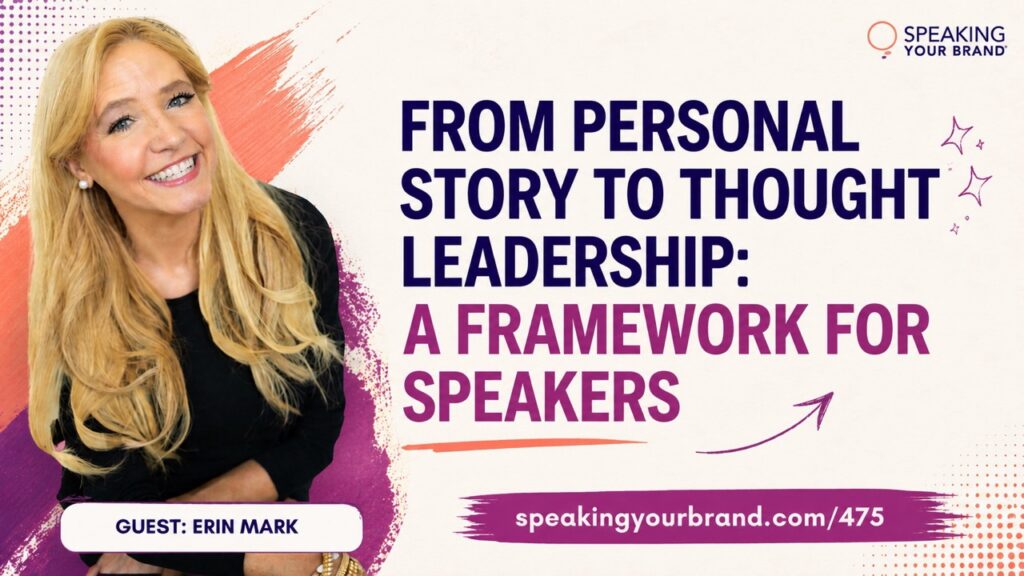
Whether you already know you have an important story to share, or you’re not quite sure which one of yours is the best, hear how Erin Mark has navigated sharing her stories on this episode of the Speaking Your Brand podcast. Hey there and welcome to the Speaking Your Brand podcast. I’m your host, Carol Cox. Today we have returning Erin Mark, who you may have heard on a recent episode where she delivered the ten minute version of the signature talk that she worked on with us in our Thought Leader Academy program. I’m bringing Erin back on because I really want to dig into not only her story, but the framework that she has used so effectively to take her story and to universalize it. Because that’s the thing when you have a story that you want to share with your audience in a bigger way, you want them to be able to see themselves in your story and then be able to take lessons from it that they can use, even if they’ve never had your exact situation, which most of the time the people in your audience are never going to have had your exact story or situation. But it’s through storytelling that we understand ourselves better and how we fit into the world and how we can make a bigger impact. And Erin Mark has done exactly that with her story. Her message and the speaking that she’s doing. So, Erin, welcome back to the podcast.
Erin Mark:
Carol. I’m so happy to be here. Thanks for having me back.
Carol Cox:
Well, my pleasure. And for those of you who are only listening, you do have to go to the Speaking Your Brand YouTube channel, click on the link in the show notes to see us on video, because we are wearing matching pink shirts that was not planned. We showed up on Streamyard and as soon as Aaron popped up, I was like, of course you’re wearing pink! And we both have similar white earbuds and blonde hair. I mean, it’s like, hello, Barbie.
Erin Mark:
Hi, Barbie.
Carol Cox:
It’s weird. All right. Erin. So as I mentioned in the intro, you we had met last fall and actually you were writing and getting ready to deliver a Ted talk, which you did. And I’ll include a link to the Ted talk in the show notes as well. And we met because you really wanted to go bigger with your speaking to become a keynote speaker. So then we were together on your keynote talk. You went through our Thought Leader Academy, you graduated in March, and you’re really your speaking has taken off. I know you’re getting more and more speaking engagements. You attended our one day speaking workshop that we hold in Orlando, Florida. We do those in the spring and in the fall. So you came to the one that we did a couple of months ago was so fun to have you there in person and seeing you and how much you have taken, what you’ve learned from speaking your brand and applying it not only to to what you’re doing speaking wise, but I know you’ve been volunteering to help some of the other women that you’ve come across in kind of just the your network. And I was like, huh. I think Erin a real natural at this, and I think I need to tap into this and kind of bring her in to some of the things that we’re doing as speaking your brand, especially for speakers like you, who have a really impactful story that is at the core of their message. And so, Erin, can you tell us a little bit about your story? What brought you to where you are today? In case listeners haven’t listened to the prior episode that you were on? And then we’ll go from there as far as thinking about how to take a story and turn it into a bigger message.
Erin Mark:
Yeah, absolutely. So I was born with a terminal illness called cystic fibrosis, and doctors told my parents I wouldn’t live past 18. And I found that out early on because I overheard my dad on the phone one night. I was very nosy, listening quietly, saying my life expectancy out loud. I was five years old when I heard that. So while most kids were dreaming about their future, I was trying to grasp that I wouldn’t get one. And that really set off this mission for me in whatever way that impact had on that five year old brain of me, of mine, to cram so much joy and urgency for whatever time I had here on this earth, I wanted to make an impact. So I’ve been keynote speaking for, gosh, over a decade because I made it to 18, then 20, and each year felt like a bonus I wasn’t supposed to get. And at the end of the day, Carol, I wanted to keep that promise to that five year old little girl to cram that joy and urgency in to make that impact. So my early Keynotes. It was all pro bono. I didn’t need a 401 K or a retirement plan, and it was how to leave a legacy and kind of really what to do when you don’t know what to do and that you don’t need a crisis to change everything.
Erin Mark:
So that was really my mission and the theme of my keynotes early on. I entered and life stage at 35, and I was dying, and I remember holding grief in one hand and gratitude in another, grief because I didn’t want to go and gratitude because it was a miracle. I got those extra years. And then at the last moment, as I was slipping away, a breakthrough drug was approved. And it saved my life. And I thought, oh my gosh, I have all these extra years. Now all of a sudden I needed that 400 1KA LinkedIn strategy SPF in my moisturizer. Like, Carol, you have been living like this your whole life, all of your listeners, because this is very stressful. You all. And I thought, oh my gosh, what am I going to do? And at the time someone said to me, you can do speaking as a career, you know, you can make money from speaking. People pay speakers to come in if that’s what you want to do. You’ve been doing it already. And I thought, no way. I thought, no, I can’t even imagine that. So I started googling and ChatGPT and then I have made speaker colleague friends and one of them, uh, shout out Julia referred me to you, Carol, and that’s how I got to you so you could set me straight.
Carol Cox:
Well, you clearly have a natural talent and gift, Erin. For what? You’re what you do. And I’m so glad that you’re out there sharing your story and your message with more and more audiences. And so for the listeners, you know, think about Erin’s story. So here she was. She was born with a terminal illness, cystic fibrosis, learning at a very young age that her life expectancy was only 18. Having to live with really the existential nature of that at a very young age. So for the people in your audience, Erin, I’m sure once in a while you’ll come across someone who either has CF themselves or has a family member or a loved one who does. But that clearly not everyone in the audience is facing or has faced any type of illness or diagnosis like that. So talk to us a little bit about how, how you’ve taken your story and the different things that have happened to you over the years. I know you have some very funny and poignant stories within your keynote, taking them and then universalizing them for the audience so they can learn from them from your story as well?
Erin Mark:
Yeah, absolutely. I think my whole life story is not common. And I think sometimes when people are thinking about being keynote speakers, they think they have to have a dramatic story like mine. I would probably argue it’s a little harder to have a dramatic story like mine, because it’s hard to universalize that sometimes. But here’s the thing. We have all had moments where we needed to tap into resilience. We had to deal with uncertainty and change. All of these things that I had to deal with, living with a chronic terminal illness. We also have these moments in life that mark a before and after who shape who we are as people, teammates, leaders. And we have this point where we ask what now? Because things end. And in psychology, there’s a term for this called identity foreclosure. And it’s when we cling so tightly to who we are, we can’t imagine who we could be. And we all have that moment. So not just me, right? Everyone. And I think with my message, knowing those struggles and those stories that I can tell, I’m able to connect with audiences just like any other keynote speaker is able to take their stories and connect it with audiences. I think it’s really important to name the feeling when you’re telling a story, when you’re teaching a lesson, because that’s what people hold on to. They know that feeling of fear, uh, imposter syndrome, uncertainty. So there’s a bridge between you and your audience with those emotions.
Carol Cox:
I. That is such a great point, Erin, about the feeling and the emotion being universal, not necessarily the specifics of the story. And to your point, that a lot of times speakers either think one of two things, either I need a big story in order to be a speaker and to have an impact as a keynote speaker. And maybe for some people, and I say, thank goodness, don’t have a big story like that. Or on the flip side, sometimes women or speaker or potential speakers will say to themselves, well, I don’t have a story at all. Or, you know, or my, or my story is not relatable or it’s too or, you know, I think we, we tend to downplay a lot of our stories or we tend to also because, and this is probably going into psychology is that when as we’re growing up, we all develop coping strategies based on our environments, parents, you know, siblings, the teachers, the people we have around us. And so it would become second nature to us, we don’t think is something that we assume everyone else does it the same way, or everyone else can do it the same way. But it’s kind of a superpower of our own. A lot of times the things that we do naturally, like Erin, you said, like, you know, you develop kind of a coping strategy to live life full of joy and a sense of urgency. So that has carried you forward. And that is a lesson that you can impart. Whereas for other people, that is not something that they develop because their situation was in circumstances were very different.
Erin Mark:
Yeah, absolutely. And what I teach, which I know, you know, because we worked on it together, is my calm framework. When I really started thinking about how I could apply my message to even go into more companies and associations who are dealing with uncertainty and change and their employees being burnt out. I thought to myself, oh my gosh, I lived uncertainty and change every day. So taking pieces of that for com. For those of you listening or watching stands for control what you can adapt. Lean on others and move forward. And those apply to all of us. If you have cystic fibrosis or not, you I can tell you are definitely dealing with some kind of change or challenge, personally or professionally or both.
Carol Cox:
Yes. And I, and I love that you have adapted your keynote or you have a keynote for, say, individuals, you know, individuals at at a conference, you know, who are maybe just people out out in the world, you know, professionals, maybe even patients. And then you have a keynote that is geared more towards leaders and teams and managers, because the principles apply to all of us as people. And Aaron, I think about for myself, so I don’t have a big story or a big life situation that has happened to me. And I remember this was back in 2020, and we were getting ready to host our first big online summit. It was so fun. We had ten women speakers and they each delivered like ten minute Ted style talks. We didn’t know each other then, but if we did, you would have been one of our speakers. And I remember I had one of our coaches at the time, Joyce Spencer, who worked with speaking your brand. Uh, and she helped me to identify one of my stories, like one of my pivotal stories for my career because it was very hard for me to identify it for myself. And so, Erin, thinking about, you know, some of the women that, you know or women you’ve talked to, have you found that to be the case? And what has been helpful for them to start thinking about what stories in their life or their career could be ones that they that could have an impact on their audience?
Erin Mark:
Yeah, that’s such a great point that we have to have these conversations outside ourself because I think it’s also surprising what people glob on to. I was talking to someone recently and working with them a little bit to help bring out their stories. And this particular individual talks about teaching soft skills, which is so important to sales reps and how that’s really needed in the industry. So her and I were having a conversation, and she mentioned something about how her grandmother put on makeup every day, and it was just like an ongoing joke in their family how she was always made up. She looked great. And she kind of just, you know, threw it off the cuff. That story. And then the way she talked about her grandmother, it wasn’t just about the makeup. It was about how she wanted to present herself every day to others, strangers that she came and that she would come in contact with. And I said to her, that story needs to be in your keynote when you’re talking about soft skills, because it’s not about the looks, right? It’s about the presentation. I forget her grandma’s name after the top of my head. I want to say it’s Betty, but who knows? I could just be pulling.
Erin Mark:
You know, it seems like a Grandma Betty. Uh, and I thought, oh my gosh, this is. And she was like, really? You think that would be in? I was like, yeah, because the other five stories you told me today are amazing. But I keep going back and wanting to hear more about your grandma and about her lessons in life and how you could easily apply those for audiences that you’re talking to. And I don’t know, I just think when we’re talking to other people, we don’t know what’s going to connect because we can’t see it. And I also think people are so focused on this data and trying to get all these numbers and sound smart in their keynotes. But listen, people remember stories and not data. Data is important, of course, to back up and what you’re proving, I understand that I use some science backed research in my keynotes to support my stories, but the stories are the elements that people come up to me afterwards, or connect with me on LinkedIn or email to say, hey, this had a huge impact on me.
Carol Cox:
Erin, what a great example of you being that kind of like standing in for the person in the audience listening to that, you know, the woman that you were helping, thinking through her stories and kind of thinking, oh, which, which of these 5 or 6 stories she’s telling me which of them are really resonating? And I feel like that is the, that is the benefit of having a coach, having someone who is listening for that, because we’ve been in enough rooms listening to speakers over the years, enough conferences and events that you know, that most speakers, you just kind of like, you don’t really remember what they said, right? Ten minutes after you leave the session. But you do remember stories, but you remember particular kinds of stories, the stories that have that emotional resonance, stories that have some type of nostalgia, like you mentioned about with the grandmother, stories that have that relational component to them. So it’s not just any story. And I, and I think that what ends up happening a lot of times, and I know I have, I’ve done this over the years is that we try to work out our stories ourselves, either in our own heads or in a Google doc or even journaling, but we either kind of spend, we keep spinning round and round around the same thing, so we can’t get like out of the same stories that we keep telling ourselves or remembering. Or more recently, we asked ChatGPT or Claude to help us. And I will tell you this they will, number one, they’re going to tell you every single story you give them is amazing, and they’re going to tell you that’s the one they are biggest number two, they don’t. Yes. And they don’t know the questions to ask you, to get you unstuck from going around and around in the same grooves that you have been, because they’re just reflecting back all the things that you have told them as the AI. Whereas we know the questions to ask that you haven’t thought to ask yourself yet.
Erin Mark:
100%. It’s not. Ai can do a lot, but it cannot listen as a person. It can doesn’t have feelings. Your audience members have feelings. They also have these emotions that they go back to. They have a picture in their mind. My goal is when the audiences are listening to my stories, is that they can picture being right next to me in that hospital bed, or being right next to me in that five K race that I was running at some point. I want them to picture that moment. Everybody knows what a hospital bed looks like or what a road race looks like, or what, you know, they could picture their five year old version of themselves. And that’s what’s so important to connect to for speakers. You want someone to say, wow, I. That story really resonated with me, not because I’m Aaron or I’m Carol and I had their experience. But again, it goes back to that emotion. And I think if you can really convey that emotion for your audience, they’re not only going to remember the story, they’re going to remember you, and they are going to remember what you’re trying to communicate and teach in your framework and how they want to change their life, their process, how they move forward long after your session or your keynote ends.
Carol Cox:
Well, Erin, you mentioned frameworks, which of course, we love to help our clients create their signature framework that goes with their signature talk. And I know you have a framework that you have used When developing your own talks and as you’re been working with people and that. And so can you tell us a little bit about your three part framework that is helpful for people who do have a story that they want to incorporate into their larger talk?
Erin Mark:
Yeah, absolutely. So it’s called story Struggle solution. I’m a big fan of 3 or 4 different frameworks, iteration, uh, acronyms because I think it’s easy to remember. So story, ask yourself a very simple question. What happened? What happened in that moment? It doesn’t need to be your whole life story. You can give a little background, but what happened in a particular moment, what was the struggle? That’s the next one we’re going to in that moment. I want you to ask yourself, why was it hard? That’s where you bring out that emotion. What emotion were you feeling? What roadblocks were you running into? How did that make you feel? And the last thing is the solution. What did that teach you? Is it three lessons? Is it a framework? An acronym? Is it two pieces of advice that you can give? It doesn’t have to be fancy. You don’t have to put so much pressure on yourself for your solution because you know it helped you. And it can be as simple as, like I said, those three step processes, three phases. But how can the audience take that and take action from it? So story struggle, solution, and in a 45 minute, 60 minute keynote, that’s the overarching Framework, but you’re going to have to kind of set in, I guess, like I’m trying to think of the right term for it, like bump, bump, set, spike, baby. So you’re going to filter some other stories and, um, you know, struggles in there, but your solution should be one, don’t confuse the audience with multiple solutions or multiple acronyms. But I think when you don’t know where to start, story struggle solution will be an easy path for you to follow.
Carol Cox:
I love that. Yes. And, and that is something that for those of you listening, can start thinking about now, whether you have a big story that has really shaped your life and who you are, you can think about the story, struggle, solution, or just kind of look back over your life and your career and think, okay, pull out a couple of stories and kind of start putting, putting some ideas around the story, struggle, solution aspect of it. And then if you would like help doing that. We do have a new package that we are offering that Aaron is. We are partnering. Aaron is partnering with Speaking Your brand, and we’re partnering with Aaron so that she can provide this coaching service to those of you who would like to think more about your story, the impact that it can have on your audience, how it can be central to your bigger message. And like we just talked about identifying what is the story or what is the moment in the story that makes the most sense to focus on or figuring out what that story is. So Aaron, tell us a little bit about the story scoping package and, and what, how you envision working with our clients on that?
Erin Mark:
Yeah, absolutely. So I think the first part of that story scoping session is for me getting to know you. And I want to ask, why do you want to share your message now? Because you might think it’s because of one reason, But I guarantee you, once you start talking and telling me your stories, it’s going to end up being a different reason. And you will be surprised at that because I don’t know if you find that happens, Carol, in your VIP days that you do with your speakers, which is a real deep dive session, which is amazing. Uh, but I think for me, what I want to help my clients with is let’s get to the point of really why you want to share your message. Okay, great. We have that. Tell me some stories. What’s happened in your life? Tell me some struggles because you have multiple. Everybody has multiple. But I’m going to be able to pick out maybe the 1 or 2 that I think would be able to become not only a keynote, you’ll feel confident in telling or even a short talk, but I want something that’s actually bookable for you that you can leverage to be able to use it to your advantage. And I mean, in a good way that you can say, okay, I feel confident about being able to tell this story, and maybe you don’t know what your framework, your solution is yet, but I bet you once we start to map out the struggle and what you did to solve that issue, we are going to find it very quickly.
Erin Mark:
But you need that sounding board to be able to curate that sometimes, because I think we’re often can’t get get outside of our own head. We need someone to listen to us as we were just saying, to see, hey, what sticks with us? The other question I would want to ask, or I do ask my clients is, what problem do you think you can solve and who would you solve it for? Because I think that can really help craft and pick out which story, which struggle solution would be the best one to start with, because it’s all about getting confidence in speaking and telling your story. So let’s start with something that really means a lot to you, and maybe that you already have a connection to, whether it’s an industry, a non-profit, or just going on stage or giving a presentation at a meeting. People hate public speaking in general, so maybe it’s not even for yourself. It could be with your company. It could be a client success story that we’re looking at, right? There are so many different ways to be a speaker. You don’t have to be on a stage to be a keynote speaker either.
Carol Cox:
Right? Or even for podcast interviews, maybe you maybe you want to get some more visibility. You want to put yourself out there. So you would like to get booked on some more podcasts, or maybe you have been doing some podcasts, but you feel like they’re falling a little flat. Like maybe there’s just a little bit too like technical, like you’re giving too much like information instead of doing, instead of sharing stories in your podcast interview. So this could also be a great way to, to, to leverage Aaron and to have her help you scope out your story so that you can use it in these different ways.
Erin Mark:
Yeah. Yeah, absolutely. I would be honored to work with you. And I, I think also your story can be someone else’s survival guide. Don’t discount your story. If it is not this huge health crisis or this massive tragedy, right? Feel confident because what you have matters, what you can share with others matters. Don’t discount your experience just because you’ve never spoken before either. I think what you’ll realize is once you have the confidence and really see it in black and white, which is my mission to give back to you, uh, you’ll be able to go out there and speak it and feel good about speaking it.
Carol Cox:
I love that, Erin. Yes. And as we like to say, is speaking your brand, your audience is waiting for you. You are the messenger for them. There are people in Erin’s audiences when she goes out to speak, who may have heard other speakers at different times in their life, maybe even give a certain a similar message. Like uncertainty is just the currency of life, right? You know, like these things are not anything brand new. We all know uncertainty, change, resilience. We’ve heard those words, but sometimes there’s a particular speaker that someone hears, whether it’s their particular story, the way they tell it, their delivery, their cadence, their energy just happens to be at that moment and that audience member’s life where that’s the message they need to hear, and you are the messenger who is delivering it to them. Exactly when they need to hear it, and without you being there on that stage or in that podcast interview, they wouldn’t have gotten it at that time.
Carol Cox:
So true, so true.
Erin Mark:
You never know who you’re going to affect in that audience. And yet maybe an audience of 50, 80, whoever who’s ever listening to that podcast, not all of them may not be connected to your message, but I think you’ll agree. Carol. There are several other people who need to hear it and will feel connected to you instantly.
Carol Cox:
Absolutely. If you would like to check out the story Scoping package and work with Erin, you can get all of the details at speaking yourbrand.com/story-coaching. Again, that’s speaking yourbrand.com/story-coaching, and I’ll include a link in the show notes so that you can check it out directly there. And I also wanted to let you all know that our next one day in-person speaking workshop in Orlando, Florida, is going to be on Thursday, October 29th, 2026. It’s at the Citrus Club in downtown Orlando. It’s a beautiful venue. We have it all decorated to look like an event. You get professional photos of you speaking on our stage and myself, Diane Diaz, our lead speaking coach, and Aaron, all three of us are going to be there so that you get one on one time with us to craft your story. And your story could be a personal story. It could also be your brand story. You get to work on that in the morning. We have a lot of fun exercises, and then you get to practice on our stage and you develop so much clarity and confidence in that day. Being in a room full of amazing, talented, Smart, supportive women. And I am so excited, Erin, that you’ll be back with us in October.
Erin Mark:
Me too. I can’t wait. I’m so excited. You have to come, everybody. Please come. This will be amazing.
Carol Cox:
It is. And you can get all those details at speaking yourbrand.com/orlando for that one day. Master your story in the stage workshop. So hopefully we will see. Well, hopefully Erin will see you online in the story scoping package. And then we’ll also see you in person because they really go hand in hand together as well. Well, Erin, thank you so much for coming back on the Speaking Your Brand podcast. You know, I always love seeing you. And you know what else I noticed? Look at our fingernail polish blue, but just different shades of blue. Again, we did not plan this. And this is the first time I’ve worn this blue color. I just bought it. It’s very bright. I’m not sure how I feel about it, but I like it.
Erin Mark:
I feel like you would normally have the dark like I have. Oh my gosh. All right Barbie well we match again.
Carol Cox:
I feel like I should go watch the Barbie movie now.
Erin Mark:
Me too.
Carol Cox:
We’ll plan a movie night. All right, everyone, go watch the Barbie movie. Go listen to the feminist manifesto monologue part of it, like the two thirds of the way. Barb, get yourself all fired up back on your soapbox. And no women’s voices are needed. More than ever. We want to hear yours, and we would be honored to work with you here at Speaking Your Brand. Erin, thank you again so much.
Erin Mark:
Carol, thank you so much.
Carol Cox:
Until next time. Thanks for listening.
Automatically convert your mp3 files to text (txt file), Microsoft Word (docx file), and SubRip Subtitle (srt file) in minutes.
Before you commit to a tool, read our guides: the speech to text for medical transcription, an honest top AI transcription tools, a deep dive into dictation software, our thoughts on best AI tools for audio and video, and the definitive roundup of best AI transcription tools.
transcribe English audio and podcast transcription pros use Sonix daily. If you handle same-day transcription, live transcription, or conversation intelligence, you’ll feel right at home.
Try Sonix free today. No credit card required.