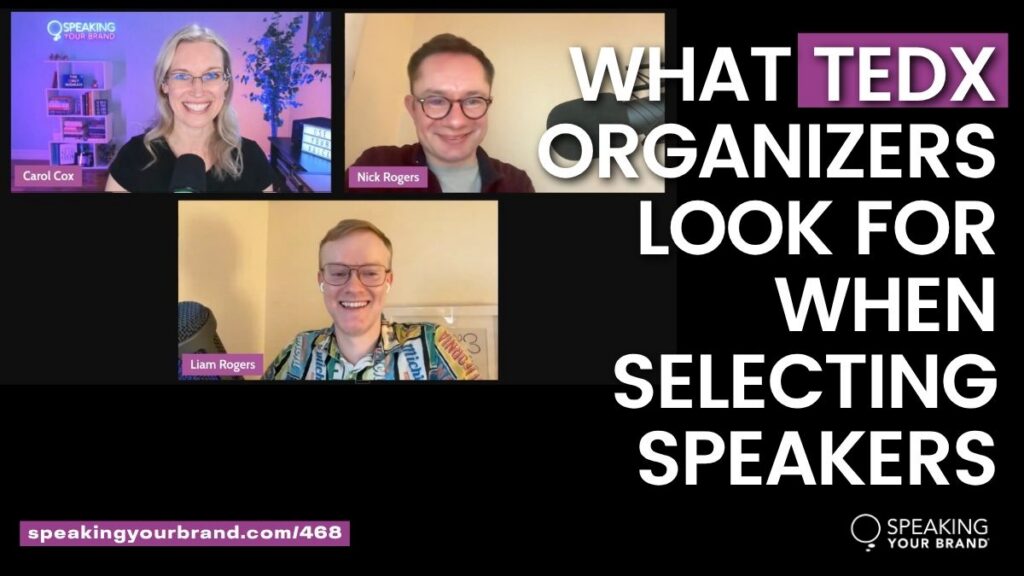
What TEDx Organizers Look for When Selecting Speakers with Nick Rogers and Liam Rogers: Podcast Ep. 468
Subscribe to the podcast!


TEDx is one of those stages that so many people aspire to.
After being part of the speaker curation and coaching team for TEDxOrlando, I can tell you that there’s a lot that happens behind the scenes that most people never see.
In this episode, I’m joined by experienced TEDx organizers Nick Rogers and Liam Rogers, who have spent the past decade reviewing applications, selecting speakers, and shaping talks that make it onto that iconic red dot.
We take you behind the scenes of what actually happens when your TEDx application is reviewed—what stands out, what falls flat, and what separates the speakers who make it to the red dot from those who don’t.
If TEDx is on your vision board, this conversation will give you a much clearer—and more honest—picture of what it really takes.
We talk about:
- Why originality matters more than expertise (and what that really means)
- The biggest mistakes speakers make in their applications—especially with AI
- How to balance your personal story with a powerful, idea-driven message
- What TEDx organizers are actually listening for in interviews
- The surprising role of coachability and why it can make or break your chances
About My Guests: Nick Rogers and Liam Rogers have been organizing TEDx events for the past ten years, first in the UK and now for TEDxOrlando. Liam is a creative entrepreneur and founder of Story Circle, a storytelling-led company spanning live events, consultancy and original productions, from podcasts to films to video games. Nick is a communicator, strategist and operator with a career that spans politics, crisis management and creative leadership.
About Us: The Speaking Your Brand podcast is hosted by Carol Cox. At Speaking Your Brand, we help entrepreneurs and professionals clarify their brand message and story, create their signature talks, and develop their thought leadership platforms. Check out our coaching programs at https://www.speakingyourbrand.com.
Links:
Show notes at https://www.speakingyourbrand.com/468/
TEDxOrlando website: https://tedxorlando.live/
Nick’s TEDx talk: https://youtu.be/AaKsb9UhZuo?si=nYRcUGT2Vyd3prH1
Story Circle: https://storycircleconsulting.com/
Discover your Speaker Archetype by taking our free quiz at https://www.speakingyourbrand.com/quiz/
Work with Speaking Your Brand to develop your TEDx application and signature talk = https://www.speakingyourbrand.com/work-with-us/tedx-coaching/
Connect on LinkedIn:
- Carol Cox = https://www.linkedin.com/in/carolcox
- Nick Rogers (guest) = https://www.linkedin.com/in/nickrogersldn/
- Liam Rogers (guest) = https://www.linkedin.com/in/liamrogershq/
Related Podcast Episodes:
- Episode 361: How to Land a TEDx Talk
- Episode 352: 7 Things the Best Speakers Do: My Takeaways from TEDWomen
- Episode 329: From Compelled to Take Action to TEDx Speaker
- Episode 98: Expanding Your Personal Story into a Universal Message
468-SYB-TEDx-Organizers.mp3: Audio automatically transcribed by Sonix
468-SYB-TEDx-Organizers.mp3: this mp3 audio file was automatically transcribed by Sonix with the best speech-to-text algorithms. This transcript may contain errors.
Carol Cox:
You’re getting the inside scoop on what TEDx organizers Liam Rogers and Nick Rogers look for when selecting speakers for that iconic red dot. On this episode of the Speaking Your Brand podcast. Hi, and welcome to the Speaking Your Brand podcast. I’m your host, Carol Cox. Today I am joined by two experienced TEDx organizers. They have been organizing TEDx events for the past ten years, so they have curated a lot of events. They have seen a lot of speaker applications, and they have helped speakers grace the Ted stage on that iconic red dot. They’re also the founders of Story Circle, and I’ll have them share in a little bit. What exactly Story Circle does Nick and Liam, so glad to have you on the show.
Nick Rogers:
Thank you for having us. Great to be here.
Liam Rogers:
Thank you for having us.
Carol Cox:
Well, we have gotten to know each other because you have taken over as organizers of TEDx Orlando and I live here in Orlando, Florida. I was involved with the previous organizers on the events that they ran in 2017 and 2018, but then Ted Orlando went dormant for a number of years because it is a lot of work to organize an event and keep a chapter running, which I know that you know. And then but the Orlando community was very excited last year when you all took over the license and are bringing Ted Orlando back into the community. So I’ve been serving on the speaker curation committee and the speaker coaching committee. So before we dive into helping the listeners understand how to put together the best Ted application that they can. Nick, let me start with you. Tell us a little bit about what got you involved in deciding ten years ago that you wanted to organize a TEDx event, and why did you keep doing it for ten years? And what and what are some of the big things that you learned?
Nick Rogers:
Well, it’s funny really, because the, the motivating, one of the motivating factors for me to start down this route when we were in south west London in Kingston upon Thames. It’s actually quite similar to motivating factor behind doing it in Orlando. So Liam is from Kingston upon Thames, which is a lovely area of south west London along the along the River Thames. Very old area. Anglo Saxon kings were crowned here, all that sort of thing. But I’m not from there. I’m from outside London, from Kent. But we moved to Kingston upon Thames and I thought, how on earth can I get to grips with this new area? Find out what’s going on, who are the movers and thinkers and doers and shakers? And I thought one day, on the way to work on the train, why not organize a TEDx event? And that I came home to speak to Liam about it and we thought, well, why not? He’s got the marketing experience. I’ve got the sort of the the Ted fanaticism. And our first event was organised in partnership with Kingston University, and it was in a small room for 100 people and we can go on. I’m sure we will talk about the curation, which was quite light touch, shall we say. Um, and.
Nick Rogers:
It was very light touch.
Nick Rogers:
And um, not what we’ve done since, but it was one of those learn lessons learned type things. And then we got together with the, um, the, some of the committee afterwards and thought, well, we can do the same thing again. We can gradually grow the event maybe to 200 people or we thought we can go for the biggest theatre in the area, which was 900 people, the Rose Theatre. And we thought, well, why not just try, see what happens? And when we sold that out, um, we realised that we’d stumbled upon a model that we could replicate and scale. Um, and before I’m sure Liam’s got some thoughts on this, but I reflect back now to that very first motivating factor, which was how can I get under the skin of this, of this fantastic, interesting place that I’m, I’m calling home. And that is the same thing for Orlando. Um, I am using this in many ways, but one way is to get to know this fantastic city. So that’s, um, I quite like the kind of, um, the mirror image of these two events.
Carol Cox:
Oh that’s great. All right. And Liam, so how did you feel when Nick was like, yeah, let’s do a TEDx event?
Liam Rogers:
I, I reckon my usual response to Nick’s ideas is like, not another idea. Like I love him. But and at the time I was working in, I was working in events and marketing. So it was kind of like, I guess it makes sense that I’ll do the event marketing side of things. Well, I do quite like that. We went into it with just very, as Nick said, it was um, about getting to know people. I had friends in the area. Nick didn’t really have friends in the area. It was almost as simple as Nick said, it’s kind of just let’s get to know the area, even though I know it well because I grew up in the area. Let’s get to know the area a little bit better by doing this. And to be honest, we went into it having absolutely no expectation that it might last for ten years and that we might end up doing TEDx Orlando. But then in some ways I like that because that’s probably the right way to go into things, even though we didn’t know. I just liked that that was how we went into it very, um, um, with no real plans. Um, and so when Nick says about the curation for the first event, we just, we had no idea how to curate a TEDx event. So we just did what we thought was right at the, at the time. And then just over time, over the ten years, that’s how we’ve sort of refined how we it was almost through trial and error of all of the events that we did in Kingston was, um, what it almost like, what things would we not do again in terms of selection, selecting speakers and what worked. And it’s become refined over the ten years. But yeah, a lot of Nick’s ideas, I’m like, you need my help, don’t you?
Nick Rogers:
So I yeah, I know exactly.
Carol Cox:
Yes. I feel like in a in a relationship and a partnership, there’s always the idea person. And then there’s the, the implementer and I’m very much the implementer. And so whenever I hear the list of ideas, my mind immediately goes to, okay, how would I implement all of this? And how much work is this going to take?
Liam Rogers:
The good thing with Nick and I, we are both, um, we are like doers. We do, we both. It’s very we’re very equal in how much we sort of do, but we just have our different areas of expertise. So Nick did a Ted talk. He actually hosted one of them as well. So that’s the kind of thing I just I don’t really have any interest in doing a Ted talk. I probably wouldn’t bother. Like, so those are the areas I’m like, that’s for you to do. I will be the person behind the scenes. Um.
Nick Rogers:
You do well, you say that you do like, um, you like getting in front of the audience though.
Liam Rogers:
Oh yeah.
Nick Rogers:
I plan what you’re going to say though, but you like getting in front of the audience.
Liam Rogers:
I don’t I’m fine being in front of an audience I don’t have. It’s more so my memory. If I had to memorize the talk, I just wouldn’t be able to do that. I know I wouldn’t be able to do it.
Carol Cox:
So you like, have like impromptu improv type of stuff where you can just flow?
Liam Rogers:
Yeah, yeah.
Carol Cox:
Yeah. Okay. So like an MC, like an MC.
Liam Rogers:
Mc.
Carol Cox:
Yeah. Okay. That makes sense. All right, so Ted Orlando, you all come in last summer again, we’re all excited about it. And then you put out the call for speakers last fall. And I think to all of our surprise, there were.
Liam Rogers:
No one no one applied. Oh.
Carol Cox:
Right. I know, right. No one applied. There were over 600 submissions, which is just extraordinary. And, you know, they came from all over the United States, not just in Florida, but I think about two thirds of them ended up coming from Florida, and a vast majority of those two thirds from Central Florida, the Orlando area. So were you surprised to get that many submissions? And what was your first reaction as far as figuring out how to go through them all? Nik, I’ll go back to you.
Nick Rogers:
Uh, yes. Of course. Well, yes. Uh, at the time, in retrospect, not so. Not so much. Because it’s clear how much of an appetite there is for for Ted to return to, to Orlando. Um, but yeah, it was, it was, it was initially a surprise. And then, of course, the thought is, how on earth do we deal with this, this, this volume of work? Um, because every single one of those applications deserves careful consideration and review. Um, and, uh, that’s what we strove to achieve. So fortunately, we have, um, a member of our team, Michael Wong, who is fantastic at systems and was able to create, um, an AR table for us whereby the whole curation team could then review each application. And when we were putting the team together, I was quite keen that we had a, um, a reasonably large curation team. We had um, ten, ten members of the team in total, because I didn’t want this to be a pure reflection of just my tastes, or just Liam’s tastes, or just a small group of people. I wanted to get different backgrounds and perspectives and views on, um, on each of those and each of those applications. But, um, and I’m sure we will explore this, but going through the applications, it was quite clear quickly the kinds of ones that would stand out and the kinds of ones which struggled a bit more. They all, there were definitely some, some common themes there. I mean, Liam, you were you were in that team as well reviewing the applications as well, weren’t you. So you’re seeing that.
Liam Rogers:
There was a moment in terms of the number. So I, I guess similar question to answer to what Nick said. It’s like in some ways I’m not surprised that we got that many, but we were about as in the night before it closed, bearing in mind like the time difference. So there was a moment where because of the time difference, it was closing sort of at midnight, but but like. Florida time. So eventually Nick and I were like, we. Went to bed in the UK because. That, you know, the time difference and it jumped up by about 200. Overnight and the next morning, all.
Carol Cox:
The last minute, all the last minute people.
Liam Rogers:
Yeah. I might be exaggerating, but it was I think it went from like in the 400 to the 600 seconds. And I just looked at my phone in the morning and I probably swore, and I won’t do it now, but I was just like, we got over 600. It was just that moment of what? And also like advice for everyone. Don’t leave it to the last minute just because, you know, it really makes any difference. But it just it’s interesting how people leave it to the last minute.
Carol Cox:
Well, I got some emails from some people who knew who know me because they had seen me promote the call for speakers on LinkedIn and in my email list, because I wanted to encourage people to apply. And a few of them emailed me right around that midnight deadline, like, oh my God, my videos not uploading. It’s, you.
Nick Rogers:
Know.
Carol Cox:
No. I might write. And so like to your to Liam’s point, don’t wait until the last minute because you don’t know if it’s going to take a little bit longer to get everything loaded than you think. So literally people were doing it down to the wire.
Nick Rogers:
Yes. And we had we had. Well, and also another tip is read the application fully through before you start to fill it in, because we had at least one, uh, that I remember, um, I got a feeling that they, whoever it is, may have actually got through in the end, but they got to the end and realized they had to upload a video and said their videos started with, I was literally about to hit send. And then I realized I had to record a one minute video. So here we go. But whoever it was was quite good. And actually that did stand out because here I am repeating that anecdote on your podcast.
Carol Cox:
So yeah, so maybe that’s a, that’s a strategy, but not everyone can use it because then it will be obvious that the strategy just I’m.
Liam Rogers:
Just thinking about it. I don’t know whether we did this, but also another reason not to leave it to the last minute is you don’t know whether the curation team are going to review them in the order that they came in. I remember we had them in some order, but I can’t remember if it was exactly that order. It was. It does mean. Yeah, but that does mean that if that’s how people are reviewing it, the ones that come in at the last minute are going to be the last ones that you review, and your perception is always going to be a little bit different on what you’ve read, because they’re the ones towards the end. So if you’ve if someone’s applied on the last day, but you’ve just been reviewing the first 600 and some people are talking about a similar topic to you, you’re going to get compared. So I don’t know, there’s many reasons why you shouldn’t leave it to the last minute.
Nick Rogers:
Well, I mean, they’re all human reasons as well because, um, you know, these these applications were coming in and I was spending time with them and I was going back to ones that had already come in, even though the deadline hadn’t passed. So get in early and you’re more likely to have your application spend more time under the noses of the curators and you get more consideration. Whereas if you if you do it right at the last minute, chances are that whatever review, official review, ranking, scoring, whatever process the event has, that’ll start pretty soon after you submit your application. So your time with the curation team is going to be less than it otherwise would be.
Carol Cox:
That’s a great point. So, Nick, let’s talk about what you looked for when you were going through the application. So I know again, it’s over 600. You know, I would I kind of scanned through the list in Airtable, kind of looked to see which topics stood out to me first rated them, you know, because again, it was a fantastic system that Michael put together where we could, each of us could put in our ratings for each speaker. And so then I would kind of do one pass and I would go back and do another pass and kind of eventually get through all 600 of them. So, Nick, as you were doing it, what were you looking for? Were you immediately knew? Okay, this particular speaker and topic has a chance, right, to get to the next round versus the ones that you were reading and you, you just knew pretty much right away that this wasn’t going to make it to the next round.
Nick Rogers:
So for me, and you know, worth emphasizing, every curator looks for for slightly different things. But for me, originality was the absolute key thing. Originality in terms of the idea and points that the talk was going to try and make, but also originality in the way that the applicant was presenting their ideas. So I think every, um, every sort of, uh, application, you don’t need to be solving world hunger or curing cancer. It doesn’t have to be like that. Um, you know, genius level science, whatever it might be. You don’t, you don’t necessarily need that, but you do have to demonstrate in your application that you have, um, you’re challenging assumptions in some way. You’re, um, you’re reframing something familiar that we all take for granted. Um, you’re making people notice something that, um, that maybe we’ve overlooked. You’ve basically got to be in some way trying to move people from one point to another. And as I say, it doesn’t have to be you’re trying to move them 100 miles. You could just be shifting their perspective a little bit, but the applications that were successful to me were the ones that were absolutely clear about what it is that they were trying to change or move people to. Um, in terms of things that, um, and bear in mind you’re doing 600 plus. So you, you, there are certain things which you notice and immediately you’re like, well, I, you know, I’m skeptical now, um, and I don’t have half an hour to spend with this application frameworks. Um, and a lot of people have them and they can be great things. And actually when you’re structuring a talk, they could be quite, you know, a good sort of architecture to have there, but people who list their four letter acronym Frameworks. Um, and then you, you realize that you’ve read 50 applications with different for acronyms, four letter acronym frameworks. And bear in mind, I remember one of them was, and that’s our cat Gus chiming in there.
Carol Cox:
Okay.
Liam Rogers:
Gus wants to be a TEDx speaker.
Carol Cox:
Yes. He wants to put his, his, uh, his words into I’m sorry.
Nick Rogers:
I remember one of the one of the four, uh, the, the little acronym frameworks spelled out s h I t and I guess it’s memorable, but I thought.
Liam Rogers:
Do you think that was intentional? I don’t know.
Nick Rogers:
Yes, it was intentional, I think.
Carol Cox:
Yes. Yeah. Well, maybe that was one that ChatGPT hadn’t written. I don’t know if ChatGPT would have come up with an s h I t acronym for it, but let’s talk a little bit. And Liam, I want to get also your your thoughts on what you look for in the applications, especially in the first pass. But so, so Liam answered that. But also a little bit about I know with the 600 plus applications, we could tell pretty much which ones had been written by AI, ChatGPT and which ones weren’t. And I’m sure that there were some that at first glance, didn’t seem like they were written by AI or helped by AI, but probably were. But maybe that that applicant did a better job of kind of finessing it. But there were I got to the point, as I was reading them, that even though the topics were different from each other, so one could have been like in healthcare, one could have been in education, one could have been in, you know, who knows productivity or whatever. But they all started sounding exactly the same because AI had written it. And what does AI do? It takes the average and it makes everything the average. And even though there were all different topics, I was like, to your point, Nick, where’s the originality? I couldn’t find it. So Liam, what what were your thoughts about the AI applications. How to. How speakers can use AI if possible, if at all, in a good way. And then what were you looking for?
Liam Rogers:
The AI thing is kind of funny because before this application process, I think Nick and I forgot that the last time that we did this in London, ChatGPT wasn’t a thing. It wasn’t. And I it’s funny how we went into it because we could, we didn’t put any notes in the application saying like, don’t use AI or please, or, you know, like some sort of cautionary wording. And it was only when they started to come in that you’re like, oh, yeah, we all forgot that this thing wasn’t wasn’t a thing two years ago. So, um, I almost now want to dig because I’m sure I do sort of have some of the applications from previous times. I’d be like, let me see. I think what it does is it does, it dilutes everyone suddenly kind of sounds like they’re really good at writing, but they’re also not really because they’re using AI. Um, and also another point on AI is actually talks that want to talk about AI, which is ironic that you’re using AI to talk about AI. And correct me if you think I’m wrong, but I think we all agreed that we just got a lot of applications about AI. Very few of them really stood out as feeling like they felt like they were actually tackling something truly unique. Um, and this again is like sort of cautionary, um, comment for some people who are applying. That’s kind of one of the hot trends right now, which means that lots of people are going to talk about it. And therefore it actually makes it even harder to stand out as being unique. So again, trends are fine, but it’s like, and also there’s always that thing of like at any one TEDx event, even though we were curating for our flagship and for our salon events, we’re probably only going to choose one talk that is explicitly about AI and therefore more people are doing it because it’s trendy, but then it’s harder to stand out. So it’s sometimes it’s trying to say to people, unless you really think you can make it unique, then I would sort of steer away from the trends.
Nick Rogers:
And in fact, correct me if we don’t on our on our well, actually, and again, it’s it goes back to this originality thing, doesn’t it? Like we don’t have a single speaker on our flagship stage who is purely talking about AI, but lots of speakers will be using that as an angle in their in their talks. You know, speakers talking about identity and all sorts of things like that. And there will definitely be touching on AI and how it affects their topics. But, um, but a pure AI talk. Yeah. As Liam says, um, they just didn’t seem that interesting.
Liam Rogers:
It was a similar thing. Um, because we did our events through Covid. It was a similar thing when everyone was applying, wanting to talk about Covid, everyone was using the new normal. And even for us when we were. So we did a 2020 event, but it was just before Covid. We like January 2020, so we just missed. We, we lucked out and then we didn’t do one until 2022 because of Covid. But when we were looking for speakers for the 22 2022 event, so many of them wanted to talk about Covid sort of slightly naively, I was like, but by the time we get to 2022, this is going to be old news, surely. I mean, it wasn’t really technically, but they were. People were very much talking about like the 2021 version of Covid and how we were all talking about it. And it just, again, it made it really difficult for them to stand out because it’s and sometimes it’s going to date really quickly. Your topic, like in two years time, this talk is going to seem really dated because that was two years ago, one year ago. And I feel like that might be a similar thing with AI because it’s going to move so quickly. Um, and I think we’re having to do this now as we’re going into the coaching process for people putting together their talks, we’re having to be really strict with people to say, please don’t write it all with, with it’s in.
Nick Rogers:
It is in our speaker agreement that every speaker has to sign is. Um, and also, we’re not naive because it’s a tool that people use in the same way that people use Google, people use internet research, people use Microsoft Word to, um, to, to write their talk. We understand that it’s a tool, but we, um, we say that, um, that the substantive heart of it and, uh, the vast, you know, the vast majority of it has to be your, you and your voice. And as we all know, it’ll be very obvious if that’s not if that’s not the case, personally, although, you know, I will use AI in, in some of my work, um, I would never, ever use AI for something that I was going to stand up and read because you have to be, you have to be completely comfortable and especially in a Ted context, you have to memorize that talk. So it has to be your natural voice. And if it’s not you, you will struggle and that will be I think that’ll be very obvious, um, for the audience.
Carol Cox:
Yes. So let’s talk a little bit about originality and how. So the the listeners right now, they may have Ted on their vision board, their bucket list. They really want to do a Ted talk. How do they think about, I know this, maybe this is a big question. How do they think about what is original to them or what is unique to them? And how much does their personal story. Personal experience, personal journey factor into that? So again, thinking about those 600 applications that we went through, I know a lot of them had, some of them were much more personal story centric than others. And I feel like the ones that were very personal, story centric, but didn’t have anything else to hang that story on, were not the ones that moved forward because there just wasn’t enough context there, like enough depth there. But versus I know there were some other applications where maybe they had an I an idea, but there was, There was nothing. Uh, there was nothing interesting about it. It felt kind of flat because there was no personal connection that that particular speaker had to that idea. So how do you find the balance between both of those? Liam, I’ll start with you.
Liam Rogers:
I think it’s a difficult balance to strike. I think that’s the that’s the challenge because sometimes people’s topic can just be truly unique. And actually using Nic as an example, when he did his Ted talk, he did it about airships. And just through researching on them. It’s like a childhood passion for him. Don’t get him started talking about it. He’ll talk about it for three hours. Um, but we just looked at on the TEDx YouTube channel and just searched how many like how many talks have talked, how many Ted talks have talked about airships. And we found one talk and just it was.
Nick Rogers:
It was a prep school, um, uh, salon. So it was a schoolboy’s very good talk. But, um, yeah, it was a school by school boys little talk.
Liam Rogers:
And you had already decided that was what you were going to talk about, but I was just interested to see if anyone else had.
Nick Rogers:
Well, actually I hadn’t, and I think this is maybe to Carol’s point, but let’s let’s get to we can get to that later. But, um, yeah, it does go to Carol’s point.
Liam Rogers:
So I think things like that. So even so for the selection that we’ve made for, um, flagship. So, um, Jimmy who’s the dinosaur man who we. And sometimes if you have a topic or that’s that dinosaurs is something he’s talking about, but that’s not really the point of his talk. That’s almost like his lens to talk about science and discovery. I don’t want to deliver his Ted talk for him, but because of it being a really unique topic, even through the application process, I remembered his application. And then when you’re sort of reflecting on them, you’re like, what about the dinosaur man? So it always is like anything that you have like that, that makes you stand out. But I appreciate that not everyone is gonna have a topic like that. I always do think your personal story is unique. It’s like your, your story, your narrative is sort of is truly unique to you, but also it’s how you frame that and how you make it relevant to your topic, because sometimes it can feel a little bit like you’re shoehorning a personal story into something that doesn’t necessarily feel like it needs it. Um, I think for me, in terms of, um, jumping back a little bit to what we were talking about before, but in terms of Orlando, I didn’t really go into the applications.
Liam Rogers:
I, I was interested when, when something came up. So for example, we know we had quite a few, um, talks that were about like the feeling of loneliness in Orlando. And that was, that resonated with me, not because of my own personal experience, but because of what other people had said about Orlando being a place that’s hard to make friends. It’s hard to like if you’re not in a relationship to find a significant other that it it’s a place where people come with their families to have these like, amazing experiences when they’re on vacation. But if you live there, it can feel quite siloed and it can just just to a lot of people, apparently it’s quite a hard place to make friends and I just knew that. So then when we had some applications that came through on that topic, for me personally, those ones stood out. So it was almost like me sort of my limited understanding of like Orlando in many ways, it was what stood out to me. When I was reading them, it’s almost like, you know what you’re going to find interesting when you see it placed in front of you.
Carol Cox:
And Nick, what about you? The balance between story and the the kind of the idea or the research of of the talk.
Nick Rogers:
Well, so we, in our application form, we had two our two main questions were equally weighted. What do you want to talk about and why are you the right person to talk about it? And both of those things are equally important. Um, but you have to have compelling answers for both of them. So they have to stand alongside and support each other. So a great idea. Uh, without a reason for why you’re the person to talk about it. As you say, it feels flat and, and sort of almost sort of purely academic, whereas, um, a great personal narrative that doesn’t offer a different way of looking at things, uh, isn’t really a, isn’t not really a Ted talk, but I think when you get that mix, that, um, of the two that works, it really shines through. And I’m thinking particular of, of, uh, Corinne Rae, who’s, um, one of our speakers for our flagship event. And Corinne is a no Saba kid. Um, so she is of Hispanic heritage, but doesn’t speak the language. And of course, that’s, that’s a personal story for her, but contains, um, a lot of a lot of ideas around identity, especially, um, that will resonate in central Florida. So she got the balance right and it caught our eyes because she’s got a strong idea and very clearly why she is the right person to tell that story.
Carol Cox:
Yes. And she’s my one of my coaches. So I’m very excited. And that’s a good segue into the interview process because I was in the interview that she did. So we had the 600 plus applications, all ten people on the curation team. We rated each of the 600 and based on those ratings, they then went to the second round, which was the interview. So we had about 50 something people who were selected for interviews. And Nick and Liam, I can’t believe it. You sat on all those 52, 53, 30 minute Zoom interviews, which each of those applicants and then the rest of the curation committee we went on the ones that where we were available to do that. And so what were you looking for in the interview round? What stood out to you, and then how did that inform who was going to make it into the flagship event and then to the other salon events? And Liam, I’ll go to you first.
Liam Rogers:
To think, actually, when we started to plan this, I was like, I don’t think half an hour’s going to be long enough. We need to make these interviews.
Nick Rogers:
Yeah, I know you wanted 45 minutes.
Liam Rogers:
And actually half an hour was perfect, but, um, yeah, I don’t know why I didn’t think it was going to be long enough, but I’m glad. No, I really I love the interview process. I really do like actually meeting. Meeting them on Zoom, but meeting them. Um, I think things that really actually things that stand out and this is where it is nice when we have more than just Nick and I and other people join into the interviews, is where the speaker does a little summary of their talk. Then we ask them some questions, and then it kind of like descends into a debate where people chipping in actually. And Karen’s, um, the no. Sabo that was we were all not a debate, but we were all like, well, yeah, you, you know, you don’t have to be a kid to feel like you’re, you know, a British person in America can feel like the language is so different. We were. Everyone on that call chipped in with their perspective of how they were reflecting on her talk. And so instantly you think, well, that’s going to resonate with the audience then, aren’t they? Because, um, because if we’re all debating it and it’s really interesting and we’ve got different perspectives, that’s how the audience are going to react. Then on the flip side, the bad thing from some interviews is where we do have half an hour, but we get 15 minutes in and we’re like, hmm, like you feel a bit like, like you’re not sure where to go next or what’s the question or, or the opposite of what you’ve just described. It’s you. It doesn’t spark a debate. And again, that doesn’t mean it’s an instant. No, but it just, it just gives you an idea of how it’s going to resonate with an audience.
Carol Cox:
Nick And what were you kind of looking, looking for, listening for on the interviews?
Nick Rogers:
Well, as Liam says, the, the, um, we’re actually quite explicit, uh, in we asked, uh, applicants to prepare five minutes presentation. No slides, but just basically explain the concept in plain English. Summarize what? What? Give us a little hint into what the talk is going to be like. And if after that I’m not clear what they’re trying to talk about, then that is quite a good indicator of, um, of, of, uh, of what the end product might or might not be like. Um, so you’re looking for, can they explain things clearly? Um, are they, do they know what they want to talk about? Because, you know, a lot of people are quite confused about, um, what their ideas might be. Um, or they may have lots of different overlapping ideas that they want to talk about. And actually that’s not necessarily a, um, a deal breaker, but it does then mean the next thing that, or one of the other top things I look for, which is coachability. Um, and we will explore that in all of our Interviews by, for example. Um, and actually, uh, Carol, you were in several interviews where you did just this effectively suggesting have you thought about this angle? Have you thought about including this? And I find that their responses to those kinds of questions are very revealing because either they, uh, they might, you know, they might be open to that or they might demonstrate that actually their idea is pretty fixed and rigid, and they’re not necessarily going to be open to, to different interpretations or different angles.
Carol Cox:
Yes, I know that was one of the top questions that we would ask is how is well presenting them with other ideas? Not necessarily because we didn’t like their idea, but it really it was a test to see how they would react to it and whether they would kind of pick the ball up and go with it for a little bit, or if they felt very resistant to whatever it was. And so I did, that was helpful for me to see. And I also noticed Their passion, like their just their natural energy and excitement and passion for it. For most of the people who had made it to the interview round, they were very excited about their topic and about sharing it. There were a few interviews where I sat in. Now maybe this could just be personality wise, but they were kind of very like monotone and flat. It could have been a little bit nerves. But then my notes for them was like, I don’t know if they could carry the Ted stage if they can’t carry us in a Zoom interview. Yeah, yeah. Did you notice some of those things too?
Liam Rogers:
Obviously, I won’t name any names, but we had one interview and, um, it’ll be clear why this person didn’t make it through, but it felt they felt argumentative with us. Any question that we put to them, it felt like and I kept sort of being thinking to myself, what are the questions that we’re asking? Because they’re the exact same questions that we ask everyone else. But the answers, and the only way I could describe it is the answers were very combative. And there was, you know, when you’re just there’s a vibe that you think this doesn’t feel right. And I, I’m like, I don’t understand what questions we’re asking that would warrant such a combative response. So there’s just sometimes and that is very that really is quite rare that that happens. Um, but it’s just sometimes that feeling of, um, as you say, you like, it’s like a, um, yes. And you try and yes and someone and then they don’t take the and they just go right, shut it down. They don’t take the ball. They let it fly past them. And I think and we experienced it the other day when we had. So we had all of our flagship speakers on a, on a sort of group call with everyone. And the vibes were so amazing because we ended obviously we selected the speakers we really wanted in our flagship stage, but you could just sense the vibe, the excitement, everyone being so enthusiastic for it. And I feel like if people can get that through in their interview, that does help. And, and, and again, we remind people we’re all volunteers doing this. So we did. We’re like, not that anyone necessarily comes through like this on an interview, but we don’t want to work with any divas. We don’t want to work with people who don’t understand the format we don’t like. Those are all. And that applies to a lot of things. But you just, you you want it to feel like the person is truly passionate about it, but also willing to come along on the journey with us. I think that’s.
Nick Rogers:
The, I actually, I wonder whether yeah.
Nick Rogers:
I wonder whether, um, there is a risk now, I appreciate a lot of people want to do Ted talks, as you say, lots of people have it on their vision boards. I don’t have a vision board and I’m thinking maybe I need to get one because everyone seems to have a vision board, but I don’t have one. But I think.
Liam Rogers:
This is my vision board. It’s Mickey and.
Nick Rogers:
Minnie, Mickey and Minnie Mouse.
Carol Cox:
Oh, you’re making it come true, right?
Liam Rogers:
Yeah, this is it.
Nick Rogers:
But I think there is. And again, it goes to passion. Um, because if you think, well, I kind of think I’ve got to do a Ted talk because it’s going to be, it’s going to help me in, in my speaker journey, in my career, whatever it might be. Help me sell my book. Um, if you if you are liked on a talk concept that you’re not totally passionate about, then it will come through in the interview and actually just use myself as an example very briefly because, um, when we decided that I was going to do a Ted talk initially my, my, my topic was going to be related to my former elected position as a member of the London Assembly. I was going to talk about cities and what makes cities tick and transport, transit networks and that sort of thing, planning policy, which I do find interesting. And but Liam said, well, why are you talking about that? Why aren’t you talking about the thing that you’ve been obsessed with since you were a little boy, i.e. airships? And I thought, oh, hang on a minute. Yes, that makes far more sense to me. And, um, you know, I can make it far more passionate and real than I could if I was thinking, well, this is more of a career type talk. So, um, I would, I would sort of caution, um, listeners to make sure that they’re talking about something that they are genuinely passionate about. And it’s a message they want to share with people. And again, to, um, to look at one of our speakers who I think in their interview, um, for obvious reasons, another one of your coaches, Carol absolutely knocked that out of the park and that’s Jason Mendelsohn, like the passion for his message and the urgency with which he wants to share it. Um, sort of, um, it bowled everyone over. And so he’s quite, um, you know, quite rightly on our flagship stage.
Liam Rogers:
I can’t believe you listened.
Liam Rogers:
I can’t believe you actually listened to me. Nick.
Nick Rogers:
Wow, sometimes I do.
Liam Rogers:
Turns out I do sometimes have some good ideas.
Nick Rogers:
Yes.
Carol Cox:
Well, and, you know.
Nick Rogers:
Orlando was one of them.
Liam Rogers:
Actually, this is a funny little story. Also, Nick, at one point, you suddenly were like, I don’t think I’m going to be able to do this anymore. I’m too busy. I can’t remember what what reason was. So so he was selected. And I know you started the process of coaching, I suppose to some degree, and then you sort of slightly were flaking out and I was like, no, because I don’t want to have to go through the effort of finding another speaker.
Liam Rogers:
That was literally it. I was like.
Liam Rogers:
Which doesn’t make me sound that supportive, but I was like, because we’ve just done all of that. So just also to state, Nick wasn’t involved in the organising of the last two TEDx events. He he hosted the 2022 event and then by the 2024, he was just too busy. So I that’s when I completely took over. Um, and so Nick then spoke at the very last one. Um, but yeah, I was just like.
Carol Cox:
Make sure to include a link to Nick’s TEDx talk in the show notes so everyone can check it out on airships. I’m curious now just to.
Liam Rogers:
I mean.
Liam Rogers:
It was genuinely very good. I didn’t, I had every faith it was going to be really good. Um, and it got selected as a TEDx editor’s pick, which until that happened, I didn’t even know that was a thing until I got the email being like, this talk has been selected. And then it happened to be just because of the way we submitted them. Nick’s was the first one that got selected. Absolutely nothing to do with us. I didn’t even know it was a thing. But then for more talks, got selected from that very event as editors picks. So yeah.
Carol Cox:
Fantastic job on the curation.
Liam Rogers:
Then I guess we were doing something right. So on the YouTube channel, if you click the like on there, the TEDx YouTube channel, if you click the bell icon every day, it sends out one talk that went live that day that gets pushed out to everyone. And those are their like editor’s picks.
Carol Cox:
Oh, okay. Good to know. All right. Well, so.
Nick Rogers:
Orlando.
Carol Cox:
Yeah for sure. So let me.
Carol Cox:
Yeah, let me let me also kind of clue listeners in a little bit about picking the speakers and making sure that there’s a variety of, of topics, you know, in stories and not too much overlap, but also things that fit well together. And this is one thing that I, I tell my clients and even listeners who contact me and they’ll say, you know, how many times does it take to submit before I’ll get selected for a Ted talk? And I tell them it could be one time. Some people submit one time and they get selected, like some of the speakers that we’re working with, some, I know colleagues and friends who have submitted five times, eight times, ten times, even 20 times because there are so many factors that go into play. It’s not necessarily that your idea isn’t good or that your application isn’t wasn’t good, it was that we need a balance of topics. And like I said, things that go well together. And for Orlando, I know we wanted to make sure we have one speaker to talk about space since NASA Kennedy Space Center is nearby, we have one speaker talking about monuments, but specifically part of it is related to pulse, which was the nightclub here in Orlando. The very tragically, uh, was shot up ten years ago now in 2016, I think 49 people were killed in that. So we wanted to make sure we honored that as part of Orlando. So we had certain not necessarily people like speakers in mind, but general topics. We wanted to make sure we’re on the stage. So, Nick, talk a little bit about, you know, thinking about the lineup. And I know that was part of the at the end, what we did as a curation committee is figuring out who is going to be the lineup and how did they fit together, I guess to again, clue the listener listeners in, but also to let them know, don’t give up just because you don’t get selected for one event or even a few events that you apply for.
Nick Rogers:
Yes, absolutely. And you’re right, it is. Um, it’s more like alchemy than, than science when you’re doing this lineup because you are trying to balance all kinds of things. Topic. Definitely one of them. And as you say, we had certain things that we knew we wanted represented. Interestingly, one of them as well was we wanted veterans voices on that stage, and we ended up with a number of veterans, but also the specific Veterans talk was about recording the stories of World War Two veterans. So I actually really like how we ended up meeting our objective on that, but through a slightly unusual way. But yes, we, we used to always talk when we were doing TEDx Kingston about talks as being head, heart and, and neck. So a head talk is more ideas forward. A heart talk is more emotions forward and neck talks are kind of a balance. And that’s one way of looking at the lineup. And Liam and I for, um, for hours and hours and hours before we had our curation meeting, we were like generals moving things around on a map. We were moving names, seeing how they fitted together. Um, because you are your, your, um, your, you’re sort of trying to balance tone of voice, perspective, you are trying to, um, curate and balance representation as well because we want to reflect the community that we serve. Um, so it is, it is very, very difficult. And if, um, if you, you know, speakers wouldn’t or applicants wouldn’t necessarily know this, but if they, if they find that they’ve been sort of edged out because, uh, there was two talks with a very similar tone. And there was one of the topics was more suitable for the overall lineup then absolutely they should not get disheartened and they should keep, keep, keep going. Yes. Take feedback about the idea, the application. But, um, you know, keep going and try again.
Carol Cox:
And Liam thinking about not only Ted Orlando, but all the other TEDx events that you have curated the lineups for, what are you looking for when balancing it out?
Liam Rogers:
It is, it’s, it is the day itself. We always curate for the day. I think sometimes people, if their experience is, um, Ted talks on YouTube, you just think about that talk as its own little 15 minute thing. Sometimes people forget that that talk happened in a day of talks. So we always curate for the day. Um, this is something that Nick and I always naturally did. I think some of the things that we did that we feel like worked, we were like, that just is the thing that made sense to me is to not, you know, so not put two topics together that, um, feel similar not to put two, you know, you’re not going to put two like emotional roller coaster talks back to back because it just feels like then they’re kind of competing with each other and in the same regard, like so. And I actually attended a TEDx event in the UK. I will not name which one it was, but I didn’t like the way that they curated their day because they split the day into here are the business talks, here are the representation talks, which I really, really didn’t like. The sort of. Here is our diverse section, which I was like, that’s not.
Liam Rogers:
The right way to.
Liam Rogers:
Me anyway. I was like, that’s not the right way to do it, guys. And then here, I can’t even remember what the third section was. And personally, the business talks to me. I was like, that’s not my area of major interest. I think some of them were not too bad, but it just meant that you’ve got then 3 or 4 talks in a row that for the person that those talks don’t resonate with you, you’re sat there thinking, when are we going to get to the talks that I’m actually more interested in? And so I that just seems like a mistake to me. And again, even with the sort of diverse talks, you’re then sort of like, um, this angle of diversity, that angle of diversity, this. And I just again, I thought that that seemed like a very strange way of doing it. But at that point, we were already doing it our way. And I left that event being like, we’re doing the right thing, guys. Um, but it’s that ebb and flow of emotion of head, heart, neck, the neck thing just came about as a joke one day. We used to always just be head and heart and then one day I think it was just a joke where it was like, we need an in-between.
Liam Rogers:
It’s your neck. Um, so, um, but then sometimes even so, the, the event is split into three sections and there’s breaks in between. Sometimes it will just be, it could be like the end of a section. You want that heart tugging Talk that then it feels like people need a minute to sort of think about it, to reflect on it. So you’re kind of allowing them that space, or it could be putting it at the end of the section because it’s a very, um, sort of divisive in terms of it’s sparking a debate in people and you want the people to go away into that break session kind of talking about that particular talk. So when it comes to the curation, it’s kind of that ebb and flow. Um, and it’s not something that we do until quite far into the coaching process. So until we’ve actually seen a draft, an early version of the talk actually being performed, we then make our selection about the curation process. Sorry about the, the the sort of lineup process, not the curation process.
Carol Cox:
Yes.
Carol Cox:
And with all the TEDx events that you have curated, have you had speakers who didn’t make it one year and then reapplied and ended up making it in a subsequent year?
Liam Rogers:
We have fun fact, the talk that has gone online to do the best in terms of telex and telex. Kingston has had half a million views online. So that’s like in terms of numbers. That was one of those people he applied at previous events, had loads of potential, like we could see the potential, but for some reason it just didn’t quite resonate. And then, um, I think he applied for the final one or I feel like maybe, I know I approached him, I said, um, when it came to the final one, I said to him, you’ve applied a few times. It was just someone I already knew as well. Um, and I just said, I do think maybe now is the time. I can’t remember what the specific reason was, but I just was like, I feel like now’s the time. Um, and who knew that was the one that went online to get half a million views, which, and it’s a, it’s a really interesting, it is an interesting talk. It’s about sort of how much money do you need to retire? Which again, it’s like, I would never have guessed that that would be the one that would go online and do do the numbers as we would say. But yeah, he is a perfect example of that. He had applied a couple of times and didn’t make it through. And then during yeah, got onto the stage at the final event that we did in Kingston.
Carol Cox:
All right listeners, so keep applying. Don’t don’t give up. Yeah. All right. So let’s talk about before before we kind of get towards the end here. One thing that I wanted to make sure that we mentioned was that I have been hearing from a number of clients over the past, especially six months. And I know this came up in one of our slack channels of people either seeing online advertisements or even being approached by companies who will say something like, if you pay us, hire us. We will guarantee you a TEDx event like guarantee that will get you onto a TEDx stage. And some of these places are charging $10,000 or even more. I assume that part of that $10,000 is helping them with their application and maybe their talk. But really, I think the premise is guaranteeing the person a spot on a Ted stage. I know that this probably makes us all a little bit livid, right? To hear this. So first Liam, I guess tell because from my understanding is that as a Ted organizer, these are all volunteer positions. You cannot accept money from anybody to get them on the Ted stage. Like obviously Ted, the parent organization would never allow that to happen. So what are these companies promising exactly? And what do they think that they’re doing? Liam, I’ll start with you.
Liam Rogers:
Yes, I hate it.
Liam Rogers:
It’s terrible.
Liam Rogers:
It just it’s the integrity of it all. I think, um, we we just take it incredibly seriously. What the, the sort of platform that we have by, you know, I have the Ted Orlando license and I just take it incredibly seriously that I have that license, I have that platform and, and that it’s, we are in these positions of like little mini positions of power where we can say yes to someone being on that stage or no. Um, and I just don’t like the fact that these companies are appealing to these people. And I, I kind of understand it from the speaker’s perspective of they really do want to be on that stage. I quite honestly would say it is not worth $10,000. It is not worth or more. It’s not. It’s that’s an absurd way of doing it. Um, and I just think, um, what I think, what I don’t like about all of it is kind of turned the tide, um, model the Ted like brand into this sort of industry where people really think they need the Ted for their careers. I just, and I, I would just genuinely say I disagree with that. I mean, I just think most people have successful careers and they don’t do this sort of thing.
Liam Rogers:
And it’s, it shows that people are then doing it for the wrong reasons in my perspective. But Nick and I literally have had these companies approach us and they will be quite. Um. Yeah. Yeah. So Nick and I, we had a phone call with the company who came to us saying we would like to sponsor your event. Now sponsorship is partnerships. Sponsorships is a big part of TEDx. And it can be it’s one of the hardest things to do is to try and get a company that’s willing to sponsor to support the event. It’s just one of the most challenging things. So when someone says that, you’re like, oh, interesting, you know, like, why wouldn’t you get on a call with that person? So Nick and I had a call with someone who said, I want to sponsor it. Turns out they wanted to sponsor for us to put their speakers on the stage. And very, very. And I, I actually do have this cool recorded because, you know, like through your sort of recording app, Nick and I were just like, absolutely not. We shut it down straight away. We’re like, you have tricked us to get us on this call.
Liam Rogers:
That is absolutely not something we would do. And we could not have got off that call. And I said, and this is terrible what you’re doing. And also you’ve wasted our time because it was. And, and they even sort of, they did hint at some other TEDx events that had done this. And I was like, I don’t know whether that was true or not. And they were very specifically non-specific about what those TEDx events were because obviously, technically, we may have been able to go to TEDx and be like, we’ve had, you know, we’ve got information about this, but they, you know, they were like a TEDx event in this country or a TEDx event in that place. It was very non-specific. But, um, yeah, we know it exists because they literally asked us. They literally said it to us. And um, yeah, really, it genuinely made me angry. Um, and then I have, yeah, I’ve seen other ones as well. I’ve, um, spoken to people who would like to maybe be involved in TEDx organizing. And then it turns out that they also have a connection to a company that are basically doing the exact same thing. And, um, no, it’s, it’s bad. Don’t do that, guys.
Carol Cox:
Yeah.
Liam Rogers:
Don’t pay. And I actually think I would, I personally would take it if I do think if we, if, if we had a speaker that did come to us or somehow. And I do think if we had found out that they had used one of those services, I would be inclined to say, I’m sorry, we’re not we’re not supporting that by putting you on our stage. I know that would be quite a difficult thing to do, but it’s just that’s that’s how much I dislike it.
Nick Rogers:
Well, I think, you know.
Nick Rogers:
Ted and Ted are beloved throughout the world. There’s a reason that the TEDx YouTube channel has got over 40 million subscribers. People love, um, the talks. They love listening to these ideas. And when you, when you basically put your hand up to say, I’m going to run a TEDx event and you get the license or you join the committee, you are, um, you are taking on a huge position of trust because, um, Ted can’t possibly monitor how every one of those speakers gets onto the stages. They can’t and they don’t, they don’t try because they trust that, um, that curators and organizers are going to do the right thing. So these companies who, they’re kind of like feeding off the. The speaker’s desire to get on a Ted page. Ted stage and also they are trying to abuse the trust that Ted has placed in organizers. So, uh, anyone who wants to get on a Ted stage never, ever feel tempted, um, to do this. If you want to spend money, spend the money on a coach who can help you deliver the best possible talk that you’re going to deliver, that’s a far better use of money. And it probably won’t be $10,000 either. So.
Carol Cox:
Right.
Carol Cox:
Well, and obviously here speaking your brand, we work with our clients on their signature talks and their thought leadership. And sometimes they will come to us and we’ll help them with their application because they want another set of eyes on their idea worth spreading. And so we’ll help them with that. But I actually have a policy that until a speaker is selected for a specific Ted event, we will not take their money to help them with their actual talk. Like actual the whole ten minute, 12 minute, 15 minute, whatever it is, because I tell them that first get selected. It could be three months from now. It could be a year from now. I don’t know. I don’t want your talk to feel stale by the time you’re actually getting ready to go on stage. The second thing is that some TEDx events, like ours are TEDx Orlando provide coaches. So you may not even need to hire someone yourself unless you really want to. But the third thing is take the direction from that TEDx event. Their theme, how many minutes do they they expect it to be. You know, what are what. How are they directing you as a speaker? And until I, as the coach, know that I don’t want to spend a lot of time scripting out their talk when it could change. So that’s why I’m like, no, no, I’ll help you with the application, but we’re not actually going to help you with the talk itself until you get selected.
Nick Rogers:
No, that makes that makes perfect sense.
Liam Rogers:
Yeah, I think that makes perfect sense.
Liam Rogers:
And every TEDx, I think this, every TEDx event is different. They are all different. So the way that we do it is different to how anyone else does it. We just. Yes, Nick and I do have ten years of doing it, so it is quite a long time.
Carol Cox:
Well, let’s talk about Story Circle. I want to hear more about it. That so Nick, tell us about Story Circle. What do you all do? Who do you work with and, and, and how did that start?
Nick Rogers:
Well, actually, I think I should pass to Liam because you are the founder and it’s your it’s your baby. So. Liam.
Liam Rogers:
Yeah.
Liam Rogers:
So story circle, it kind of comes out actually originally did come out of us running Ted. It was real. No connection to Ted, but it was the idea for me personally. And the reason why it’s called Story Circle was I was thinking about it from the lens of what’s like the oldest form of storytelling. It’s people gathering, gathering around a campfire in a circle and telling stories. So that’s where the story circle. Um, and I guess for me, I was thinking about the idea of storytelling, like as an audio thing. So like. Visual, visual and audio storytelling. Um, less about like, almost like moving away from the ideas of Ted and moving into the storytelling of personal narrative. And that was actually kind of the original idea. And I had this idea in 2020, before the pandemic, I was going to start doing some things. I was going to start running some events that were really separate from Ted and called Story Circle. Story circle live. It was going to be. And then the pandemic came along, but I guess ultimately with Story Circle now, um, we are running other events. We’re running events that are centered around public speaking in some in some form storytelling and public speaking. So we are organizing, um, a epoch America’s history festival, which is, um, actually, I’m going to throw it over to Nick because this was Nick’s idea. So this was a, um, a, like a history as entertainment festival. Nick.
Nick Rogers:
Yeah.
Nick Rogers:
So I mean, I’m, I’m a huge, um, history nerd. I always have been. Um, and, uh, there’s, there’s no doubt that history as, as entertainment is having a huge moment right now. We’ve got the rest is history podcast, for example, is, is frequently the, um, the, uh, the number one downloaded podcast in, in the world. Um, and that’s because there are so many incredible stories out there in, in our history. So, uh, we have, um, uh, this epoch America’s history festival concept, which we are working to organize at the moment. Alongside that is another work stream that’s come out, which is, um, uh, basically shows that tell the story of a moment or a period in the words of the people who lived it and the music that they would have listened to. So we are, I’ve created one which is about 250 years of American independence. Um, and we’re in discussions with a, um, an arts organization in Central Florida to put that on. I’m also writing another one about the Titanic and the story of the Titanic. So we’ve we’ve got all these all these concepts coming out. Um, and you know, I am Liam spent his entire career in, in the private sector working for startups or small companies. I’ve spent my entire career working for large organizations in the, in the public sector. So this is a completely new experience for me. And I’m absolutely loving the ability to live your life doing things that actually interest you. It, it does feel like a privilege.
Carol Cox:
Oh, that is fun. So my undergraduate and graduate degrees are in history, specifically European history. So. So you’re studying American history from England? I studied European history from the US and fun fact, having lived here in the Orlando area since for 20 over 20 years, I have probably been to the Titanic exhibit, at least the original one that they built in the early 2000 at least a dozen times, because every time someone would come to visit us, we would take them there. And so if you need any information about the Titanic exhibit in Orlando, I’m sure I remember it.
Liam Rogers:
Nick and I did it a few years ago. We loved it. It was so funny, the re-enactors and everything. It was amazing.
Carol Cox:
Yes it.
Liam Rogers:
Is. It was a.
Carol Cox:
Lot of fun.
Liam Rogers:
Did they make you touch the ice for, like, a minute? Is that the thing that they do at the end?
Carol Cox:
Yeah. And it’s cold when you get to the room where it’s like, you know, dark and you can see the stars and this guy in his cold because that’s of course, when the Titanic was going down. Yeah. It was yeah, quite, quite, quite the memorable experience I still remember. And it’s been a long time since I went through that. But yeah, we’ll never forget. Yes. All right. Nick and Liam, thank you so much for coming on the podcast and sharing your incredible, valuable insights with our listeners. I know I have learned a lot just in the past about six months that we’ve been working together on ten Orlando. And for those of you listening, come to the TEDx Orlando flagship event. It is October 17th, 2026. You can get tickets at Ted Orlando dot live. I’ll include a link in the show notes. Whether you’re here in Florida or anywhere else, you can come, you can come. And we have a big auditorium to fill, right? Liam.
Liam Rogers:
Very big. 2600 seats.
Carol Cox:
Yeah. Not not intimidated at all for any of the speakers who are going to be there. Yeah. It’s going to be a fantastic event. So come, come see us on October 17th and Nicole Liam, thank you again. So it’s such a great pleasure to talk with you today.
Nick Rogers:
Thank you, Carol, and it’s fantastic to work with you on the on the team as well. Thank you for your contributions.
Carol Cox:
Until next time. Thanks for listening.
Sonix is the world’s most advanced automated transcription, translation, and subtitling platform. Fast, accurate, and affordable.
Automatically convert your mp3 files to text (txt file), Microsoft Word (docx file), and SubRip Subtitle (srt file) in minutes.
Sonix has many features that you’d love including share transcripts, transcribe multiple languages, world-class support, advanced search, and easily transcribe your Zoom meetings. Try Sonix for free today.