480-SYB-Corrin-McCloskey.mp3: this mp3 audio file was automatically transcribed by Sonix with the best speech-to-text algorithms. This transcript may contain errors.
Carol Cox:
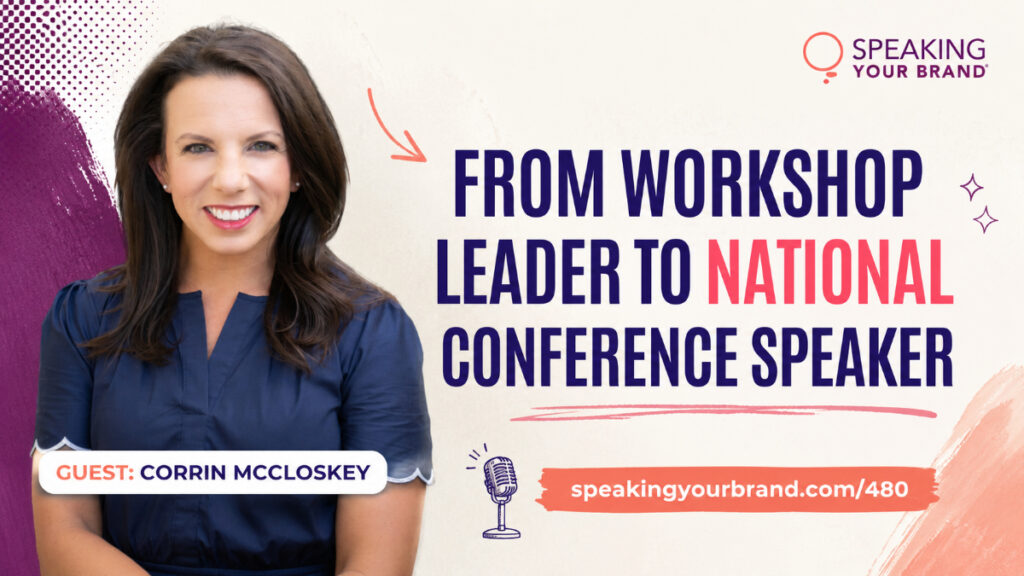
If you love facilitating workshops and trainings, but you know there is more that you want to do. You want to speak at national conferences, you want to be on bigger stages. My conversation with Corrin McCloskey is for you. I’m Carol Cox, founder of Speaking Your Brand and host of the Speaking Your Brand podcast. Corrin is here to talk about how she has made the leap from what we call our fabulous facilitator speaker archetype into a true thought leader, and how much momentum she’s been getting, both in her speaking and her writing in the year and a half since she worked with us in the Thought Leader Academy. So we’re going to touch on what made the difference for her to step into thought leadership, what that has looked like at a concrete level, including getting out of what I call the expert trap, how she’s been putting her her thought leadership out in a more public way. We’re also going to talk about some of the experiences she’s had at speaking engagements, both the good and the not so good. But what is showed, Corrin, about the power of using her voice, especially as a woman. Corrin, welcome to the podcast.
Corrin McCloskey:
Thank you so much, Carol. It’s so fun to be here. I’ve had a wild year and a half, and a lot of it started with you and Thought Leader Academy. So thank you so much and happy to be here and give back a little bit of what I’ve learned.
Carol Cox:
Well, I am thrilled to have you. You are vice president of Heart and Vascular and Oncology services at Tanner health, which is located about an hour or so outside of Atlanta, Georgia. And you lead strategy, growth and service line development there. I know you’re very passionate about leadership and especially organizational culture and leading change in healthcare. And for sure, there’s a lot of change going on in healthcare. Well, probably every industry nowadays. So can tell us a little bit about the types of speaking and workshops you were doing before you came into Thought Leader Academy in January 2025. And what helped you to make the shift into thought leadership?
Corrin McCloskey:
Yeah. Goodness. There is a lot of change in healthcare, but we need more. And that really is what I’m passionate about. So when I first met you, Carol, you know, I was a great facilitator. I could do a strategic plan. I could help with leadership development. I really enjoyed, you know, getting in front of people and helping teams find solutions. But what I was really passionate about was trying to help change healthcare. I mean, healthcare is ripe for some desperate need of change, right? But how do you do that sometimes when you’re within the system? And so I really wanted to break out of just, I’m here as a, as an executive or administrator and more, where do I need to be to have the conversations at a more national level and really help make an impact in this industry that I love so much. And I think you really helped me build some of the confidence I needed to start. And then the network I needed to keep going. And you know, I’m on that journey. I think it’s little steps every day, but it’s been amazing what’s happened in just a year and a half and, and how I continue to grow in this space.
Carol Cox:
I remember Corinn, it was probably about halfway through the eight week Thought Leader Academy program, and we had encouraged everyone kind of maybe threw down a challenge to submit to speak at a conference. And I, and not so surprisingly or not unusual, you know, being a little bit reticent, like, well, who am I to submit to speak at this important conference? And why would they pick me? So do you remember that? And then you sent me the email with the response that you got from them.
Corrin McCloskey:
Yes. Oh my goodness. You know, it can be so scary to put yourself out there. There’s a lot of that imposter syndrome and kind of who am I? And, you know, but I had a really robust career at that point, you know, 15 years in hospital administration. I have a lot of letters behind my name. And more than that, I’ve had a lot of experiences. And I think there was this mindset, mindset shift to it’s not about self-promotion, it’s not about fame. It’s how can I get out there and help others and support other people that are in the same place I am by sharing what I’ve learned. And so I think it just took a little bit of a leap of faith and, you know, hey, low risk, high reward. I’m going to submit to some national conferences. And I was really fortunate this past spring, I got to speak in three national conferences, all on topics around change, leadership, physician leadership, healthcare, change. And so I really was able to take my speaking from doing workshops or individual coaching to more what are the hot topics that my peers and others around the country are facing, and how do I support them? And how do we create more of a voice as an industry that we need change?
Carol Cox:
And Corrin, can you tell me a little bit about the content that you’re including in the talks that you give, especially around this idea of, of leadership and belonging? Because I know obviously when we work together in our VIP day, we mapped out your talk using our signature talk canvas framework. So we have a mix of your key points and supporting points and stories and audience engagement. So yes, give me a little sense of the content that you’re sharing and how you feel like it’s connecting with your audiences.
Corrin McCloskey:
Yeah. You know, it’s so funny because it was at first a little overwhelming. Your brain kind of goes in a million different directions and you all have such a great framework for how to start finding these stories or these, um, beliefs in ourselves that we want to get out and share. And so I think when I first started working with you, you know, I was really focused on how do you train healthcare leaders, which is important work and things that we need to focus on, or how do we change, um, teams or introduce change management within healthcare systems? And what I’ve realized is there’s a much bigger story. There’s a much deeper need there in how do we belong to each other and to our patients within healthcare? How do we create system change? Not from a tactical standpoint, but as a leader. What does that mean and how you’re showing up? So I think there was a shift in what I was able to talk about, where it was more personal, it was more Connecting. It was less about this very structured content, and it was much more about just supporting people. And so one of the talks I recently gave was about leading and belonging in a new culture. And I think right now in healthcare, all of our systems are going through rapid change and leadership and structure. And so how do we as leaders fit into that change? And I remember after this one talk, I had a physician come up to me and he’s like, oh my gosh, this is the presentation I’ve been waiting for. You know, we need to talk more about change management, not as a tactical kind of thing. We execute, but how do we use our voices to connect to people and to elevate some of the things that need to change in healthcare. Um, so it’s been really rewarding to start to focus on some of that. And again, I think you gave such a great framework for how to get started and how to do that.
Carol Cox:
Well. And that’s a great illustration, Corinn, of of what thought leadership is. And to have an attendee in your talk come up to you afterwards and not say, great content. That was so useful. I took a bunch of notes of a bunch of things that I’m going to do next when I, when I get back to work on Monday, which is fine, but then again, that’s a little bit more of a workshop style, right? Implementation versus thought leadership is really about getting people to see something in a new or different way that they hadn’t before, to shine that light, to provide that perspective. And a lot of times that perspective comes through personal experiences, either your own or the people that you’ve been working with or observing, whether it’s leaders or patients. So I think a lot of times people tend to think thought leadership is some like airy fairy thing where they’re like in an ivory tower, like, you know, as an intellectual, which is fine. That can be thought leadership. But for me, thought leadership is about observation and about realizing what is missing in the conversation that I can lend my voice to to make positive change.
Corrin McCloskey:
Yes, I think that’s so well said. And I think there is such this opportunity within healthcare specifically. I mean, it is still it’s a mission driven field, right? These are people that want to make a change, a positive change. But I think a lot of times our systems and structures get in the way. But, you know, that connectivity to other people and their stories and to introduce how we solve some of those larger problems by connecting with each other, it’s really powerful, especially when other people are like, oh my gosh, me too. And it’s not just this very kind of formulaic workshop. It’s more broad than that. And then it becomes deeper to to the individual and hopefully more impactful to the industry.
Carol Cox:
Along with the speaking engagements that you’ve been doing. You’ve also been doing quite a bit of writing, and you are an excellent writer. And I can say that because you attended the joint story to spotlight writing and speaking retreat that my friend and book coach, Tiffany Hawk and I did in last year, in May of 2025 in Tucson, Arizona. You came out along with nine other women for 3 or 4 days. And it was such a great experience, and I had a chance to read some of your writing while I was there. And it was really, really good. And I say that as someone who’s been working on my book for a very long time. So I’m so impressed that you have been actually writing and putting things out there. So tell me a little bit about how your writing, both for publications in your industry, and then also a little bit about your book project, has helped you to expand your thought leadership beyond just the talks that you’re giving.
Corrin McCloskey:
Well, first of all, that was one of the most fun things I have ever done. So when you all do another writing retreat, I’m going to be the first one to sign up because the content was fabulous, but the network of women was just, I mean, top notch. So I think that’s part of it. Right? Is the inspiration of other women that want to make a difference in their industry. We were all different ages, different backgrounds. I mean, and it was just so, so fun. But I think there was this inspiration of if you have a message that you want to get out, those things of speaking and writing go so well together. It gives you more, you know, validity as a speaker when you have a book. It helps you get your message out when you have a book, if you’re also a speaker. Um, so I think, you know, writing is one of those things where it’s a muscle you’ve got to flex, right? And sometimes I wish I had more time to do it than others, but you’ve just got to start somewhere. So again, I have an experience, um, you know, at a, at a conference or, you know, I had an experience recently where I went to a, um, legislative day for one of the big, uh, national conferences I’m a part of.
Corrin McCloskey:
And I got back and I just wrote a little bit about like, this was my perspective as an administrator going, you know, with a group of physicians to DC. It was actually during shutdown. So it was really kind of a cool experience. Um, and I submitted it. I just said, well, you know, maybe they’ll accept it, maybe not. And they published it. And so that was just a really cool thing for me where I would just say, if inspiration strikes, it doesn’t have to be perfect. Just, you know, get your thoughts out there. And it continues to build that momentum. And I think both in my speaking and my writing, it’s been an exercise of showing up, um, knowing that not every time you get up to the plate, it’s going to be a home run. But all of that experience is building up to something and none of that’s wasted. It gives you perspective on yourself, on the industry. It helps you make connections. Um, and so in that way, I think those things are really well connected.
Carol Cox:
Have you always been the type of person where you’ll just put something out there where you don’t feel like it has to be perfect or you’re willing kind of just to, I mean, obviously what you put out is excellent, but you know, there’s a lot of times where even if it’s excellent in other people’s eyes, we don’t think it’s good enough. Whether it’s fear of rejection, fear of, you know, imaginary, right? Fear of failure, fear of criticism, whatever it happens to be. So how has this been for you in other parts of your career?
Corrin McCloskey:
Gosh, thank you for that question. That’s you know, I think that’s something that’s come with maturity and just time. I would not say that I’ve been somebody that’s always kind of taken that chance. But as I’ve gotten more confidence in myself and who I am, I think the fear of rejection doesn’t weigh on me as much, you know? And it’s more if I don’t do it now, then when if I don’t try now, then when? And so I think I’ve learned to push past a little bit of that fear, um, to say, well, it’s definitely not going to happen if I don’t try. Right. It’s definitely not going to happen if I don’t put it out there. Now there’s measured risk in that. Of course, you know what’s worth putting your effort and energy into and what’s not. And I think sometimes I’ve had to pivot away from things where it’s like, ah, that’s not really benefiting me. It’s not filling me up. It’s not giving me energy. Maybe that’s not the right thing to put energy into. Um, but overall, I think you just, you’ve got to put it out there before you’re ready because you’re never really 100% ready. You know, I submitted a Ted talk proposal and I didn’t get it, and that’s okay. My goal was to say I had done it. And so now I know better for the next time, right? But you have to be willing to put things out there in order to build that momentum.
Carol Cox:
Yes. And definitely keep submitting, Corinn, because I know plenty of people who have submitted three times, five times, seven times, ten times, 15 times because every Ted event is different. They have different curation of speakers, and you never know. And I believe the right Ted event is out there for you, right? Versus so you just never know. So and it’s and don’t, and I tell this to not just you, but anyone listening. Don’t take it as a personal rejection if you don’t get selected. There are so many factors that go into play when having to do that lineup. And I know because of having looked at 600 speaker submissions for Ted Orlando, It’s it’s a lot, right?
Corrin McCloskey:
No, I mean, and I think that’s great insight, but I’m going to feel more confident this next time because I’ve gone through it once. Right. And so I think it also is what is your goal? My goal is to try right now, my goal is to put out content and not to worry about all the results. Um, and I’m getting results without being so focused on that piece of it. My focus is more, am I adding value? Am I creating collective voice? Am I connecting to people? And in doing that, it’s building success. Um, but I’m not focused in on the number of speaking or the number of publications or the number of, you know, um, because I think when you focus on those things, sometimes the rejections can feel harder, uh, versus really being focused on what you can give and that connection.
Carol Cox:
Yes. And focus on the quality over the quantity. Because sure, you can, You can do a whole list of speaking engagements, but if they’re not feeling good to you or align with the audience, or you’re not even feeling rested and like prepared for them, then it’s like, well, why, why are you doing this for just the metrics?
Corrin McCloskey:
Exactly. Yeah, absolutely, I agree.
Carol Cox:
Well, Corrin, so speaking of putting yourself out there and using your voice, I know we you had mentioned this incredible feedback you got from a physician at one of your talks. You said, this is the presentation I’ve been waiting for. But then you’ve also been on the receiving end of some other comments that were not quite as helpful, to put it mildly. And I’m and I’m so glad that you had wanted to talk about this on the podcast, because as you’ll hear listeners, this is something that I don’t think gets talked about enough, but it is a reality of what could happen and may not ever happen, but you may know someone that it happens to. And we want to make sure that that you know that there is there are, you know, people out there to talk to. And you don’t have to do navigate this alone. So, Corrin, do you want to share a little bit about what happened that happened to you and, and what you took from it?
Corrin McCloskey:
Yeah, you know, thank you for the opportunity of speaking about this, Carol. I think anytime you put yourself out there, right, there’s a risk you’re going to get feedback. You’re going to get people who are jealous or unkind. Um, you might have to deal with some comments that don’t feel great. Um, unfortunately, recently at that conference where I had that great feedback, uh, I had a male colleague, um, make a sexual harassment comment. Uh, to me, it was, it was really very jarring. Um, and, you know, I think I wish in that moment I’d had something really witty to say back about it. But the truth is, I think it makes you feel kind of small and, and stuck. And I just kind of walked away and, um, you know, unfortunately it’s not uncommon. Right. And I think we need to talk about this. And as women and women speakers who are putting ourselves out there, none of that is okay. And what you choose to do after something like that happens, I think is deeply personal. And my advice would be to find trusted mentors, friends, colleagues, or professionals to really process that with.
Corrin McCloskey:
Um, but a good mentor of mine said, you know what, Corinn? That’s awful. And that never should have been said. But now that it has been, it’s your choice what you do next. And I think that can be really empowering to say, I get to choose if that’s going to keep me from that stage or not. And after some time and thinking through it and what I wanted to do, what I chose was to do is to put my energy into my work and getting back on that stage. And so I submitted three speaking proposals. I’ve already had one accepted and I booked two podcasts. And so I think, you know, for me, able being able to say that did not feel good and that was not right. Um, and trying to process that with a trusted friend and then getting back out there. And so I think if there’s somebody listening that has gone through or is going through something similar, um, unfortunately, it’s, it’s part of this, but don’t do it alone and make sure you find a resource and friend to navigate it with you.
Carol Cox:
Yes. Well, Corrin, thank you so much for sharing that. I am sorry that that experience happened to you. It should not happen to anyone of any gender, you know, to be bullied or harassed or anything like that. And I’m glad that you, you had people that you could talk to who were there to support you and that you could, you know, reflect and think about it and then decide what to do. And I’m so glad because you are a woman who has an important perspective to share in these conversations around leadership and healthcare, that you are putting yourself back out there and doing it in a relatively quick turnaround. Because for those of you who have listened to the podcast for a long time, you may, uh, remember. And if you haven’t been listening, I’ll include a link in the show notes where I go into this in more detail. But when I was around 30 years old, so bright eyed and bushy tailed, much younger than I am now, I had a professional experience where I was bullied out of my position, and I strongly believe it was because I was a young woman with very was very ambitious, who had a very public presence and a very public voice, and a group of people decided they didn’t like that anymore. And I don’t even think consciously they knew why they were having the reaction that they were. This is the patriarchal waters we all swim in. And I think we’re very uncomfortable with women in whether it’s positions of power or women who have a strong voice.
Carol Cox:
And this. So this can happen and it can show up in different ways. And as I say in the speech that I give related to this, I was not the empowered woman that I wanted to be at that time. I just finished my term and I just left. And I kind of lost my voice for a few years because I didn’t have that support system that you mentioned, Corinn. And this happened about eight years before I started speaking your brand. And I didn’t realize until later that I had started speaking your brand to provide this support system to women that I didn’t have. And like it was so unconscious that I was doing this. So this is why, like, I am so glad that you’re willing to have this conversation, Corrin, because you know, it could happen. It may happen to one of you who is listening, but know that you are not alone. You can always reach out to me. I’m sure Corrin would be happy to hear from you as well, and to, and to have those people that are close to you to help you and, you know, get back out there because we need you. We need your voice speaking, writing, online podcasts, whatever it looks like, process it, you know, and, and recognize and how you feel about it, but then decide that you’re going to do something differently and you’re gonna, and you’re gonna put yourself out there again. Yeah.
Corrin McCloskey:
I mean, and this was a comment that was made from insecurity of that male and it was completely inappropriate. But I’m not going to let his insecurity or anyone’s insecurity really keep me from that. But I do think it can be easy to get lost or feel kind of stuck in that if you don’t have people to move you forward. So I got chill bumps when you were telling that story, Carol. And we are so grateful that you did go through that and that you have this incredible platform for women today. I mean, it’s truly remarkable. And so anyone that’s listening that’s not gotten to know Carol or speaking your brand, um, I don’t know what’s what’s holding you back, but it’s a great place to be. And if you need that, uh, community that, that Carol and I have been talking about, uh, I strongly recommend it. We need more women supporting women. Uh, we also need men to support women. I have quite a few male sponsors, too, but, uh, you know, we need each other, and the more we can get that message out and more we can talk about how things are hard and we need each other. I think, um, we’re going to really be able to move some things forward for everyone.
Carol Cox:
Mike. Drop. Corrin. I couldn’t say it better. Oh. All right, so what is next for you? Tell us a little bit about what you’re working on.
Corrin McCloskey:
Yeah. So I am really excited about some of the work I’m doing within healthcare right now. I mean, I think it’s long overdue for us to look at healthcare from a more human compassion connection lens. I didn’t mean to make those seas there, but, um, you know, I just think that there’s so much happening in healthcare and healthcare connects all of us. And I think we need a new kind of leader in healthcare and those that are more concerned about making healthcare human, um, than, you know, making it a machine. Like sometimes it can be, or it can feel like right when you’re in healthcare. So I’m really excited about continuing to work with those people I know within healthcare that want to make a difference, that are excited about creating change and looking at healthcare leadership differently. And so that’s really what a lot of my writing centers around. That’s what some of my speaking that I have coming up. Um, again, it’s that what kind of leader do we really need? And what does that look like? Um, to truly change healthcare. Uh, and so it’s, you know, it’s a journey I’m learning and I’m connecting to people and it all builds right. Momentum, I think was the theme today. So I think you build momentum by putting yourself out there and continuing to do so. And so that’s, that’s my plan, Carol. And just continuing to stay connected to speaking your brand and other women that are doing the same.
Carol Cox:
Well, I’m inspired by our conversation, Corinn, and, and continue to build this momentum. And I know I’ll be cheering you on as you do that. And I will let you know as soon as we have our 2027 writing and speaking retreat booked with Tiffany. I know you’ll be the first to sign up and hopefully some of the listeners will join us as well. And if you need a speaker on the topic of leadership in healthcare, definitely reach out to Corrin. Her website, Corrinmccloskey.com, the link is in the show notes, as well as to her LinkedIn profile, so you can find her there. Corrin, thank you so much for coming on the Speaking Your Brand podcast.
Corrin McCloskey:
Thank you, Carol, and thank you, everyone for listening.
Carol Cox:
If you’re curious about our Thought Leader Academy and working with us both one on one and in a small group in our most comprehensive program, you can get all the details, including pricing and speaking yourbrand.com/academy. Once you’re there, you can schedule a Zoom call with us so we can talk about your goals and make sure the Academy is the best fit for you. Again, go to speaking yourbrand.com/academy. Until next time. Thanks for listening.
Automatically convert your mp3 files to text (txt file), Microsoft Word (docx file), and SubRip Subtitle (srt file) in minutes.
Not sure which tool fits your workflow? Our TranscribeMe transcription review breaks it down, our best transcription app compares pricing, and our guides to Otter AI vs Rev, best medical transcription software, and AI tools for audio and video handle the edge cases.
Every workflow is different. That’s why newsroom transcription, medical transcription, transcribe interviews, Microsoft Teams transcription, and features overview all work out-of-the-box on Sonix.
Try Sonix free today. No credit card required.