497-Solo-Keynote.mp3: this mp3 audio file was automatically transcribed by Sonix with the best speech-to-text algorithms. This transcript may contain errors.
Carol Cox:
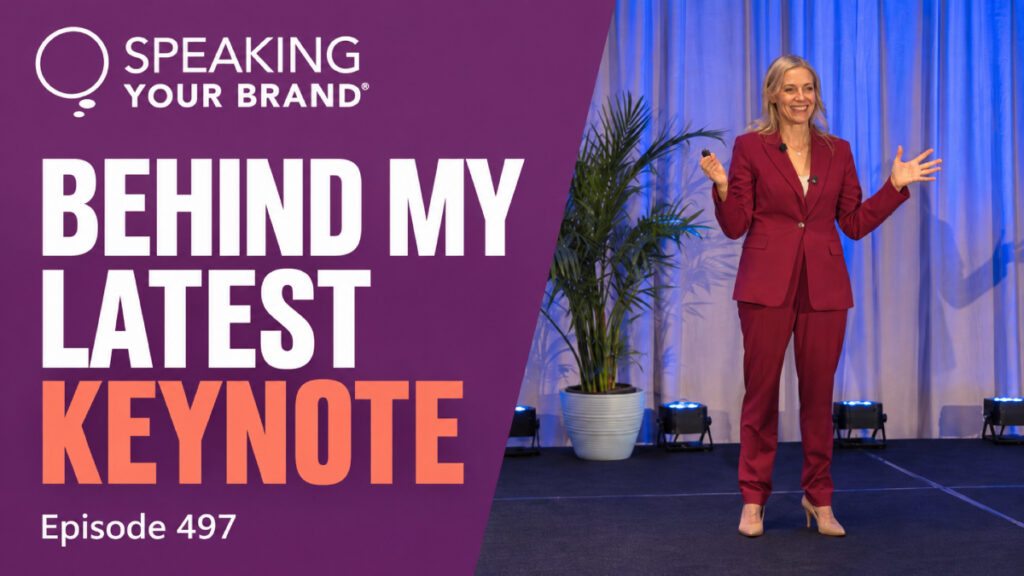
Imagine you’ve just delivered a keynote at an event or a conference. People in the audience come up to you and say, wow, I learned a lot. Or I was taking so many notes that I don’t even know where to start. That’s exactly the wrong kind of feedback. You want to get after a keynote, after a workshop or training? Yes, absolutely. You are there to teach and the audience is there to learn. With a keynote, though, you’re there for a different purpose. As a keynote speaker, you’re there on the stage to provide an experience for the audience and to help them see something differently about themselves or their industry or their community or their world, and to have them believe that they can do it. So what you want is the audience to come up to you afterwards and say, wow, you got me to think differently. Or I realize now that there’s something else that I can do to make the kind of impact that I want to make. Welcome to the Speaking Your Brand podcast. I’m your host, Carol Cox. In this episode, I’m going to share with you how I created and delivered my recent keynote talk so that you can take some of the same strategies and apply them to your own presentations and talks as well. Back in episode number 445, called Three Must Haves. For an unforgettable keynote, I dissected a different keynote that I had delivered at the time, and those three must haves were storytelling, The Rule of three, and humor and participation.
Carol Cox:
Definitely go back and listen to that episode. The link is in the show notes. Today, though, I’m going to share with you three different things, three different strategies that you can use for your keynotes. This keynote was for the Space Coast Chamber of Commerce Annual Leadership Retreat. The Space Coast is located in Brevard County, Florida, where Kennedy Space Center is. I live just in the middle of the state from there in Orlando. I was invited to be the keynote speaker because I know the person who is the incoming board chair for the Chamber of Commerce. You’re going to hear her on next week’s episode about how board positions can help you to get more speaking opportunities and visibility. So definitely check that one out as well. She invited me to be the keynote speaker, and so I worked closely with her and some of the other leaders in the Chamber of Commerce to make sure that the keynote was what they were looking for. It was a two and a half day leadership retreat starting on Thursday evening, and then all day Friday and ending Saturday after lunchtime. I was the closing keynote speaker, so mine was on that Saturday morning, wrapping up what everyone had been doing at the retreat. Now, I know sometimes keynote speakers literally just fly in.
Carol Cox:
They drop in, they do their keynote and they leave. But that’s not really my style. I really like to get to know the audience, the event, who was there and what they’re talking about. So I arrived on that Thursday night, stayed and participated in the entire retreat. And that made a tremendous difference. If it’s possible for you to attend the entire event or conference, I highly recommend that because here is feedback that I received from the people who were there. They said, Carol, I absolutely loved how you embraced the entire retreat. Thank you for being a big part of our success. And people noticed that I was there taking notes, sitting in the different sessions, talking with them, asking them about why they attended, what they love about their community. So let’s go into these three strategies I’m going to share with you today. There are around preparing for the keynote, creating the keynote, and delivering the keynote. Let’s talk about preparation. I had several Zoom calls with the event organizers, the chamber leaders. I really wanted to find out more details about the audience, the leaders who would be in the room, the goals that the event organizers had for the entire retreat, what would make it a success to them? Past speakers that they’ve had and what they’ve liked about past speakers, and what really resonated with the audience and what current challenges they were facing as a community that I could help them to address.
Carol Cox:
They came with me with a topic which was about making sure that the different sectors in the community don’t remain siloed. So you have nonprofits, you have government, small business, big business, and everyone’s doing their own thing. But how can we come together and collaborate to solve some of the challenges and have a positive impact in that community? So they brought that topic to me. So in those Zoom calls, I asked them a lot of questions about, well, tell me a little bit about the silos. Where are you seeing them show up? And do you have examples of community initiatives that have been successful? And so they gave me a couple, and I interviewed the leaders of one of the initiatives. It’s called Save Our Indian River lagoon, and this had been started about 15 years ago. And so it was still very active, and it had been extremely successful in the community, bringing together all these different constituencies. I had a Zoom call with two of those leaders. It was about an hour long. Ask them a lot of questions, had them give me a lot of context and background about the initiative and why they thought it was so successful, because I wanted to integrate that a a local example into my keynote. Now, you may be wondering, well, what if I have a standard signature talk or a standard keynote that I deliver? Do I have to change all of it? And the answer is no, you don’t have to change it.
Carol Cox:
The beauty of a signature talk, the way that we develop it for ourselves and with our clients is that you have interchangeable parts. It’s it’s a little bit modular. There’s act one, act two, act three, and you can change out the examples, change out the questions for the audience based on that particular event and what is relevant to them. So in this case, I use that example of Save our Indian River lagoon as the thread throughout the keynote. But if I was going to go deliver a version of this keynote in a completely different community, a different city, I would then interview them to find out a community initiative that has been successful for them, and then just replace that within the keynote. So that leads me to strategy number two, which was creating this keynote. Now, here is perhaps what’s ironic about this. This was a new keynote topic for me, this idea of breaking silos and leading as a community. And I really struggled at first I had all my notes and the transcripts from the Zoom calls that I had done, and I was working on the outline in a Google doc, and I was trying to piece it together. And I was thinking about the examples and a story or two of mine that I could integrate.
Carol Cox:
And what would be that rule of three? So what are the three things, the three lessons that I wanted to share. And it was kind of a little bit all over the place. And I was, and I was having a hard time wrapping my head around what kind of content to include and how to really make it so that the audience who are leaders, leaders in the community, what I could share with them, that would be the most helpful because remember, keynotes are about the audience. They’re not about me. But of course, the keynote had to be based on the work that I do, my intellectual property, my thought leadership, which is around, of course, story, voice, purpose. So I was looking at this outline and I was kind of trying to figure out where how to put everything together. And then again, this is ironic. I realize, well, the reason I’m struggling in the outline is because outlines are very linear and it’s hard to see everything at one time. So I got out our trusty poster board with the post-it notes. This is the process that we use with all of our clients, and that one on one VIP day, it’s based on our signature talk canvas framework, which I developed years ago with that act one, act two, act three. So I got out a empty poster board, got my four stacks of different Post-it note colors, and I started to map out my talk on there.
Carol Cox:
And wow, what a difference that made. It really came together because I had my pink post-it notes for stories and examples, my orange post-it notes for audience questions and activities, the yellow for the key points, and the blue for the supporting points. And I could start moving the post-it notes around, and I could start to see where there were gaps where I needed to find an additional story or example, where I needed to break up some of the content and add an audience activity. So I started mapping all of that out, and then I came back to the opening, the beginning, which I usually do towards the end, because the opening will oftentimes set the stage for what’s coming next. I was trying to think of a good story, and I wanted it to be a personal story. I didn’t want to get into the community initiative quite yet, because I wanted to let the audience know that even though I didn’t live in their community in the Space Coast in Brevard County, this was still something that was very much of interest to me. I grew up in South Florida. Space has always fascinated me. And then I remembered way back in 2011, I had attended a conference in Orlando called the 100 Year Starship. It was the best conference I have ever attended. I wish they still put them on and they still have a website, but they don’t.
Carol Cox:
They’re not that active, unfortunately. But what made this conference so memorable was that they were asking a bigger question. They were talking about how do we build a starship and send humans to another solar system, which is incredible. And the reason is called 100 Year Starship is because it would take 100 years. It would be a multi-generational starship. At the conference, they had sessions on the technology, engineering, the type of propulsion you would need, of course, to to even have something like this last 100 plus years and go to a different solar system. So all the technical aspects of it. But what they had there really surprised me was that they had sessions on history, political science, anthropology. Because if you’re going to have humans living in a closed starship for multiple generations, you had to think about Governance conflict. How do you raise children on a starship who have never stepped foot on earth, but yet still want to have a connection to those of us here? This is why it was so fascinating to me. So I shared in the beginning of my talk a story of me going to this conference, and I used our ideal storytelling ingredients, imagery, dialogue, emotion, action, and lesson. And the lesson that I drew from that story was this idea of asking a bigger question when as a community, you ask a bigger question, then you need more people to answer it.
Carol Cox:
Not one sector or one industry can answer it. You don’t just need the engineers. You don’t just need the political scientists. You don’t just need the sociologists. You need everyone to come together because that’s how big the question is. And when you need everyone to come together, collaboration becomes a must have, not just a nice to have. So I thought, oh, this is the way to start breaking down these silos. So even though this was a new keynote for me, then I brought in all those things that I always talk about shared purpose, shared story and shared voice. But I put it within the context of a community versus just individuals, which is what a lot of my content is based on is individuals. How do we use our voices and share our stories and bring people along with a common purpose? Now, this keynote was actually two hours long, which is rather unusual, I think nowadays for a keynote, most of them are about 45 to 60 minutes long. But it was two hours. And I knew right from the beginning that I wasn’t going to be talking to the audience for two hours straight. I really needed to incorporate audience activities and substantial audience activities to give them time to work on things. There are about 120 people at the event, and so as I worked on my outline, after each section of the shared purpose, shared story, shared voice.
Carol Cox:
I gave the audience about a ten minute long activity that they would do at their round table, and then I so they knew what their activity was. And then I would have one person at each table. At the end of that ten minutes share with the group had come up with. And it was very interactive. Everyone was engaged. No one was on their phones, everyone was participating. And then I also made sure that everyone at the table had a different role. So one person was the timekeeper at their table. One person was the facilitator, one person was the note keeper, one person was going to be the spokesperson. I even told them that one person at each table was going to be a spy, and they got to go around to the other tables to eavesdrop on what the other tables were talking about. So I made it fun. I made it lively. I made it very engaging and participatory. Preparing for this keynote was a little bit of a challenge, because I couldn’t just practice for two hours worth of content because I had these activities. What I did was I had my one page outline that had the act one, two and three and had the audience activities. And then I worked backwards at the one hour, 55 minute mark.
Carol Cox:
I knew I needed to be closing, so I needed to be on my last lines at that point. So then at the one hour and 45 minute mark, where did I need to be in the outline at the one hour and 30 minute mark, etc., taking into account the 10 to 15 minutes for each of these activities. So that’s what I did. So I knew as I got to a certain section of the keynote that I needed to be at a certain time point, I needed to be at the 30 minute mark. By the time act one was done, I needed to be at the one hour mark by the time we started a certain activity. So then I could just pace myself and I knew as I was going along, okay, here we are. We’re at this activity, but we are about five minutes behind what my original schedule had thought. So okay, so I’m going to maybe just shave off two minutes here on this activity. And then we’re going to keep going and I’ll drop a little bit of a description that I had on this next section. This is why we always say it is not possible for you to script out or to memorize your talk. It has to be fluid, it has to be flexible, and you have to be willing to go where the audience is at. I could tell one activity in particular they were working on.
Carol Cox:
They were really into it, so I didn’t want to cut them off prematurely. I let them go for a few more minutes, and we had each of the tables share, and that was incredibly valuable. Strategy number three was in the delivery of my talk, I mentioned that I had the outline where I had the timestamps and the audience activities integrated throughout. What I also did, which really surprised the event organizers, was that I incorporated what the previous speakers at the retreat had said. The day before the Friday, there had been an opening keynote speaker and then several different panels on different topics. And so I was taking notes. And then that night, Friday night, after I got back to my hotel room, I updated a few of my slides to include quotes from some of the speakers and the panelists that were relevant to what I was talking about. And I really wanted to bring that in to show that they were on the right track, to give them that sense of validation and to reflect back to them what I, as an outsider to their community, had heard them and had heard what they cared about. Here’s what one of the event organizers said in an email to me afterwards. Carol, thank you so much for delivering a compelling and thought provoking session. The attendees were engaged and interactive. I particularly appreciated the research you put into local Space Coast issues, making the examples relevant and timely.
Carol Cox:
Pulling in quotes and key points from Friday was also a Great way to tie the event together. And that’s the difference between a good speaker and a great speaker. A great speaker pays attention. A great speaker makes it about the audience, not about them. I mentioned at the beginning that after you deliver a keynote, you don’t want the audience to come up to you and say, I learned a lot. That’s being stuck in the expert trap. Instead, what people said to me, like your challenge to us to be bolder was excellent. Thank you for pushing us to think and dream bigger. Someone else said, excellent mind opening session. You were amazing. Thank you for helping us to think differently. And that was exactly my goal for this keynote, was to encourage them and to invite them to think differently about what they’re doing, because they’re already doing so many good things. And I knew that they were capable. They had the potential to do so much more to enhance their community. If you would like to work with us to develop your signature talk, whether it’s for a keynote or for conference presentations or for lead generation talks for your business, I invite you to check out our Thought Leader Academy. That’s our comprehensive online program. We’re also hosting a three day in-person speaking retreat coming up in February in Orlando, Florida.
Carol Cox:
You can find the details about the Thought Leader Academy and The retreat on our website at speaking your brand.com under the Work With Us tab. All the details are there, including pricing and dates. The best thing to do if you’re interested in learning more is to schedule a consultation call with us. It’s no pressure. I always love to talk to, especially podcast listeners, to find out your speaking goals, what you need the most help with. We’ll answer your questions And determine if one of our programs is a great fit for you. Again, go to speaking your brand.com/academy or speaking your brand.com/live. To find out about our Thought Leader Academy and our in-person speaking retreat. Don’t forget the next episode I have as my guest, the incoming board chair for the Space Coast Chamber of Commerce. My friend Tamara Harvin, who is the one who invited me to be the keynote speaker and then the episode following that, I have another guest, Jennifer Blatz, the CEO of Strive Together, which is a community organization based out of Cincinnati, Ohio. I use Strive Together as one of my examples in this keynote. So I had reached out to her and invited her to be a guest on this podcast to talk about not only this idea of asking a bigger question, but also how she approaches being the face and the voice of her organization. Until next time. Thanks for listening.
About this transcript
This transcript was generated by Sonix in just a few minutes using English speech-to-text and automatic mp3 conversion. Want to see how it works? Start with automated translation.
For the best results, good source audio matters as much as the AI. Start with word-for-word verbatim transcripts, then read these audio recording tips if your recording needs cleanup.
Create a free Sonix account to transcribe your own recordings in minutes — and check what transcription costs before you commit.