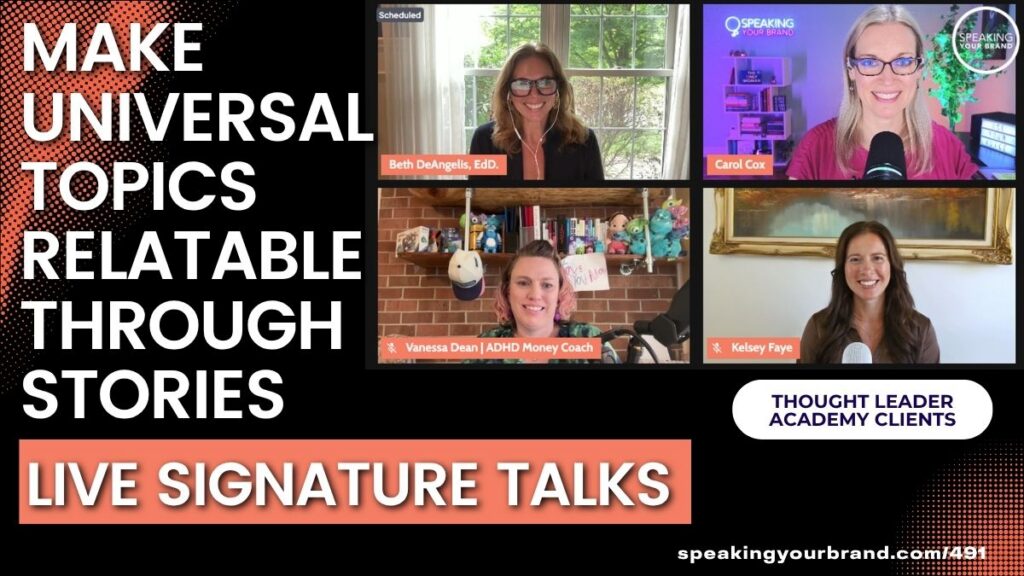
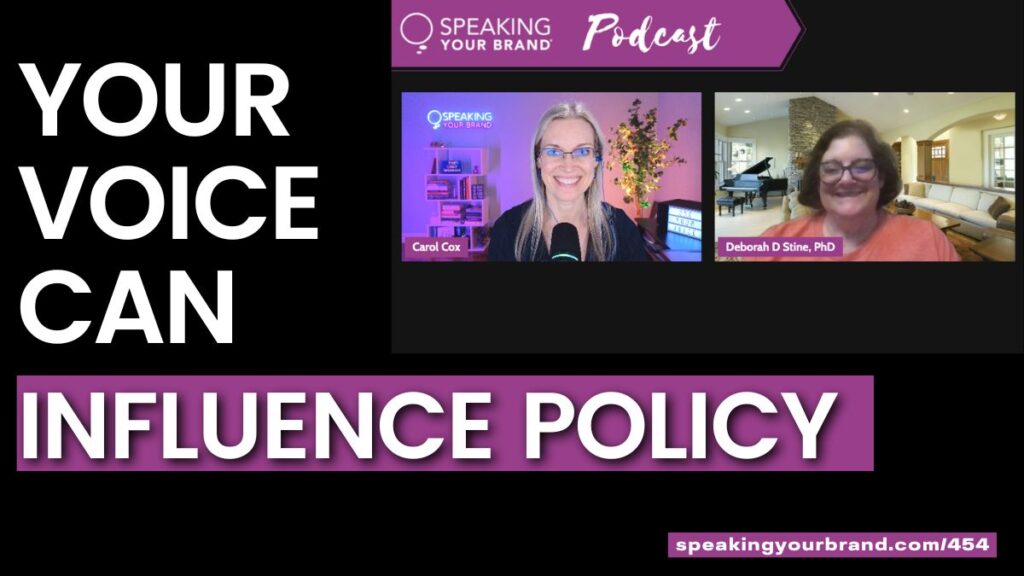
Your Voice Can Shape Policy: Frameworks for Clear, Influential Messaging with Deborah Stine, PhD: Podcast Ep. 454
Subscribe to the podcast!


When most people hear the word policy, they immediately picture Washington, D.C., marble hallways, and people in suits arguing on TV. But as my guest today so brilliantly reminds us, policy is simply how decisions get made – and you don’t need to be a political insider to influence it.
In this episode, I talk with Dr. Deborah Stine, founder of the Science and Technology Policy Academy, former Executive Director of the President’s Council of Advisors on Science and Technology in the Obama White House, and someone who has spent her career helping scientists, engineers, and health professionals turn their expertise into impact.
And yes—her résumé reads like a Washington fairytale, but what makes Debbie extraordinary is how down-to-earth and practical she is. She’s spent decades working at the national level and then chose to move back to the “ground floor” of change—state and local work—where impact shows up fast and in real lives.
Debbie and I talk about:
- Why most experts accidentally sabotage their own influence
- Her 4E Framework for better decision-making
- How to translate complex, jargon-heavy research into something the public—and policymakers—actually understand
- Why state and local advocacy can be even more powerful than federal work
- How to work with people who disagree with you
- A surprising turn into AI—and how Debbie used my Automate & Amplify program to keep her content going while traveling the world
This conversation is a powerful reminder that your voice matters, especially when you pair your expertise with a compelling story and a clear message.
About My Guest: Dr. Deborah Stine is the founder of the Science and Technology Policy Academy, where she helps scientists, engineers, and health professionals translate what they know into policies that improve people’s lives. Deborah has worked with the National Academies of Sciences, Engineering, and Medicine, at the Congressional Research Service, and was the Executive Director of the President’s Council of Advisors on Science and Technology in the Obama White House. She was also Professor of the Practice, Engineering and Public Policy at Carnegie Mellon University. Deborah is also the author of From Expertise to Impact, which is all about how experts can communicate in a way that truly influences public decision-making.
About Us: The Speaking Your Brand podcast is hosted by Carol Cox. At Speaking Your Brand, we help women entrepreneurs and professionals clarify their brand message and story, create their signature talks, and develop their thought leadership platforms. Our mission is to get more women in positions of influence and power because it’s through women’s stories, voices, and visibility that we challenge the status quo and change existing systems. Check out our coaching programs at https://www.speakingyourbrand.com.
Links:
Show notes at https://www.speakingyourbrand.com/454/
Deborah’s website: https://scitechpolicyacademy.com/
Listen to my Confident Speaker companion podcast = https://confidentspeaker.transistor.fm/
Discover your Speaker Archetype by taking our free quiz at https://www.speakingyourbrand.com/quiz/
Enroll in the Automate & Amplify with AI course: https://www.speakingyourbrand.com/ai/
Apply for our Thought Leader Academy = https://www.speakingyourbrand.com/academy/
Attend our 1-day in-person Speaking Accelerator workshop in Orlando: https://www.speakingyourbrand.com/orlando/
Connect on LinkedIn:
- Carol Cox = https://www.linkedin.com/in/carolcox
- Deborah Stine = https://www.linkedin.com/in/deborah-stine/
Related Podcast Episodes:
- Episode 411: Reframing Public Speaking: From Elite Skill to Everyday Power with Dr. Karen Corbin
- Episode 406: Authenticity and Owning Your Story as Women with a Public Voice with Jennifer Adams and Sarah Henry
- Episode 384: How to Tackle a Big Global Issue in Your Thought Leadership and Talks with Dr. Neha Pathak
454-SYB-Deborah-Stine.mp3: Audio automatically transcribed by Sonix
454-SYB-Deborah-Stine.mp3: this mp3 audio file was automatically transcribed by Sonix with the best speech-to-text algorithms. This transcript may contain errors.
Carol Cox:
Your expertise and your voice can shape a public policy. You’re going to learn frameworks that you can use to influence policy makers. With my guest, Doctor Deborah Stine, on this episode of the Speaking Your Brand podcast. More and more women are making an impact by starting businesses, running for office and speaking up for what matters. With my background as a TV political analyst, entrepreneur, and speaker, I interview and coach purpose driven women to shape their brands, grow their companies, and become recognized as influencers in their field. This is speaking your brand, your place to learn how to persuasively communicate your message to your audience. Hi there and welcome to the Speaking Your Brand podcast. I’m your host, Carol Cox. Today we’re diving into a conversation that I know will resonate with many of you who listen to the show, because I know that you’re here not to just have expertise, but you really want to make a real impact. And, you know, if you’ve been listening to me for a while, that I talk about this idea of escaping the expert trap, as I always say, I want you to be experts with your clients, with the work that you’re doing, because that’s why they want you for your expertise. But when it comes to using your voice, to sharing what matters to you with your audience and what matters to them, what happens is that we so often stay behind this kind of curtain of information and data, instead of sharing our ideas publicly in a bigger, bolder way.
Carol Cox:
Well, my guest today has dedicated her career to helping brilliant people do exactly that. Deborah Stine has a PhD, and she’s the founder of the Science and Technology Policy Academy, where she helps scientists, engineers and health professionals translate what they know into policies that improve people’s lives. And her background is incredible. It’s like a dream to read on LinkedIn. Deborah has worked with the National Academies of Sciences, engineering and Medicine at the Congressional Research Service, and probably my favorite position she’s had. She was the executive director of the President’s Council of Advisors on Science and Technology in the Obama White House. She was a professor of the practice engineering and public policy at Carnegie Mellon University. So, yes, Debbie has a lot of credentials and she puts them to good use. She also knows a thing or two about using your voice in Rooms of Power. We’re going to talk about the book that she’s written, the work that she does, and how you don’t have to be a political insider to shape policy. So we’re going to talk through all of these different ideas, including her framework, so that you can figure out how to craft your message to create change. Debbie, welcome to the podcast.
Deborah Stine:
Thanks, Carol. So glad to be here.
Carol Cox:
All right. So let’s let’s talk about the work that you do now, which is your Science and Technology Policy Academy. What does what made you decide to leave kind of the the DC political world, you know, working at all of these impressive places to go out on your own?
Deborah Stine:
Well, you know, when I left the the white House, I was trying to kind of figure out what I wanted to do. And I got an offer from Carnegie Mellon University and ended up moving to where I still am, which is Pittsburgh, Pennsylvania, which I never thought I would in my entire life. Um, and, uh, what I found, uh, is, is I was working in energy policy, primarily energy, environmental policy. There’s a lot of things related here to hydraulic fracturing, shale gas, things like that. And those are the classes I teach. And I worked on something called the, uh, establishing the Scott Institute for Energy Innovation. And, you know, after working, I was in DC for like 30 years, and that had been my dream. I started as a field engineer in Texas. And I made it from there to D.C. you know, like I said, I worked for the Congress, worked for the white House. Um, and, you know, when I came, um, to university and I started working again at the state and local level, which is where I started out in my in my Texas days, you know, I really found that I enjoyed being at that ground level again, because, you know, when you’re in D.C., um, you know, like I worked on state manufacturing policy, establishing something called the Advanced Manufacturing Partnership.
Deborah Stine:
Um, there’s things all over the country now which, um, are things to kind of help advanced manufacturing. Uh, and I did a lot of things related to manufacturing workforce. Uh, when I came here, all of a sudden, I could start working, like, okay, trying to help people who are unemployed get those manufacturing jobs. You know, I did focus groups with people who were unemployed. Um, I worked with people who are from underrepresented groups who were trying to, like, just make a living, all sorts of things. And the same thing was true with in energy and environmental issues. And I really started to enjoy again being like right at the forefront. I mean, I think most people think at the national level you’re at the forefront and you’re at the forefront of policy, but you don’t necessarily see those like day to day impacts at the national level that you will at the state and local level.
Carol Cox:
And so tell me a little bit about what your academy does now. What how do who do you help and how do you help them?
Deborah Stine:
Well, when I first, uh, you know, left Carnegie Mellon University, I thought that I was going to go and start working for somebody again. And I and I interviewed for jobs in DC to be like an executive director and things like that. And, you know, it just didn’t appeal to me anymore. Um, I really wanted to basically be at home with my dogs, looking, looking, looking at the horizon. You know, I just wanted to be independent right after working for other people for so many years. And the thing in policy is you really to have an impact, you really have to be behind the scenes, right? So I could not really express my own voice. And what happened was, is that as I was kind of looking and deciding what I wanted to do, what became what were originally side gigs, things just to kind of earn money. All of a sudden I realized, oh my goodness, I could make a business out of this. And I it was only because I was actually talking to somebody who was actually a staff member at one of the major foundations here in Pittsburgh, and he said, you know, Debbie, you should form an LLC. And I thought, oh, I guess I could.
Deborah Stine:
And then, um, you know, as soon as I sort of let people know that I was leaving, I started getting like offers of people to, like, do work, and I and I thought, oh, you know, maybe I can do this. And then it took me a long time, maybe six months or so at least, to say, hey, you know, I can make a business. And then over time, I definitely, like, earn as much as I did when I was a professor. Um, and I have a lot more independence. Um, you know, as you know, I just came back from, like, a month in southern Africa. Um, back in March. I spent another month around in Antarctica. Uh, those are things I never could have done when I was a professor or any of those jobs that I had in DC. And so in terms of quality of life, uh, it’s definitely much, much better than I had. So, you know, when I left, I started with like sort of two, two firms. One was consulting, which was analysis. And that’s still where I get most of my income is analysis. Um, uh, and then the second part is more things that are teaching workshops, coaching, um, you know, giving keynotes, those kinds of things.
Deborah Stine:
And I actually had them as two separate companies. And then over time, again, this maybe took a couple of years. I realized, you know, why am I doing this? I need one brand, right? And I decided of the two companies that I had that the one that had the most visibility that people understood the most was a science technology policy academy. A lot of my analysis is confidential. It’s kind of behind the scenes. Um, and so that brand never really had a lot of visibility, but the Science Technology Policy Academy, because it was things that were much more public, like workshops, coaching and and things of that nature. Uh, it did have a lot of visibility. And so I as opposed to the, I should say, when I started, I did my own website and everything else. I actually hired a professional, did something that was a quality, uh, website that included all the different lines of business that I, um, that I have and engage in. Um, and, uh, like I said, I’ve been able to make it successful. Now, I think I’m getting on close to like ten years or so since I, since I left, uh, um, Carnegie Mellon.
Carol Cox:
Well, let’s talk a little bit about this idea of policy, public policy, because I’m sure that for many listeners, especially those who’ve never been involved in politics or even thought about influencing policy, or especially if they don’t live in the Washington, D.C. area, they don’t really come across it. So in in their lives, they may think, well, how can I possibly impact policy? Like, I’m just one person. And even though I may have certain research that I’ve done, maybe I am a scientist or I’m an engineer or I’m a health professional. So I do have expertise, and I do have important things that could impact policy, but I don’t even know where to start or what to do. What would you tell them?
Deborah Stine:
Well, the first thing is, is that oftentimes people sort of conflate policy and politics, right? I don’t do politics. I mean, you know, I did work for the white House for for the first three years of the Obama administration, but I was not involved in the Obama campaign. You know, I was they basically just called me one day, asked interview me and voila. I you know, that’s how I sort of got the position. Um, and policy is really very, uh, analytical. Right. So it’s things where like, what I teach is neutral policy analysis, where, uh, speaking truth to power, that means that I’m doing the analysis. I’m going to tell the policymaker that maybe the their favorite idea that they really loved may not be a great idea. And I’m going to tell them why. Uh, and that’s, I think, super important. Right. To understand that, you need to take an analytical approach to policy. It’s not just about like, oh, this is my opinion. But really, when you’re giving your opinion based on analysis, uh, it will have substance. So I’m going to just give an example just because I happen to see it, uh, in the newspaper this morning, uh, Actually the Pittsburgh newspaper. So one decision that the Trump administration has made is to say that that nursing is no longer a professional degree. Okay. Now this has first, it’s got to be one of the silliest decisions like, ever, right.
Deborah Stine:
Um, and but it has major implications for something where we, we a we know there’s a shortage of nurses, right? Nurses are like, super, super important as anybody who’s ever had to, you know, have health care or go to the hospital or have, you know, a relative who’s been sick, know that nurses are often even more important than doctors. I think, in terms of your day to day care. And, um, but if this decision is kept right, then it means that it’ll be harder for people who do seek nursing degrees to, like, get their loans repaid. And, you know, there’s all sorts of negative implications. So the person who wrote this article and is a very long piece, uh, an opinion article, uh, explained this, right. And people understand it. It’s something that when you really, you know, anybody like I said, everybody’s had somebody who’s been ill in their family. And he said, okay, well that’s not fair. Right. And that’s what you really are going for when you are talking about an issue. Your goal is for the other side. You know, people on the other side, people generally who are unaware this is even an issue will understand, hey, this is something that I should care about. This is something that is not fair, right? Another thing that just happened this week is Doge is finally at an end, right? Well, why did that happen? Like it took months, right? I mean, we’re now in December.
Deborah Stine:
You know, this chaos started in January, so it took like a whole year. But in the end, I think it’s because people saw that the decisions that were being made were not fair. Um, I had, for example, like somebody that I had been working with for a while at West Virginia University, uh, she had a PhD, she had postdoc. She got her dream job with the Department of Interior. She moved her family with two small kids. Her husband quit her job. They moved to California, southern California. She was in the job for two weeks before she lost her job. Okay, because she was a provisional employee, she didn’t even have a chance to get started. Why? Because what she was doing for the Department of Interior had the word equity in it. Right? And that was it. It wasn’t like there was any judgment about the job or anything else. It was because it had one word. Right. And I do have a happy end to the story. She was eventually able to get a job, um, you know, with. Well, first. First, there was a lawsuit that that led her to actually getting paid. So you can imagine, again, you had to buy a new house.
Deborah Stine:
Again, this is again where people say it’s not fair. You move your family, you change everything. You bought a house and all of a sudden, okay, chaos happens, right? And, um, like I said, eventually a lawsuit went and gave her some back pay that kept her going for like six months or so. She now has a new job with the state of California. But still, people understand this stuff is not fair. And sometimes it takes time. And that’s one thing you have to understand with policy is that, you know, you know, it can take a year. It can take a decade. I mean, things can take a long time. But eventually, if you keep on speaking truth to power, eventually things will get corrected. And that is sort of the good thing about our democracy. Um, you know, one thing I always say is that if you work in policy, you have to be an optimist. You have to believe That what you do and things you do will eventually lead to change. And I’ve been lucky throughout my career. I can tell you probably 20 or 30 things where we have a better world because of studies and analysis that I have worked on with teams of experts on all sorts of issues in health, energy, environment, health, IT, and like you name it.
Carol Cox:
Yeah. And Debbie. Well, thank you for sharing those examples. It brought to mind a couple that that I hadn’t thought of until this conversation here. So one of the women I’ve worked with in the past, she’s a pediatrician and she runs a group called Women in Pediatrics for other women pediatricians. And I know that there are several of them that I have talked to who oftentimes will go to their state capitals and the states where they live and advocate on behalf of their patients. So the kids, for whatever it is that they need, that the legislature is considering some bill which may be detrimental to children’s health in one way or another, so they will very much use their voice and go and do that, or write op eds in the local papers or in some type of publication, again, taking their expertise, but then putting a story and, and their face and their voice on it, instead of just having it be some abstract bill that the legislature is considering.
Deborah Stine:
Right. And so that’s a really good example. Like, one of the things that I really tried to emphasize with my clients is that, you know, we think about policies being a federal thing, working in government, but there’s lots of very important policies, particularly in health care. Um, you know, but also all these other issues as well there at the state and local level. And you can have just as much impact by telling your stories. And, you know, when I teach people how to communicate, one thing I always emphasize is that I teach something called like a one minute policy pitch. Right. And and there’s a couple of principles. One of the one of the first principles is what this bottom line up front, at the very beginning, you say this to the policymaker, this is what you want to do in the middle. What you do is you always tell a story with a real person, right? So I would bet those pediatricians, you know, can say, you know, like, okay, this happened to this person, this happened to that person. And that’s what really makes an impact on policy makers. If you look at, just for example, the state of the Union speech, which is every year, and there’s always people that are kind of up in the galley, right. And what they do is so they can point to that person and say so and so this happened to that person or so-and-so, this happened to that person.
Deborah Stine:
And out of like, it could be a one hour speech, 45 minutes, one hour for the state of the Union. The only thing people remember is those stories, right? Right, right. And when I have people do In workshops where I teach people how to do policy pitches. And sometimes there’s competitions, you know, like with them, like so I travel around the country and do this sort of thing, even though I tell people, you got to have a story. Sometimes the people I’m teaching don’t put it in and I have them vote, right, or I have I have experts vote and without a doubt, the one that always wins has a really good story, and the one that always loses is the ones who ignored me. And thought facts and figures are going to make a difference. And it’s just, you know, we all remember stories, right? That’s what really has an impact. And that’s why it’s important to, as you said, op eds are really good. Like the one I just talked about where this nurses is, uh, you know, talking about, you know, you do need those kind of facts and figures, um, to, uh, to justify these things. But what people will remember are the stories.
Carol Cox:
Where do you think the reluctance comes from, especially on that part, I feel, of those highly credentialed experts, their reluctance to include personal stories. Is it that they haven’t seen it modeled for them in other people and other peers, so they feel like they it’s not something that they should do as well? Is it that they don’t think of personal stories, or do they feel like persuasion comes from the facts and the data?
Deborah Stine:
Well, I think it’s kind of like all of the above. Yeah. So so the first one, when I, when I teach, uh, how to do policy analysis, I focus on these four E’s. So the first one is effectiveness. Effectiveness is the degree to which the societal goal will be met. And when we’re trained as scientists or engineers or health professionals, that’s what we always look at. We only look at that one thing, you know, will this cure this disease or, you know, will this solve this environmental problem or will this innovation make money? Right? So those. But that’s not how people make decisions, right? So I don’t care if you’re buying a car, buying a house, deciding where to go to college. You’re going to talk about more about effectiveness. Like there’s a million places you can get a college degree, right? For example, a car island is, you know, like you could have any car that will get you from point A to point B, but you consider a lot more things, right. And so that’s where the other three E’s come in. So let’s just take like you’re buying a car. Um, so that the second E is efficiency and efficiency is economic efficiency. And that is that is basically what will get the most bang for the societal buck, right? So, you know, maybe, you know, like when I was young, um, in fact, in fact, my sister came across a picture of me, I bought this very cool red Honda Prelude, a little sports car kind of thing.
Deborah Stine:
And I was, you know, it was just me. I would tool around my town back in Corpus Christi, Texas. That was where I was a field engineer. And that was great. Okay. But as I got older, you know, I had a kid, and then I had to have transport the grandparents. And then I had the friends of the kid, and all of a sudden. Right. You know, I needed more than that. Right. I needed more than getting from point A to point B and squeezing everybody in. But I could only afford so much, right? Because if you have a kid, have a house. So I needed to figure out, well, how can I meet the needs of my family and at a decent price, right? And so I changed. All of a sudden I went to, like, you know what I have now? A Honda CRV, right? Much more practical. Still Honda. Right? But a different, different thing. The second thing, the third thing is sort of equity. Equity is thinking about who are the winners and who are the losers. So then you might want to think about, say like the size of the car, right.
Deborah Stine:
So yeah, sure. I probably could have had I don’t know, let’s just say a Honda Civic, you know, like, you know, I could have fit everybody in, but it would have been kind of a tight squeeze. Right. So, you know, that meant that the losers would be who’s ever in the back seat. It wouldn’t be me. Right. Because, you know, I’m in the driver’s seat, but it would be everybody else sort of in the back seat. Right. So there’s always winners and losers for every policy. And you need to understand who those losers are because you don’t want the losers to lose too much. Right. But you still have to keep the in these the effectiveness and the efficiency. The economic efficiency. The last one is ease of political acceptability. So let’s just say, um, that it it doesn’t mean like politics, like politicians. It means who’s likely to oppose or support a policy. Right. So let’s just say I went and thought, okay, I’m going to get this car, but, you know, I’m going to get an orange car. Okay. Now, somehow I think that, you know, the kids and the grandparents would say, really, Debbie? An orange car? Is that really what we want to be wandering around the neighborhood in? You know, or maybe a purple car or all these different things. People are going to object to certain things, or maybe people are going to say, well, you know, like, why are you getting.
Deborah Stine:
Let’s just say I said, okay, I’m not going to get a Honda CRV. I’m going to get a, you know, one of these big giant, uh, SUVs, right? And so I was like, oh, like Debbie, you know, like my colleagues are going to say, hey, you’re why are you driving around the giant SUV? Do you really need that big of a car? Think about what you’re doing to the environment. Right. And that goes into equity issues, ease of accessibility issues. So those things, you know, efficiency, effectiveness, efficiency, equity, ease of accessibility are really how we make all our decisions that we just don’t really realize it. We kind of internalize it. Policy makers are the same, same way. So going back to your original question, the challenges is that when we are trained as scientists, engineers and health professionals, we are not trained to look at these other things. We’re not trained to look at cost. We’re not trained to look at public acceptability. You know, we’re not trained to look at equity issues. Um, and because of this, we don’t do a very good job communicating because fundamentally, we have been trained that the facts should speak for themselves. And the answer is facts do not speak for themselves.
Carol Cox:
Right. Okay. Yeah. Thank you for sharing your for ease I love frameworks so that is that is that is definitely right up my alley. So thank you for that. So, uh, let me ask you this, Debbie. So when we think about especially a lot of the, the clients that you work with or just people who who come to you or who are in your world, the scientists and the engineer and the health professionals, uh, obviously, and very rightly so. They they are very deep into the details of their research. You know, oftentimes they spend years studying it. They’re doing research. They’re putting together the data and the analysis to draw conclusions from it. So it’s very precious to them. Plus, they are very familiar with it, with all the jargon, the vocabulary way, the conversations that their research is a part of. But then you go to either the public or to policymakers, and they don’t have that familiarity at all. I remember we were working with some faculty at the University of California, and this one woman, she has a PhD in engineering, and she was trying to do. She was talking about cement and concrete and making it more environmentally friendly and how to do that. And so I had to I had to help her find a story to do that, because cement and concrete, like, we don’t know, like those of us who don’t work in that, that’s not our thing. So when you’re thinking about the people that you work with, how do you help them to kind of pull their head out of the really that minutiae and get them to see the bigger bird’s eye view, to translate that to the public and to policy makers.
Deborah Stine:
Well, the first thing is I really work on them getting a good headline, right? So, you know, like, imagine I know, you know, like, like how to do keynotes and these other things. Right. Okay. Probably I, I suspect, um, that one of the things you do is you need a good headline for your talk. You need something that will grab people’s attention and bring them in and do these things. So when I’m teaching, like, in fact, I’m going to be at the University of Virginia, like in about a month, actually doing this workshop with University of Virginia, um, uh, graduate students. Uh, and I will work with them over the course of a day to get it. So whatever their key messages, they can get it down to initially, that one Sentence that headline the things you know, like the way I explain it is that, you know, like when you when they themselves. Right, they’re looking through, say an online right. And they’re, you know, maybe whatever it is, whether it’s like they’re on LinkedIn or they’re on some, uh, I don’t know, through Facebook or just a, their journal, it doesn’t matter what it is. They’re looking right at those headlines, those titles, and they’re saying, should I read or listen to this or should I not? Right. And that that’s really the first key is getting it so they can get it down to that one sentence, the one thing they want people to remember and they want people to do differently. Right. So you’re not just saying, um, like nurses are important or something like that. You’re saying, you know, change, um, the policy of nurse of those getting nursing degrees to make it a professional, you know, degree.
Deborah Stine:
Right. So you’re saying very, very clear. What is you want them to change. And it can only be one thing. Yes. It cannot be 500 things. Right. So when I teach them analysis right, I say okay, you have to first start with the status quo. That status quo is the current policy. And then you look at two different policy options. And I say in the end you have to pick only one. That’s it. You cannot combine the two together. You cannot do anything else. You got to pick one. And the one that you pick needs to be based on analysis. It needs to be based on evidence, not just your opinion. Oh, I think we should do solar. I think we should do wind. Well, you know, solar doesn’t necessarily make sense where I am here in Pittsburgh, you know. Yet it might also make sense in Arizona, right? So I teach them, you know, how to really get down to that one sentence I teach and say, hey, you got to find a story. So I teach them how to find a story, you know, or something that they can use that they can, like, um, bring several stories together, you know, just like a author does, to kind of illustrate what they need to do. And then somehow they need to also connect it to whomever it is they’re speaking, the policy maker to whom they’re speaking. Right. And that means understanding them, understanding their their jurisdiction, what it is they have control over and not have control over, you know, so the governor of Pennsylvania, for example, can’t make policy for new Jersey, right? Um, and the governor of Pennsylvania, you know, he can only do so much on, say, Stem education because Stem education is generally a local issue.
Deborah Stine:
Right? And so part it’s no good to tell a policymaker to do things that they legally cannot do. Right. Um, it needs to be something that relates to their constituency and to their, um, um, their what it is that they can do, uh, illegally. Uh, and also that kind of relates to their background and their interest. You know, if somebody is like, not at all interested in, I don’t know, climate change, you know, it’s no good trying to convince that person to do something on climate change. Instead, you have to take a different route. So, uh, like one example, like in this region, um, in fact, there’s an article I think maybe in the New York Times, uh, about flooding. So flooding in Appalachia is a really big issue. So you don’t talk to, say, a West Virginia policymaker about climate change. Instead you talk to them about flooding. Mhm. Uh, you talk to them about the impact, the economic impact of flooding. About the impact on businesses and on community things that they care about. Right. They care about West Virginians. They care about about the economy. Don’t try to convince them that climate change is causing flooding, although it is. Right. There’s, you know, there’s there’s plenty of data for that, that that’s not what you want to focus on. Instead, you focus on the end goal, which is hopefully getting West Virginia, West Virginia to invest more in flooding, uh, protection, uh, because it will help their people, not because of climate change.
Carol Cox:
Right. It reminds me of the old saying, do you want to be effective or do you want to be right?
Deborah Stine:
There you go.
Deborah Stine:
That’s a good way of putting it. Yes. Do you want to be effective or do you want to be right? Yeah. Yes. And and so part one of the workshops I teach is how to interact with people with whom you disagree. Um, and this is an example. And part of it is just first being respectful, you know, and not talking down to them, not criticizing them because they don’t believe that climate change is happening, all these different things. You know, that’s the first thing. The second is listening. You know, you really need to be a good listener, make a connection with them. You know, everybody can make some connection. Maybe it’s because you both have dogs. Maybe it’s, you know, because you know, the, you know, you watch the same football teams or whatever, whatever it is, you need to somehow make a connection, like with that person, before you really kind of dive in to whatever it is that you are there to talk about. And I understand this is challenging. Back when I was a field engineer, I had a boss who was a former NASA engineer. Right. But he was head of this regional office, uh, that I was part of. This is for the Texas Air Pollution Agency. And, you know, I would go and I would give a violation to some company because they violated some air pollution laws, and they would come in for a meeting and he would spin, I swear, the first 15 20 minutes talking about football. I don’t know the weather. I don’t know. It just drove me crazy. And then we would finally get to it. I did not understand that when I was like 25 years old. Right. I now understand it. Right. And we are not taught in the Stem world how to communicate with other people. We should, um, you know, or maybe it should be part of our general education. Whatever. Um, I went to University of California for engineering school. I wasn’t taught any of that, even though I did learn a lot about literature and other things. But I was not taught how to communicate about anything related to Stem.
Carol Cox:
Yes. And I feel like that is most industries even I mean Stem specifically, but even so many other ones and, uh, you know, so I’ve been involved in Democratic politics for over 20 years now. And, you know, I and I know Debbie, you don’t do politics. I you’re on the policy side and I’m on on the politics side. But I will say that, you know, seeing what has happened with the Democratic Party specifically in the past year with last year’s election and then what happened earlier this year and inability to stand up to the Trump administration is that I feel like and this is my own little separate soapbox rant. You don’t have to comment on this unless you want to. Is that the and I’m including myself in this is that the Democrats got so fixated on purity test for making sure that every person checked every single box for whatever the different issues were, rather than figuring out how can we connect with voters so that they understand that we are listening to them and we’re on their side, and we want to help them, and we want them to understand how to help themselves, like to aspire to that American dream. And we totally took our eye off the ball. And hence this is where we’re at. But I’m thinking, based on November’s elections, and now we’re getting back into the right frame of mind for next year in the midterms.
Deborah Stine:
Yeah, no, but I agree with you. Yes. No, I totally agree. And, you know, even, um, you know, in fact, I was just actually mentioning this to somebody. I think like yesterday there was a there was a certain kind of like, holier than thou kind of mentality, um, that that sort of pervaded, uh, or still pervades in some ways, you know, like, uh, a good portion of the Democratic Party. And it’s making, you know, as opposed to saying we, you know, we are it’s us. Right? Like, you know, we’re all like Americans and things like that. But thinking that we’re better than other people or all these other kinds of things, it just is, is a losing proposition. And, uh, you know, just as, as basically the same thing, as I said, with the people with whom you disagree. Three. Well, you know, if if people don’t feel that you have, um, that you respect them, then, you know, they’re going to feel, hey, you’re not not going to listen to me. One of the big changes, um, and this was actually a very good thing that happened during the Biden administration was in the scientific world is a memo came out from HHS, the Department of Health and Human Services about honoring what they call lived experiences. And so what that means is that, uh, when you are having, uh, like a conversation with somebody like, let’s just talk about flooding in West Virginia, right? Well, we can have all the data that we want about flooding, right? But equally important is not just a scientific, quantitative data, but the lived experiences of the West Virginians who have lived in these communities for like, you know, maybe their family has lived in their hundreds of years, right? They know the flooding when it happens.
Deborah Stine:
Why it happens. All those different things. And so what this memo, um, did was say, hey, we need to incorporate it. And it is important as lived experiences. Now, the challenge that occurred is that, you know, I talk about equity. Equity is one of the fundamental principles of policy analysis, the fairness of the policy, things like that. The word equity just got focused so much on Dei that the concept of equity as fairness, which is what it means in policy analysis and and saying that we need to be fair and honor this kind of knowledge, it got lost. Right. Um, and so that like one of the, one of the things I teach is equity analysis. I have for a really, really long time. And, uh, it really, really is understanding that fairness, understanding, you know, and involving that community. And that’s one of the things that I, um, like, I did a whole like sort of five part webinar series, uh, for an organization called Innovate Us that talked about community engagement and honoring that knowledge when one of the things when I was in Africa, um, I met a guy and he said, well, you know, um, I just, you know, I just don’t know as much.
Deborah Stine:
You know, I don’t I never went to school. Right? And I said, look, just because you didn’t go to school doesn’t mean that you don’t have a lot of knowledge. It’s just it’s learned knowledge. It’s learned in real life. Right. Um, but yeah, it is, you know, and I think it’s sort of even as we, um, you know, go into this like the next election, you know, it’s still not a done deal, right? Because we still do have definite, uh, challenges, um, in, in, um, you know, interacting with real people and honoring them regardless of, you know, their status in terms of, um, you know, their, you know, assuming that you’re better than sorry, that you’re better than them for any of these other purposes. Um, and it’s a very frustrating thing for me, you know, to do, particularly since I was a field engineer for five years, I spent a lot of time on the road talking to people. Um, you know, we really just need to, to, uh, to try to have more engagement. Uh, but it’s it’s a real challenge because everybody’s busy, including the people with whom we want to engage. Right. And then the feeling is, okay, you’re going to talk to them or try to convince them as opposed to listen to what it is they have to say.
Carol Cox:
Yes. All right. Very well, said Debbie. So I’m going to make a 90 degree turn here, and we’re going to talk about AI, which of course is still related to science and technology. It’s just a different aspect of it. So we actually met because we have a mutual connection. And she had gone through my automated amplify with AI program that I ran over the summer, and it was a lot of fun. And I taught a bunch of AI automations for content creation. So she mentioned must you must have been talking with with Stephanie, and she mentioned the program to you. So you reached out. And so then I gave you access to the self-paced version of the program, because you were going on your trip to Africa, and you very much wanted to keep up with your LinkedIn newsletter and some of your other content creation. And so, voila, AI automations came to the rescue. So can you tell us a little bit about what what you did with those and what you found? The benefits were?
Deborah Stine:
Yeah. So Stephanie is somebody she her organization is called Rising Engineers. And I’ve known her for a good number of years, I guess, I guess maybe five years ago we were part of a, like an educational activity together for quite a while. Um, and we were just kind of chit chatting, updating, and she said, oh, you know, I went through this thing and so forth, and it was like the best $500 I’ve ever spent. I said, oh, really? And I myself, uh, have been doing a lot on AI. So I’ve been doing analysis on AI data centers. I have a whole series of webinars that I’ve done on them from, um, like an environmental and manufacturing kind of standpoint. Um, and then, uh, I also teach things about AI. Uh, had had applied DNI for policy analysis, program evaluation, all the different things that I teach, but I had never really, uh, and this has happened to me before. I never really thought about applying it that much to my own, uh, business. Right. And so, um, I went, um, you know, to your website, and I watched the video and I thought, oh, that that could really kind of help me do these things. And what I liked about it was the concept of, of I don’t want like, want to produce things that are generic. Right. So a lot of one of the things I’m doing, because a lot of scientists and engineers and health professionals out there looking for jobs right now because of the Trump administration, and it’s unexpected for them.
Deborah Stine:
They thought they were in their dream jobs. They thought they’d be there for the rest of their lives. And so I have a lot of people, you know, that I’m trying to help. Um, and I don’t don’t want to, like, not help them while I go on my adventures. All of which is, as I say, were playing pre-trump. Right. Um, and so I do. Um, so I actually produce for LinkedIn newsletters. One is like an opinion newsletter. Uh, one is a jobs newsletter. So it’s for people who are looking for science, technology, policy jobs. And so I have over like 100 listings every week that I collect from LinkedIn. Um, and then, um, I have uh, one which is, uh, About my sort of like about my book. It’s about it’s kind of like science, technology policy 101. But the one that I really wanted to do, keep up, you know, while I was gone was what I call was, was Dear Debbie. So Dear Debbie is where people send in questions like, um, anything that sort of career related like, well, what is this ATS resume thing? And like, how do I do it? Or the one that’s actually coming out tomorrow is, you know what, what should I do during the holiday season? Um, you know, should I keep looking for a job? What what should I do? All these different things.
Deborah Stine:
Right. So when I produce these, um, I want to, you know, answer them with things that are in, like, my voice. Right? And so that’s what really appealed to me. So, um, what I did is, is when I, as I was trying to figure this out, I took. I have a lot of Out of content. Um, that is, you know, because of my book, because of all this, all these, uh, posts and things that have been generating. I have all the, the workshops I give, like I said, like 40 different workshops, as you know, all these different things. So I have all that content. And so I thought, okay, well, all I do is I upload all this content. And then I had never used make before, I had never even heard of make until you did it. Um, and I but I was using, um, like ChatGPT to kind of help give me some ideas for what to say. So I had my own ideas about how to solve these problems. But, um, I always like to, like, send it through ChatGPT or do something because, you know, other people have good ideas too, right? Not not just me. And, um, so I went and I, um, I kind of it took me a while, but I spent, like, I don’t know, a weekend putting all this stuff in, getting it to work. I did have this one glitch which you helped me fix very quickly, which I greatly appreciate because just a little tiny thing, those are the things that do then.
Deborah Stine:
And so what I did is I, I picked the topic. So I run a coworking space for the people that I coach. And I said, give me questions that you guys have. And so what I did is I just put those questions in and really short, you know, like the one I the holiday one is a good example that was came from one of my coaching clients. And she said, oh, you know, I’m trying to figure out what to do about during the holiday. Should I stop looking for a job? What is I should do? Um, and, um, and so I put it in and then miracle of miracles, poof! All of a sudden, I have something for my LinkedIn, uh, newsletter, Debbie, where it basically says, okay, here it is. Now, it doesn’t mean that I don’t change it because I do. Um, but I start out with a very, very solid first draft. That sounds like me. Um, it was able to like, for ChatGPT, I was already doing. I already had a relatively long prompt that I had kind of been modifying here and there. And so I was able to, like, use that as part of this make process. Um, and then I could produce like basically, I don’t know, like in a morning, let’s just say, you know, maybe for like a month’s worth of these Dear Debbie columns.
Deborah Stine:
And because they’re not time sensitive, like, my opinion thing is very time sensitive, but these are not time sensitive. Um, and so as a result, I can just produce a whole bunch of them, get it off my list of things to do. I go and I upload them into LinkedIn so that they’re just ready to go. And then one of my colleagues said, well, it’s like really amazing, Debbie, how you’re sending out all this content while you’re in Southern Africa. And I said, yeah, you know, well, it’s because I did. I did all the work before I left. Um, now that I’m back, I’m still planning to do it, like, sometime, probably this weekend. Um, I will, uh, generate all the content for December. And because I do again for newsletters on LinkedIn, um, I do need to try to reduce the amount of time I spend as possible because of course, none of these pay me income. Right? But on the bright side, they you know, they do. They have been successful in bringing me coaching clients, right? Because I’ve been doing coaching for years and years, but it’s only been in the past a year or so that I got, um, certified by the International Coaching Federation, that I decided to make coaching a serious part of my business, not just something like I did on a very haphazard kind of basis. Um, so anyhow, I thank you.
Deborah Stine:
It really has worked well, um, I am hoping now that I’m, I was really coming to it very quickly to try to get it done before my trip. But I’m hoping in December I can advance to, you know, doing something that is more voice oriented. Because now that like when I wrote my book, um, and uh, uh, there was not it was just going to be too much hassle to do a audiobook. But I know I myself only listen to audiobooks, so I know it’s important. Um, so I’m hoping to take again all this content now that I have on LinkedIn, uh, and, uh, plus my book and then use it to do, you know, maybe some, you know, a very clear podcast. I like the fact that you, uh, that was another thing that you clearly say, hey, this is like AI Carol. Right? So I’m my world is fine with saying, this is AI Debbie doing this because I think people appreciate the fact that, you know, for some of them podcast, um, and things that are by sound are their best way. They just don’t have time to read. Write. And for me, like I said, I myself, I don’t read books as often as I do in the evening, like fun books because I spent all day reading online. And the last thing I want to do sometimes my eyes are just too tired to read and I want something that’s oral. Not. Yeah.
Carol Cox:
Yeah, exactly. Well, this is why I called it Automate and Amplify with AI very much to that point, because I wanted to create a repeatable system where literally a one click button to generate this new, you know, on brand, high quality content based on your existing content library, and then also do an audio version. So for those of you listening who have not yet checked out my companion podcast called Confident Speaker by AI Carol, definitely check it out. You will find it sounds pretty much exactly like I sound right here, and it literally at a click of a button, and in one minute it produces an entire episode. And it’s good content because it’s based on my content library. It’s not just some generic random content from the internet that is pulling together. Yeah. So I’m excited for your podcast, Debbie, and having more people be able to consume your work, your expertise, your knowledge, so that they can have a greater impact in their careers and on public policy as well. So for those of you listening, look in the show notes. I have links to Debbie’s LinkedIn profile. Definitely connect with her there so you can check out her LinkedIn newsletters. I have a link to her website as well and check out Confidence Speaker, my AI podcast. And if you want to check out the AI program that we just talked about, link in the show notes there as well. Debbie, thank you so much for coming on the Speaking Your Brand podcast.
Deborah Stine:
Thanks, Carol. It’s been great. A lot of fun.
Carol Cox:
Until next time. Thanks for listening.
Sonix is the world’s most advanced automated transcription, translation, and subtitling platform. Fast, accurate, and affordable.
Automatically convert your mp3 files to text (txt file), Microsoft Word (docx file), and SubRip Subtitle (srt file) in minutes.
Sonix has many features that you’d love including automated translation, powerful integrations and APIs, automatic transcription software, secure transcription and file storage, and easily transcribe your Zoom meetings. Try Sonix for free today.