476-SYB-Relationships.mp3: this mp3 audio file was automatically transcribed by Sonix with the best speech-to-text algorithms. This transcript may contain errors.
Carol Cox:
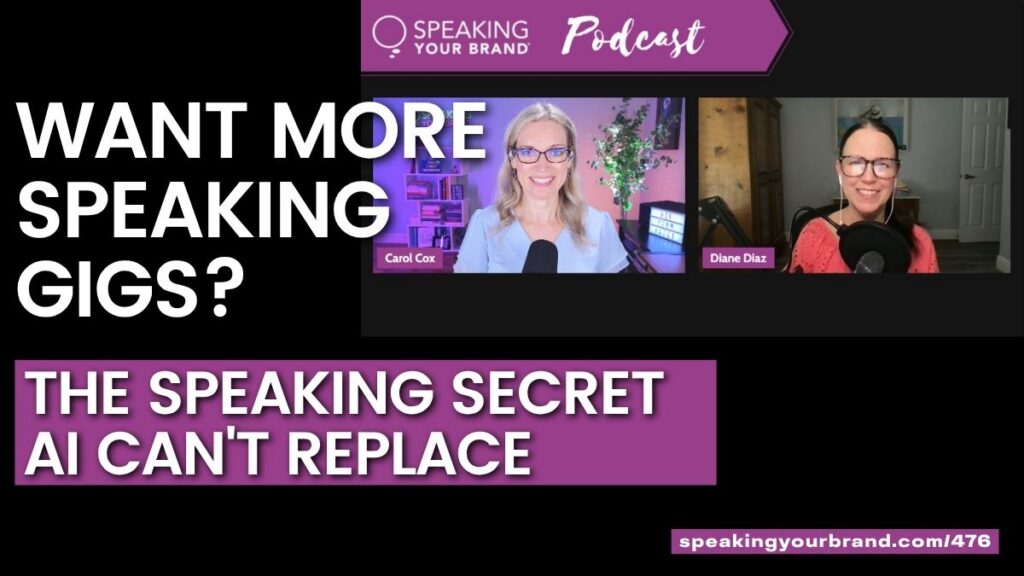
You may be closer to your next speaking opportunity than you think. We’re gonna show you how. On this episode of the Speaking Your Brand podcast. Hey there and welcome to the Speaking Your Brand podcast. I’m your host, Carol Cox, joined today by our lead speaking coach, Diane Diaz. Hi, Diane.
Diane Diaz:
Hi, Carol.
Carol Cox:
I want to talk about the power of relationships and networks in getting speaking engagements. We obviously have been speaking a long time in our careers, and I know when we talk with our clients and the Thought Leader Academy, one of the things that we help them to identify and figure out is who is it that they already know? Whether it’s individuals or organizations or places they’ve been associated that they can reach out to for speaking opportunities. Because I think this is where especially people who are aspiring to be speakers is that they feel like, well, if I just post more content online, whether it’s on LinkedIn or if I submit more speaker applications for Conferences, the speaking engagements will come, and certainly that can happen. And it does happen. So you should be doing some of those things as well. But I have found and I know you have found two Diane, from your experience, that the best speaking engagements, the ones that are most aligned, the ones that pay well, the ones that that reach your goals, they rarely come from people we don’t know from strangers. They really come from trust that you have built over time through relationships. And so I want to talk about why that is the case, especially now more than ever. Why trust and relationships is going to be the the main thing that’s going to help you to get speaking opportunities, but also some practical ways to go about doing this, even if you hate the thought of networking. Because I know, Diane, we don’t like that. Like, we don’t like the thought of like going to a networking event is definitely not something that makes us jump up and down for joy.
Diane Diaz:
No, absolutely. And I think most I think most people, if they’re being honest, probably feel that way.
Carol Cox:
Maybe there’s like 2% of people who really like love it, and I would love to hear from them. If you love.
Diane Diaz:
To.
Carol Cox:
Hear networking event and that makes you want to like go, let us know because then those tips from you. But here’s why I think trust and relationships is more important than ever. There’s a few things going on. And you know, we, Diane and I, you know, we have submitted conference proposals over the years for conferences that we’ve wanted to speak at, like podcasting conferences early on when I was starting my podcast conferences related to AI, I’ve submitted speaking proposals for and I’ve gotten selected women’s leadership conferences. So that definitely is something to do. But here’s what’s making it more challenging. Number one, there’s just more speakers out there. There’s more competition. There’s just more people. There’s more people in the world and there’s more people because of online content. And YouTube and Instagram and TikTok are realizing that they can be speakers, which is great. We want women to use their voice and go out there and share their message and their story and have an impact. But that just means there’s more volume out there. But then the second thing is AI, because all of a sudden anyone can draft and submit what seems like a decent sounding speaking proposal. Mhm. Chatgpt is great at that. It’s great at putting words together.
Carol Cox:
And then so this is why with Ted Orlando, where I was on the Speaker Curation committee, we got over 600 speaker submissions in the years past. Before AI, we would probably get 50. Why? Because it was hard. It was hard to put together an application. So not only are there just more people out there who want to be speakers and who are submitting for speaking proposals, but now there’s just so much. Now instead of them submitting, say, for three that they would do at one time, they can submit for 30 and right and multiply that by all the people who are out there. So that is why competition is harder and harder. So what to do instead? To make sure that you are getting those speaker opportunities? Because there are great events out there and conferences and companies and associations who need great speakers, and we want them to choose you. So, Diane, thinking back to the earlier part of when you had first launched your business, the brand teacher before you, even before you came here to speaking your brand, I remember that I was in the audience when you did some speaking engagements. So how did those come about?
Diane Diaz:
Well, as you just mentioned, those came about not through AI. We didn’t even have AI then. Um, those came about through personal connections, people that I met at either a women’s group or maybe I knew them from some other, you know, connection that went back a little bit. And then some event came up and they’re like, they reached out like, oh, I, you’d be a great fit for this. So those did come through those personal connections. And I think that, you know, this this idea of like people using AI to do all these submissions and, you know, the example you gave that you got 600 submissions for the TEDx Orlando. I think if someone’s hearing that and they might think, well, why should I even bother? But here’s the thing. I think that instead of that being a problem, it’s actually an opportunity for you, the listener, right? Because this is an opportunity to really stand out through a more personal connection than trying to use AI to create something that stands out, which is going to look like everyone else’s thing.
Carol Cox:
Yeah. Because that’s exactly what we saw in all of those submissions for TEDx Orlando, is that even though on the surface, the topics were different. So, you know, you would look at the words and the words would be on different topics, but then you would read the submission part and literally it all sounded exactly the same, like the way words were constructed. And so then at some point, it’s just like nothing stands out. Nothing feels unique. Nothing feels authentic, nothing feels genuine. And then your eyes just kind of glaze over and you just go. And I’m like, literally, I’m scanning through all 600, right in the Airtable database. I’m looking for things that stand out. And what stands out to me now is imperfection.
Diane Diaz:
Yes, yes.
Carol Cox:
Because ChatGPT will get it exactly right.
Diane Diaz:
Yes, yes.
Carol Cox:
You know, the grammar and the sentence structure and putting words together. And I’m not saying your speaker submissions that have typos and things that are obviously spelled wrong. That is not it at all. But like I, when I write, I like to use sentence fragments on purpose. I like to use parentheticals for like something humorous. That is my style. Chatgpt never does that at all because it’s not the way that it’s been trained. So really like, come back to who you are, the way you like to express yourself and put that into your speaking proposal. Don’t think that having AI polish it is going to make it better, as actually will end up making it worse, because you are literally going to sound like everyone else. Even though when you read it, you think it sounds great and but it doesn’t.
Diane Diaz:
No, I completely agree with that because you and I have read enough content everywhere, uh, generated by different AI tools. And again, there’s nothing, there’s nothing wrong with using tools like that to help you brainstorm, but to craft your final submission of something. Probably not the best idea because you and I have read enough of these things of all sorts of types of content where it’s like, oh, I mean, is it is it good? Sure. Is it is it interesting? Not really. Does it stand out? No. Definitely not. So I would rather like you said, I’d rather read something that has slight imperfections to it that speak to that person’s unique style or personality or humor. That’s another thing. Ai is not very good at is humor, as you know, like it’s. So I would rather have that person’s personality infused into it into an imperfect way versus something perfectly crafted by AI.
Carol Cox:
And this brings us back to what we were talking about, the power of relationships and showing up because we are going to show up as our human selves. And that’s what people want to connect to. And I feel like what also AI strips away is passion and energy. And that’s one of the things that I tell, can tell when I talk to someone is where is their passion coming through for their topic? And if they’re just kind of repeating words or things that they think sound good, it just strips away all of that. And I just, and I want just to hear whatever it is that lights either lights you up or gets you on your soapbox. Like, what do you either want to like rant about and shout to the world because it makes you mad, like you want to change things or what really light you up because something has really positively influenced you. Okay, so let’s go back. Yeah. Go ahead.
Diane Diaz:
Just add one thing. This just occurred to me that this is not unlike when we do our in-person workshop. And, and one of our attendees will get on the stage and want to read from a script. Then we take that script away, and then they just speak from the heart and their passion comes through. Right. It’s very similar. It’s trying to be perfect versus trying to be yourself.
Carol Cox:
Totally. And you know, and this is why I love the in-person workshop because when we’re on Zoom with our clients, we know that sometimes they’re reading from their document. And even though we encourage them not to, we can’t take it away from them. Yeah. But we can do that at the in-person workshop. And I know that that first that, you know, the women are just like, no, no, no, I need my scripts and my notes. And I’m like, they never do. And you never do. And that’s, that’s the power of what? And then they’re so grateful. Yes. That they showed themselves what was possible without relying on that.
Diane Diaz:
Mhm.
Carol Cox:
Is that okay? So you mentioned when you were starting your business, you were you did speaking engagements to increase your visibility and to meet new women and get clients and to grow your network. And so I, you showed up at places, you met the event organizers. You got to know them, got to know the members and the women who would show up, go to those different events. And then you pitched yourself as a speaker and then they said, yes. And I know what happened after that is that then there were other women in the audience who ran other groups, other local groups, and they saw you speak, and then they invited you to speak at their organization. And I feel like that is the domino effect that happens once you can get the first 1 or 2 speaking engagements, whether it’s within your local community or within an industry where you’re going to have people in common who are in those different audiences, and that is much more effective and much more worth your time and effort to do that than to, to, to have AI craft 100 speaking proposals and submit them to a whole bunch of conferences.
Diane Diaz:
Oh, absolutely. Absolutely. And the other thing is that, you know, there’s multiple things that can come from those relationships, not just not just speaking engagements, but maybe other like paid work, maybe maybe paid speaking gigs, maybe connections to other people who know of other speaking gigs. So it AI can’t do that for you, right? Ai doesn’t know who you know or don’t know. And then it can pair you up and say, hey, it can’t do that. So, so much more comes from the personal relationships than just, you know, ten pitches to a conference.
Carol Cox:
And thinking about what else that the speaking opportunities can do for you. Yeah. So you’re going to get other speaking invitations for sure, but you’ll get clients. Maybe you’ll be invited to serve on a board of a, of a local organization. And that gives you a lot of visibility. That has happened to me. I remember I did a speaking engagement, this was way back in 2010 when I had my technology business. I spoke at a technology event and they I got to know there were a couple other women speakers who were there and we were there all day. So we we chatted and we got to know each other. And those two other women also ran events. So they ended up inviting me to speak at their events. And from that one event, I probably got ten other speaking engagements through them in the next couple of years, and that wouldn’t have happened if I hadn’t just shown up for to speak at that event. And that was unpaid. And I was happy to do that because you never know where it’s going to lead. Now you need to be you need to have a great talk and you need to deliver it really well. You have to have the goods behind speaking that you’re doing so that you’re getting those other speaking engagements from from that. And Diana, I want to talk about a couple of our clients who have been guests on this podcast where their relationships have really made such a difference, and them showing up and doing speaking engagements have really made a difference.
Carol Cox:
So one of them is Julia Corn. She was on the podcast back in episode 422, And she, we talked about creating her keynote where that she delivered at a conference. And it was a lot of fun. She has a fantastic personality. And we talk in that episode about kind of her, her, the creative way that we found to, to make the keynote, not only informative and valuable, but truly an interactive experience for the audience. And the audience was blown away. The event organizers, even the AV guy, you know, who sees speakers all the time, he told her afterwards. He’s like, wow, like that was a ten out of ten. That’s like the best keynote I’ve ever seen. So we talk about that. But here’s how that keynote came about. The year before that conference, Julia was a breakout session speaker unpaid. She had she showed up, she delivered the goods. She did a fantastic job at her breakout session, but she didn’t leave it there. Then a month or two after that conference ended, giving the event organizers a little bit of space to decompress. Then she reached out to them and pitched them on her being the keynote speaker at next year’s conference. And they said, yes. And that was a paid a very nicely paid speaking engagement. So she showed up. She did a great job. She had a great talk, but then she built a relationship and nurtured the relationship to get that keynote the following year.
Diane Diaz:
Mhm.
Carol Cox:
Then the other example, I remember Diana’s, you interviewed one of our clients, Charlotte McCullough, and this was back in episode 396. And you had worked with her on a talk. And I remember in that episode, she was so appreciative because from that one talk, she got a bunch of other stuff afterwards. So can you share a little bit about that?
Diane Diaz:
Oh she did. She had a talk coming up that was and she’s in the mental health space. So, you know, she has spoken before, so it’s not like she wasn’t new to speaking, but she really wanted a talk that was really going to set her apart. So we worked together. And then from delivering that talk, other people started to come up to her and say, oh my God, you would be great for this event. You’d be great for that event she got. I, I want to say, didn’t she say 10 or 20 different opportunities to speak? Many of which were paid speaking gigs and the opportunity to tell she had a fantastic personal story that she shared in this talk. So she was able to leverage that one talk into 10 or 20 other some of paid speaking engagements just from the one talk. So that’s and of course, as you said, you got to deliver the goods. She does deliver the goods. But you know, when you can do that and you can put yourself out there, show up, do the thing and people see that they’re going to want to have you come speak at their event. And then she’s also done, uh, TV appearances. So she’s doing more than just the speaking gigs. Now once she’s gotten her message out there.
Carol Cox:
And I, and I see her a lot at the events that we go to here in Orlando. And I, you know, I talked to her about the TV stuff and this is my experience as well, having gone on TV a lot, once the news director gets your name and number, they will keep calling you because you’re a known quantity to them. They know you’re going to show up, you’re going to do a great job. They would rather keep using you than go try to, you know, hunt and find someone that they don’t necessarily know. So like, you have to get your foot in the door. And the best way to do that is through guess what? Relationships.
Diane Diaz:
That’s right.
Carol Cox:
So with, with Shirley, if someone else say in the Orlando area wanted to, you know, do some TV, you know, not necessarily related to mental health, but to something else. Get to know Charlotte, right? Build a relationship with her, then maybe she would be willing. And I’m here. I am pretty sure that on the spot. Yeah. Be willing to to introduce, you know, her new director contact or put a plug in for you. But that happens through relationships. It doesn’t happen with just a whole bunch of cold emails to people you don’t know.
Diane Diaz:
No. Absolutely. And and you know, Charlotte is someone who, from what I can see, doesn’t look at it as networking. She looks at it as relationship building, which is, I think the better way to look at it, right? Because if we look at it as networking, it does feel icky and gross, and we don’t want to do it. But if you just look at it as relationship building, that feels better for everyone and the people on the receiving end of it too. But you’re, you’re both, it’s mutually beneficial. And then you support each other. And Charlotte is a master at that.
Carol Cox:
And you never know when the speaking opportunity is going to come and how many years it’s been in between. So I am delivering a keynote this coming fall. And the woman who reached out to me, she I have known her for at least ten years at least, and she. And then she was thinking about. She’s heading up the the committee for the retreat that that they’re planning and needed the keynote speaker. So she thought of me and she reached out and I’m not even sure they interviewed or thought of any other speakers. She thought I would be a great fit for their topic and their audience. So we talked. I shared my fee. She went back to the board. The board said yes, and here we go. And so that was a, you know, a relationship that has been around for ten years. And, you know, I see her on LinkedIn and I, you know, I comment on her post here and there, not with any intention of wanting a speaking engagement from her, because I had no idea that she would even be in this role. But just because I like her and, you know, I want to put good feelings back into her when I see what she posts on LinkedIn.
Diane Diaz:
You know, the same. A similar thing happened to me when I spoke recently. Well, I think it was was it a year ago when I spoke to, um, Florida executive Women and I had met the woman who reached out to me. I had met her again probably like ten years before that and actually hadn’t seen her in quite some time. But she contacted me and said, hey, we need a speaker and it needs to be really good and it needs to be on this topic. And you came to mind it kind of out of the blue, she reached out to me, but I had maintained a relationship with her. We hadn’t seen each other in a while, but we would message back and forth every so often. We liked each other. So there she went and just recommended me, reached out to me, and then I spoke at the event and we got three clients from it. So. So you don’t, you don’t ever know where those relationships are going to lead. So, you know, relationship building is a long term play. Just like personal branding is like, it’s a long term play, but it pays off much more effectively than just having ChatGPT write everything for you.
Carol Cox:
Exactly. So then you may be thinking, okay, well, this sounds great, but like, where, where do I get started? Maybe you haven’t been doing a lot of, you know, networking or going to local events. And so what should you do now? I know my personal approach is quality over quantity. So I have picked 1 or 2 organizations that I attend regularly. So I became a member of Florida Executive Women, actually, Diane, after you spoke there because I hadn’t been around that group for since before the pandemic. And I was like, oh, I kind of forgot about them. So I became a member, and now I’m on their board of trustees for this year. And so I am really investing in the relationships with the other women who are members of that organization, because I really want I’d rather dive deep than go abroad. And then I still go to other events that are here in the local area. And Diane, you kind of took the same approach.
Diane Diaz:
Yes. I had been involved with Women’s Executive Council for probably five or so years, um, or maybe more actually going back before the pandemic. And then I joined probably about three years ago. And then this year I was asked to serve as vice president. So I agreed to do that. So I also have gotten more involved with that group. And it’s, it puts you in a more prominent, more visible role. So you get seen not just by attendees, but by the speakers that come to those groups. Anyone that you know, when they post about it on online. So it’s a really great way to build deeper relationships. But I would also encourage people, if you’re new to like, well, which group? And I’m not sure, just go to some of the luncheons, go to some of the meetings, go to some groups that you think, I don’t know, because I’ve been to some groups before where I thought, hmm. And then I ended up loving it. So you never know until you check it out. So if you’re new to the relationship building game, just get out there. And then you don’t have to keep going to things, right? You go to something like, it’s not quite a fit, stop going, that’s fine. But just explore, experiment, and then you’ll find the place where you feel most aligned that has the people you want to meet in the group.
Carol Cox:
And, and this is where actually AI can be helpful because it can do some research for you and find groups in your local community. So search for women’s groups, women’s business groups, chambers of commerce, industry associations, uh, you know, leadership, uh, like alumni leadership programs that a lot of cities have as well. So to kind of look around whatever your industry is and different types of groups, and that’s where ask ChatGPT or ask Claude to go, you know, give them those parameters and it will come back with a list. And that that is actually a great use of AI. Oh for sure. Put them on your calendar and start going into Diane’s point like you did feel for it. Go once or twice. And if the group doesn’t seem like a good match for you, no problem. You know, you tried it out. But then once you do find 1 or 2 that are a good match, keep showing up every month consistently and regularly because that’s how they’re going to get to know you. If you just show up once every 6 or 8 months, you’re it’s not, it’s not going to, you’re not going to be able to build that relationship with people.
Diane Diaz:
And I will say too, if you join a group and you don’t necessarily want to serve on the board, consider serving on a committee. It’s a lot less of a time commitment and an easier way for you to be involved and be visible without necessarily that much responsibility that a board position would require. So that’s another option.
Carol Cox:
Yes. Yeah. Volunteer on a committee or just volunteer to help out in general? Yeah. They have a big gala or a big annual event that they do volunteer for that. The same thing goes with conferences and associations. Say there’s a conference that you really want to speak at, but it’s competitive. You know, they get a lot of submissions. So reach out to the event organizers and say, you know, I would be happy to volunteer at the conference this year because now they know your name and your face and you’re helping them out and building that relationship. And then for the following year, you can then propose yourself as a speaker.
Diane Diaz:
Another thing that I like to do is when I meet someone, let’s say, let’s say I meet someone new at Women’s Executive Council, I’ll say to them, maybe I would go to coffee or whatever. And then I just say, kind of at the end, I’m like, hey, if you know of any other women’s groups or similar groups or events, let me know about them because I’m always looking to meet new people and make new connections. Right. And so every so often, I’ll have someone reach out to me and go, oh, hey, you, you might like this group. You might like this event. That’s a great way to find out about things because there’s almost also sometimes like a hidden network of events that I don’t necessarily know. And they don’t come up in ChatGPT because they’re smaller, but that’s a good way to find out about those.
Carol Cox:
That’s a great idea. Yeah. Ask because if people are at events, they probably know of other events that are going on for sure. All right. So then here’s my challenge to you listening. If you had to find three speaking opportunities, three places where you could speak and the next 90 days, who already knows you. Now your first thought would be like, oh, I don’t know. No one. Like no one. I don’t know anyone. I don’t know any event organizers who have that title or any presidents of groups and say, okay, well, let’s maybe you might actually know more than you think. Think about former clients of yours that you may have had. Maybe they’re not the president of an organization or they don’t run the conference, but maybe they have spoken somewhere themselves and they can do an introduction for you. Former work colleagues or colleagues. If you if you work someplace right now. Alumni groups are actually a really great place. I have spoken at Emory University’s alumni group. I’m on one of. I’m in one of their coaches for alumni as well. And that came from me actually pitching the person who runs the Emory Alumni Learning Network. And I got to know her and I did a session for them last summer, but I had the built in trust because I was a graduate of the school already. It wasn’t just someone like, I’m not pitching to some school that I didn’t attend.
Diane Diaz:
It’s like instant credibility.
Carol Cox:
Exactly. So think about professional associations that you’ve been a member of, even if it’s been a while, but it’s still relevant to what you do. You can go back, maybe renew your membership in that association and get to know them. It could be strategic partners that you have now or have had in the past. It could be a podcast host that, you know, maybe you’ve been on their podcast or you know, someone who has a podcast, they know a lot of people. Yes, who have podcasts know a lot of people because they’ve had a lot of guests on their podcast, so they can be great places to also get ideas for places to speak and to get introductions. Of course, the community organizations and groups that we just talked about. So really think about, you probably know more people than you realize, even if you haven’t talked to them. And even if it’s been since before the pandemic, that’s okay. Our, our timelines and memories are so screwed right now. And 2019 almost feels like it was yesterday. Yet it also feels like a million years ago. Yes.
Diane Diaz:
Good point.
Carol Cox:
So it’s yeah, just kind of reach back out. Hey, you know, I’d love to hear what you’re doing. You know, it’s been a while. Don’t pitch them on the first time that you reach out to them. Just kind of build, build a conversation again, right? Because you’re not like saying like, hey, can you give me a speaking engagement? No, that’s probably not not going to work. You don’t want to do that. You need to build a relationship because truly you want to have the relationship and don’t necessarily, you know, suggest like a Zoom virtual coffee or an in-person coffee right off the bat because you want to get a sense of, you know, where are they at? Do they respond pretty quickly to your email? Or do they say like, oh my God, I have a gazillion things going on because the kids are going to college and I have this. I’m like, okay, I have time right now. So just keep establishing the relationship. And if you get an email response back, like, oh my gosh, it’s so great to hear you, you know, love to catch up, then, you know, you can take the next step and invite them to something.
Diane Diaz:
Yes. And don’t be afraid also to maybe support them in some way. So if you, if you see that they, maybe they just launched a book, you can post about it on LinkedIn or something, right? So if you support others, they’re more likely to support you. And it doesn’t it similarly to not saying, hey, can you get me a speaking engagement? It doesn’t have to be overt. You just make a post, right? It doesn’t have to be, but just show that you’re supportive of others and that will come back to you.
Carol Cox:
Yes, yes, I love that because it is you’re because you’re it’s not transactional. You’re not, you know, you’re not buying something from 7-Eleven right? From the, from the grocery store. And then like getting and getting your product back, you’re building the relationship because you want to genuinely and sincerely care about the other person and how they’re doing and what they’re doing and what they want, like what, you know, what they’re interested in as much as you want them to care about you. It has to go both ways.
Diane Diaz:
Mhm.
Carol Cox:
All right. So here’s then your closing challenge. So we mentioned about what would you do if you had to get three speaking opportunities in the next 90 days. So let’s make this really actionable. So here’s what I would love over the next week. Reach out to three people you already know but haven’t connected to in a while, but you think would be a good people to build relationships with. So three people reach out to them, attend one in-person event, or at least get the next in-person event on the calendar. So have AI do some research for you. Do some Google searching, find a local event that you can attend and get it on the calendar, and then go to that event. And if you like it, make sure to put the next event on the calendar. So keep showing up on that. And then based on those three people that you reached out to that you already know, or maybe someone that you meet at that in-person event, schedule a coffee date with them. It could be virtual if they’re not local or in person as well, because as Diane said, speaking is the long game. Yeah. And it would be great. You could show up and they’re looking for a speaker and you get the slot next month.
Carol Cox:
That actually happened to me last year. There is an AI meetup that I have been going to run by a woman who works at Disney. And so I, you know, I, of course, you know, here’s the thing, I like AI like I use it all the time. We’re not anti AI. It’s just knowing when to use it. So I had, was attending her first couple of meetups and I went to one, I think it was in April of last year and I was talking to her afterwards. I’m like, oh, you know, I really enjoy this. And you know, if you ever need a speaker, let me know. But that was it. And then she said, well, actually, my speaker for May just emailed me today that he can’t make it like, you know, a month out from their next meetup. And so I need another speaker. Would you want to do it? And I said, sure. Yeah. So I showed up, right? I got, you know, I got to know her. I chatted with her and I just happened to say, if you ever need a speaker, let me know. Yeah. So you just never know. But that wouldn’t have come probably, if I had just done a whole bunch of like, cold email submissions to her.
Diane Diaz:
Absolutely not. And you were willing to say yes, even though it’s, you know, not that far off. I mean, I think being willing to say yes is very important because some people might feel like, oh no, I can never be ready. But yes, you can, you can, you absolutely can. So be willing to say yes when the opportunity arises.
Carol Cox:
Yes. And so have your talk, your presentation ready to go. Now, in that case, I didn’t because I was working on building AI workflow.
Diane Diaz:
But you got it ready, didn’t you?
Carol Cox:
Well, you know what? That deadline made me do things. It made me build things sooner than probably I would have otherwise. That’s why I love speaking engagements, too, because it forces me to get things done by a certain date. Yeah. So if you would like to create your signature talk so that it’s ready for you whenever the opportunity strikes and learn the business of speaking, you can get all the information about our Thought Leader Academy and apply today at speaking yourbrand.com/academy. Again, that’s speaking yourbrand.com/academy. You’ll fill out the application form, and then we’ll schedule a Zoom call so that we can get to know you, your speaking goals, and answer your questions. And then hopefully you all will have you join us in our next cohort. Well, Diane, thank you so much for joining me on the podcast today.
Diane Diaz:
Oh, of course, my pleasure.
Carol Cox:
Until next time. Thanks for listening.
Automatically convert your mp3 files to text (txt file), Microsoft Word (docx file), and SubRip Subtitle (srt file) in minutes.
We’ve tested dozens of platforms. Start with the medical transcription software if you’re evaluating options — then read our AI tools for audio and video, multilingual transcription tools, VEED.io review, and top meeting transcription tools for more.
Whether you’re focused on conversation intelligence, all Sonix features, or verbatim transcription, Sonix adapts to your stack. Our fast transcription and podcast transcription capabilities are a standout.
Try Sonix free today. No credit card required.