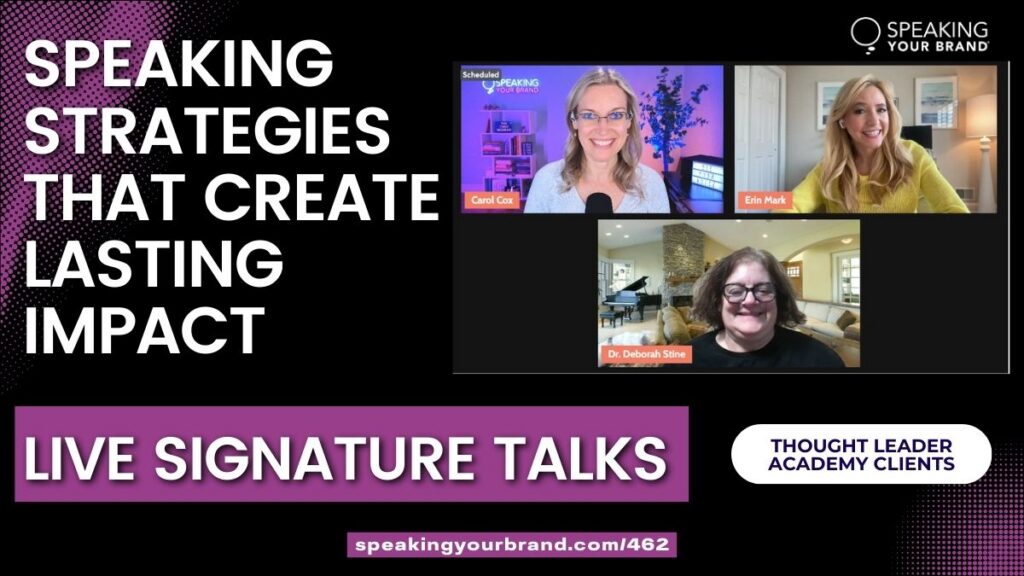
Speaking Strategies That Create Lasting Impact: Live Signature Talks from Our Thought Leader Academy Grads: Podcast Ep. 462
Subscribe to the podcast!


What’s the difference between a presentation people forget in five minutes… and a talk that quietly reshapes how someone thinks, decides, and acts for months afterward?
It’s not more information and it’s not prettier slides (although pretty slides are nice!).
This episode is the audio from our Back Stage with Speaking Your Brand live show, where you’ll experience two powerful examples of what happens when purposeful storytelling meets clear, actionable frameworks – the core of every transformational signature talk.
Erin Mark and Deborah Stine, recent graduates of our Thought Leader Academy, each delivered a 10-minute version of the keynote signature talks they created during their VIP Day with us and refined throughout the program.
You’ll hear:
- Two real signature talks delivered by our Thought Leader Academy graduates
- The difference between informational speaking and transformational speaking, especially important for keynotes
- How your message can position you as a thought leader
- What makes a talk memorable and actionable
- What they learned in the Thought Leader Academy and what’s next for them
About Us: The Speaking Your Brand podcast is hosted by Carol Cox. At Speaking Your Brand, we help women entrepreneurs and professionals clarify their brand message and story, create their signature talks, and develop their thought leadership platforms. Our mission is to get more women in positions of influence and power because it’s through women’s stories, voices, and visibility that we challenge the status quo and change existing systems. Check out our coaching programs at https://www.speakingyourbrand.com.
Links:
Show notes at https://www.speakingyourbrand.com/462/
Watch the video at https://youtube.com/live/TKkEHY0rRXw
Erin’s website: https://erinmark.com/
Debbie’s website: https://scitechpolicyacademy.com/
Discover your Speaker Archetype by taking our free quiz at https://www.speakingyourbrand.com/quiz/
Apply for our Thought Leader Academy: https://www.speakingyourbrand.com/academy/
Connect on LinkedIn:
- Carol Cox = https://www.linkedin.com/in/carolcox
- Erin Mark = https://www.linkedin.com/in/erinmark/
- Deborah Stine = https://www.linkedin.com/in/deborah-stine/
Related Podcast Episodes:
462-SYB-LI-Live-TLA-Clients.mp3: Audio automatically transcribed by Sonix
462-SYB-LI-Live-TLA-Clients.mp3: this mp3 audio file was automatically transcribed by Sonix with the best speech-to-text algorithms. This transcript may contain errors.
Carol Cox:
Here. What happens when purposeful storytelling meets clear, actionable frameworks? As you listen in to two of our recent graduates of our Thought Leader Academy deliver their signature talks on this episode of the Speaking Your Brand podcast. More and more women are making an impact by starting businesses, running for office and speaking up for what matters. With my background as a TV political analyst, entrepreneur, and speaker, I interview and coach purpose driven women to shape their brands, grow their companies, and become recognized as influencers in their field. This is speaking your brand, your place to learn how to persuasively communicate your message to your audience. Hi there and welcome to backstage with Speaking Your Brand. I’m your host, Carol Cox. Today we have two of our current Thought Leader Academy clients who are actually graduating next week. They will have been with us for eight weeks working on their signature talks, their thought leadership messages, and their pitching and speaking proposals. I’m excited to bring Aaron, Mark and Doctor Deborah Stein to you today. Next week we’re going to hear from the three other women who have been in our Thought Leader Academy as they deliver the ten minute version of the signature talks that they have worked on with us.
Carol Cox:
And what I love about doing these live shows is that not only do I get to share with all of you how amazing these women are, but to also showcase the different industries, the different topics that they represent and that and how much variety it is and how important it is for you to have that thought leadership message for the change that you want to see in the world, and the change that you want your audience to be able to do for themselves. So we’re going to have a round table discussion after Aaron delivers her ten minute version, and then Debbie presents her ten minute version of her talk. So hang tight, listen to them. Please let us know in the comments what you’re liking. Questions you have. Cheer them on, and then we’ll have that round table discussion afterwards to talk about what it was like to put their talk together and what is next for them as speakers and thought leaders. All right, Erin, you are first up. So I’m going to bring your slides up on the stage. Awesome. Go ahead and take it away.
Erin Mark:
Awesome okay. Thanks so much Carol. Hi, everybody. All right. Let’s get started. So obviously as you know my name is Erin Mark. And this is the beginning of my talk. So think about something. Don’t you just love that feeling when you first wake up in the morning and you kind of look around and think, wow, everything in my entire life has worked out exactly the way I wanted it to. Now, thank God. Me neither. I was going to say, if you said yes, please message me afterwards. I have so many questions. That space between expectation and reality. That’s where uncertainty lives. Uncertainty is one of the biggest stressors we are all living with. It is causing us so much burnout. And that’s what I talk about. And here’s the good news. These aren’t going to be some big dramatic changes that I’m going to suggest. They’re small, and it’s based on my lived experiences with research to back it up. Because for me, uncertainty hasn’t been just an occasional visitor. It’s been a constant companion. I have spent my entire life training to die. I want to talk about that a little more in a second. But first, I want to start with a little confession about, oh, maybe ten years ago, before one of my very first big keynote talks. I was so nervous. I had this pounding headache. So a few seconds before I went on stage, I reached into my bag, grabbed some Tylenol, took it when I went to put it back. That’s when I noticed the label.
Erin Mark:
I didn’t take just regular Tylenol. I had accidentally taken a Tylenol PM. Instant panic. I started sweating, my heart was racing. By the way, that headache the least of my worries. My brain went into overdrive. Am I going to start slurring my words on stage? Am I going to fall asleep in the middle of this 45 minute keynote? Is everybody going to think I’m drunk? Of course, none of that was actually happening yet, but my brain was fully reacting to what might happen. Because that’s what our brains do. They don’t wait for danger to show up. They respond to the possibility of it. And research shows our brains find uncertainty more stressful than receiving bad news. When you don’t know what’s coming next, your nervous system is on constant alert. Okay, so if you are feeling more stressed, anxious, overwhelmed. You are not alone. It is a human response to the world. We are all living in at work. That can look like showing up when you’re already exhausted, understaffed, and still expected to hold it all together. You’re probably being asked to do more with less. And on top of that, navigating your own uncertainty in your personal lives. Maybe with families, relationships, finances, your own health. It’s a lot of pressure. And listen, while I may not know every unique challenge that you have, I do know what it’s like to live with uncertainty that doesn’t let up. Which is why right when the MCU was announcing my name after I took that Tylenol PM, I had to pause and ask myself one question what can I control right now? Because for me, that question has always been my North Star.
Erin Mark:
I was born with a fatal illness called cystic fibrosis, and my life came with an expiration date. Doctors told my parents I wouldn’t live past 18, and I found that out early on because I overheard my dad on the phone one night quietly saying my life expectancy out loud. I was five years old. While most kids were dreaming about their future, I was trying to grasp that I wouldn’t get one. In the night. After I heard my dad on that phone call, Make-A-Wish came to our house. I didn’t fully understand what that meant at the time, but I was putting two and two together, and I knew I was sick enough to get a wish. And most kids back then wished for Disney World. That was sort of the default and had already been prearranged, but no one told me that. So when one of the men from Make-A-Wish leaned down to ask Aaron, if you could have one wish to go anywhere in the world, where would it be? Well, without hesitation I shouted, Tahiti! Yes, you heard that right. And you see that picture Tahiti in French Polynesia. I was a very exotic five year old, as you can imagine, the room went silent. After a couple seconds, that same man cleared his throat and said, how about Disney World? I had a follow up question.
Erin Mark:
Are there palm trees there? The entire room shouted, and you’re probably thinking it too. Yes. So I grudgingly accepted the palm trees and a chance to meet Mickey and Cinderella. Even though I don’t look pleased in this picture, I remember thinking, Tahiti will have to wait. But not too long, because even at five I knew I was on limited time. And limited time changes how you see the world. Birthdays feel different. I made it to 18, then 20, then 30. Each one a bonus I wasn’t supposed to get. I was so grateful, and I wanted more. But at 35, that road ran out. I entered end stage disease and I was dying. And I remember holding, excuse me grief in one hand and gratitude in the other. Grief because I didn’t want to go in gratitude because it was a miracle I got to live those extra years. But at the last minute, as time was running out, a breakthrough drug was approved and it saved my life. I didn’t die, I was going to get to live. But I did not expect how I would feel next. It was both relief and confusion. I was preparing to wrap things up and suddenly I needed a 400 1KA LinkedIn strategy SPF in my moisturizer, I have to pause and ask you people been living like this your whole lives? This is very stressful. The future I never thought I have was in front of me. This identity shift that happened overnight, almost.
Erin Mark:
And you don’t have to have gone through what I have to know that feeling of an identity shift for you. It could be a role, a goal, a season of life that has suddenly disappeared. In psychology, it’s called identity foreclosure. And it’s what we cling so tightly to who we are. We can’t imagine who we could be. This future that I had wide open came with almost a lot of pressure. Positive pressure, but new expectations, new options, new decisions, even good change can knock us off balance, right? We buy a new house, have a baby, get that job we always wanted, or get that role we worked really hard to get. Nothing bad happened, but suddenly there’s more at stake. And what I learned was everything that I needed to live, to train, to live, to really live for this next phase of my life. I had already learned while dying. Because struggle has a way of teaching us things that comfort never does. What I learned through all of that massive uncertainty, that burnout I went through. It wasn’t about pushing harder. It was about staying calm and not just as an emotion, but as four key pieces that anybody can use to help survive uncertain moments. Whether you’re a company, corporation or individual, it relates to all of it. Controlling what you can, adapting, leaning on others and moving forward. I would be honored to share my framework with you. And thanks so much for listening to a little bit of my story.
Carol Cox:
Thank you so much, Erin. That was fantastic. Uh, as you know, we’ve been working closely over the past few months, so I’m always inspired when I hear your story and your message and the message that you have to share with your audiences before we bring Debbie on for her ten minutes. Let me just ask you one quick question. So how did that feel? Did it feel as good as going to Disney World or Tahiti?
Erin Mark:
I mean, maybe not of Tahiti, but it felt just as good as Disney World, I guess. Okay, you’re better than Disney World. Carol speaking, your brand is better than going to. It’s almost like at the Super Bowl. Like, what will you do next? I’m going to see Carol Cox at Speaking your brand.
Carol Cox:
Which you did last week. And we’ll talk about that during the roundtable, too. All right. That was amazing. Um, fantastic delivery as well. And we’ll talk a little bit about that too during the roundtable. All right. So, Debbie, you’re next. I’m going to load your slides up here on the stage. Let me bring you up. And so, Debbie, go ahead and take it away.
Deborah Stine:
Okay. So I’m doctor Deborah Stine, I’m founder of the Science and Technology Policy Academy. Um, and I Want you to first think about what societal problems that you care about. It could be health policy, just like Erin was talking about. It could be environment or energy, national security, homelessness, whatever it is. Just think about those sort of problems and what you might be able to do to impact policy that will help resolve those challenges. So the first societal challenge I addressed was when I was a high school student, uh, I was in Texas and the Gulf Coast. And just like the little girl in this picture, I was really concerned about oil pollution in the Gulf of Mexico. I could see it on the beach when I went in the water, it would get in my swimsuit. And as a high school student, I conducted research on the use of microbial elements to clean up that oil. And that was like really exciting for me. And I produced a paper. But what I found out shortly after words was that, you know, if you want to have impact on society. It’s not enough to produce a paper. So just like, uh, the. At the Raiders of the Lost Ark, Indiana Jones went to all that effort to find the Ark of the covenant, and then it ended up in this big warehouse. The same thing can happen with scientific research, unless we take actions to get it out there into the world.
Deborah Stine:
So this came up again when I was at the White House. And and you can see me there in the back and I’m sort of in the red suit, and President Obama is on the, the right. And this is during the BP oil spill. And I sat there in my office listening to the folks in the office next door trying to figure out ways to respond to this challenge. And I thought back, you know, that goes back to my paper just, you know, again, we have an oil spill in the Gulf of Mexico. What can we do about it? What what actions can we take to have an impact on society? And luckily, through the years I was in DC, including at the White House. I was able to have an impact. And I can say all these things change because of my contribution and that of many other scientists, engineers and health professionals to society. And but what I learned is that it doesn’t happen just with scientific and technical evidence. It also means storytelling. So the person on the the left who is shaking hands with President Clinton is a guy named Norm Augustine, a former CEO of Lockheed Martin. I worked with him on this report called Rising Above the Gathering Storm. And this was a bipartisan, bicameral effort to try to think about how the US could be more innovative with scientific and technical information.
Deborah Stine:
And it was something where we could really see that the parties could work together. Uh, they passed the American Competes act. Uh, when President Obama came into office, he signed legislation to actually fund all the different activities in the America Competes act. But unfortunately, those days are are behind us. So although it used to be that Republicans and had a great deal of confidence in scientists, that’s not the case. Overall, the United States, we’ve seen a 10% decrease in confidence in scientists and in Republicans it’s been 20%. So we really need to take actions to figure out how to get back that confidence that we lost and began during the pandemic. But what’s of greater concern is that we’re not really getting it back. And one way to do that is to make sure that we answer the questions that policymakers and the public have. And too often, as scientists and engineers, we focus on effectiveness, the degree to which a societal goal is met. We also have to think about efficiency. What will get the best bang for the buck? We have to think about equity, the fairness of the policy, who are the winners, who are the losers? And we have to think about ease of political acceptability. The degree to which people will oppose or support a particular policy. Another lesson that I learned, and this goes back to when I was working on The Rising Above the Gathering Storm report, is that we need to learn that people prefer stories.
Deborah Stine:
You know, you’ll see here on this chart on the right that, yes, facts and evidence do play a role, but stories also play a very important role. And so for those of you who are not scientists, engineers, but you still think that public policy should be evidence based, your stories, your lived experiences, are just as important as that scientific evidence in trying to bridge these moral and political divides that we’re facing today. So what we need is a combination of skills and stories and spaces. We need skills. So this is an example of an analysis I just recently did for an organization called Reimagine Appalachia, about using waste heat from data centers to provide some sort of community good, like perhaps a greenhouse that could help grow food for people who lack food, or those who are for food deserts. Um, when I was teaching a workshop in Virginia, a student told me about her grandmother, who was forced to leave her home because of PFAS in her. Well, and we need spaces. We need to make sure that the stories and the analysis that we do are focused on where people live on their communities. And this is analysis done by one of my former students when she was at the University of Minnesota, uh, that, uh, and she was concerned about tear gas that came into where she was living, uh, attending the University of Minnesota during the George Floyd protest.
Deborah Stine:
And we’ve seen this even again today, recently with the Ice protest. So we need those skills and stories and those spaces where people live to really have an impact on policy. So to do this, I came up with this Ace framework. It includes three elements. The first is analysis. The key thing that I’ve been doing for decades. Getting those facts and figures. Um, and then we want to communicate. We need to sort of tell a story. But just like this, we also have to do engagement because just like this scene, which is from Hamilton, where he’s where, um, Aaron Burr is telling Alexander Hammer to to talk less and that he needs to smile more, listen more. That’s something else that we also need to do. And we need to do this in partnership with those who have those lived experiences, so that together, we can have an impact on society and make the world a better place. So if you’d like to know more about my Ace framework and how you can get involved in all the work that I’m doing to try to bring scientific and technical information to bear on societal outcomes, please connect with me on LinkedIn and I’d be happy to tell you more.
Carol Cox:
Fantastic. Debbie. All right. Let me. I’ll leave that. All right. We got that slide. Wonderful. So it was. It’s been so fun to work with you as well, Debbie, because you and Aaron are so different in your approaches. Your speaker archetypes, I would say. And but you. But I love that you bring what is authentic to you, to your speaking, to your messaging and to your talk. So, Debbie, I’ll start with you. Tell me a little bit about the the speaking that you traditionally do. And I know we call you a presentation machine because you do. I don’t know how many virtual presentations and workshops plus in-person conferences that that you do. So tell me a little bit about how you approach putting your presentations together, and then why you decided to come work with us here at Speaking Your Brand.
Deborah Stine:
Well, I do, I actually did a catalog last summer and I do about 40 different workshops and different workshop topics, so I really cover all sorts of different things. Analysis, community engagement. Um, AI you know, the application of AI, um, things about AI data centers. So I really cover a vast array of topics. Most of, most of the time my audience is, um, scientists, engineers. It can be anything from high school students up to very senior professionals. Uh, but it’s a very but it’s still sort of the same people, people who already, um, believe that scientific and technical evidence should have an impact on public policy. And this year, I really felt that I would kind of try to make my for 2026. I tried to go from that workshop stage, which I’ve been on for quite a while, uh, to try to do more at, at a, at a keynote level. But I also realized that the same presentation that I give for all these workshops is not going to be the same as that. I would give on a stage, uh, you know, where like sometimes, uh, as I find out I can have I can’t even have slides with me that I can point to and talk about my four E’s and all these different things that I that I do, which for me is a real challenge, um, in terms of doing these things. But if you look at like Ted Talks and South by Southwest, I mean, it’s true that, you know, it’s not rarely do you see sort of slides. So I sort of knew I needed help. Um, and then I came across Carol, actually for totally other reasons, for AI related reasons. And then I found out that she did this work. And I thought, you know, I think Carol can maybe help me. And that’s that’s how I started.
Carol Cox:
Okay, great. We’ll come back to you, Debbie, in just a moment. Erin, let me come to you. So we also connected last fall and tell tell us a little bit about, you know, where did this, uh, you know, desire to become a speaker come from and sharing your message of having cystic fibrosis and this idea of training to die and then now training to live. Where did that come from? That you wanted to share your message with more audiences? Yes and yes. Like you said, broadening your message out. Say not just to even people who have an illness like cystic fibrosis or some other type of illness, or even like, you know, caregivers or people in the health care industry, which I know one of your one of the different types of audiences you can speak to are people in health care, but then broadening that out. And so I remember when, as we’ve been working together on your talk, Aaron, obviously you have the personal stories and that really is the core of your talk and your message because it is incredibly inspiring to people, even if they’ve never been in your situation, they can still think about this idea of uncertainty and where it shows up for them, but then taking the storytelling, but then wrapping it into a framework. Your calm framework and into that third party credibility, the research studies and kind of blending all of that together. So what was the process like for you working on your talk? I know you like you like to write, which is great. I’m a speaker. Clearly I’m not a writer you like to write. So tell me a little bit about the process and what worked well for you.
Carol Cox:
Well, and I was going to tell you on your delivery today. You did an incredible job at the pacing. So for those of you who are watching and listening, we talk about with with your content. The content should have contrast, right? Like you’re kind of bringing the audience up, you know, energetically and kind of like then bringing them down and bringing them up through your stories and your content and so on. The same thing applies for delivery. Even if you’re super energetic and upbeat, if you keep that same energetic, upbeat level the entire time, the audience doesn’t really have a chance to like, just like, take a breath. Neither do you, right? And so that’s like one of the things we’ve been we’ve been encouraging all of you is to do that vocal contrast, find those key moments to slow down. Right. Bring the energy down a beat. Have those intentional pauses. And you did it.
Carol Cox:
I can tell. And you did. And because you have such great energy. Naturally. And I saw this when you were at our one day workshop here in Orlando last week. You have incredible energy. But then just doing that contrast, then when your energy comes back up, the audience tunes in even more and the same thing when like, and this is for any speaker, you slow down and you pause and then the audience also leans back in. So I love that. All right, Debbie, let’s come back to you. So you and Aaron and the and the other three women who will be on the LinkedIn live with Diane next week have been with us and our thought leader Academy for it will be eight weeks as of next week, your graduation. So tell me a little bit about what that experience has been like for you. Because we do the one on one VIP day where we map out your talk, but then we have these small group weekly calls to dive into other topics. What has been the value for you there?
Deborah Stine:
Yeah. I think for me, the hardest part, uh, sort of like Aaron is trying to get down to, like, my core message, you know, like, this was ten minutes, but I have to do this again in a week. In five minutes. Right? And, you know, that’s really tough. You know, for somebody, particularly for somebody like me who, you know, was a former academic and a policy where you used to have like an hour to talk, uh, it’s really, really tough to get your core message down. So, um, I think that the what was useful for me was, you know, the session where we went with your big board, you know, with, you know, kind of like the kind of introduction or like act one, act two, act three, all that other aspect of it. And then that was still kind of like the first time I did that. Um, not long after that, it was still pretty long. Uh, and then it’s ever since then, I’ve been just trying to winnow it down further and further and further. This is the closest I’ve gotten. I don’t know what it was, you know, just now, but when I was, you know, doing my practice runs and tying myself, I got myself down to eight minutes, which for me is amazing to get down to eight minutes, because just a couple days ago I was like at, you know, like much longer than that.
Deborah Stine:
So, um, so I think, I think that is really helpful. And then the other aspect, I think that you added and I guess this is maybe even the day after we did it, is you added those three S’s, you know, the, the, the spaces and things like that, which, which I thought was helpful in bringing together some of some of the aspects that I was interested in. Like I was focused much more because I’m an analyst on my Ace framework, which is analysis, and I thought that would be the focus of what I was doing. But you basically said, okay, no, that’s more the endpoint as opposed to the beginning point. And that was a change for me because again, I have been for decades teaching workshops, classes, everything on how to do policy analysis and how to communicate those analyses. But I really wanted to get to that engagement point. And, um, I think you can just see and this is why I think Aaron and I pair well, so well together is. Yes, you need an analyst like me. You need those researchers who do the research, but you also need people like Erin to tell the story, because believe me, they’re going to remember Erin a heck a lot more than they can remember me. I mean, even the people on this podcast, they’re going to remember Erin’s story more.
Erin Mark:
Because opposites attract. We need you. Yes.
Deborah Stine:
Yes, we we need both of us. We need a partnership to kind of have an impact on society. And, you know, we’re just having our impacts in different, different ways. Um, so, um, I think that that to me was something that really helped helped because I’m used to doing stories, right. I’m used to writing reports with beginning and middles and ends, but, uh, I have always done it for my workshop presentations. It’s more of steps, you know, like one steps, one through ten versus more of a story.
Carol Cox:
Yes. Well, I’m glad you brought up the three S’s. Now I’m a sucker for alliterations. I will if you know whether it’s an acronym like Erin has with Calm, if that. You know, if I can’t think of an acronym, you already had an acronym, Debbie with Ace, which I figured was good for act three for the call to action for the for your audience. But I really wanted in that act to to think about you sharing with an audience on a keynote stage. Right. Not a workshop training, not your traditional presentations that you are already excellent at. But how can we broaden out your message? And that’s where I thought of the the skills, the stories and the spaces. And again, I like alliteration because then I remember it, which I just did, which otherwise I probably would not have remembered it. Yeah. So because I really imagine you, Debbie, because of the, the background, you have the Obama White House, National Science Foundation, all of these incredible positions you’ve had and the impact that you have, I think a lot of people can learn from you, not only the scientists and the researchers and the people who are already in those fields. But I think a lot of other people, whether it’s healthcare or nurses or just, you know, people who do have some type of expertise but don’t think of themselves as connected to having an impact on policy. But to your I know your message is, but we need them, right? You know, to whether it’s writing op eds, engaging with their local community, state legislatures, etc., so that these positive changes are more likely to happen.
Deborah Stine:
Yeah. And I think that’s really the case. You know, it’s one thing for me as an analyst to present their story, but I will never be as strong a voice as, you know, I’m based in Pittsburgh, you know, and for those of you who watch Pitt, you know, the, you know, the Pitt, which is with no Wiley. You know, they had you know, they definitely have doctors and nurses, you know, from Pittsburgh who said, hey, this is real life. Like what’s on that show is really what we experience. Well, that obviously means a lot more to people than anything. I would say. Any data I would give about all the challenges that are faced by emergency departments in Pittsburgh, public hospitals. Right. Um, so I really think it’s important to kind of broaden that message. And like I said, that’s the reason I wanted to do this, is to try to go beyond, you know, my core audience who already know me. And, you know, I know maybe they’re tired of me at this point, but but, but to reach others because ultimately, you know, my life goal is to have an impact on society with evidence based knowledge, whatever that knowledge you know, might be.
Deborah Stine:
And to to realize, um, that though we as scientists, engineers, we have to be humble enough to recognize that what we say is not enough to really impact action, impact society. Uh, and that’s, I think, a very important message for us to understand. And then for also those who have stories to know that we need them, you know, because oftentimes people will say, oh, but I don’t know, science or I don’t know, it doesn’t really make any difference. What’s important is that you tell your story so that you can show that, yes, you know, this is an important issue to address. Or like in Aaron’s case, you know, like there’s been a lot of cuts to research funding, for example, to show that. Yes. Just because, you know, we had federal research funding, it created this drug which ended up saving her life. Right. And we’ve really had for the past year or so, really had to get across that message. Um, and before, I think as a community, we took that for granted and we could no longer take for granted that people understand the power that science and technology can bring to people’s lives.
Erin Mark:
Uh, Debbie, are we are we collaborating for a. I think what’s next is Debbie and I are going on tour for. Yeah, yeah. Yes, yes. I didn’t mean to interrupt. Sorry. I was like, Debbie, what are we doing here? What are we doing? Let’s get together. Yes. Bring with us, Diane. Hop on. All right. Go ahead. Sorry, Carol. I got so excited.
Carol Cox:
No, we’re going to Tahiti. We gotta find a speaking engagement.
Erin Mark:
Yes.
Deborah Stine:
You know, I you know, I kept wondering, Aaron, actually. Did you ever make it to Tahiti? I’ve actually been to Haiti, and it’s very lovely. Did you ever go?
Erin Mark:
I have never made it to Tahiti yet. Okay.
Deborah Stine:
Okay, well, we gotta solve this problem. We need to book a speaking gig in Tahiti.
Erin Mark:
Right? If anybody is listening, hire me for your off site Tahiti for corporate. Debbie and I will come. Carol’s going to come. We’re in. Yes.
Carol Cox:
Make Erin’s wish come true.
Deborah Stine:
Right.
Erin Mark:
The adult Make-A-Wish. Right. Like. Yeah, I survived, right? I remember, by the way, Cinderella, this beautiful blonde would save me a seat every day at breakfast because I was obsessed with her. I was not obsessed with Mickey, but the Cinderella I warmed up to. She was near a palm tree, and I thought to myself, if she only knew that I made it right. That I survived because at the time, right? She probably didn’t think so. Me? I gotta find her. So, Cinderella, if you’re watching, I made it. I made it, Cindy. And I’m going to Tahiti eventually.
Carol Cox:
Oh, we’re gonna get you there soon. All right. Erin. So that was my next question is, what’s next for you?
Erin Mark:
Yeah, yeah. Besides Tahiti, what’s next for me is keynotes and being able to impact as many people as possible and really firing up this business of mine and really just taking it to the next level. I’m looking to really expand into just healthcare, more conferences, associations, but corporates really any industry is going through change, which is very broad, right? But partnering right with HR teams to come in and to help also motivate their employees. Talking about realistic Resilience. Not this forced optimism. Right. Because I think we have so much going on in both our professional lives and our work lives and in our personal lives. So we need a way to stay calm as much as possible, to keep moving forward and to make a better life for all of us. You don’t need a crisis to change everything in your life. You don’t have to have a terminal illness like I did, right? It’s just these small changes that can really set you up for success professionally and personally.
Carol Cox:
You know, Erin, I was actually was just last week because I know your framework and I know your talk since we’ve been working together. And there was there was something I was like sitting on the sofa and getting ready to, you know, watch something on TV for the night to like, you know, like, relax and you’re calm. Framework popped into my head for some reason. Maybe I had been watching the news. I don’t know, I probably was it. And then I actually went through it. I’m like, okay, what can I control? Adapt. Lean on others, you know, move forward and I remembered it. And so I think that is the power of combining a framework with a story for a talk, for an audience, because I think they will walk away remembering it, and then they’ll start putting it into practice. Because as speakers, sure, we want to, you know, entertain the audience while we’re on stage, you know, inspire them, make them feel good, have them think differently for that 30 minutes or 45 minutes or an hour that we’re with them, but we want them to be able to take what they heard from us and carry it forward and remember it. And so I think they’ll remember your story and they’ll you’ll remember your framework. And, Debbie, same with you. So what’s next for you? I know you also have some speaking engagements coming up.
Deborah Stine:
Um, yeah. So I’m sort of like building up again for my goal of 2026, which is to move to more of a keynote, um, stage, uh, where I’ll be next week is actually with Dorie Clark, who you’ve had, I know on your podcast, Carol and and her interview was really very useful. And so my my challenge I think that I have next is to figure out, um, the uh, kind of how to market this enough to get to the right audience because in my world, you know, you know, a lot of people speak for free. And I would certainly love to speak for free. But the reality is, is I cannot afford to speak for free. And so I need to figure out some way to to still get across my message and find audiences who are interested in inspiring their audiences. You know, with what it is that my message is, uh, in terms of what it is that I have to say. So that I think is my big next, uh, step. So I’m doing that next week and then the like, I know, two weeks after that, uh, here in Pittsburgh, I’m, I’m doing a, uh, speakers, uh, with the National Speakers Association. I’m doing another event also. Again, I have to do this in, like five minutes, uh, to get a recording to Again to be able to use that for for marketing.
Deborah Stine:
So I still have a lot of like workshops and things booked. I haven’t really tried yet to book. Um, like to find the right thing for the keynote? Um, because I think it’s going to take some thought. And I’m hoping after this strategy session I have next week, plus all the stuff I’ve learned from you, Carol, um, that I can figure out, you know, who might be interested in the message that I have that I can make, maybe make the pitch to. And I feel that it’s definitely possible because I’ve done this in the past, like at NIH, they didn’t at one point. They didn’t have any classes that were on policy or things like that, and I pitched it to them, I don’t know, maybe ten years ago now. Um, and, you know, then I started out with one like, you know, class, and then I went to, like, five, right? Uh, so I found that if I could just find one, like, niche. Niche, you know, that I can. It will make sense to me, but I’m just not quite sure what that is yet. So I’m going to rely on you and others to try to help me figure out it from a marketing perspective, what that is, I don’t feel very comfortable yet again with that keynote style of, uh, of marketing.
Carol Cox:
Okay, well, we are here for you, Debbie. And like I told you, I think because of your background, your credibility, your message, your storytelling ability, you are right for the keynote stage. A lot of it is relationship building. And even going back to the conferences you’ve spoken at in the past, even if you, you know, even if you weren’t paid at the time or, you know, you were a breakout session and pitching them as the keynote speaker for their next, the next event, whatever that it could be next year, you know, because they book far in advance a lot of the times it’s you would be surprised that we have to let them know that, hey, like, I’m could be this like I could be your keynote speaker because they don’t necessarily put two and two together and it can feel very like, uh, intimidating to do it because you’re, you know, and I’m speaking for me and probably for a lot of listeners, if you’re a rejection, like, maybe they just don’t reply. What are they going to think about me? But I would just say, like, Debbie, you are so qualified to be on those keynote stages. Audiences need to hear your message. So as a public service to your audiences, you should start pitching yourself.
Deborah Stine:
Yes, yes I will, and I just I just need to figure out how how best to do it. But yeah, I mean like and again, I’m passionate about my message. My entire career has been focused, you know, like that was to not because originally I could have just been a researcher, but to try to have an impact on society. And I’ve been able to have that, you know, working for all the different places that I’ve worked. And so I really feel I can still carry that message. I just, I just need to figure out how best to do it.
Carol Cox:
All right. Well, you’re in the right place. All right. So everyone who was watching and listening Make sure to connect with Debbie and Erin on LinkedIn. Obviously, if you’re watching on LinkedIn, you can see them as the speakers and you can connect with them there. If you’re listening to this on the podcast, check the show notes for the links to their LinkedIn profiles. Also for their websites. You can find Erin at Erinmark.com that’s e r i n m a r k . Com and you can find Debbie’s website at scitechpolicyacademy.com. Again, links will be in the show notes. And if you would like to join us in the Thought Leader Academy to develop your thought leadership message, your signature talk, learn the business of speaking and be around an amazing group of other women speakers and women leaders. You can get all the details and apply speaking your brand. Com Academy again, that’s speaking your brand academy. And until next time, thanks for listening.
Sonix is the world’s most advanced automated transcription, translation, and subtitling platform. Fast, accurate, and affordable.
Automatically convert your mp3 files to text (txt file), Microsoft Word (docx file), and SubRip Subtitle (srt file) in minutes.
Sonix has many features that you’d love including world-class support, powerful integrations and APIs, enterprise-grade admin tools, advanced search, and easily transcribe your Zoom meetings. Try Sonix for free today.