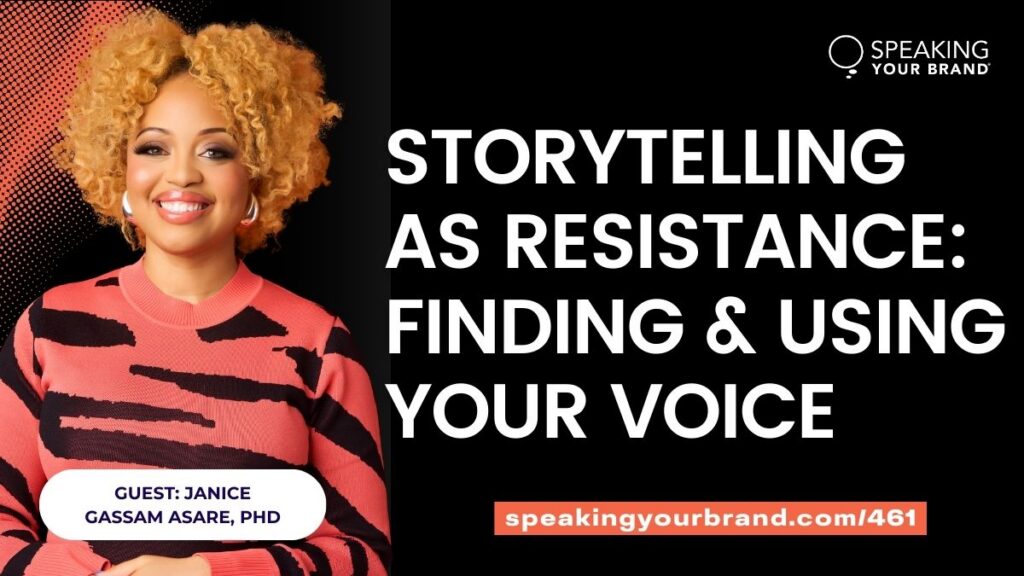
Storytelling as Resistance: Finding and Using Your Voice with Janice Gassam Asare, PhD: Podcast Ep. 461
Subscribe to the podcast!


Your story is not just your story. It’s part of a larger narrative about whose voices are heard and whose are erased.
I’m honored to have Janice Gassam Asare back on the podcast. She’s an organizational psychologist, equity consultant, and author of the new book Rise and Resist – and this conversation went places I didn’t expect.
What struck me most is how Janice reframes resistance. Not as something dramatic but as the small, daily choices we make: amplifying someone else’s idea in a meeting, speaking up when it’s uncomfortable, refusing to let an important story quietly disappear.
We also get into what it takes to develop your voice when you’ve spent years being rewarded for staying in your lane. If that hits close to home, this episode is for you.
Janice and I talk about:
- Why storytelling is preservation and power, not just communication
- How personal stories build connection that expertise alone never can
- The everyday acts of resistance that shape workplaces and culture more than we realize
- How to find your voice when you were taught not to rock the boat
- What to do when you speak up and face criticism or pushback for it
History keeps showing us the same thing: progress comes with resistance. But so does agency. It’s never gone; it’s just waiting to be used.
Your voice shapes conversations. Your voice opens doors. Your voice creates possibility.
Don’t wait until you feel perfectly ready. Don’t minimize your story. And don’t silence yourself before anyone else has the chance to try.
About My Guest: Janice Z. Gassam Asare, Ph.D. is a Ph.D.-trained organizational psychologist and the founder of BWG Business Solutions, an award-winning consultancy designed to help organizations create cultures built on equity. Dr. Janice provides consultations, facilitates workshops, provides guidance, delivers keynote speeches and “Awareness Talks” to spark important dialogue about equity in the workplace. Dr. Janice has had the opportunity to collaborate with Google, Amazon, Yale University, Nordstrom, H&M, and Paypal/Venmo among many others. Dr. Janice is the author of three best-selling books, “Dirty Diversity: A Practical Guide to Foster an Equitable and Inclusive Workplace for All”, “The Pink Elephant: A Practical Guide to Creating an Anti-racist Organization and Decentering Whiteness in the Workplace”, with a new book “Rise and Resist: How to Reclaim Workplace Equity and Justice” coming in February 2026. She is a senior contributing writer for Forbes having authored over 500 articles, a Harvard Business Review contributor, a LinkedIn Learning and Udemy Business instructor and EBSCO Learning facilitator. In 2022, Dr. Janice was recognized as a LinkedIn #1 Top Voice in Racial Equity. In 2023 she was recognized by Gusto as one of the 25 Top Workplace Experts to Follow. She is a 2-time TEDx speaker, the host of the Dirty Diversity podcast and an adjunct professor at Columbia University. During her free time, Dr. Janice enjoys volunteering as a job coach for the Coalition for the Homeless.
About Us: The Speaking Your Brand podcast is hosted by Carol Cox. At Speaking Your Brand, we help women entrepreneurs and professionals clarify their brand message and story, create their signature talks, and develop their thought leadership platforms. Our mission is to get more women in positions of influence and power because it’s through women’s stories, voices, and visibility that we challenge the status quo and change existing systems. Check out our coaching programs at https://www.speakingyourbrand.com.
Links:
Show notes at https://www.speakingyourbrand.com/461/
Janice’s website: https://www.drjanicegassam.com/
Get Janice’s new book “Rise and Resist: How to Reclaim Workplace Equity and Justice”: https://www.penguinrandomhouse.com/books/808352/rise-and-resist-by-janice-gassam-asare-phd/
Forbes article by Janice: “How Carol Cox Is Helping Women Speakers Get Paid What They Deserve” = https://www.forbes.com/sites/janicegassam/2019/12/01/how-carol-cox-is-helping-women-speakers-get-paid-what-they-deserve/#1f5c3921533f
Discover your Speaker Archetype by taking our free quiz at https://www.speakingyourbrand.com/quiz/
Apply for our Thought Leader Academy = https://www.speakingyourbrand.com/academy/
Connect on LinkedIn:
- Carol Cox = https://www.linkedin.com/in/carolcox
- Janice Gassam Asare (guest) = https://www.linkedin.com/in/janicegassamphd/
Related Podcast Episodes:
- Episode 156: Visibility Strategies That Get You Noticed with Janice Gassam
- Episode 257: Writing a Book Gives Your Ideas Depth and Longevity with Tiffany Hawk
- Episode 378: The Power of Women’s Voices and Stories to Change the World with Carol Cox
461-SYB-Janice-Gassam-Asare.mp3: Audio automatically transcribed by Sonix
461-SYB-Janice-Gassam-Asare.mp3: this mp3 audio file was automatically transcribed by Sonix with the best speech-to-text algorithms. This transcript may contain errors.
Carol Cox:
We’re continuing our series about big ideas. My guest today is Janice Gassam, whose new book, Rise and Resist, is a tour de force about finding and using your voice. On this episode of the Speaking Your Brand podcast. More and more women are making an impact by starting businesses, running for office, and speaking up for what matters. With my background as a TV political analyst, entrepreneur, and speaker, I interview and coach purpose driven women to shape their brands, grow their companies, and become recognized as influencers in their field. This is speaking your brand, your place to learn how to persuasively communicate your message to your audience. Hi there and welcome to the Speaking Your Brand podcast. I’m your host, Carol Cox. Today we’re going to dive into how to find and use your voice, especially if you have something that’s a bigger impact that you want to make and how that can take different forms. It could be your signature talk for speaking engagement. It could be articles and publications that you write. It could also be an entire book. And I am so thrilled to have back on the podcast, my guest, Janice Gassam, she was last on the podcast in episode 156, which aired in January 2020. And boy, does the world look a lot different than when she was on, because at the time we talked about visibility strategies to get you noticed and definitely go back and listen to that episode.
Carol Cox:
I’ll link to it in the show notes. But since then, as I mentioned, a lot has gone on. Janice has a PhD in organizational psychology, and she’s the founder of an award winning consultancy that works with organizations to create cultures built on equity. She has written three best selling books, and the reason I’m having her on now is because she has a book that is coming out right now in February 2026, called Rise and Resist How to Reclaim Workplace Equity and Justice. Obviously, it’s very timely, which is why I wanted to have her on to have this conversation. Janice is also a senior contributing writer for Forbes, having authored over 500 articles. That’s like me having over 450 podcast episodes, but I feel like writing articles is a lot harder than me just talking on the podcast. She’s also a contributor to Harvard Business Review, a LinkedIn learning instructor, and a two time TEDx speaker. On top of all that, she’s also an adjunct professor at Columbia University. Janice, I don’t know how you do it all, but welcome back to the podcast.
Janice Gassam Asare:
Thank you so much, Carol, for having me. I’m so glad to be back. So much has changed in these last six years, but I’m so glad to be here and to to be joining you.
Carol Cox:
Well, I you sent me an advanced a galley of your new book, Rise and Resist. And it is beautifully written, which I’m not surprised because you are such a great writer. And actually we first connected because back in 2019 you found this podcast and then you were so kind. You wrote an article featuring me in Forbes about how I’m trying to get women speakers paid to speak because we still have problems in public speaking, with equity, with women speakers, and that’s something that we still work with our clients on to. First of all, ask to get paid, but then ask what the going rates are for it as well. So thank you for for spotlighting that. But let’s dive into your new book, Rise and Resist. So tell us a little bit about the premise of the book and why you decided to write it.
Janice Gassam Asare:
Yeah, I, you know, I, I was just I’ve just been seeing what’s happening, what we’re all seeing in the US going on and unfolding. And you mentioned in earlier in the podcast that I have a background in organizational psychology, but a lot of my work and my writing has focused on equity, right? How to make sure that the most marginalized employees have an opportunity to succeed and to thrive in the workplace. And what I’ve noticed is, in just the time that I’ve been doing this work for the last several years, is that a lot of things are cyclical. And what has happened ten years ago or 20 years ago or 30 years ago happens again and happens over and over and over. And, you know, I know you are you have a background in history. I am not. As I wrote in the book, I was never really a fan of history. I’m not a student of history, but I’ve learned that if I am in this position where I want to help people to have better experiences in the workplace, I need to study and learn what has happened to get us to this point. And so in my realization of that, I have been studying the legacies of different black people throughout the world who have resisted the circumstances that they’ve lived through because I’ve been wondering, like, how did these people who lived 60 years ago that were getting hosed down by, you know, water hoses and dogs and all of these things and lynchings and all of the horrific things that have happened.
Janice Gassam Asare:
How did these people endure, and what lessons can we take from their journeys? And how can what they went through inspire us in this moment? Where for me, I know when I open up my phone, it’s just I feel bombarded with so much news and this happening and that happening and that, and it feels really overwhelming. And so I in writing this book, it was very cathartic for me because it reminded me of the power and the strength that each of us have and that, you know, it’s the people who came before us have been able to withstand and endure. Then we can definitely push through. And just so thinking about, like, what are the lessons that they can teach us is really what inspired me to write this book.
Carol Cox:
And to your point, Janice, about feeling overwhelmed because the news cycle just speeds up. And then one tragedy just kind of falls into the next one. And then we forget, literally forget about the thing that happened a week or two before. And I feel like for so many of us, and I count myself among them, feeling powerlessness, feeling like, what can we do? It’s like a drop in the ocean. You know, as far as feeling like there’s things that we can do or agency that we have. And I feel like reading your book also to remind me, like you said, of all the people who have come before and how they found power and agency and what they were doing. And as soon as I opened up the book and I saw the table of contents with these different people’s names, you know, from from history, you know, from relatively recent modern history, right? But then how you structured it in these different chapters for things that they did and that we can do, whether it’s documenting, storytelling, coalition building, etc.. And so what gave you the idea to structure the book in that way?
Janice Gassam Asare:
Yeah. You know, I was speaking with my editor and my the editor that I work with. He actually started the publishing company, and he’s an older white male. And he to me, he felt like my grandfather because he was very, just like, so helpful in the process. And he he was like, I am an advocate. I want to help the most marginalized. And I know that maybe you are writing this book for a particular segment of the population, but I’m inspired by these stories. So what are the lessons that people can really pull from these individuals? Because I think when I wrote it, I was like, I had one person in mind or a few people in mind, and I had multiple lessons that we could pull from them. But I think distilling it down to one specific thing made it feel more tangible, because I think we hear about these people or we read about these historical figures and we’re like, oh my gosh, they accomplished so many really, really amazing things. How did, for example, someone like Harriet Tubman do what she did during the Underground Railroad, and how was she able to play such an instrumental role? And it feels like out of reach for us because it’s like, well, I’m just one person working at this place and trying to get my speaking business off the ground. What can I realistically do? And so in talking with my editor, he was like, what is one thing that people can actually pull out of the stories of these historical figures who seem so amazing and so great? But what is one thing that is tangible and realistic? And so I think that’s where the theme started to emerge, because I started to notice that, okay, a lot of these figures, for example, have utilized coalition building and realized that there’s a lot of power in community and leaning on your community.
Janice Gassam Asare:
And I know you as somebody who’s built this really powerful community here. You understand the power of of building these coalitions of people who have these same interests, and you’re trying to lift each other up. And so I think that a lot of the people who have resisted throughout time have utilized the same strategies. And so I think that that’s when I started to see these themes and patterns that were emerging. So I think it was great to kind of see these are very simple things that all of us can do storytelling. Right. And and just sharing what has happened in our lives and sharing our story and how inspirational that is, especially if you’re somebody who has a marginalized voice, whose voice doesn’t get heard often. You know, there’s a lot of power in people being able to read your truth and read your story. And I think what we’re seeing now is that there is a lot of attempts to erase the stories of different people and erase black history. And so I think that what this book, I hope inspires people to understand is that there is power in telling your story and having your voice in whatever ways, whether that’s a podcast or a book or or how you show up online or what you do within your community. And so I think that there are, I hope, really tangible takeaways for people to see that all of these things are can be very simple and even micro resistance strategies that you can utilize every day in your life and in your community.
Carol Cox:
Yes. And to your point about storytelling, I wanted to make sure we we talked about that because I talk quite a bit about storytelling here on the podcast and with the work that we do with our clients, because especially because so many of the women that we work with, they’re high achieving, educated, credentialed women and they’re oftentimes speaking related to their expertise or whatever their topic is. And we’ve almost been trained out of personal storytelling in corporate culture or in business culture. So we feel like somehow it’s not appropriate or it’s not going to be looked upon well. But I know every time I go to to a conference or an event and I hear a speaker just share a little bit about something personal or like their journey or where they came from and what they’ve discovered about themselves. I feel a greater connection with them, more so than any list of expertise that they could, that they could do. And then to your point about the erasure of black history and the erasure of stories, and that’s why I studied history, because I wanted to find the women in the stories, because all the history that I learned growing up, women were barely there, much less black people or marginalized people.
Carol Cox:
Their stories weren’t there. They were talked about, but they weren’t able to tell their stories. And so that’s why I love that you included storytelling as a form of resistance in your book. So but let’s before we go more into the book, I want to back up and ask you because I think this will be helpful for the listeners who probably enjoy public speaking. They want to work on their keynote or do a Ted talk, or maybe do lead generation presentations for their business, and maybe some of them also have the inkling that they would like to write a book one day. Now, you’ve written a lot, Janice. Over 500 articles just for Forbes. You have an email newsletter. You’re active on LinkedIn. Why did you decide that a book was the right medium for sharing this message? Like, why do books still matter in this day of, you know, TikTok videos that last for 30s and people are constantly scrolling versus reading an entire book?
Janice Gassam Asare:
Yeah, I actually think that this book was my way of documenting as resistance because, um, I’ve seen that there has been a move, especially among younger generations, and Gen Z and Gen Alpha have really moved away from or they’re trying to move away from technology. And so, you know, I’ve been reading a lot of these think pieces about how people feel like we own nothing now. Right. You know, so when you buy a car now, they’re making you pay for a subscription to get maybe like heated seats or these different perks that used to come with just buying and owning a car. And, you know, we see what has happened with the streaming services. And, you know, I we don’t even have me and my partner don’t even have cable. Um, but everything is a streaming service. Everything is just, you know, you have you don’t own anything, you don’t own any music. And I remember being in college and downloading music and you actually owned it. You could put it into your car. But now if there is an outage at your favorite music streaming service, you can’t listen to the songs that you purchased or that you paid for. And even, you know, I’m a huge audiobook fan. But if they change the terms and conditions, what if your audiobooks disappear and you paid for them but you don’t actually own them? So I do think that having physical copies of things, especially now, you know, where, um, everything is digitized and we don’t really own anything.
Janice Gassam Asare:
There’s a lot of power in physically having, like, okay, I have a copy of this book and no one can take that away from me. And so I do still think books matter. And I think that people are actually moving toward books in an age where everything is digital. People want the physical copies. People want to go back and refer to things, and you can’t quite do that in the Kindle versions. And I’ve just been, um, diving back into physical books because I’m not a physical book person, surprisingly. I just feel like I don’t have the time. Um, but my attention span, I’ve noticed, has gotten a lot better since I’ve started rereading physical books again. Because when I’m on the Kindle or I’m doing the audiobook, I’m multitasking, so I’m not actually processing what I’m reading. And so I do think in the age and the era that we are in where we don’t actually own anything, there’s power in having physical things and physical books.
Carol Cox:
Oh, I love that. And that actually makes me feel a little bit better about the younger generations, because I’m an avid reader. I always have been, but I read all on Kindle because it’s easy. I can make the font big right versus right. But I do. You know, I remember when I was going to get my PhD in history, like I had only physical books, like the Kindle didn’t even exist back then. But it’s true because you could thumb through them and dog ear them and highlight and go find the places and you could see the connections. Yeah, I could see the connections between different books that I was reading. And so I pre-ordered your your book, Janice. So I’ll be received in the mail once it comes up. So I’m very excited to to read the print version of it as well. Okay. So let’s dive into some more of the key themes from the book. So you talk, you know, right off the bat about this anti die backlash that we’re in. And you mentioned at the beginning of our conversation that things tend to be cyclical. So were you surprised by the backlash, or have you been surprised by maybe the the ferocity and the just the universality of the backlash?
Janice Gassam Asare:
Yeah, I would say I wasn’t really surprised because there were some indications that things were reaching this point. You know, if you looked at the peak in interest in die in the summer of 2020 and 2021 and 2022. And then there was like at the end of 2022 and early 2023, there was I was starting to see declines or retreats rather from die, and there was less interest. And I think that it was a quote unquote hot topic, and people were really interested in it because everyone was talking about it. And then companies felt like they didn’t need to continue to invest in die. And so it was something that a lot of companies started to retreat from. And I think with this current administration that is very anti die. And there’s been a lot of anti die legislation. I think people companies felt like that gave them permission to to just completely do away with it. And so I would say most people who have any sort of understanding of history know that any time there is any progress, whether that is for women or black people or any sort of underrepresented and marginalized community, there is going to also be this backlash and this group of people that don’t want to see that progress happen. And so we see how hard it has been for different marginalized communities to be able to gain rights and fight for their rights. And we saw what happened with women fighting for our rights to vote and black people fighting for civil rights and all of these things. And so I think that if you understand how history works, you’ll see that everything happens in a cycle.
Janice Gassam Asare:
And I do think that the pendulum will swing back. You know, we see things are very anti die right now. But I do feel like within a company or corporation, the fact of the matter is that there are different people in your company, and if you want every employee to feel like they have an equal opportunity to advance and that they have the tools that they need to succeed, you need to prioritize, you know, what are the strategies we can utilize to make sure everybody is treated fairly and equitably, and everyone is paid equitably. And so that is something that is not going to go away just because of an administration or just because some people don’t like it. And so I think that that is what people are starting to realize is it’s not just like, hey, we want to make sure black people are hired equitably, but it’s also if a person is breastfeeding, do they have access to a room to breastfeed in the workplace or do. Are people able to, you know, are women being paid at the same rates as their counterparts? And so di encompasses all of that. And so I think that I, I’m such a big advocate of Di and I’m like, Di is beneficial for all of us. And so I think that, um, I know that the pendulum will swing back and companies will start to realize again, this work is important and we can’t just throw it away.
Carol Cox:
Um, and so, Janice, a couple of things come to mind. First, I was listening to something recently, and they were having this discussion about this backlash to di, and they said that I forget I forget who who the person was, of course, it was on a podcast, because that’s all I do during the morning when I’m like cleaning and getting ready, listening to podcasts. And she said something to the effect of the, the, the problem. And I’m using the word problem. But the problem with, say, like Black Lives Matter movement in the MeToo movement and that like, you know, 2014 to say 2020 ish era was that there was no legislation that actually got passed. It was just a bunch of companies who decided on their own voluntarily to put these things into practice because it made them look good, right? It helped with employee hiring and retention. Some of the companies had good meaning behind it. Some of them did it because they felt like they had to. But nothing. But it wasn’t able to stick because it didn’t have, like, real teeth behind it. Do you have you seen the same thing?
Janice Gassam Asare:
Yeah. That’s actually I’ve never heard that argument before, but that’s actually a very valid point. Um, where there hasn’t there hadn’t been, I’m thinking in the period from 2020 to maybe 2023, there wasn’t any significant sort of legislation. There were a lot of cities that implemented things like a racial equity, um, coalition, um, as part of a city or a town or state. So there were a lot of those. I know that, um, um, former President Joe Biden had some sort of like, racial equity commission on his administration. But there as far as, like specific legislation, there wasn’t any that I can think of that is comparable to what was implemented in the 1960s. So I think that that’s a really valid point where that kind of makes it easier to undo and dismantle when there isn’t anything sort of solid, um, forcing people to ensure, hey, we have, you know, there’s things from the 1960s, but nothing that was really in that period, um, post the murder of George Floyd.
Carol Cox:
Um, right. Because we think of like title seven, title nine, these things that have been that are in law but that have made things more equitable and and if they’re not, then people can sue and it goes to and it goes to court. And then I remember at the end of President Biden’s term that there was a push for him to sign the Equal Rights Amendment into law. But there’s, you know, some, some controversy about whether or not because of the time frame and things like that. But he didn’t do it, even though I think he probably should have, you know, and then have it settle because we have no equal rights amendment for women in this country.
Janice Gassam Asare:
Yeah. Yeah, exactly. And so there wasn’t a lot that I know of. You know, I’m like trying to think through the different laws. I know that, um, they were looking into different, um, maternal mortality, um, legislation or, or I wouldn’t say it was legislation, but policies to support maternal mortality, because we have we’re a quote unquote, developed nation, and we have the most abysmal rates for maternal health in the US, especially for black women. So I know that there were some initiatives that were put forth, but I don’t know if anything was like a law per se. So I do think that that is a really, really great point that that person on the podcast made where there wasn’t actually a lot of legislation. I know people pushed for different legislation. I know that there was the pushing of like there was some sort of, um, George Floyd act that they were trying to get passed. I know they were trying to get an anti-lynching law passed, and I think that that did pass maybe at the end of Biden’s term. Um, but I don’t know how effective that legislation has actually been.
Carol Cox:
Mhm. Yeah. Well, and even more reason to get more women and underrepresented people into politics and into Congress so that they can have that impact. So let’s talk a little bit more about what it looks like to rise and resist. And I know, Janice, you mostly focus on workplaces because that’s what you do in your consulting. And so thinking about for listeners who maybe are executives or, you know, they work within companies or even those who are have their own businesses that they consult within companies and within their industries. What are some things that they can either be looking for or things that they can do that will will give them that sense of agency back, but also be something positive with that they can do within their workplace, especially to support those around them.
Janice Gassam Asare:
Yeah, I think there’s so many things. Like as a as a business owner, like, for example, I’ve been following what’s happening. What what has been happening with the ice presence in, um, Minneapolis and Minnesota in general. And I’ve been seeing, um, you know, there have been business owners that have opened their stores up for the local community, you know, for people who want to exercise their right to protest. There are business owners that are like, we know that these are below zero temperatures. You can come into our establishment and warm your hands or get free food. And so this is a really small and impactful way to just rise and resist that. I don’t think people think about like as a business owner, right. So there are so many things that you could do as a business owner that are more, um, that are more micro, that seem more micro, but make a huge impact. But I think as an individual even like recognizing the power that you have in your workplace, right? If you’re somebody, even if you’re a more junior level employee, if you’re somebody who is influential and who people listen to and who has a voice, you can use that voice to advocate for different things, right? You can use that voice to I’ve. I’ve had it happen to me.
Janice Gassam Asare:
And it’s often usually women who anytime I’ve had a speaking engagement within an organization or an institution, I would say 80% of the time it has been a woman that has brought me in. And so using your voice to advocate for another person and bring them in and amplify their voice, you know, is another thing that you can do. But even like speaking up in a meeting when this happens a lot to women, where we are interrupted when we say things in the workplace, we are cut off our ideas and our contributions aren’t valued as much. And so just speaking up for another person when you see that they are being erased or their voices being silenced in a conversation. And so I think just that amplification is so, so important and so powerful. And people might say, well, I’m just one person. I’m just a junior employee who just started what what can I do? I can’t really make a difference. But I think that if you look at just even through history, there are so many things that people accomplished that seemed impossible before they actually accomplished it. But now we look back and we’re like, oh, of course that happened, right? And so I think that there are so many small things we can do, whether it’s amplifying someone’s voice or even, you know, something that I’ve been doing is I have a pretty robust community on LinkedIn.
Janice Gassam Asare:
And anytime somebody, especially people who’ve lost their jobs, reach out to me and they’re like, I would love to introduce to be introduced to Carol Cox. You know, I love her podcast. Can you make an introduction? I will do that even if I don’t know the person. And I actually did that for a friend of mine who was transitioning out of the Army, and she really wanted to work at Deloitte, and that was like her dream job. And so I looked through my my connections on LinkedIn and I was like, I see I’m connected with a couple people who are, um, higher executives at Deloitte. I reached out to one person. We’re connected. I don’t know how. I’ve never met or talked to this person. I messaged him and he put me in touch with somebody else. And long story short, my friend was able to connect with that person, and she ended up getting the job at Deloitte just from like a few LinkedIn connections. So even something small like that, where you might be somebody who is a business owner, you don’t work in corporate, but you’re connected with somebody, and even offering to make those introductions can be really, really powerful.
Janice Gassam Asare:
Because I think whether you work in corporate or you’re a speaker or a consultant, we all know that connections are very powerful and you’re not going to get an opportunity or you’re not going to be promoted, or I don’t want to say you won’t be, but I say, I say that the likelihood of getting promoted or getting opportunities is higher when you are connected with different people. And so I think really prioritizing those connections is important, and even offering to make those connections whenever possible. Malcolm Gladwell talked about this in his book. I think it was in The Tipping Point. He talked about those people that are like the connectors, and I consider myself one of those people, or I try to be somebody who tries to make connections between different people. And so something even as small as that, you could open the door to an opportunity that someone would have never had otherwise. So I don’t want us to think that resistance has to be this, excuse me, large, grand actions. It could be something as small as making an introduction or amplifying somebody’s voice online or in a meeting so that more people can can hear them and they can gain more visibility.
Carol Cox:
Oh, I love that, Janice. What a great, great suggestions. And I think about sometimes when people will reach out to me because they want me to speak at something and I’m not available for whatever reason, I will oftentimes then send them back recommendations of other speakers, you know, women speakers and, and, you know, black or Hispanic women speakers. I’m like, no, she would be great because I want to give these other women these opportunities, too. So I don’t just write back and say, no, sorry, I can’t make it, but then I recommend other women to. And then I think also to your point is that I feel like so many of us need to expand what our network looks like, because most of the time our networks like kind of by default, look very much like us because like attracts like and that’s what we tend to do. So I know I have made a concerted effort over the years to make sure that my network looks very much like society looks, not just looks like me.
Janice Gassam Asare:
Yeah, exactly. And you know, I know we know all about the like within companies. They’ve done, you know, McKinsey and all of these places have done so much research on within a corporation like the benefits with having people who are just from different backgrounds and think differently and look differently, and how that makes a company more innovative, because you don’t have this homogenous group of people thinking the same way. But I would say even in your friend group and in your circle of friends in your community, just the people that you connect with, being really intentional about connecting with people who are different from you. And it’s hard because like you said, like attracts like. And you know, you if you look at your circle of friends or your LinkedIn connections, they’re going to look like you. And so really being intentional and I think that you have a great opportunity with when you are reached out to for speaking engagements, providing other names and other people who can serve if you can’t. So I think that really being intentional about that, even the podcast that I listen to, I really, really try to be intentional about who I listen to, you know, because I found myself, I might have mentioned this in our podcast in 2019, in 2020, but I found that around that time when I looked at all of the audiobooks and podcasts I was listening to, it was all men, and it was all like these finance experts and finance bros and tech bros and and I was just like, I need to diversify the people who I look to for advice and who I see as an expert. And so being really intentional about that is important.
Carol Cox:
Yes. Well, I have I discovered the same thing. I did this challenge right in March 2020 as the pandemic was starting that I had planned before then called Choosing Women’s Voices. And the challenge was right for us to audit. Like the podcast that we listen to, the audiobooks we listened to. Like literally, how many women’s voices are we hearing versus men’s voices not to discard the men, but my balance was way off. It was probably like 80% men versus 20% women because I listened to a lot of politics podcasts and technology podcasts. But there are other podcasts out there that are by women and with women guests. So. But just me, myself, like, I had to be more intentional and seek out those, those other voices to make sure that I was listening to them as well. So speaking of voice, Janice, let me ask you, how have what has helped you to define and develop your own voice over the years? Because clearly you have a very strong voice. And by that I mean, you know, what you talk about, you know what matters to you. You know, the bigger mission that you have, you know the impact that you want to make. Obviously, you’ve done a lot of writing. So what has helped you over the years to develop that?
Janice Gassam Asare:
Yeah, I would say, um, I look to other people for inspiration. I think that there was a time, if you can believe it, where I was scared myself to bring things up, and I was not the person that wanted to rock the boat. And I know a lot of women who are listening to this can relate, because I think we are conditioned in society to be people pleasers, and I’m the middle child and I’m very much into like birth order because I do think that, like, it does play a role if you’re an only child versus an eldest daughter and all of those things. And so I’m a middle child and we’re supposed to be like the peacemakers. But I think that part of being a middle child, I’ve been conditioned to be very much a people pleaser, and I don’t like to rock the boat. And so it’s very ironic that I’m doing the work that I’m doing as somebody who’s pushing back and resisting and trying to help people find their voices within their corporations and push back, because I struggled with be rocking the boat earlier in my career. And when I was younger, I never wanted to be like that person. I wanted to be agreeable and I wanted to be likable.
Janice Gassam Asare:
And so I think that my mom has been a huge source of inspiration because she has always, since I remember, has been somebody that pushed back when she saw something happening that was not right. You know, my mom was a. Both my parents are educators, and my mom used to be a school teacher, and she was at schools where the principal forced her to change a student’s grades because the student was, like, in line to be valedictorian. And she my mom was just like, no, I’m not going to do that. That’s not morally right. And they did not renew her contract the next year. And so, you know, they could have said, oh, her performance and this and that, but it’s like she could have easily just said she’ll change the grade. Like in the grand scheme of things, a lot of people would say, what does it matter to change one student’s grades and keep your job? But she just had so much integrity that she was like, I’m not going to do that. And, you know, she she lost that job opportunity. And so I think that my mom has been a really big source of inspiration. And then I look to other people.
Janice Gassam Asare:
There’s so many people that I see who are fighting for whatever they’re fighting for in their own lives, whether it’s for victims of of violence, um, whether it’s people who’ve been silenced in their workplace, whatever it is, I think I look to those people for inspiration because I think it’s really, really hard to speak up. Um, especially when you’re in a situation where, you know, people aren’t going to listen to you, people aren’t going to believe you. You know, just thinking about all of the women. There’s been a lot of conversations about domestic violence as of late. And, um, you know, child violence and thinking about all of the women and the people who’ve come out and said, hey, this person harmed me. This person who’s powerful, who has a lot of money, who has a lot of visibility, has harmed me. And everyone’s not believing you and the courage and the strength that it takes to come out and say that. And so I think those people inspire me. So I see a lot of inspiration in the people that are able to still speak out and use their voice, even though they’re they’re not listened to and they’re not heard and their stories aren’t always amplified.
Carol Cox:
Well, Janice, that actually leads me to the next question that I wanted to ask you, which relates to this. And it’s interesting that I believe in birth order, too. I’m the oldest. No surprise, because.
Janice Gassam Asare:
You must be very.
Janice Gassam Asare:
Organized.
Carol Cox:
Very.
Janice Gassam Asare:
Financially responsible.
Carol Cox:
Very adult at a very young age, like very organized for sure. And so but, but but to your point, like so many of us are socialized to be people pleasers, we don’t want to rock the boat, you know, we want to, to get along. But I know that as you write in your new book that you experienced quite a bit of of unexpected to you backlash and criticism because of the work that you were doing. I think there was some like Twitter mob or something that ended up finding something. So can you do you mind telling us that story? And then what did you do to navigate that? Because, you know, I’ve had experiences, you know, from from doing political analysis on the TV news, like, but this was like back, you know, a decade ago when stuff was not like it is today. And I just kind of just could ignore the comments. And luckily there was not mobs of people, but. So how did you navigate this and what did what do you recommend to other women?
Janice Gassam Asare:
Yeah. So I tell the full story in the book. Um, and I’ve shared the story online before. Um, but I actually got attacked by he was then just a senator from Ohio, JD Vance. Um, but in 2023, I, I had a book coming out then called Decentering Whiteness in the workplace, which looked at how whiteness culture impacts the workplace and how everything that we do in the workplace, whether our policies or our practices, are rooted in this culture and how it negatively impacts our workplaces. So I wrote an article that was centered on some of the things I talked about in the book. A month after I wrote the article, nothing happened, everything was fine. And I remember around Thanksgiving of 2023, Forbes tweeted the article and they posted it on their Facebook and LinkedIn. And it got a ton of backlash because of the title. Right? And the title was like something like three Ways to De-center Whiteness in Your workplace. And when they tweeted it, it went viral. And, uh, Vivek Ramaswamy and JD Vance and a bunch of, um, people on the right saw the title and they were disparaging me, and Fox News did some hit pieces on me and all of these right wing New York posts, and all of them did some hit pieces on me. And, um, you know, JD Vance basically said he was going to investigate my consultancy and it was a lot. And I’m kind of used to getting online backlash because I’ve written articles before where I’ve gotten a lot of hate mail. And, you know, Fox News did a story on me in 2022 because of an article I wrote. So I’m kind of used to it.
Janice Gassam Asare:
I’m not on Twitter much these days, but I’m kind of used to like that. But it wasn’t to that level, and I was maybe 2 or 3 months pregnant when that happened. And it was just a lot that was happening at that time. And so what I actually did was I just didn’t log on and didn’t I don’t usually read the comments and see what people are saying, because I know that, like any time that has happened to anybody, people are not going to do that forever. They’re going to troll you for like a week, and then they’re going to get tired and then they’re going to go away and then they’re going to find their next victim. So I would say, hopefully none of your listeners go through any type of trolling or victimization online. But I would definitely say to, you know, make sure that you protect your data and your information. You know, I started paying for a service where it looks for my information online, and if there’s any personal information, it deletes it because I was like, as a woman, as somebody who writes about things that could be considered controversial. I am an easier target. And so how can I protect myself? And I think all your listeners who are women or who identify as women, need to make sure that they’re doing things to protect themselves online, because there’s so many ways that people can access your information if they just know a little bit about like, okay, Carol Cox, maybe I’m like, she lives in Pennsylvania or she lives in Florida. Let me Google the city she lives in.
Janice Gassam Asare:
And then your information pops up, your family members pop up. And so making sure that you keep yourself safe online, you delete any information, you delete your data if wherever you can and wherever possible. Um, and also just know that it’s not going to last forever, right? That if anyone is attacking you or doing these hit pieces, they do it for a little bit and then they get tired. And so I was able to make it through that relatively unscathed. But that was a tough. And prior to that, I wasn’t really familiar with JD Vance. My husband had to tell me, oh, he wrote his book Hillbilly Elegy, and I was not really familiar with him. Um, but now, you know, it’s just we we see who he is and all of that. But I say all that to say that whatever it is that you’re going through, whatever trolling, just know that I think it’s usually a good sign that you’re doing something right when people are, ah, you’ve hit a nerve, um, when people are doing that to you. But also it doesn’t last forever. And then also as women, making sure you’re keeping yourself safe and you’re really mindful of what you post online, because all of that can be used and taken and scraped and used to harm you.
Carol Cox:
Um, yeah. Well, Janice, well, thank you for sharing that because that, you know, it is scary to have a sitting U.S. senator say something like, I’m going to we’re going to investigate your business. Like that’s just not some, you know, random troll who could be a bot, right? Responding to something online. So wow. Well, and I and I appreciate your point that they’re going to go look for their next victim, right? The next, whatever it is the hot button issue. So like, just like, like you said, like, kind of like lay low, right?
Janice Gassam Asare:
Yes.
Carol Cox:
Get through it. Have a strong support system. You know, like you had your husband. I’m sure you had some friends around you. Right? To help you in that moment and not and probably not to catastrophize it and feel like, oh, my whole life is over or the whole, you know, my whole business is over because of this.
Janice Gassam Asare:
Exactly. Yeah. And I think that, um, yeah, you just have to know that this is just the ups and downs that come with if you’re a business owner, I know many of you are listeners, are business owners, and it’s just the ups and downs that come with being a business owner. I’m sure you have a lot of stories, especially maybe back from your political days, that you can tell that it’s just like it’s just I think it comes with the territory.
Carol Cox:
Yes. And I, you know, I and I know some women will ask me, you know, questions about this, like, oh, what do I do if I get, you know, criticized online? And I said to them, well, most likely you’re not, because if unless you’re kind of stepping into political topics, you’re probably fine if you’re just talking about like leadership coaching or marketing practices or things like that, you’re going to be fine. Most of the time, people are not looking for you. If you are talking about things that maybe have a political connotation, then, you know, there’s some other strategies that we can use because I don’t want women to feel like, oh my God, anytime I post something online, I’m going to get criticism because I post stuff on LinkedIn, you know, all the time. And I’d be grateful for more comments.
Carol Cox:
Like those, right?
Janice Gassam Asare:
Yeah, I know, so it’s just like, yeah, I think you just you can’t, um, let the I think you should deal with the situation when it happens, but don’t be discouraged from posting because you think you’ll get backlash. I think there will always be someone who, especially if you are a if any of your listeners do work around, um, women, you know if you.
Janice Gassam Asare:
Like a women’s leadership coach or your there’s always going to be people or someone who says something. So I think that that is just something that’s constant. Regardless of what you do, There’s going to be people who are not supportive, who think what you’re doing is silly, who think you don’t know what you’re talking about. There’s there’s and I think it’s important to be able to distinguish between valid critiques and valid criticism and people who are just saying it because they want to be a contrarian.
Carol Cox:
Right? Yes. Excellent point. And and here’s what I try to keep in mind, too. They want to silence us for whatever reason. Don’t silence yourself beforehand.
Janice Gassam Asare:
Yes, exactly.
Carol Cox:
Because you’re just kind of doing the work for them. And we don’t want that. We don’t want to make it easy for them.
Janice Gassam Asare:
Exactly. So yeah. Don’t um, and I think that more people will be positively impacted by your voice than those few trolls that say whatever it is that they want to say to deter you.
Carol Cox:
Exactly. Yes. Yeah. We need we need your voices out there because there’s a lot of work that we have to do for sure. And Janice, I am so grateful for the work that you do. I loved your new book, Rise and Resist. For those of you listening, make sure to order Janice’s book and it is beautifully written. I love the historical portraits and like I said, feeling like there’s something that we can do to to kind of not only to get through this moment, but actually like do something in a positive way for the communities around us, for those around us, but then come out the other side with things that are actually going to have a lasting difference. So we can have these lasting changes that we want.
Janice Gassam Asare:
Absolutely, 100%. I think that I hope people walk away feeling like, um, they can do something, whether it’s something more micro or something. You know, I talk about there’s an amazing woman, um, Mary Ellen Pleasant, and she was a woman who, um, she lived in the 1800s in California. And she ended up, um, her husband passed away, and she inherited a bunch of money, and she invested the money in different things. And she was helping people on the Underground Railroad in California. And she actually posed as, like, a domestic service worker. Um, so that she could actually learn more about money and investment. And no one knew who she was, and that she was somebody who had some sort of wealth, but she was using that wealth and that money to reinvest in, uh, causes that, that she supported and communities that were important to her. And so I think that there’s so many micro ways that we can support. And it could be something as easy as, like making connections between people, um, sharing something with your community, whether online or in person. So I think that it doesn’t have to be this grand thing, but there are so many different ways we can resist.
Carol Cox:
Absolutely. Well, Janice, thank you once again for coming back on the Speaking Your Brand podcast. And again, for those of you listening, get Janice’s book and connect with her on LinkedIn. And until next time, thanks for listening.
Sonix is the world’s most advanced automated transcription, translation, and subtitling platform. Fast, accurate, and affordable.
Automatically convert your mp3 files to text (txt file), Microsoft Word (docx file), and SubRip Subtitle (srt file) in minutes.
Sonix has many features that you’d love including enterprise-grade admin tools, automated translation, generate automated summaries powered by AI, world-class support, and easily transcribe your Zoom meetings. Try Sonix for free today.